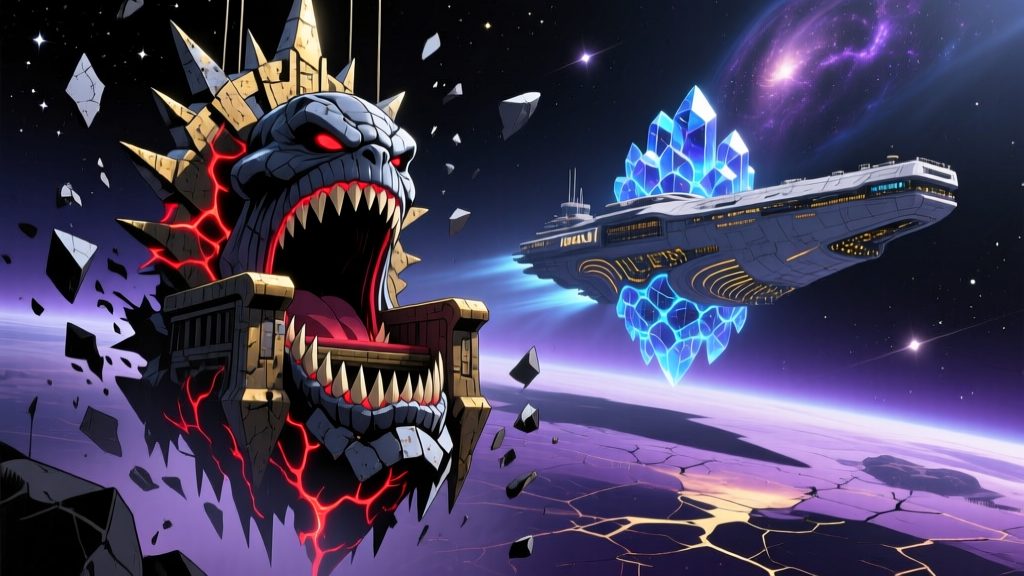
Picture this: a vessel so vast it swallows an entire star system. Inside its outermost hull, planetary debris drifts in zero-gravity corridors wide enough to park a dreadnought. And at the dead center of this impossible architecture, bolted to a floor of compressed neutron-star alloy, sits a chair. Not a metaphorical seat of power. A literal, physical throne where a being older than the current universe rests between meals. Each meal happens to be a planet.
That being is Galactus, and his throne aboard the Worldship Taa II might be the single most imposing piece of furniture in all of comics. It is not decorative. It is not comfortable in any human sense. It is a control nexus, a cosmic altar, and a statement of absolute dominance compressed into one jagged silhouette of alien metal and crackling energy. For nearly sixty years of publication history, this throne and the ship that houses it have captivated artists, writers, toy engineers, and fans who cannot stop staring at that impossible silhouette on the page.
From Taa to Taa II: Building a Home for a Star-God
To understand the throne, you need to understand what it sits inside. Galactus was born Galan, a humanoid from the planet Taa in the universe that existed before the Big Bang. When that universe ended and the current one was born, Galan merged with the abstract force known as the Sentience of the Cosmos. He emerged millions of years later as something else entirely: a towering cosmic entity driven by an insatiable need to consume planetary energy to survive.
After millennia of wandering and feeding, Galactus constructed his permanent residence. He took the remains of Archeopia, a civilization he had consumed, and reformed the raw materials into what would become Taa II, also called the Worldship. This was not a ship in the conventional sense. According to Fantastic Four Vol. 1 #242 (1982, written and drawn by John Byrne), Taa II encompassed the entire Archeopian system, restructured into a mobile headquarters of incomprehensible scale. The Marvel Database describes it as "solar system-sized," which puts its diameter somewhere in the range of billions of kilometers if you use our own solar system as a rough benchmark.
"Galactus used the remains of Archeopia as the raw material to construct his Worldship, Taa II. It was more than a vessel. It was a declaration: the Devourer of Worlds had made himself a home from the bones of his victims." -- Marvel Database, "Worldship (Taa II)" entry
The name itself carries weight. By calling it Taa II, Galactus acknowledged the homeworld he lost when the previous universe collapsed. The ship was both memorial and monument, a way of saying that the new creation was built on the wreckage of everything that came before. It is one of the rare moments where Galactus displays something approaching sentimentality, and that emotional undercurrent makes the throne room inside feel less like a captain's bridge and more like a reliquary.
The Interior Nobody Could Fully Map
No comic, handbook, or encyclopedic supplement has ever produced a complete floor plan of Taa II, and that ambiguity is intentional. The interior shifts depending on the story being told. What we do know: the ship contains vast machine halls housing the planet-draining engines, containment fields for captured cosmic beings, living quarters for the current Herald of Galactus, and automated defense systems including the M-11 robot known as the Punisher, a towering sentinel that guards key areas of the vessel.
But the throne room always sits at the heart of it. In Fantastic Four #242 (1982), when the team ventures inside Taa II for the first time in John Byrne's legendary run, they traverse corridors and chambers of staggering scale before reaching the central chamber where Galactus sits. Byrne drew those interiors with a sense of oppressive grandeur: ceilings lost in shadow, walls lined with alien circuitry, and at the end of it all, the throne, elevated on a dais, bathed in the glow of cosmic instrumentation.
Sixty Years of Cosmic Furniture: How Artists Drew the Throne
The Galactus throne has never looked the same way twice. That is not a criticism. It is a reflection of how different creative teams have interpreted the impossible task of designing a seat for a being who eats planets.
The Jack Kirby Era (1966-1970s): Brutalist Monument
When Galactus debuted in Fantastic Four #48-50 (1966), the so-called "Galactus Trilogy" by Stan Lee and Jack Kirby, the worldship was already present in the background, a massive spherical vessel hanging in orbit. But Kirby did not give readers a detailed interior throne scene in those initial issues. The focus was on the external threat, the Silver Surfer's arrival, and the cosmic scope of the conflict. The throne as a distinct visual element would come later.
When Kirby did sketch Galactus in repose, the Devourer was often shown standing or in mid-action. The throne concept developed gradually through the late 1960s and 1970s as various artists filled in the interior of Taa II. Early depictions tended toward the brutalist: massive stone-like blocks, angular geometry, and a sense that the throne was carved from a single asteroid rather than manufactured.
John Byrne's Defining Run (1981-1986): The Technological Cathedral
John Byrne's tenure on Fantastic Four gave the Taa II throne room its most influential depiction. In issues #242-244 (1982), Byrne presented the interior as a technological cathedral. The throne itself was a towering construct of alien metal, bristling with conduits and energy feeds that connected directly to Galactus's armor. The chair was not separate from the ship. It was integrated into it, a hardwired node in a vessel-wide network. Byrne drew Galactus seated with his arms resting on wide armrests that doubled as control interfaces, his helmeted head framed by a halo of instrumentation arcing overhead.
This design choice established something crucial: the throne was not just where Galactus sat. It was where he interfaced with Taa II's systems, monitored his heralds, and processed the planetary energy he consumed. It made the chair a functional piece of cosmic infrastructure rather than a decorative symbol of power.
Modern Interpretations (2000s-Present): Organic and Abstract
Artists in the 2000s and beyond pushed the throne's design toward more organic and abstract territory. Some renditions depicted it as a floating platform suspended in a void of cosmic energy, with no visible walls or ceiling. Others rendered it as a crystalline formation that appeared to grow from the ship's hull rather than being bolted in place. Esad Ribic's painted covers for various Marvel events often portrayed Galactus on a throne that looked almost biological, as if the chair and the being had fused over the eons.
The 2025 film The Fantastic Four: First Steps brought the throne room to live-action for the first time. Concept artist Thomas du Crest shared artwork on ArtStation showing his work on the throne room environment, describing it as one of the most significant spaces he helped bring to the screen. The film's production design leaned into a retrofuturist aesthetic that matched the movie's alternate-1960s Earth setting, blending mid-century modern design language with alien technology in a way that honored the comics while forging its own visual identity.
Why the Throne Matters in Galactus Lore
It would be easy to dismiss a throne as mere set dressing for a cosmic villain. But the Taa II throne carries narrative weight that goes beyond aesthetics.
A Symbol of Permanence for a Wandering God
Galactus is, by nature, a nomad. He travels from world to world, system to system, consuming and moving on. The existence of a fixed home base contradicts his entire modus operandi, and that contradiction is what makes it interesting. The throne on Taa II represents the one place in the universe where Galactus does not have to hunt. It is where he plans, where he recovers between feedings, and where he receives (or dismisses) his heralds.
Several storylines have used the throne room as the setting for herald appointments. When Galactus empowers a new herald with a fraction of the Power Cosmic, the ceremony typically takes place at or near the throne. Silver Surfer, Nova (Frankie Raye), Terrax, Air-Walker, and Stardust all have connections to this space. It functions as a cosmic court where the Devourer holds audience.
The Throne as a Vulnerability
Paradoxically, having a fixed throne made Galactus targetable. Multiple comic storylines have involved heroes or rivals boarding Taa II and confronting Galactus at his seat of power. In Fantastic Four #243 (1982), Reed Richards essentially weaponizes Galactus's own ship against him. The throne room became a battleground. Having a throne means having a place where enemies can find you, and writers have exploited that repeatedly.
The Worldship itself has been destroyed and rebuilt multiple times across Marvel continuity. After certain catastrophic events, Galactus has been shown constructing a new version of Taa II, which always includes a new throne room at its core. The throne is not optional. It is as essential to Galactus as his armor or his heralds.
Owning a Piece of the Devourer: Collectible Thrones and Figures
If you cannot build a solar-system-sized worldship, the next best thing is putting a scaled-down Galactus on your shelf. The collectible market has responded to fan demand with some genuinely impressive pieces.
| Product | Manufacturer | Scale / Size | Price Range | Key Features |
|---|---|---|---|---|
| Marvel Legends HasLab Galactus | Hasbro | 32 inches (81 cm) | $400 (retail), $700+ (secondary) | 70+ articulation points, LED lights in head and chest, 3 swappable face plates, Doctor Doom accessory head |
| Galactus Deluxe (First Steps) | Hasbro / Marvel Legends | Approx. 18 inches | $200-$350 | Film-accurate sculpt, world-sphere accessory, articulated hands |
| Galactus Premium Format Statue | Sideshow Collectibles | 25 inches | $450-$600 | Polystone construction, diorama base with planetary debris, throne-like seating |
| Iron Studios Galactus (MCU First Steps) | Iron Studios | 1:10 scale | $800-$1,200+ | Hand-painted polystone, film concept art reference, attachable herald figures |
| Marvel Legends Galactus (classic, 6-inch line) | Hasbro | 6 inches (build-a-figure) | $120-$180 (complete set) | Build-a-figure across wave, includes miniature Taa II base piece |
The HasLab Galactus deserves special mention. Launched as a crowdfunding campaign through Hasbro's HasLab platform, it required a minimum number of backers to enter production. The campaign hit its target, and the resulting figure stands nearly three feet tall. At $400 retail, it was a serious investment, but the secondary market has pushed prices well above $700 for sealed copies. The figure does not include a standalone throne accessory, but the sheer scale of the piece means it dominates any shelf it occupies the way a throne dominates a room. As one reviewer at FigureFanZero noted, "Hasbro couldn't toss in four generic AAA batteries" for the LED features, which speaks to the figure's premium-but-not-quite-perfect positioning.
The Fan Build Community
A dedicated subset of the Marvel collecting community has taken matters into their own hands. Custom builders have constructed Taa II throne room dioramas at 1:12 and 1:6 scale, using resin casts, 3D-printed components, and LED strip lighting to recreate the interior of the Worldship. Some of these builds have appeared at conventions like San Diego Comic-Con and New York Comic Con, where they drew crowds of fans who recognized the specific John Byrne-era interior design being referenced. These are not official products. They are love letters to a fictional room that exists only in ink and imagination.
Beyond the Page: The Throne in Games and Media
The Galactus throne has made its way into interactive media as well. In Marvel Snap, the digital card game by Second Dinner, Galactus appeared as a high-cost card with the "Space Throne" designation, referencing his seated cosmic authority. The card's ability revolved around consuming lanes on the board, a mechanical nod to his planet-eating lore, and the artwork depicted him on his throne with the Worldship visible in the background.
In the mobile game Marvel Contest of Champions, Galactus's throne appears in his stage background, rendered with the purple-and-gold energy palette that has become the standard visual shorthand for the character. Video game adaptations have generally followed the John Byrne template for the throne room's design: elevated dais, integrated control systems, and a sense that the chair is part of something much larger than itself.
The 2025 Fantastic Four: First Steps film marked the throne room's biggest mainstream exposure. Ralph Ineson portrayed Galactus, and the production design team created a throne room environment that combined the alien grandeur of the comics with the film's retrofuturistic aesthetic. Concept artist Thomas du Crest's work on the environment drew attention from the art community, with pieces shared on ArtStation garnering significant engagement from fans and industry professionals alike.
Why Fans Cannot Stop Thinking About It
There is a peculiar fascination with the Galactus throne that goes beyond typical comic book fandom. Part of it is the sheer absurdity of the scale. A throne built for a being who stands hundreds of feet tall (his exact height fluctuates depending on the writer and the energy he has recently consumed) inside a ship the size of a solar system. The numbers do not make practical sense, and that is precisely the point. Comic book cosmology operates on mythological logic, not engineering specs.
The throne also represents something psychologically compelling: the idea that even a force of nature has a place where it rests. Galactus is often described as beyond morality, a natural process rather than a villain. But the existence of a throne humanizes him just enough to make him relatable without diminishing his cosmic terror. He sits. He waits. He plans. These are things a person does, not things a hurricane does. The throne is where the person Galan and the force Galactus coexist most visibly.
- The scale fantasy: Fans are drawn to imagining spaces too large to comprehend. Taa II's throne room triggers the same part of the brain that marvels at cathedral interiors or planetary landscapes.
- The villain's lair appeal: Every great antagonist needs a memorable base. The throne room of Taa II sits alongside Sauron's Barad-dur and Darth Vader's meditation chamber as iconic villain spaces.
- The design challenge: Artists and designers are attracted to the throne as a brief: how do you design furniture for a god? That question has no correct answer, which makes it endlessly interesting to attempt.
- The lore anchor: For long-time Marvel readers, Taa II's throne room is where some of the franchise's most pivotal cosmic confrontations happened. It is hallowed ground in the continuity.
Questions Fans Ask About the Galactus Throne
What exactly is Taa II made of?
Marvel Comics has never provided a definitive materials list, but the established lore states that Taa II was constructed from the raw matter of the Archeopian civilization that Galactus consumed. That means the ship, and by extension the throne, is composed of restructured alien alloys, compressed planetary minerals, and cosmic-energy-infused composites. Some stories suggest portions of the ship are semi-living, responsive to Galactus's will through the Power Cosmic that permeates every component.
Has anyone else ever sat in Galactus's throne?
Not in mainstream Marvel continuity, at least not voluntarily and survived the experience in a standard state. The throne is attuned to Galactus's cosmic energy signature. In Fantastic Four #243, Reed Richards manipulated the systems connected to the throne to turn Galactus's own power against him, but Reed did not sit in the chair itself. Various heralds have operated from the throne room, but the throne appears reserved exclusively for Galactus.
How big is the throne itself?
Galactus's height varies wildly across comics, from roughly 28 feet to several hundred feet depending on how much cosmic energy he has recently absorbed. The throne scales accordingly. In John Byrne's depiction, the throne was at least 40 to 50 feet tall, with armrests wide enough to serve as landing pads for smaller spacecraft. There is no canonical measurement because there is no canonical Galactus size.
Is the Taa II throne the same as the Mobius Chair from DC?
No. The Mobius Chair is a DC Comics concept, primarily associated with Metron of the New Gods and later Batman in the Darkseid War storyline. It is a time-and-space-traveling vehicle that grants its occupant near-omniscient knowledge. Galactus's throne aboard Taa II serves a different purpose: it is a command center and power interface integrated into his Worldship. The confusion occasionally surfaces in online discussions because both involve powerful beings seated on technologically advanced chairs, but they belong to entirely separate fictional universes with different mythological frameworks.
Where can I see the best comic depictions of the throne room?
The essential reading list for the Taa II throne room starts with Fantastic Four #242-244 (1982, John Byrne) for the definitive interior exploration. Fantastic Four #48-50 (1966, Lee and Kirby) for the Worldship's first appearance in orbit. Silver Surfer Vol. 3 #1-10 (1987-1988) for additional cosmic context. And the various Annihilation event tie-ins (2006-2007) where Taa II plays a role in the larger cosmic war.
- Fantastic Four #48-50 (1966) -- "The Galactus Trilogy" by Stan Lee and Jack Kirby
- Fantastic Four #242-244 (1982) -- John Byrne's Taa II interior exploration
- Silver Surfer Vol. 3 (1987-1998) -- Steve Englehart's cosmic deep dives
- Annihilation (2006) -- Keith Giffen's cosmic event featuring Taa II
- The Thanos Imperative and related cosmic arcs -- modern Taa II appearances
The Chair That Outlasted Universes
There is something quietly magnificent about the fact that one of the most memorable locations in Marvel Comics is a room with a chair in it. Not a battlefield. Not a city skyline. A room. The Taa II throne room has persisted through decades of continuity reboots, cosmic retcons, and shifting artistic styles because it represents something that transcends any single story: the idea that even the most alien and unfathomable being in the universe has a place it calls home.
Galactus does not need a throne. He could exist as pure energy, a wandering force without form or fixture. But Stan Lee and Jack Kirby gave him a ship, and John Byrne gave him a chair, and every artist since has understood that the throne is not optional. It is the visual anchor that makes the Devourer of Worlds feel like a character rather than a weather pattern. The next time you see Galactus on a comic page or a movie screen, look past the helmet and the cosmic fire for a moment. Look for the chair. It is where the real story lives.