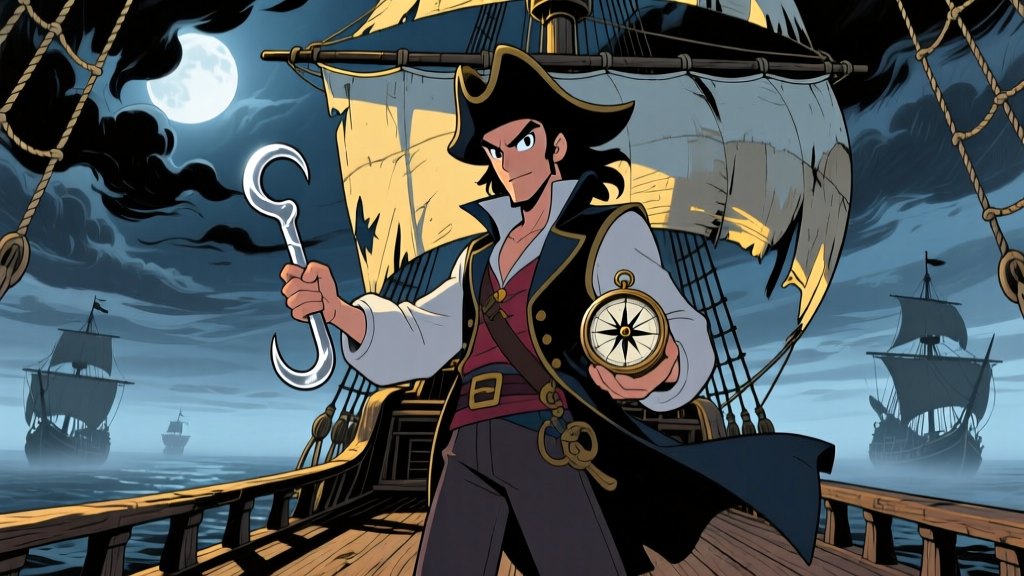
The curtain rises on the Jolly Roger, and every eye in the theater snaps to the tall, angular figure commanding the deck. His coat is crimson, his wig is immaculately curled, and where his right hand should be, a cold silver hook glints under the Neverland moon. That image—elegant, menacing, and somehow hilarious all at once—has lodged itself into pop culture's collective memory for over seven decades. Captain Hook, as rendered by Walt Disney's animation studio in 1953, is not merely a villain. He is a masterclass in character design, vocal performance, and the strange alchemy that makes animated antagonists endure long after the credits roll.
For otaku and animation enthusiasts who study character craft the way a chef studies knife work, Captain Hook represents something rare: a villain whose charm routinely eclipses the hero he was built to oppose. This article traces the animated pirate from Frank Thomas's first pencil sketches through Hans Conried's legendary vocal performance, his obsessive rivalry with a clock-swallowing crocodile, his complex dynamic with the boy who refuses to grow up, his reincarnations in live-action television and film franchises, and the booming collectibles market that keeps his silver appendage firmly in the public eye.
Lines, Angles, and Aristocratic Menace: Designing Captain Hook
When Walt Disney assigned Frank Thomas to animate Captain Hook for Peter Pan (released February 5, 1953), he was handing the project to one of his most trusted hands. Thomas, who had joined the studio in 1934 as employee number 224, was already a veteran of Bambi, Pinocchio, and Cinderella. He was part of the legendary group Walt jokingly dubbed the "Nine Old Men"—the core animators who shaped Disney's golden age.
Thomas's approach to Hook was built on a foundation of sharp angles and deliberate posture. The character stands roughly six feet tall in the film's proportions—willowy and upright, with a spine that seems permanently arched in disdain. His silhouette reads as immediately aristocratic: the long coat with its flared tails, the tricorn hat, the elaborately curled wig that cascades past his shoulders. Every line in Hook's design communicates vanity. Even his mustache—two thin, precisely waxed curls—suggests a man who has never met a mirror he did not admire.
The hook itself is a study in visual economy. It replaces his right hand at the wrist, a gleaming steel curve that catches light in nearly every scene he occupies. Disney's color team rendered Hook's palette with deliberate theatricality: a deep red coat, a gold-laced vest, and ivory cravat, all set against the muted browns and grays of his pirate crew. He is, visually speaking, a peacock strutting through a barnyard. That contrast was intentional. Hook's flamboyance telegraphs his fundamental insecurity—a man who dresses like royalty to mask the fact that he is, at heart, terrified of a ticking reptile.
The Live-Action Reference Process
Disney's animation pipeline in the early 1950s relied heavily on live-action reference footage. Actors performed key scenes on soundstages while cameras recorded their movements, which animators then studied frame by frame. Hans Conried—who voiced both Captain Hook and Mr. Darling—served double duty as the live-action reference model for both characters. Footage from these sessions, portions of which have been released by Disney archivists over the decades, shows Conried sweeping his arms in grand gestures, tilting his chin upward with practiced snobbery, and physically embodying the preening pirate captain long before a single cel was painted.
This dual-casting was no accident. In J.M. Barrie's original 1904 stage play Peter Pan, or The Boy Who Wouldn't Grow Up, and subsequently in the 1911 novelization Peter and Wendy, tradition held that Mr. Darling and Captain Hook should be played by the same actor—a theatrical convention meant to underscore the psychological link between Wendy's bumbling father and the terrifying pirate lord. Disney honored that convention by giving Conried both roles, a choice that animation scholars cite as one of the film's most literate creative decisions.
Hans Conried: The Voice Behind the Villainy
Hans Georg Conried Jr. was born on April 15, 1917, in Baltimore, Maryland. He studied drama at Columbia University and cut his teeth in radio before transitioning to film and television in the 1940s. By the time Disney cast him in Peter Pan, Conried had built a reputation as a character actor with a voice like polished mahogany—deep, resonant, capable of sliding from urbane charm to theatrical fury within a single syllable.
His performance as Hook is built on vocal precision. Listen to the scene where Hook interrogates Tinker Bell in the pirate ship's cabin. His voice starts soft, almost conversational: "You know where that Peter Pan is, don't you?" Then, when the fairy refuses to cooperate, the volume creeps upward like mercury in a fever. By the time he snarls "Tinker Bell, I'll have the truth out of you!", the words are nearly operatic—yet he never loses that clipped, upper-crust diction. The effect is terrifying precisely because the anger is so controlled. Hook does not lose his temper. He deploys it.
Conried's comedic timing proved equally vital. The scene where Hook attempts to shoot Smee with a flintlock pistol—only to have the bumbling first mate duck and the shot ring harmlessly into the air—is punctuated by the captain's exasperated "That man! I'll teach him!" The line lands not because of its content, but because of the way Conried lets the silence hang for a half-beat before delivering it. That half-beat is where the comedy lives, and it is the kind of micro-timing that separates a great voice performance from an adequate one.
Conried continued to voice Hook in Disney's Disneyland television series episodes and the 1958 short film Peter Pan promotional materials until his death on January 5, 1982, at age 64. Voice actor Corey Burton subsequently took over the role for Disney theme park attractions, video games, and the Kingdom Hearts series, consciously modeling his delivery on Conried's original performance—a testament to how thoroughly the original actor defined the character's vocal identity.
Tick-Tock: The Crocodile Rivalry That Defines Hook
Every great antagonist needs a weakness that humanizes them, and Hook's comes with scales, a permanent grin, and an alarm clock lodged permanently in its belly. The crocodile—sometimes called "Tick-Tock" or simply "the Croc"—is Hook's living nightmare, a relentless predator who has already claimed the captain's right hand and is plainly hungry for the rest of him.
The ticking clock is a stroke of narrative genius. It functions as both comic device and psychological torture. Hook hears the crocodile coming—always—but never knows precisely when. The sound is a countdown, a memento mori in 4/4 time. In the film's most memorable gag, the crocodile sneaks up behind Hook on the pirate ship's plank, its jaws snapping inches from the captain's coattails, while the audience (and Peter Pan, watching from the rigging) can see the whole thing unfolding. Hook turns, catches a glimpse of green scales, and his face freezes into a mask of pure, uncut terror. The contrast between his usual hauteur and this sudden, abject fear is the emotional core of the film's humor.
From an animation standpoint, the crocodile scenes demanded precise timing coordination between Frank Thomas's Hook animation and the effects animators handling the reptile. The croc's movements are slower, more deliberate than Hook's frantic reactions—a visual tempo difference that heightens the comedy. The crocodile never rushes. It does not need to. It knows, with the patience of a predator, that its prey will eventually make a mistake.
"Hook is not brave. He is only brave until the ticking starts. And that is what makes him the most honest villain Disney ever drew."
Peter Pan and Captain Hook: A Rivalry Built on Mirrors
The relationship between Peter Pan and Captain Hook operates on multiple levels. On the surface, it is straightforward: hero versus villain, child versus adult, flight versus earthbound. But beneath the swordplay and the pirate ship antics lies something more textured—a rivalry that reads, in many ways, as a distorted reflection of the same figure.
Peter is cocky. Genuinely, insufferably cocky. He hovers above Hook during their climactic duel, crowing "You're a codfish, Hook!" with the gleeful cruelty of a child who has not yet learned that words can wound. Hook, for his part, is obsessed with the boy not merely because Peter severed his hand and fed it to the crocodile—though that certainly contributes—but because Peter represents everything Hook cannot control. The boy is unafraid of him. Worse: the boy finds him funny.
The 1953 film stages their rivalry through physical geography. Peter occupies vertical space—treetops, rigging, the sky itself. Hook is anchored to horizontal surfaces: the deck of the Jolly Roger, the plank extending over shark-infested waters, the flat expanse of Skull Rock. This spatial opposition is not accidental. It visually encodes the thematic tension between freedom (Peter, who can fly) and constraint (Hook, who is bound to his ship, his crew, and his fear). When Peter finally severs the Jolly Roger's mast and sends Hook tumbling into the crocodile's jaws, the victory is spatial as well as narrative: the boy who owns the sky has defeated the man who could never leave the ground.
What Barrie Started, Disney Refined
In J.M. Barrie's original text, Hook is considerably darker—a former Eton student whose real name is never given (the "Hook" is, of course, a prosthetic, not a surname). Barrie describes him as "cadaverous and blackavised" with eyes "of the deepest blue" save when committing violence, at which point they turn red. Disney's adaptation softened these edges, replacing Barrie's psychological horror with theatrical villainy. The result is a Hook who is menacing enough to sustain dramatic tension but comic enough to coexist in a film aimed at family audiences. It is a balancing act that few animated villains have replicated successfully.
From Neverland to Storybrooke: Hook in Live-Action Media
Disney's animated Captain Hook has cast a long shadow across live-action adaptations, none more significant than ABC's Once Upon a Time, which ran from 2011 to 2018. Irish actor Colin O'Donoghue portrayed Captain Killian "Hook" Jones, a reimagining that transformed the pirate from a one-dimensional antagonist into a layered, morally ambiguous anti-hero across six seasons.
O'Donoghue's Hook debuted in the fourth episode of Season 2, arriving in the fairy-tale town of Storybrooke with a vendetta against Rumplestiltskin (played by Robert Carlyle). The character's hook was no longer a simple prosthetic but an enchanted weapon capable of absorbing magic—a creative departure that gave the iconic appendage new narrative weight. Over 135 episodes, Hook evolved from vengeful pirate to romantic lead to self-sacrificing hero, a trajectory that would have been impossible without the foundational personality traits—vanity, wit, vulnerability—established by Conried and Thomas in 1953.
The Descendants franchise offered a different spin. In Descendants 2 (2017), Scottish actor Thomas Doherty played Harry Hook, the teenage son of Captain Hook, attending Auradon Prep alongside the children of other Disney villains. Harry inherits his father's swagger and silver hook but channels them through adolescent rebellion rather than pirate malice. Joshua Colley later portrayed a younger Captain Hook in Descendants: The Rise of Red (2024), exploring the character's origin before he became the notorious pirate captain. Each iteration pulls from the same well: the Disney animated template of a man whose theatrical flair masks genuine insecurity.
| Version | Actor/Performer | Year(s) | Tone | Key Departure from 1953 Original |
|---|---|---|---|---|
| Disney Animated Film | Hans Conried | 1953 | Theatrical villain | Baseline portrayal |
| Once Upon a Time | Colin O'Donoghue | 2012–2018 | Anti-hero / romantic lead | Enchanted hook; full character arc |
| Descendants 2 | Thomas Doherty (as Harry Hook) | 2017 | Teenage rebel | Hook's son, not Hook himself |
| Descendants: The Rise of Red | Joshua Colley | 2024 | Youthful origin story | Pre-pirate era characterization |
| Kingdom Hearts (video game series) | Corey Burton (voice) | 2002–present | Menacing ally of darkness | Interactive combat mechanics |
| Peter Pan & Wendy (live-action) | Jude Law | 2023 | Psychological antagonist | Realistic portrayal, reduced theatricality |
Hook on the Shelf: The Collectibles Market
Captain Hook occupies a disproportionately large footprint in the Disney collectibles market relative to his screen time. The character's visual distinctiveness—the red coat, the tricorn hat, the silver hook—translates exceptionally well to physical merchandise, and collectors have driven prices for vintage and limited-edition pieces into surprising territory.
Original production cels from the 1953 Peter Pan film are among the most sought-after pieces of Disney animation art. Heritage Auctions has handled multiple Hook cels, with individual pieces selling in the range of $2,000 to $8,000 depending on the scene depicted, the size of the character within the frame, and the cel's condition. Cels showing Hook in dynamic poses—sword raised, hook extended, face twisted in rage—command premiums over static dialogue scenes. A cel depicting Hook's climactic confrontation with Peter Pan at Skull Rock would, if it reached the open market, likely exceed $15,000.
The modern collectibles landscape is dominated by Funko's POP! vinyl figures. The Captain Hook POP! figure, released as part of the Disney Villains line, retails around $12.99 and has spawned multiple variants. The Walt Disney World 50th Anniversary edition—depicting Hook atop the Peter Pan's Flight ride vehicle—was released in 2022 as a park-exclusive collectible and immediately became a target for scalpers, with secondary market prices hitting $65 to $90 within weeks of release. The figure's packaging, featuring the gold 50th Anniversary logo and the distinctive Peter Pan's Flight ride car, makes it one of the more visually compelling entries in the Disney Parks POP! series.
Beyond vinyl figures and animation cels, Hook merchandise extends into high-end collectibles. Limited-edition statuettes from Disney's official licensed lines, such as the Disney Villains sculpture series by Jim Shore, typically retail between $60 and $120. Vintage Hook merchandise from Disneyland's opening era (1955–1960s)—including plush toys, tin lithograph toys, and character pins—can reach $300 to $500 at auction, with authenticated pieces in excellent condition occasionally breaking $1,000. The market reflects a simple truth: Hook is one of the few Disney villains whose brand recognition rivals that of the heroes he opposes.
What Collectors Look For
- Production cels: Full-body Hook poses from key scenes; cels with original production backgrounds command 30–50% premiums
- Funko POP! variants: Chase editions, convention exclusives, and park-specific releases appreciate fastest on the secondary market
- Vintage Disneyland merchandise: Items from the 1955–1965 era with intact original packaging; Peter Pan's Flight attraction tie-ins are particularly desirable
- Jim Shore and high-end statuettes: Retired editions with original boxes; signed pieces from Disney artist events
- Kingdom Hearts merchandise: Japan-exclusive figure sets featuring Hook as a boss character; Bandai action figures from the early 2000s
Why the Animated Hook Endures Where Others Fade
Seventy-three years after its premiere, Disney's Peter Pan still resonates with audiences, and Captain Hook is a significant reason why. The film grossed an estimated $87.4 million during its initial theatrical run against a production budget of approximately $4 million—a return on investment that would make any modern studio executive weep with envy. But financial success alone does not explain Hook's longevity.
The character endures because he is, at his core, relatable in a way that pure-evil Disney villains like Maleficent or Chernabog are not. Hook is vain, yes. He is cowardly in the face of his specific phobia. He throws tantrums when thwarted and schemes with a pettiness that borders on the absurd. But these are human flaws, not supernatural ones. Maleficent is evil because she is a fairy who chose darkness. Hook is villainous because he is a man who cannot accept that the world does not revolve around him—and that existential frustration makes him endlessly compelling.
For otaku culture specifically, Captain Hook represents an early example of what modern anime audiences would recognize as a "chara-stand" villain: a character whose personality is so vividly drawn that he functions independently of the narrative that contains him. In the same way that Dragon Ball's Frieza or One Piece's Blackbeard transcend their source material to become cultural touchstones, Disney's animated Hook has escaped the confines of a single 77-minute film to become a free-floating signifier for theatrical villainy itself. When someone says "he's such a Captain Hook," you know exactly what they mean—and it has nothing to do with prosthetics.
Frequently Asked Questions About Animated Captain Hook
Who animated Captain Hook in Disney's 1953 Peter Pan?
Frank Thomas, one of Disney's celebrated "Nine Old Men," served as the directing animator for Captain Hook. Thomas joined Disney in 1934 and worked on the character through the film's entire production cycle. His animation of Hook is considered among his finest villain work, alongside Lady Tremaine in Cinderella (1950) and the Queen of Hearts in Alice in Wonderland (1951).
Why does Captain Hook have a crocodile chasing him?
In the story, Peter Pan cut off Hook's right hand during a duel and threw it to a crocodile, which found the taste so agreeable that it has stalked the captain ever since, hoping to consume the rest of him. The crocodile also swallowed a clock, which ticks loudly and serves as Hook's only warning that the beast is nearby. This premise originates from J.M. Barrie's original 1904 play and 1911 novel.
Did Hans Conried voice any other characters in Peter Pan?
Yes. Conried also voiced George Darling, the Darling children's father. This dual-casting follows the theatrical tradition established by J.M. Barrie, in which the same actor traditionally plays both Mr. Darling and Captain Hook, symbolizing the connection between the mundane adult world and the fantastical villainy of Neverland.
What is Captain Hook's real name?
J.M. Barrie never revealed Hook's true name in the original play or novel. In the text, Barrie writes that "Hook was not his true name. To reveal who he really was would even at this date set the country in a blaze." Disney's adaptation did not address this question, leaving the captain's pre-pirate identity a mystery. The Once Upon a Time series later named him "Killian Jones," but this is an invention of the television show and not canonical to the original Disney film or Barrie's source material.
How much do Captain Hook collectibles cost?
Prices vary enormously by category. Modern Funko POP! figures retail between $12.99 and $15.99, with rare variants reaching $65–$90 on the secondary market. Original 1953 production cels typically sell for $2,000 to $8,000 at auction houses like Heritage Auctions. Vintage Disneyland merchandise from the 1950s and 1960s ranges from $100 for common items to $500+ for mint-condition pieces with original packaging. High-end collectible statuettes typically fall in the $60–$120 range.
Is Captain Hook in the Kingdom Hearts video games?
Yes. Captain Hook appears as a recurring boss and story character throughout the Kingdom Hearts series, beginning with the original Kingdom Hearts (2002) on PlayStation 2. He is voiced by Corey Burton, who has served as Hook's official Disney voice since Hans Conried's passing in 1982. Hook typically appears in Neverland-themed worlds and serves as a mid-game boss encounter.
Captain Hook's journey from a sketch on Frank Thomas's animation desk to a global pop-culture icon is a reminder that great character design does not age. The silver hook catches the light the same way in 2026 as it did in 1953. The crocodile still ticks. And somewhere, in every generation, a new audience discovers the delicious absurdity of a pirate captain who is more afraid of a reptile than he is of the boy who severed his hand. That is the real magic of Neverland: not the flying, not the fairies, but the villain who makes you laugh even as he draws his sword.