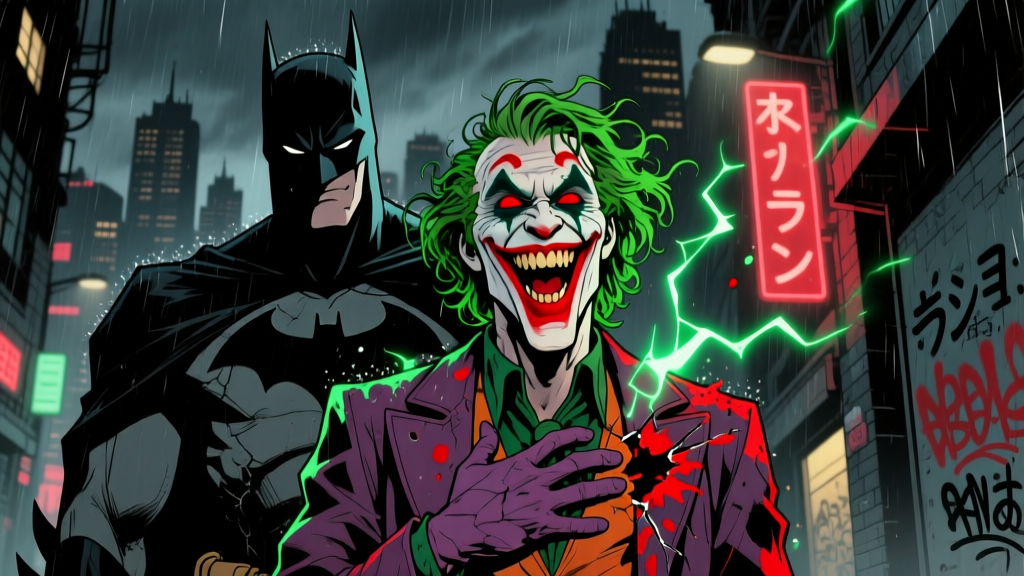
In February 1986, DC Comics published a four-issue prestige-format limited series that cost $2.95 per issue — nearly four times the standard cover price for a mainstream comic. The Dark Knight Returns, written and drawn by Frank Miller with inks by Klaus Janson and colors by Lynn Varley, was supposed to be a one-off Elseworlds experiment: an aging Bruce Wayne pulling the cowl back on in a dystopian Gotham. But buried inside that four-issue arc was a single narrative beat that permanently altered the DNA of the Joker as a fictional character — and it all hinged on a smile.
Not a laugh. Not a joke. Not a crime. A smile — drawn in six panels on page 13 of issue #1, as a catatonic man in a hospital ward watches a television broadcast of Batman's return. That smile, rendered in Miller's brutal, expressionist linework, did more to redefine the Clown Prince of Crime than the preceding 46 years of Joker comics combined.
A Man Who Hadn't Smiled in a Decade
Miller's premise is deceptively simple. In the near-future Gotham of TDKR, the Joker has been catatonic at Arkham Asylum for approximately ten years. He hasn't spoken. He hasn't moved. He hasn't so much as blinked in response to stimuli. The doctors have written him off as a permanent vegetable — a man whose mind simply shut down.
Then Batman appears on a news broadcast, beating a criminal gang in the streets. The camera pans to the Joker's hospital room. His psychiatrist, Dr. Bartholomew Wolper, is watching the news in the background. And on the television screen, the Batman throws a punch. Miller cuts to a close-up of the Joker's face — slack, grey, expressionless. Then, across six consecutive panels arranged in a tight grid, the corners of the mouth twitch upward. The lips part. The teeth show. The grin widens into something obscene and unmistakable.
Here's what makes those six panels so devastating: no dialogue accompanies them. Not a single word balloon. The Joker's return to consciousness is communicated entirely through the physical architecture of a smile — a smile that exists because Batman exists, because the Batman is back, because the game is on again. Miller understood something that most writers before him had treated superficially: the Joker does not function as a person. He functions as a response.
In interviews collected in the 2002 Absolute Dark Knight Returns edition (DC, ISBN 1-4012-1078-3), Miller noted that he wanted the Joker to be "less a criminal and more a force of nature — something that exists purely in relation to Batman." This was a radical departure from the prankster-of-the-month Joker who had dominated Bronze Age DC comics throughout the 1970s and early 1980s, where the character routinely escaped Arkham to execute themed crimes involving laughing gas and trick flowers.
The Tongue, the Television, and the Talk Show
Once revived, the Joker's re-entry into the world plays out across two issues (#3 and #4) with an economy that borders on surgical. Dr. Wolper — a smug, publicity-hungry psychiatrist who views the Joker as a career-making case study rather than a homicidal maniac — arranges for his patient to appear on a late-night talk show. The show is called The David Endochine Show, a barely disguised stand-in for the era's dominant late-night formats.
What follows is one of the most disturbing sequences in mainstream comic history, and Miller accomplishes it without a single act of on-panel violence during the broadcast itself.
The Joker sits across from the host, dressed in a purple suit, his hair slicked back. He speaks calmly, even charmingly, about his rehabilitation. He tells Endochine that he has found God, that he regrets his past, that he blames Batman for his crimes. The audience laughs. The host laughs. Dr. Wolper, sitting beside his patient, beams with professional pride.
And then the Joker licks his lips.
Miller draws it as a single panel — the tongue darting out across the upper lip, quick and reptilian. It lasts a fraction of a second in the comic's timeline. But it communicates everything. The audience in the comic doesn't understand it. The reader does. That tongue-flick is the Joker dropping the mask for one microsecond, letting the audience glimpse the monster beneath the rehearsed humility. It is the visual equivalent of a predator's pupil dilating before it strikes.
By the end of that night, the Joker has murdered everyone in the television studio. The method is his signature Joker venom — a toxin that kills its victims by locking their facial muscles into a permanent, rictus grin. The detail that matters: Dr. Wolper dies wearing the same smile that the Joker had given him during the interview. The psychiatrist who believed he could cure evil dies mimicking its expression. Miller is not subtle about his thesis, and he shouldn't be.
The Tunnel of Love: Where the Joke Ends
The confrontation between Batman and the Joker in TDKR takes place in a funhouse called the Tunnel of Love — a setting so on-the-nose that only a writer with Miller's raw visual confidence could make it work. The sequence occupies roughly 10 pages of issue #4, and it is the least comedic fight scene ever staged between two characters whose relationship is ostensibly defined by dark humor.
Miller stages the fight with an almost perverse emphasis on physical damage. Batman is already injured — he has taken a bullet, he is exhausted, he is 55 years old and fighting on a body held together by stubbornness and Kevlar. The Joker is younger, faster, unhindered by any concern for self-preservation. He slashes Batman with a knife. He taunts him. He stabs him again. And throughout the fight, the Joker delivers what may be the most psychologically cutting monologue in the Batman mythos:
"I've had a lovely time, Batsy. I've killed more people than a plague, and I've enjoyed every minute. But I'm bored now. I've done the talk show, the murders, the grand finale. What's left? Only you, old friend. Only our last dance."
The fight ends with Batman breaking the Joker's neck — not killing him, but paralyzing him from the neck down. And then the Joker finishes the job himself. With his last functioning muscles, the Joker twists his own head the final fraction of an inch, snapping his spinal cord completely. He dies with a grin on his face. He has framed Batman for murder — technically, the Joker killed himself, but the optics are indistinguishable from Batman having gone too far.
This ending accomplishes three things simultaneously. First, it proves the Joker's ultimate point: that the line between Batman and himself is thinner than anyone wants to admit. Second, it denies Batman the satisfaction of victory — even in death, the Joker wins the argument. Third, it establishes a template that would echo through every major Joker portrayal for the next 40 years: the Joker as a character who would rather die than live without Batman.
What Miller Destroyed, and What He Built
Before TDKR, the Joker was a funhouse mirror — a distorted reflection of comedy, certainly, but one that operated within predictable genre constraints. The Silver Age Joker (1960–1970) robbed banks with joke-themed gadgets. The Bronze Age Joker (1973–1985), particularly in the work of Denny O'Neil and Neal Adams, regained some menace but remained fundamentally a criminal — a man who committed crimes for profit, revenge, or notoriety.
Miller's Joker commits crimes for none of those reasons. He murders the talk show audience not for money, not to send a message, not to escape custody. He murders them because it amuses him and because the act serves as a calling card — proof to Batman that he is still alive, still dangerous, still waiting. The Joker of TDKR is not a criminal. He is an ontological counterargument to Batman's existence.
This reframing had seismic consequences. Consider the structural parallels:
| Portrayal | Year | TDKR Echo | Evidence |
|---|---|---|---|
| Alan Moore's The Killing Joke | 1988 | Joker as philosophical argument | "One bad day" thesis mirrors TDKR's "thin line" thesis |
| Mark Hamill (animated) | 1992–2019 | Obsessive Batman fixation | "Without Batman, crime's no fun" (Batman: The Animated Series) |
| Heath Ledger (The Dark Knight) | 2008 | Joker as force of nature, not criminal | Burns the money; "I'm an agent of chaos" |
| Arkham video game series | 2009–2015 | Symbiotic dependency on Batman | Joker's dying words in Arkham City: "What would you do without me?" |
| Joaquin Phoenix (Joker) | 2019 | Joker as response/symptom of society | Arthur Fleck's existence is entirely reactive to external stimuli |
| Scott Snyder's Death of the Family | 2012 | Joker as ontological threat | "I made you, Batman. You know I did." |
The pattern is unmistakable. Every major Joker portrayal after 1986 carries at least one structural element that Miller introduced or codified: the Joker as response rather than instigator, the Joker as philosophical position rather than criminal actor, the Joker as a character whose existence is inseparable from Batman's.
The Art of Silence: Miller's Visual Storytelling
One aspect of TDKR's Joker that receives insufficient attention is Miller's use of negative space in the character's design. Throughout the series, the Joker appears on fewer than 20 pages total. He speaks on perhaps 8 of them. For the remainder, he exists as a visual presence — looming, grinning, silent.
Miller's art style in TDKR is deliberately crude by mainstream standards. His figures are blocky, his anatomy sometimes questionable, his backgrounds often reduced to abstracted shapes. But this crude quality works in the Joker's favor. When Miller draws the Joker's smile, it isn't a precise, anatomical rendering — it's a slash across the face, more wound than expression. Lynn Varley's coloring reinforces this: the Joker's green hair and white skin are set against backgrounds of deep purple and midnight blue, making him appear lit from within by something toxic.
The critical technique Miller employs is what cartoonist Scott McCloud would later term "amplification through simplification" in his 1993 book Understanding Comics (HarperCollins, ISBN 0-06-097625-X). By stripping the Joker's face down to its most essential features — the grin, the eyes, the angular jaw — Miller makes the character more iconic, not less. A hyperrealistic Joker would be frightening in one specific way. Miller's simplified, expressionist Joker is frightening in the way that a child's drawing of a monster is frightening: it leaves room for the reader's imagination to fill in the worst possible details.
This approach directly influenced how later artists drew the Joker. Lee Bermejo's photorealistic Joker in Joker (2008) and Greg Capullo's angular, horror-tinged Joker in Scott Snyder's Death of the Family (2012) both owe debts to Miller's decision to treat the character's face as a landscape rather than a portrait. The grin isn't a facial expression; it's a geological event.
The Catatonic Gambit: What Silence Reveals About the Character
Miller's decision to introduce the Joker in a catatonic state was narratively brilliant for a reason that becomes clear only in retrospect: it forced readers to confront what the Joker is without Batman. The answer, according to Miller, is nothing. Literally nothing — a blank, motionless, unresponsive body. A man who ceases to function in the absence of his adversary.
This is not a romantic interpretation. It's not suggesting that the Joker "loves" Batman in any conventional emotional sense. It's suggesting something far more unsettling: that the Joker is a parasite in the most existential sense of the word. Batman is his host organism. Without the host, the parasite enters dormancy. It doesn't sleep, it doesn't dream — it simply waits, in a state indistinguishable from death, for the host to return.
The implications of this reading are grim. It means the Joker has no interior life worth examining. He has no desires independent of his relationship to Batman. His crimes, his humor, his theatricality — all of these exist only as responses to Batman's existence. The catatonic Joker in Arkham is not a man choosing to be still. He is a man who cannot choose, because choice requires motivation, and his only motivation is the Batman.
Alan Moore would push this idea further in The Killing Joke (1988), where the Joker's origin is presented as a series of contradictory memories — "I prefer my past to be multiple choice," he says — suggesting that even the Joker doesn't know who he was before Batman. Christopher Nolan would strip the idea to its bones in The Dark Knight (2008), giving Ledger's Joker no origin, no real name, no fingerprints on file, and a series of mutually exclusive stories about his facial scars. Joaquin Phoenix's 2019 film would invert the formula entirely, building an origin story that pointedly excludes Batman — but the absence is felt precisely because the audience has been trained by Miller's template to expect the Batman connection as the character's organizing principle.
Why It Still Matters, 40 Years Later
The Dark Knight Returns sold approximately 400,000 copies across its initial four-issue run, according to distribution data compiled by The Comics Journal in 1987. The collected editions have never gone out of print. As of 2025, TDKR has sold an estimated 3.5 million copies in trade paperback and hardcover formats combined, based on figures reported by DC Comics at the 2025 San Diego Comic-Con publisher panel.
But raw sales numbers understate the book's influence. TDKR was one of the texts — alongside Moore and Dave Gibbons's Watchmen (1986–1987) and Art Spiegelman's Maus (1980–1991) — that critics and scholars pointed to when arguing that superhero comics could constitute serious literature. The book appeared on reading lists at NYU, Columbia, and the School of Visual Arts by the early 1990s. Its version of the Joker became the default "serious" interpretation of the character, displacing both the Silver Age prankster and the Bronze Age gangster.
When you watch Heath Ledger lick his lips in The Dark Knight — a gesture that Nolan and Ledger developed independently — you're watching an echo of Miller's tongue-flicking talk-show Joker. When you read Tom King's Batman run (2016–2019), where the Joker is presented as a figure of almost cosmic dread who cannot be killed because his death would destroy Batman's reason for existing — that's Miller's ontological argument, refined and extended. When the Arkham video game series ends the Joker's arc with a dying villain whispering "What would you do without me?" to a silent Batman, the question has already been answered in TDKR: without Batman, the Joker is catatonic. Without the Joker, Batman is an old man in a costume, fighting muggers in an alley.
They are each other's disease and each other's cure. Miller was the first writer to put that diagnosis on the page and refuse to look away from the implications.
Questions Readers Frequently Ask
Did Frank Miller invent the catatonic Joker concept?
No earlier comic story depicted the Joker as catatonic or dormant. The concept appears to be Miller's original contribution to the character's mythology. Prior to TDKR, the Joker was typically written as either incarcerated (and scheming to escape) or at large (and committing crimes). The idea that he would simply shut down in Batman's absence had no precedent in DC continuity.
How does Miller's Joker compare to the 1960s TV show version?
Cesar Romero's Joker on the 1966–1968 Batman television series was a camp villain — colorful, theatrical, and fundamentally non-threatening. He robbed banks, committed elaborate prank-crimes, and always lost. Miller's Joker is essentially the anti-Romero: where Romero's Joker was a performer who needed an audience, Miller's Joker is a force that needs only one specific audience (Batman) and will literally cease to function without him. The contrast is so stark that many readers in 1986 experienced TDKR as a direct rebuttal of the Adam West era's tonal legacy.
Did Heath Ledger read The Dark Knight Returns before playing the Joker?
Ledger's preparation for The Dark Knight is well-documented: he isolated himself in a London hotel for six weeks, maintaining a "Joker diary" of thoughts and images. Director Christopher Nolan has publicly cited TDKR as a primary influence on the film's tone and conception of Gotham, though Ledger himself reportedly drew more from Alex's A Clockwork Orange (1962) and Tom Waits's vocal mannerisms. The structural parallels — the Joker as a character who exists purely in reaction to Batman, who would rather die than lose his adversary — are consistent with Miller's framework whether or not Ledger engaged with the source material directly.
What issue of TDKR features the Joker's death?
The Joker dies in The Dark Knight Returns #4 (cover-dated June 1986, published in April 1986). The death occurs in the Tunnel of Love sequence during the final confrontation with Batman. The Joker breaks his own neck after Batman paralyzes him, deliberately making Batman appear responsible for his murder. This ending is specific to the TDKR universe and does not affect mainstream DC continuity.
Has DC ever revisited Miller's catatonic Joker concept in other stories?
Several writers have echoed the concept without directly replicating it. In Scott Snyder and Greg Capullo's Endgame (2014–2015), the Joker is absent for an extended period and returns with a fundamentally altered personality. In Tom King's Batman #50 (2018), the Joker's relationship to Batman is framed in explicitly co-dependent terms that parallel Miller's parasite-host dynamic. The animated film adaptation of TDKR (2012–2013, directed by Jay Oliva) faithfully recreates the catatonic-to-smile sequence and the Tunnel of Love fight, confirming the concept's enduring centrality to the story.
Is TDKR still considered canon in the DC Universe?
The Dark Knight Returns exists outside mainstream DC continuity — it takes place on Earth-31 in the current DC Multiverse framework. However, elements of Miller's story have been incorporated into mainline continuity multiple times, including the "mutant gang" aesthetic, the idea of an aging Batman, and the Batman-Superman confrontation that appears in various forms throughout DC's publishing history. The Joker's catatonia has not been directly adopted into mainline canon, but the conceptual framework Miller established — the Joker as Batman's existential mirror — is treated as a core character truth across virtually all modern DC publications.
Frank Miller's The Dark Knight Returns remains in print through DC Comics. The Absolute Edition (2002) and the 30th Anniversary Deluxe Edition (2016) include Miller's original scripts and sketches, which document the evolution of the Joker's portrayal from early drafts to final pages.