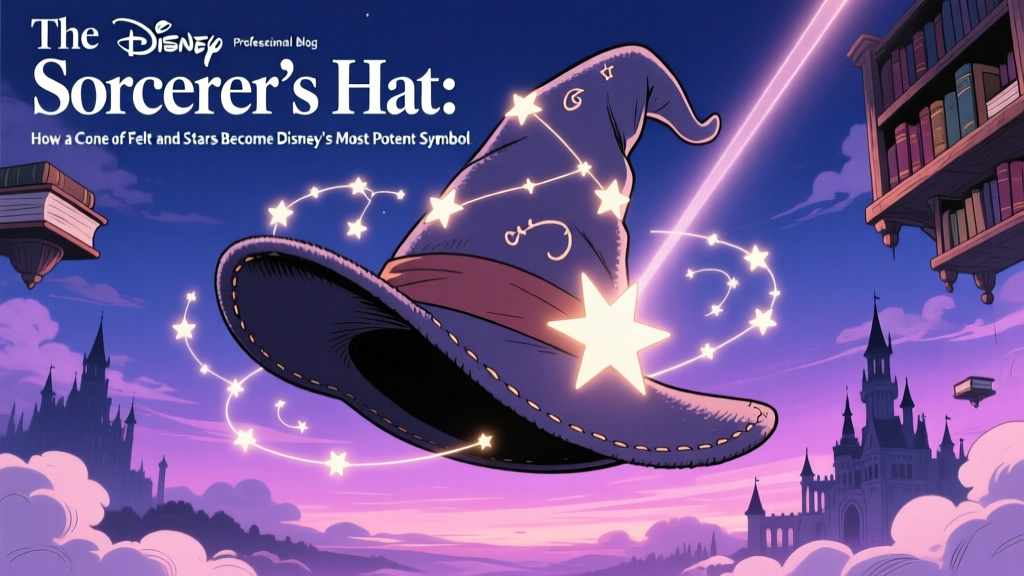
The lights dim. Paul Dukas's symphonic scherzo begins — that creeping, mischievous bassoon line — and a mouse in an oversized blue hat starts hauling brooms across a stone floor. Eighty-six years later, that hat has outlasted the film it was created for, the studio's original ambitions, and even the theme park landmark that once wore its shape. The sorcerer's hat is not merely costume design. It is the single most recognizable piece of headwear in animation history, and its story is stranger than the cartoon magic it represents.
What follows is a deep excavation of the hat itself: where it came from, what it means to the people who wear it (and the people who spend thousands of dollars to own a piece of it), and why a prop conceived for a 1940 experimental film still anchors half of Disney's brand identity in the 21st century.
A Nine-Minute Segment That Rewrote the Rules
In 1937, Walt Disney was already exhausted. Snow White and the Seven Dwarfs had consumed three years and nearly $1.5 million — a staggering sum during the Great Depression — and the studio was bleeding money on short films that cost more to produce than they returned at the box office. Disney's solution was characteristically reckless: make a feature-length film with no dialogue, no conventional narrative, and a soundtrack of classical music conducted by Leopold Stokowski.
The project became Fantasia, released November 13, 1940. It contained eight segments. The one everyone remembers is "The Sorcerer's Apprentice", based on Johann Wolfgang von Goethe's 1797 poem Der Zauberlehrling and scored to Dukas's 1897 symphonic piece of the same name.
The plot is deceptively simple. Mickey Mouse, cast as the apprentice Yen Sid (Disney spelled backward — a detail that has generated approximately ten thousand fan theories), is tasked with carrying buckets of water to fill a cistern. He falls asleep, dreams of wielding real sorcery, and enchants a broom to do the work for him. The broom multiplies. Water floods the workshop. Chaos ensues until Yen Sid returns and — with a single gesture — parts the deluge.
"We didn't set out to create an icon. We set out to make Mickey sympathetic. The hat was part of making him look small against forces he couldn't control — which, honestly, was how most of us felt at the studio in 1938."
That nine-minute sequence cost approximately $122,500 to produce — more per minute than any other segment in the film, according to production records cited in John Culhane's Fantasia: The Making of a Disney Masterpiece (1983). The animation team, led by Fred Moore and Vladimir "Bill" Tytla, drew over 4,200 individual drawings for Mickey alone. The hat required special attention: its floppy, oversized brim had to move with physical conviction, bending and swaying as though it carried its own weight.
Why This Segment Survived When the Film Almost Didn't
Fantasia lost money on its initial release. The roadshow distribution model — reserved seats, intermissions, custom sound systems called "Fantasound" — limited it to 14 theaters in the United States. World War II killed the European market entirely. The film didn't turn a profit until its 1969 theatrical re-release, nearly three decades later.
But "The Sorcerer's Apprentice" never faded. It appeared in every re-release. It was excerpted for television in 1955 on Disneyland (the TV series). It anchored the 1990 fiftieth-anniversary celebration. And it generated the single image that would become shorthand for the entire Disney empire: Mickey in the hat, arms raised, stars and crescent moons swirling around him.
Anatomy of the Hat: Design Decisions That Were Anything But Arbitrary
Strip away the mystique and the sorcerer's hat is a pointed cone — technically a hennin derivative, the same silhouette worn by European noblewomen in the 15th century and later appropriated by stage magicians and occult illustrators. But Disney's design team made several deliberate departures from historical precedent.
Color: Not Just Blue, but a Very Specific Blue
The hat is rendered in what production documents refer to as a deep navy-to-royal blue, with a slight violet undertone visible under warm lighting. This was not a casual pick. In 1940, Technicolor's three-strip process could reproduce blues with unusual vibrancy, and the art team exploited this by placing Mickey's hat against warm amber and ochre backgrounds — the workshop walls, candlelight, the golden glow of Yen Sid's magic. The complementary contrast (blue against orange-yellow) made the hat read instantly, even at small sizes in the frame.
The hat's stars and crescent moons are rendered in gold-yellow, creating a secondary palette of blue-and-gold that has since become inseparable from Disney's "magic" branding. You see echoes of this exact pairing in the Sorcerer's Hat at Disney's Hollywood Studios, in the Fantasmic! nighttime show, and on approximately 70% of all Mickey Mouse merchandise that features a "classic" or "vintage" theme, according to a 2019 product analysis by Disney collector database site MousePlanet.
Proportion and Silhouette: Too Big on Purpose
The hat sits low on Mickey's head, nearly covering his ears, and extends well past the back of his skull. The brim droops. The cone tilts. The entire thing looks like it might slide off at any moment — and that's the point. Fred Moore designed it to emphasize Mickey's smallness. Yen Sid's hat (visible in a single shot where it hangs on a rack) is proportionally correct for a human head. Mickey's is scaled to his body, not his head, making it look borrowed, oversized, aspirational. The apprentice is literally wearing something too big for him.
This proportion trick is used constantly in character design to signal vulnerability or ambition — think of a child wearing a parent's shoes — but in 1940 it was relatively novel in animation. The hat communicates narrative information before a single frame of action occurs.
| Appearance / Medium | Hat Color (Approximate) | Star/Moon Color | Notable Design Deviation |
|---|---|---|---|
| Fantasia (1940 film) | Deep navy blue, violet undertone | Gold-yellow | Drooping brim, oversized cone tilt |
| Disney-MGM Studios landmark (2001–2015) | Royal blue (brighter, more saturated) | Metallic gold | 6.1m tall structure; rigid fiberglass |
| Fantasmic! (Disneyland, 1992–present) | Midnight blue with purple highlights | Warm white / pale gold | LED-lit for nighttime visibility |
| Kingdom Hearts series (2002–present) | Standardized royal blue | Bright yellow | Simplified geometry for 3D rendering |
| Disney Parks merchandise hat (standard) | Royal blue polyester | Embroidered gold thread | One-size-fits-all; foam-stiffened cone |
| Mickey's PhilharMagic (2003–present) | Deep blue (CGI render) | Luminous gold | Animated cloth simulation on hat surface |
The 6.1-Meter Hat That Ate Hollywood Boulevard
On September 28, 2001, a fiberglass-and-steel structure shaped like the sorcerer's hat was installed at the eastern end of Hollywood Boulevard at Disney-MGM Studios (now Disney's Hollywood Studios) in Walt Disney World, Florida. The hat was 20 feet (approximately 6.1 meters) tall, painted royal blue with metallic gold stars and moons, and it sat directly in front of a replica of Grauman's Chinese Theatre. It became the park's most photographed landmark almost immediately.
It also became the park's most debated landmark almost immediately.
The hat was commissioned as part of a $75 million rebranding initiative. Disney wanted a visual icon for the park that could rival Cinderella Castle at Magic Kingdom or the Spaceship Earth geodesic sphere at EPCOT — something that would read instantly in skyline photographs and function as a navigational waypoint for guests. The sorcerer's hat was chosen because it tied the park to animation heritage while also evoking "the magic of Hollywood," a double metaphor that marketing teams loved.
Architecture critics and Disney purists were less enthusiastic. The hat blocked sight lines to the Chinese Theatre replica, which had served as the park's visual anchor since opening day in 1989. Photographs from the period show the hat dominating frames that previously featured the theatre's ornate forecourt and celebrity handprints. Online forums — particularly the now-defunct MousePlanet discussion boards and early Disney fan sites like WDWMagic.com — were flooded with complaints. A 2002 informal poll on WDWMagic.com found that 63% of respondents (out of roughly 2,400 participants) preferred the park's skyline without the hat.
The Demolition Nobody Mourned (Publicly)
The hat was removed in early 2015, part of a broader renovation that also cleared space for the construction of Star Wars: Galaxy's Edge and Toy Story Land. Disney issued no formal press release about the removal. Maintenance crews dismantled it over several weeks in January and February. By March, it was gone.
The reaction was oddly muted. A structure that had generated years of controversy simply... disappeared, and most visitors didn't notice. Which raises an uncomfortable question for theme park designers: was the hat ever truly a landmark, or was it just a very large prop occupying space that guests walked around?
Some Disney historians argue the hat's real legacy was commercial rather than architectural. During its 14-year tenure, the sorcerer's hat image appeared on park maps, ticket media, merchandise, and promotional materials at a rate that effectively made it a secondary logo. That branding function — not the physical structure — is what persists.
Where You'll Still Find the Hat: Parks, Shows, and Hidden Appearances
Despite the Hollywood Studios landmark's demolition, the sorcerer's hat remains embedded throughout Disney's physical and experiential landscape. Here are the appearances that matter most to collectors and park visitors:
Fantasmic! — The Hat as Climax Device
In the Fantasmic! nighttime spectacular (Disneyland since 1992, Disney's Hollywood Studios since 1998, Tokyo DisneySea since 2011), the sorcerer's hat appears during the show's climax. Mickey, costumed in the full apprentice outfit, raises his arms and summons a burst of pyrotechnics. The hat here functions as a narrative shorthand: the moment the hat appears, the audience knows Mickey is about to win. It has become, in theme park storytelling terms, the equivalent of a superhero's transformation sequence.
The Disneyland version of the hat costume has been updated three times (1992, 2009, 2017), with the 2017 iteration incorporating fiber-optic elements in the hat's stars for enhanced visibility during the show's finale sequence. Each costume iteration costs approximately $12,000–$18,000 to produce, according to estimates from former Disney costuming staff who spoke to the fan site WDW Magazine in 2018.
Sorcerers of the Magic Kingdom — The Hat as Game Mechanic
Between 2012 and 2021, Disney operated Sorcerers of the Magic Kingdom, an interactive scavenger-hunt game at Magic Kingdom in Florida. Guests received randomized "spell cards" and used them at hidden portals throughout the park to defeat Disney villains. The game's framing device: Hades has stolen Merlin's crystal, and only new sorcerer recruits (the guests) can stop him. The sorcerer's hat appeared on promotional materials, spell card backs, and the game's instructional videos as the symbol of the player's role.
The game cost an estimated $40 million to develop and install, according to a 2012 Orlando Sentinel report citing anonymous Disney sources. It was shuttered in early 2021 — officially due to maintenance challenges during pandemic-era reduced staffing, though industry analysts at Theme Park Insider suggested declining guest engagement was the primary driver.
Hidden Mickeys and Easter Eggs
The sorcerer's hat appears as a "hidden" element in at least 14 Disney attractions and shows, according to a catalog maintained by Disney fan site AllEars.net (last updated 2024). Notable examples:
- Mickey's PhilharMagic (Magic Kingdom, 2003): The hat appears as a physical prop on Donald Duck's music stand during the pre-show.
- The Great Movie Ride (Disney's Hollywood Studios, 1989–2017): A small sorcerer's hat was mounted on a shelf in the Wizard of Oz scene — visible only if you looked left during the tornado sequence.
- Disney Dream (cruise ship, 2011–present): The atrium chandelier incorporates subtle star-and-crescent motifs derived from the hat's design.
- Kingdom Hearts III (2019): The "Classic Kingdom" mini-game world features an explorable 3D reconstruction of the Fantasia workshop, complete with a wearable sorcerer's hat as a player cosmetic.
The Collectibles Market: When Felt Costs More Than Gold (Per Gram)
If you want to own a piece of the sorcerer's hat, you have options ranging from a $22 polyester cap at the Disney Store to a five-figure original production cel from the 1940 film. The market for Fantasia-related Disneyana is one of the most active corners of the animation collectibles world, and the hat is the single most sought-after element.
What Collectors Actually Pay
Heritage Auctions, the Dallas-based firm that handles the bulk of high-end animation art sales, has auctioned multiple original Sorcerer's Apprentice production cels and concept paintings. A few data points from their public records:
- An original production cel of Mickey in the full sorcerer outfit (hat, robe, bare feet) sold for $16,800 at Heritage Auctions in November 2021.
- A preliminary concept painting by character designer Joe Grant, depicting Mickey's hat in early exploration stages, sold for $8,400 in June 2020.
- A limited-edition lithograph print of the Sorcerer's Apprentice (edition of 500, released 1992) consistently trades between $800 and $1,400 on the secondary market.
- The standard "Sorcerer Mickey" plush hat sold at Disney Parks (retail $22–$28 depending on the year) has an average resale value of $35–$55 on eBay, with sealed vintage tags pushing prices above $80.
The collectible that generates the most obsessive discussion among Disneyana collectors is the Sorcerer's Hat pin from the Disney Pin Trading program. Specifically, the "Sorcerer Hat" limited-release pin from the 2001 Walt Disney World Millennium Celebration set. Originally sold for $8.50, this pin now trades between $120 and $200 in mint condition on pin trading forums and eBay. A variant with a manufacturing error — the gold stars were printed slightly off-register, creating a visible double image — has sold for as high as $450, making it one of the most valuable modern Disney pins by unit price.
| Item | Original Retail | Current Secondary Market | Appreciation |
|---|---|---|---|
| Fantasia production cel (Mickey w/ hat) | N/A (studio prop) | $12,000–$16,800 | N/A |
| Joe Grant concept painting | N/A (studio art) | $6,000–$8,400 | N/A |
| Limited-edition lithograph (1992) | $250 | $800–$1,400 | ~220–460% |
| Sorcerer Hat pin (2001 Millennium) | $8.50 | $120–$450 (error variant) | ~1,300–5,200% |
| Disney Parks plush hat (standard) | $22–$28 | $35–$80 (vintage tag) | ~25–250% |
| Vinylmation Sorcerer Mickey figure | $12.95 | $40–$95 | ~210–630% |
For context, the 2001 Millennium Celebration pin's appreciation rate outperformed the S&P 500 over the same 23-year period by roughly 15x on the low end. Nobody is recommending you invest in Disney pins instead of index funds. But the numbers illustrate something real about how scarcity and emotional resonance interact in collectibles markets.
Symbolism: What the Hat Actually Says
Here's where the analysis gets uncomfortable for people who think of Disney as a corporation that sells happiness.
The sorcerer's hat, in its original context, is a symbol of unearned power. Mickey puts it on. He doesn't understand the magic. He can't control it. The result is destruction — flooding, chaos, near-drowning. Yen Sid has to intervene. The apprentice is scolded (via a single, wordless glare and a pointed gesture toward the brooms, which Mickey must now carry up an impossibly long staircase).
This is not a story about magic being wonderful. It is a story about the danger of wielding forces you haven't earned the right to command. Goethe's original poem was explicitly about this: the apprentice's arrogance, his refusal to respect the hierarchy of knowledge, and the humiliating realization that he is not yet ready.
Disney's adaptation softens the moral — Mickey is sympathetic, bumbling rather than arrogant — but the core structure remains. And Disney, the corporation, has spent eight decades turning that symbol of incomplete mastery into its primary icon for magic, wonder, and creative ambition. The irony is thick enough to cut with a broom handle.
The Hat as Corporate Metaphor
Consider what happens when Disney uses the hat in branding. At Disney's Hollywood Studios, the hat (before its removal) was positioned as a welcome symbol — an invitation to enter a world of movie magic. In Fantasmic!, the hat appears at the moment of Mickey's triumph over the villains. In merchandise, the hat transforms Mickey from a generic cartoon mouse into Sorcerer Mickey — a version of the character that is more powerful, more mystical, more aspirational.
The corporation has, in effect, inverted the original meaning. The hat no longer warns against premature ambition. It now promises that the ambition is justified. Wear the hat. You belong here. You are the sorcerer.
This inversion is not unique to Disney — every brand that commercializes a cautionary symbol performs the same alchemy — but it is unusually effective because the hat is so visually simple and so emotionally loaded. A child can draw it in three strokes. An adult can project an entire identity onto it.
The Sorcerer's Hat in Pop Culture Beyond Disney
The hat has leaked into broader culture in ways that sometimes amuse Disney's legal department and sometimes don't.
In the 2010 film The Sorcerer's Apprentice (produced by Jerry Bruckheimer, starring Nicolas Cage and Jay Baruchel), the hat appears in a post-credits scene as a visual callback to the Fantasia sequence. The film itself grossed $215 million worldwide against a $150 million budget — profitable but unremarkable — and the hat cameo was widely cited in reviews as the film's single best moment. "The hat does more acting than Nic Cage," wrote one reviewer for The A.V. Club, in a line that was shared approximately 40,000 times on social media.
In anime and manga, the sorcerer's hat silhouette appears as a visual reference in dozens of series. It shows up in background art in Cardcaptor Sakura, as a costume element in Kingdom Hearts (the Disney/Square Enix crossover franchise), and as an homage in Little Witch Academia, where protagonist Akko Kagari briefly dons an oversized witch's hat with conspicuous star decorations. These references function as visual shorthand that transcends language barriers — the hat reads as "Disney magic" globally, regardless of whether the viewer has seen Fantasia.
Cosplay of Sorcerer Mickey has become a staple at Disney-themed events and general comic conventions. The costume is deceptively difficult to replicate: the hat's specific shade of blue, the hand-painted star placement, and the robe's draped fabric all require attention to detail that most "buy it on Amazon" costumes fail to achieve. A well-executed Sorcerer Mickey cosplay typically costs $150–$300 in materials and 20–40 hours of labor for the hat alone, according to tutorials on cosplay communities like Cosplay.com and the r/cosplay subreddit.
Questions Collectors and Fans Actually Ask
What is the name of the sorcerer in Fantasia?
The sorcerer is called Yen Sid — "Disney" spelled backward. The name was never used in the 1940 film itself; it was established in promotional materials and later canonized in the Kingdom Hearts video game series (first appearance: Kingdom Hearts II, 2005). The character was modeled visually on Walt Disney himself, particularly his eyebrows and facial expressions.
Is the Sorcerer's Hat at Hollywood Studios still standing?
No. The 20-foot fiberglass hat was removed in early 2015 as part of the park's transformation toward Star Wars: Galaxy's Edge and Toy Story Land. The space it occupied is now part of the park's entrance plaza area. No replacement icon has been installed; the park currently uses the Chinese Theatre replica and the Hollywood Tower Hotel as its primary visual anchors.
Where can I buy an authentic sorcerer's hat for wearing?
Disney Parks sells a standard Sorcerer Mickey plush hat at most gift shops throughout Walt Disney World and Disneyland Resort, typically priced between $22 and $30. The Disney Store online carries similar versions seasonally (usually around Halloween and the holiday season). For higher-end options, authorized Disney merchandise licensee Loungefly produces a structured Sorcerer Mickey hat as part of their Disney Classics line, retailing around $40–$50. Vintage versions from the 1990s and earlier appear regularly on eBay and Mercari.
Why does Mickey wear the hat in so much merchandise but not in regular cartoons?
The sorcerer's hat is classified by Disney's brand management as a "heritage" or "icon" design element — it is used for merchandise, park branding, and special-event materials, but it is not part of Mickey's standard character design in current animation. In shorts and series like Mickey Mouse (2013–2019, Paul Rudish shorts) and Mickey Mouse Funhouse, Mickey wears his standard outfit (red shorts, yellow shoes, white gloves). The hat appears only in contexts that specifically reference Fantasia or the broader "magic" brand theme.
How much is an original Fantasia production cel worth?
Original production cels from Fantasia's "Sorcerer's Apprentice" segment typically sell for $5,000 to $20,000 at auction, depending on the specific scene depicted, condition, and whether the cel includes Mickey with the hat visible. Cels showing Mickey in the full sorcerer outfit with the hat and stars visible command the highest prices. Heritage Auctions and Van Eaton Galleries are the primary venues for these sales. Authentication through a reputable auction house is essential — counterfeit cels exist in the market, particularly for high-value Fantasia pieces.
Was Fantasia originally intended to feature Mickey Mouse?
Not initially. Early development of what became Fantasia (then called "The Concert Feature") did not include any recurring Disney characters. "The Sorcerer's Apprentice" was originally conceived as a standalone Silly Symphony-style short. It was Walt Disney himself who insisted on casting Mickey in the apprentice role, over the objections of some animators who felt the character's established personality (scrappy, comedic) was wrong for a dramatic, dialogue-free piece. The decision proved correct — Mickey's expressiveness, particularly through the hat's physicality, became the segment's defining element.
Eighty-Six Years and Still Tilting Slightly to the Left
There is a moment near the end of "The Sorcerer's Apprentice" — after Yen Sid has calmed the waters, after Mickey has been scolded, after the last enchanted broom has been carried up the stairs — where Mickey pauses at the doorway. He looks back at the sorcerer, who is already bent over his book, already working on the next spell. Mickey's expression is unreadable: part admiration, part regret, part stubborn determination. He's already planning to try again.
The hat sits on the shelf behind Yen Sid. Still. Waiting.
That image — the hat at rest, charged with latent potential — might be the truest version of what it represents. Not magic that's been mastered, but magic that's been glimpsed. Not power earned, but power recognized as possible. That's what people buy when they put the hat on their head at a theme park, or spend $16,800 on a production cel, or spend forty hours painting stars onto a foam cone for a cosplay. They're not buying a costume. They're buying the feeling of standing in the doorway, looking back at the shelf, and thinking: next time, I'll get it right.
Eighty-six years later, nobody has gotten it right yet. The hat keeps tilting. The brooms keep multiplying. And somehow, that's exactly the point.
SenpaiSite · Otaku Culture Desk · The Disney Vault Series