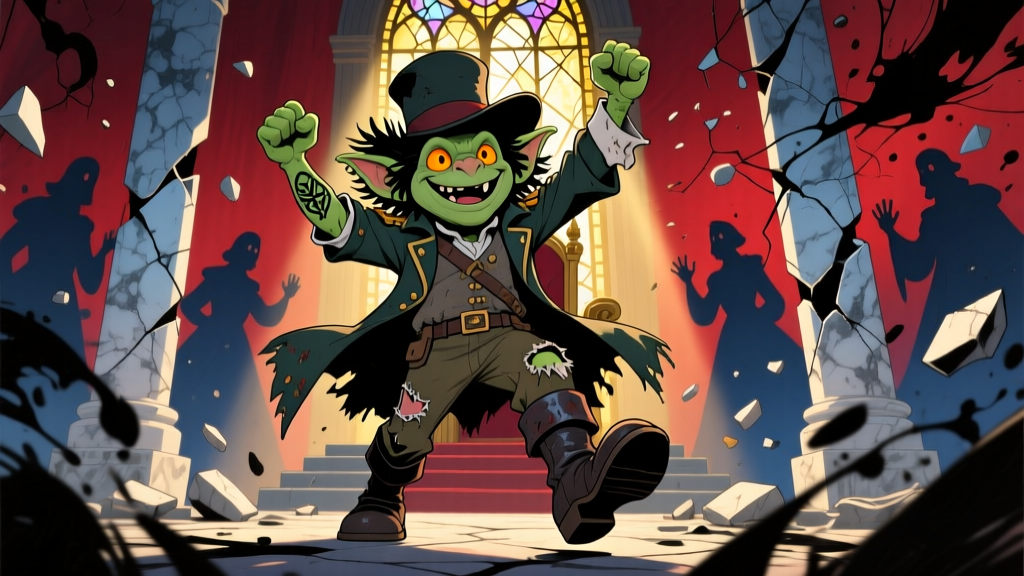
The year was 1986. David Bowie was strutting across screens in skintight trousers as the Goblin King, Jennifer Connelly was wide-eyed and fourteen, and somewhere inside a rubber suit barely four feet tall, a woman named Shari Weiser was sweating through one of the most physically demanding performances in puppetry history. The character she inhabited — Hoggle — was a warty, hook-nosed, cowardly dwarf who peed in fountains and hoarded cheap plastic jewelry. And yet, forty years later, Hoggle remains the character people talk about first when the word Labyrinth comes up. Not Jareth. Not Sarah. The goblin who couldn’t even keep his pants on.
That says something. Something worth unpacking about craft, character design, and the strange alchemy that turns an ugly little puppet into an icon.
Brian Froud Drew a Feeling, Not a Face
Conceptual designer Brian Froud had already proven his worth on The Dark Crystal (1982), where his paintings gave Jim Henson an entire world to build. For Labyrinth, Froud went in a different direction. Where The Dark Crystal was all alien grandeur and mythic scale, Labyrinth needed to feel closer to home — like a fairy tale that had been rotting in a basement for a century. Hoggle was the embodiment of that vision.
Froud’s original sketches for Hoggle described a creature somewhere between a garden gnome left out in the rain and a toad that had given up on life. The design featured an oversized, bulbous head covered in warts and boils, a pronounced hooked nose, sagging jowls, and beady eyes that seemed permanently caught between guilt and panic. His body was squat and barrel-chested, with stubby limbs that made every movement look like an effort. The costume department translated Froud’s paintings into a practical suit, but the head — that magnificent, repulsive head — required its own engineering team.
Jim Henson’s Creature Shop built the Hoggle head with a combination of foam latex skin and internal animatronic mechanisms. The face could blink, wrinkle its nose, frown, and — crucially — look ashamed. That last expression was the one that mattered most. According to production notes from the Jim Henson Company archives, the Hoggle head contained approximately 18 separate mechanical controls operated by up to four additional puppeteers off-camera, while Weiser inside the suit handled the body performance. The result was a face that could convey genuine emotion through layers of rubber and wire — something most human actors can’t manage on a good day.
“I wanted Hoggle to look like someone you’d cross the street to avoid, but then feel terrible about it afterward. He’s ugly on the outside, and he knows it, and that knowledge is what makes him sympathetic.”
— Brian Froud, in reflections on the Labyrinth character designs (as cited in Inside the Labyrinth, Harper & Row, 1987)
Shari Weiser: The Invisible Actress Inside the Goblin
Here’s the part that most people skip past, and it’s the part that matters most. Shari Weiser was not just a person in a costume. She was a trained physical performer who had to deliver a full-bodied acting performance while encased in roughly 40 pounds of foam, latex, and mechanical hardware, with zero visibility through the head piece and limited mobility in every joint.
Weiser stood approximately 4’10” and was cast specifically because the role demanded someone small enough to inhabit the proportions Froud had designed, but skilled enough to project character through restricted movement. Every step Hoggle took on screen was Weiser navigating uneven terrain — the Labyrinth set was built with irregular stone floors, ramps, and steps — while blind, essentially, inside the head. She communicated Hoggle’s cowardice through the tilt of his shoulders, his reluctance through the drag of his feet, his moments of unexpected courage through the way he’d square that barrel chest and march forward despite every instinct screaming at him to run.
The voice was Brian Henson — Jim Henson’s son, who would later take over running the company after his father’s death in 1990. Brian gave Hoggle a reedy, slightly nasal voice that cracked when the character was scared, which was often. The combination of Weiser’s physicality and Henson’s vocal performance created something rare in puppetry: a character who felt genuinely alive. You can see it in the way Hoggle wrings his hands when he’s lying, or how he flinches before Jareth even raises a hand. These aren’t programmed movements. They’re acting choices made by a performer who understood, bone-deep, that she was playing a creature defined by fear.
The Reluctant Guide: A Character Older Than Fairy Tales
Hoggle’s narrative function in Labyrinth is straightforward: he’s Sarah’s guide through the maze, assigned (somewhat ambiguously) to either help her or lead her astray. But what makes the character resonate goes deeper than plot mechanics. Hoggle is one of the clearest cinematic examples of the reluctant guide archetype — a figure who knows the path, has probably walked it many times, and absolutely does not want to walk it again.
Think about it. When Sarah first encounters Hoggle, he’s literally spraying graffiti on the Labyrinth walls and pretending he doesn’t know anything. He’s been Jareth’s servant for who knows how long — the film never specifies, but Hoggle’s weary familiarity with the maze suggests years, possibly decades. He’s a creature who has made his peace with cowardice. He serves the Goblin King because serving the Goblin King is safer than the alternative. And then this teenage girl shows up, and something in her stubbornness — or maybe just his exhaustion with being a toady — cracks him open.
The turning point comes at the bridge over the Bog of Eternal Stench. Hoggle has already betrayed Sarah once (giving her the peach that puts her into the Junk Lady’s dream trap, on Jareth’s orders), and when he finds her again, the guilt is written all over that rubber face. He doesn’t give a speech. He doesn’t make a grand declaration. He just shows up, looking miserable and ashamed, and starts helping again. That scene — more than any sword fight or musical number — is where Hoggle becomes a real character. It’s the moment the audience realizes that courage isn’t the absence of fear. It’s being terrified and showing up anyway, especially when you’ve already failed once.
Sarah and Hoggle: The Friendship That Wasn’t Supposed to Work
One of the smarter choices in Terry Jones’s screenplay (from a story by Jones and Jim Henson, with additional contributions from Laura Phillips and Elaine May) is that Hoggle and Sarah never become best friends in any conventional sense. Their relationship is transactional at first, antagonistic in the middle, and grudgingly loyal by the end. Sarah calls Hoggle a “horrible little man” within minutes of meeting him. He calls her names back. They bicker like siblings who were forced into a car together for a road trip neither of them wanted.
This friction is what sells the emotional payoff in the film’s third act. When Sarah tells Hoggle, “I need you,” during the final confrontation with Jareth, the line lands because we’ve watched these two characters earn every scrap of trust between them. Hoggle’s response — “I’ll help you, but it’s not because I’m brave” — is one of the most honest things any character in a fantasy film has ever said. He’s not lying to himself or to her. He’s helping because he cares, not because he’s suddenly become a hero. That distinction matters.
The relationship also works because the film never sexualizes it or forces sentimentality onto it. In a decade where family films often shoehorned tearful goodbyes and swelling orchestral cues into every emotional beat, Labyrinth lets the Sarah-Hoggle bond stay awkward and imperfect. When Sarah kisses Hoggle on the cheek near the film’s end, it plays as genuine affection between two people who were rough on each other and came out the other side. The simplicity of it is the point.
The “Ugly” Controversy: When a Puppet Was Too Grotesque for Some
Not everyone loved Hoggle in 1986. When Labyrinth premiered, the film underperformed at the domestic box office — earning roughly $12.7 million against a $25 million budget, per industry records. Among the complaints from parents and some critics was that certain characters, Hoggle chief among them, were simply too ugly and grotesque for a children’s film. The New York Times review by Nina Darnton (June 27, 1986) described the creatures as “more repulsive than appealing,” and audience surveys at early screenings flagged Hoggle’s appearance as off-putting to younger viewers.
There was a genuine tension in the production between Froud’s vision — which drew from centuries of European folklore where goblins, trolls, and hobgoblins were deliberately unsettling — and the commercial reality that Labyrinth was marketed as a family fantasy adventure. American audiences in the mid-1980s had been trained by Disney and early Spielberg to expect their fantasy creatures to be cute. E.T. was cute. The Muppets were cute. Hoggle, with his pus-colored warts and sagging lower lip, was emphatically not cute.
The irony, of course, is that this “flaw” became the character’s greatest asset. As Labyrinth found its audience on VHS and cable throughout the late 1980s and 1990s, Hoggle’s ugliness became part of his charm. He was ugly and he knew it. He was ugly and he was tired. That combination — self-awareness plus exhaustion — reads as deeply human, no matter what the face looks like. The same audiences who recoiled from Hoggle in theaters were quoting his lines by the time they were in college.
Hoggle by the Numbers: Design, Production, and Legacy
For those who appreciate the technical side, here’s a breakdown of the key production facts around the Hoggle character:
| Category | Detail |
|---|---|
| Body Performer | Shari Weiser (approx. 4’10” height, trained physical performer) |
| Voice Actor | Brian Henson |
| Conceptual Designer | Brian Froud |
| Puppet Fabrication | Jim Henson’s Creature Shop — foam latex, animatronics |
| Face Controls | ~18 mechanical controls, operated by up to 4 off-camera puppeteers |
| Estimated Suit Weight | ~40 lbs (foam, latex, hardware, costume layers) |
| Film Release | June 27, 1986 (U.S.) |
| Domestic Box Office | ~$12.7 million (against ~$25M budget) |
| Director / Producer | Jim Henson (director) / George Lucas (executive producer) |
Collectibles, Comics, and the Afterlife of a Goblin
Hoggle’s second life as a collectible icon began almost as soon as the film left theaters. The initial wave of Labyrinth merchandise in 1986–1987 was modest — a handful of action figures from a licensing deal, some paperback novelizations, and a few poster prints. But as the film’s cult status grew through the 1990s, so did demand for Hoggle-specific merchandise.
By the 2000s, Hoggle had appeared in several comic book adaptations, most notably the Return to Labyrinth manga-style series published by TOKYOPOP between 2006 and 2010. In these comics, Hoggle continued to serve as a reluctant mentor figure to new characters entering the Labyrinth, maintaining the same grumpy-but-loyal personality that made him beloved in the film. The comics expanded his backstory somewhat, suggesting that Hoggle had been trapped in the Labyrinth for far longer than anyone guessed, and that his servitude to Jareth was as much a prison sentence as it was a job.
On the collectibles side, high-end Hoggle figures and statues began appearing from specialty manufacturers in the 2010s. Companies like Weta Workshop and various boutique sculptors produced limited-run resin statues that could fetch $200 to $500 on the secondary market. More affordable vinyl figures and Funko-style pops also entered the market, aimed at the generation that grew up watching Labyrinth on VHS and wanted a piece of it on their shelves. Convention culture amplified this — Hoggle cosplay became a niche but dedicated presence at fan conventions, with some cosplayers spending months perfecting the warts-and-all head sculpt.
Why He Endures: The Hoggle Paradox
There are fantasy characters who endure because they’re powerful. Gandalf. Galadriel. Darth Vader. And then there are characters who endure because they’re small — because they remind us that heroism isn’t reserved for the chosen, the destined, or the talented. It’s available to anyone who’s scared enough to do the right thing anyway.
Hoggle is the anti-hero before anti-heroes became a television trend. He’s selfish, he’s dishonest, he pees in public water features, and he will absolutely rat you out to the villain if the villain looks intimidating enough. And yet when it counts — when Sarah is dangling over the Bog of Eternal Stench, when Jareth’s clock is running out, when the easy choice is to stay hidden and safe — Hoggle shows up. Every single time.
That pattern of failure and redemption, repeated across a 101-minute film, mirrors something most people experience in their own lives at a smaller scale. We don’t fight goblin kings. But we do face moments where our fear tells us to stay silent, to stay home, to not make the call, to not take the risk. Hoggle is the part of us that whines and complains and tries to wriggle out of it — and then, somehow, does it anyway. Maybe that’s why a rubber-suited puppet with eighteen mechanical face controls hits harder than most CGI spectacle. The craft serves the character, and the character serves something true.
A Note on Puppetry in the CGI Era
It’s worth noting that Hoggle exists at a specific moment in film history — the tail end of an era where fantasy creatures were built by hand, performed in real time, and captured on film without digital enhancement. Within a decade of Labyrinth’s release, CGI creatures would dominate the genre. Jar Jar Binks. Gollum. The Na’vi. All remarkable achievements in their own right, but none of them carry the same tactile strangeness that Hoggle does. You can feel the weight of that suit. You can sense the heat inside it. That physicality translates through the screen in a way that pixels, however beautifully rendered, have never quite replicated.
Jim Henson understood this instinctively. In interviews from the Labyrinth production period, he spoke about the importance of the audience believing that a creature was really there — occupying the same physical space as the actors, casting a real shadow, taking up real air. That philosophy is baked into every frame of Hoggle’s screen time, and it’s a large part of why the character still feels present and alive in a way that many digital creations from the same decade have not aged as well.
Hoggle in the Broader Otaku and Fantasy Fandom
It might seem odd to discuss a Jim Henson puppet on a site devoted to anime and pop culture, but Hoggle’s influence extends well beyond Western fantasy circles. Japanese fantasy media — from Studio Ghibli films to the Mushishi manga series — share a common ancestry with Froud’s creature designs. The idea that supernatural beings should be simultaneously beautiful and grotesque, helpful and dangerous, is deeply embedded in both European folklore (which Froud drew from) and Japanese yokai traditions. Hoggle sits squarely in that overlap: a creature who is neither fully good nor fully evil, whose appearance unsettles, and whose loyalty must be earned rather than assumed.
Fan communities across Tumblr, Reddit, and various Discord servers have kept Hoggle’s legacy alive through fan art, meme culture, and ongoing discussions about the film’s themes. The “Hoggle” archetype — the reluctant, ugly, self-interested ally who comes through in the end — shows up repeatedly in anime and manga. Characters like Shuu Tsukiyama from Tokyo Ghoul or even certain portrayals of Puck from Berserk carry echoes of Hoggle’s grudging loyalty and complicated morality. The Labyrinth goblin may have been built from foam latex, but his DNA is everywhere in modern character design.
Frequently Asked Questions About Hoggle
Who performed inside the Hoggle costume?
Shari Weiser, a trained physical performer standing approximately 4’10”, performed the body role inside the Hoggle suit. Brian Henson provided the character’s voice, and up to four additional puppeteers operated the animatronic facial controls off-camera. The performance was a collaborative effort between multiple artists, with Weiser’s physical work forming the foundation of every scene.
Is Hoggle good or evil in Labyrinth?
Neither, really. Hoggle starts the film as a reluctant servant of Jareth the Goblin King, carrying out orders that include misleading Sarah and giving her an enchanted peach that traps her in a dream. Over the course of the story, he shifts allegiance — not because he becomes brave, but because his loyalty to Sarah eventually outweighs his fear of Jareth. He’s a morally gray character who ends up on the right side, which is part of what makes him feel authentic.
Why was Hoggle considered controversial when the film was released?
Some parents and critics in 1986 felt that Hoggle and other Labyrinth creatures were too grotesque for a family film. Brian Froud’s designs drew from traditional European folklore, where goblins and hobgoblins were deliberately unsettling — a sharp contrast to the cute fantasy creatures American audiences had grown accustomed to through Disney and early Spielberg films. The controversy faded as the film found its audience on home video.
What does Hoggle collect in the film?
Hoggle collects cheap plastic jewelry and trinkets — rings, necklaces, baubles. Sarah uses this weakness to bribe him early in the film, offering him her jewelry in exchange for guidance through the Labyrinth. This detail adds texture to the character: he’s a creature of small, pathetic desires, which makes his larger acts of courage feel more significant by contrast.
Did Hoggle appear in any Labyrinth sequels or spin-offs?
Hoggle appeared in the Return to Labyrinth manga series published by TOKYOPOP (2006–2010), which served as an unofficial continuation of the film’s story. He has also appeared in various comic adaptations, merchandise lines, and fan-created works. As of 2026, a live-action Labyrinth sequel has been in various stages of development for years, though no confirmed version has reached production.
Where can I buy Hoggle collectibles?
Hoggle merchandise ranges from affordable vinyl figures (typically $15–$40) to high-end resin statues from specialty manufacturers ($200–$500+ on the secondary market). Funko and similar companies have released stylized Hoggle figures. Convention vendors, online marketplaces like eBay and Etsy, and specialty fantasy merchandise shops are the best places to look. Vintage 1986-era merchandise is rare and commands premium prices among collectors.
Why is Hoggle peeing in a fountain at the start of the film?
The opening fountain scene is one of the film’s earliest introductions to Hoggle and immediately establishes his character: crude, self-interested, and unconcerned with social norms. It’s a deliberate choice by Jim Henson to show the audience that this is not a sanitized fairy-tale creature. The scene also serves a practical storytelling purpose — it gives Sarah (and the audience) a reason to initially dislike Hoggle, which makes his eventual loyalty more meaningful because it was earned, not given.