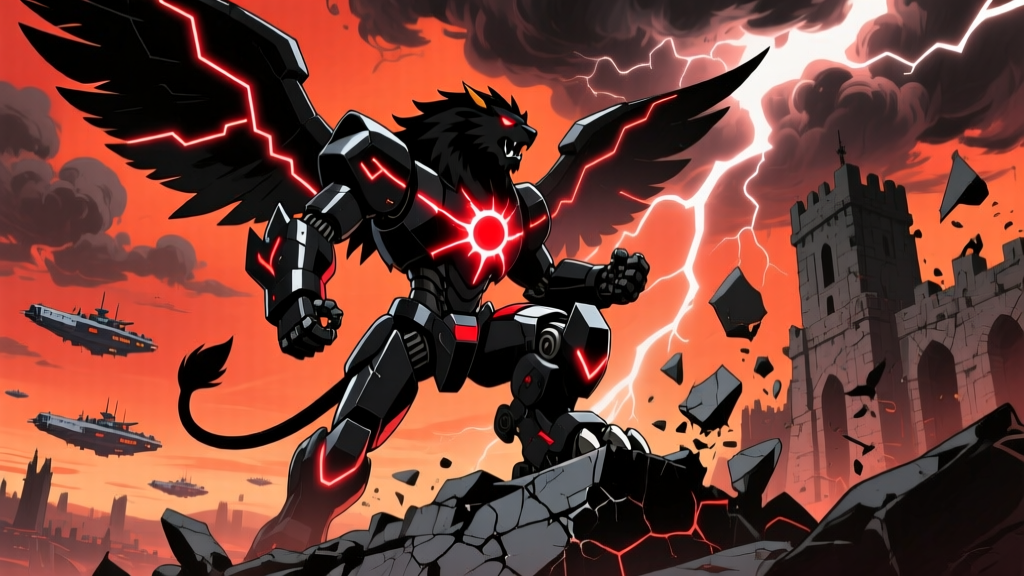
The hangar bay doors grind open. Five mechanical lions, each the size of a city bus, roar to life on thrusters that turn the sky orange. The pilots are strapped into cockpits built into the beasts’ heads, gloved hands gripping control yokes that translate every twitch into tons of articulated steel. One by one the lions launch — Red, Green, Blue, Yellow — and then the last one rises. Obsidian black. Chrome silver joints catching the firelight. Purple energy crackling along its spine like static before a lightning strike. The Black Lion. The one that forms the body, the head, the spine of the thing the universe fears most: Voltron, Defender of the Universe.
Every mecha fan remembers the first time they saw the formation sequence. The lions lock together mid-flight, limbs folding and interlocking with the precision of a Swiss watch scaled up to absurd proportions. The Black Lion sits at the center of it all — literally. Its torso becomes Voltron’s torso. Its head, nestled between massive shoulder pylons, becomes the giant robot’s head. When Voltron speaks, it speaks through the Black Lion’s cockpit. When Voltron draws the Blazing Sword, it is the Black Lion’s pilot who guides the blade. The other four lions are limbs. The Black Lion is the body. Without it, you do not have Voltron. You have four very angry cats.
That centrality is not accidental. From the original 1981 Japanese series Hyakuj&umacru Ō Golion (Beast King GoLion) through the 1984 World Events Productions adaptation that turned it into Voltron, all the way to DreamWorks’ 2016 reboot Voltron: Legendary Defender, the Black Lion has consistently occupied the role of leadership, narrative weight, and the kind of design philosophy that says: the most important thing in the room should also be the darkest, heaviest, and most dangerous-looking.
From GoLion to Legendary Defender: Forty Years of Black
The Black Lion’s story starts in Japan, 1981, inside the animation studios of Toei Company. Hyakuj&umacru Ō Golion aired for 52 episodes and told the story of five young pilots who commanded mechanical lions to fight the Galra Empire — a brutal alien regime led by Emperor Daibazaal (who would become King Zarkon in the American adaptation). The GoLion version of the Black Lion was piloted by Takashi Shirogane, the team’s original leader, a character whose calm authority and military bearing established the template that every subsequent Black Lion pilot would inherit.
Shirogane was not the protagonist in the way audiences typically understand the word. He was not the hothead. He was not the one with the dramatic backstory or the love triangle. He was the steady hand. The one who gave orders and expected them to be followed. When World Events Productions licensed the footage in 1984 and rebranded it as Voltron: Defender of the Universe, they renamed Shirogane to Sven Holgersson — and then, in one of the most infamous decisions in localization history, wrote him out of the story partway through the first season, killing him off (or so the audience believed) and replacing him with Princess Allura as the Blue Lion pilot. The Black Lion went through a brief identity crisis, shifting between pilots before the American adaptation eventually stabilized around a different team dynamic.
Then came 2016. DreamWorks Animation and World Events Productions rebooted the franchise with Voltron: Legendary Defender, an 8-season, 78-episode series on Netflix that reimagined the entire mythology for a new generation. This time, the Black Lion’s pilot was Takashi “Shiro” Shirogane — a direct homage to the GoLion original, now reimagined as a former Galaxy Garrison pilot who had been captured by the Galra Empire, lost his right arm (replaced with a Galra-tech prosthetic), and returned to Earth with fragmented memories and a body that was more weapon than flesh. Shiro was older than the rest of the team, battle-scarred, and carrying the kind of quiet trauma that made him feel like a war veteran cosplaying as a space cadet.
Midway through the series, Shiro’s deteriorating health forced a pilot change. Keith Kogane — the impulsive, hot-tempered former Red Lion pilot who had been groomed for leadership since the show’s first season — took over the Black Lion cockpit. The transition was not just a logistics swap. It was a narrative statement. The Black Lion does not accept just anyone. It accepts leaders. And Keith had spent two seasons earning that title through every reckless decision, every moment of self-doubt, every time he chose the team over himself.
“The Black Lion doesn’t care how fast you fly or how hard you punch. It cares whether you’ll put the team ahead of yourself when it matters. That’s what makes it different from the Red Lion. The Red Lion wants a warrior. The Black Lion wants a leader.”
— Joaquim Dos Santos, co-showrunner, Voltron: Legendary Defender, interview with Collider (2018)
Anatomy of a Mechanical Beast: Design Breakdown
The Black Lion’s visual design has evolved across three major iterations, but certain constants have persisted from the beginning. It is always the largest of the five lions. It is always black — not dark blue, not gunmetal gray, but a deep, light-absorbing obsidian that makes the other lions’ colors look almost cheerful by comparison. And it always features chrome silver or platinum accents at the joints, around the mouth, and along the spinal ridge, giving it the appearance of a predator whose skeleton is trying to escape through its skin.
GoLion Era (1981–1984)
The original Toei design was chunky, angular, and unapologetically a product of early-1980s Japanese mecha aesthetics. The Black Lion stood approximately 12 meters tall in standalone form, with a blocky torso, thick limbs, and a head that looked more like a stylized samurai helmet than a realistic big cat. The color was a flat, matte black with minimal shading — animation budgets in 1981 did not allow for the kind of reflective surface rendering that later iterations would take for granted. The eyes glowed a steady yellow, and the mouth could open to reveal rows of metallic teeth that served no combat purpose but looked fantastic in transformation close-ups.
In combined form, the Black Lion became Voltron’s head and upper torso. The lion’s head folded backward and nested between two armored shoulder blocks formed by the Red and Green Lions, creating the iconic silhouette that appeared on lunch boxes, bed sheets, and the nightmares of Galra soldiers for the next four decades.
Legendary Defender Era (2016–2018)
Studio Mir, the South Korean animation house behind The Legend of Korra, handled the character design for Legendary Defender, and their version of the Black Lion was a masterclass in modernized mecha design. The proportions were sleeker, the surface geometry more complex, and the color palette introduced subtle gradients — the obsidian black was now punctuated by deep purple energy lines that pulsed along the lion’s flanks and legs when it powered up. The chrome accents were more pronounced, catching light in ways that made the lion look like it was forged from a single piece of polished volcanic glass.
The Legendary Defender Black Lion measured approximately 18 meters from nose to tail in standalone mode, making it roughly 50% larger than its GoLion counterpart. Its cockpit was located inside the head, accessed through a hatch behind the jaw, and featured a neural interface that connected directly to the pilot’s nervous system — a design choice that meant the pilot felt what the lion felt. Damage to the mech registered as phantom pain. The connection was intimate, invasive, and narratively rich: when Shiro’s Galra-prosthetic arm began malfunctioning, the Black Lion’s response was sluggish, as if the machine itself was struggling with its pilot’s compromised biology.
One detail that Studio Mir got exactly right: the Black Lion’s eyes. Unlike the other four lions, whose eyes glowed in their respective colors (red, green, blue, yellow), the Black Lion’s eyes shifted between a cool silver-white and a deep, threatening purple depending on its combat state. Idle mode: silver. Combat mode: purple. When Shiro pushed the lion to its limits during the Battle of Naxzella in Season 6, the eyes burned so bright purple they left light trails across the screen — a visual choice that made the lion look less like a machine and more like a predator that had just decided you were prey.
The Black Bayard: A Sword That Cuts Through More Than Armor
Every Voltron lion carries a signature weapon called a Bayard — a blade that slots into the lion’s mouth and can be drawn by the pilot during combat. The Red Lion’s Bayard is a straightforward sword. The Green Lion’s is a shield. The Blue Lion’s is a blaster. The Yellow Lion’s is a grappling claw. Each weapon reflects its pilot’s personality and combat role. But the Black Bayard is something else entirely.
In Legendary Defender, the Black Bayard is a double-edged longsword with a blade that runs roughly 2.5 meters in scaled length, forged from a Galra-tech alloy that hums with purple energy when activated. The hilt is wrapped in what appears to be a synthetic grip material, dark gray with chrome endcaps, and the crossguard flares outward in a design that echoes the Black Lion’s own jaw geometry. When Shiro draws the Black Bayard, the blade ignites with a violet edge-glow that makes it look like a lightsaber designed by someone who thought lightsabers were too subtle.
But here is what separates the Black Bayard from every other weapon in the Voltron arsenal: it only activates for the pilot the Black Lion has accepted. When Keith first attempted to draw the Black Bayard after taking over the Black Lion, the blade refused to ignite. The sword literally rejected him. This was not a mechanical failure — the Bayard’s activation is tied to the bond between lion and pilot, and Keith had not yet earned the Black Lion’s full trust. The moment the blade finally lit up in Keith’s hands (during a critical battle in Season 5, Episode 6, “The Colony”), it signaled something that no dialogue could convey: the Black Lion had accepted its new pilot. The sword was the handshake.
The Black Bayard’s most devastating ability in Legendary Defender is its charged strike — a technique where the pilot channels the lion’s full energy output into the blade, creating a single slash capable of cutting through Galra cruiser hull plating. The charge-up takes approximately four seconds of screen time, during which the blade’s purple glow intensifies to near-white, and the air around it distorts from the energy output. The trade-off is significant: a charged strike drains the Black Lion’ s combat reserves by roughly 30%, leaving it vulnerable for the 15–20 seconds it takes to recharge. Every use of the charged strike is therefore a calculated risk — a commitment to ending the fight in one blow, because if it fails, you are standing in front of an enemy with a very expensive, very dead sword.
Across the original GoLion series, the Black Bayard equivalent (simply called the “jaw blade” in Toei’s production materials) appeared in 38 of the show’s 52 episodes — a 73% usage rate that made it the most frequently deployed weapon in the GoLion arsenal. In Legendary Defender, the Black Bayard appeared in 61 of 78 episodes (78%), with its charged strike deployed exactly 9 times across the entire series. Nine charged strikes in 78 episodes. That restraint is deliberate. When the blade lights up, the audience knows something important is about to happen.
Black vs. Red: Two Lions, Two Philosophies of Combat
The Black Lion and the Red Lion have circled each other since the franchise’s beginning — not as rivals, exactly, but as contrasting arguments about what a war machine should be. In every iteration of Voltron, the Red Lion is the fastest, most agile, and most aggressively designed of the five. It is built for speed, built for offense, and piloted by characters who lead with their reflexes. The Black Lion is built for everything else: durability, authority, and the kind of gravitational presence that makes enemy formations break apart when it enters the battlefield.
In Legendary Defender, the contrast became explicit. Keith piloted the Red Lion for the first three seasons before transitioning to the Black Lion, giving the show a rare opportunity to demonstrate how the two machines handle differently through the eyes of the same pilot. Keith’s own description, delivered in Season 4, Episode 3 (“The Mark of Marmara”), was blunt: “The Red Lion is like a sports car. You think it and it moves. The Black Lion is like a tank. You think it and it decides whether your idea was good.”
| Attribute | Black Lion | Red Lion |
|---|---|---|
| Voltron Component | Head and upper torso (central core) | Right arm |
| Approximate Height | ~18 meters (standalone) | ~14 meters (standalone) |
| Primary Color | Obsidian black with chrome silver accents | Crimson red with gold trim |
| Signature Weapon | Black Bayard (double-edged longsword, purple energy) | Red Bayard (single-edged sword, flame-orange energy) |
| Speed | Moderate — prioritizes stability over velocity | Highest among the five lions — built for pursuit and interception |
| Armor Rating | Heaviest plating; can withstand direct cruiser-class weapons fire | Lightest plating; relies on speed and evasion for defense |
| Pilot Archetype | The strategic leader — calm, burdened, decisive | The frontline warrior — impulsive, instinctive, aggressive |
| Legendary Defender Pilots | Shiro (Seasons 1–4, 7–8); Keith (Seasons 4–7) | Keith (Seasons 1–4) |
| Neural Interface | Full-spectrum neural link — pilot feels mech feedback | Standard cockpit controls — responsive but less immersive |
| Role in Formation | Initiates and stabilizes the combining sequence | First to launch; provides forward momentum |
The speed-versus-durability split is not just a design choice. It is a philosophical statement about the difference between fighting and leading. The Red Lion’s pilot is the one who charges ahead, who breaks formation to chase a target, who trusts instinct over intel. That is a valuable role — every military unit needs someone willing to run toward the gunfire. But the Black Lion’s pilot is the one who decides where the gunfire should be. The one who holds the formation together, who absorbs the hit that would shred a lighter machine, who stands in the center of the storm and says: this far, and no further.
When Keith transitioned from Red to Black, the show’s animators made a subtle but brilliant choice: Keith’s combat style inside the Black Lion was visibly different from Shiro’s. Where Shiro fought the Black Lion like a chess piece — measured, positional, always thinking three moves ahead — Keith fought it like a brawler who had been handed a tank. He pushed the lion faster than its design intended, banked it into turns that stressed its heavier frame, and generally treated a 40-ton command platform like an oversized sports car. The Black Lion tolerated this because Keith was good enough to make it work, but the machine’s responses were noticeably stiffer under Keith than under Shiro — as if the lion itself was saying, I will do what you ask, but I want you to know this is not how I was built to move.
The Weight of Command: Why the Black Lion Demands More Than Skill
Here is a question the franchise has circled around for forty years without ever fully answering: what makes someone worthy of the Black Lion? It is not the fastest lion. It is not the most heavily armed. Its pilot is not necessarily the best fighter on the team — Keith, for all his talent, was consistently outflown by Lance (Blue Lion pilot) in pure dogfighting scenarios during Legendary Defender’s training sequences. So what is the criterion?
The answer, across every iteration, is the same: the Black Lion selects for the willingness to carry the burden of other people’s lives. Not the ability to win fights. Not the reflexes to dodge incoming fire. The specific, grinding, unglamorous willingness to make decisions that will get people killed and then live with the consequences. Shiro understood this instinctively. His entire character arc in Legendary Defender was built around the cost of leadership — the prosthetic arm, the fragmented memories, the nights spent staring at the ceiling of his quarters on the Castle of Lions while the rest of the team slept. The Black Lion amplified that cost through its neural interface, feeding Shiro’s pain back into the machine and the machine’s strain back into Shiro until it became impossible to tell where the man ended and the mech began.
Keith’s journey to the Black Lion was, in many ways, the emotional backbone of Legendary Defender’s first five seasons. He started as the loner, the dropout, the kid who had been kicked out of the Galaxy Garrison for punching a superior officer. He did not want to lead. He wanted to fly fast and hit hard and let someone else handle the strategy. But the narrative kept pushing him toward responsibility — first as the de facto second-in-command when Shiro went missing, then as the leader of the Blade of Marmara (a Galra resistance cell that recognized Keith’s mixed Galra-human heritage as a bridge between species), and finally as the Black Lion’s pilot when Shiro’s body could no longer sustain the neural load.
The moment Keith draws the Black Bayard for the first time — and the blade actually ignites — is played without fanfare. There is no triumphant orchestral swell. No slow-motion celebration. Keith looks at the glowing purple blade in his hand, exhales, and says: “Okay.” One word. That is the entire thesis of the Black Lion’s pilot selection process. There is no ceremony. There is only the work. And the person holding the sword has just accepted that the work is now theirs.
Before Voltron Was Voltron: The GoLion Black Lion
For fans who only know the franchise through the 1984 American adaptation or the 2016 Netflix reboot, the original Hyakuj&umacru Ō Golion is a revelation — and in some ways, a shock. The GoLion version of the story was considerably darker than what American children saw on Saturday mornings. The Galra Empire (called the Galveston Empire in some Toei materials) was not just a generic alien menace. It was a slave-trading, planet-conquering, genocide-committing regime that drew explicit parallels to Imperial Japan’s wartime atrocities — a bold choice for a children’s anime airing in 1981.
Takashi Shirogane, the GoLion Black Lion pilot, was written as a former prisoner of war. He had been captured by the Galveston forces, subjected to forced labor in their mines, and escaped — returning to a destroyed Earth with a hatred for the empire that was personal, not abstract. This backstory gave Shirogane a weight that Sven, his American counterpart, never quite achieved in the original Voltron adaptation. When Shirogane climbed into the Black Lion’s cockpit, he was not just a soldier following orders. He was a survivor who had decided that the machine he piloted was the instrument of his revenge and his redemption.
The GoLion Black Lion also differed from later versions in a crucial mechanical detail: it could operate semi-autonomously for short periods. In Episode 31 of the original series, Shirogane was incapacitated mid-battle, and the Black Lion continued fighting on its own for approximately 90 seconds of screen time — executing basic defensive maneuvers and even deploying the jaw blade without pilot input. This autonomy was never fully explained in the series, but supplementary materials from Toei suggested that the GoLion mechs contained a form of artificial intelligence modeled after actual lion behavior, giving them a rudimentary survival instinct when their pilots were compromised. Legendary Defender would later explore a version of this concept through the Black Lion’s neural bond, which allowed the mech to mirror its pilot’s combat instincts even during moments of disconnection.
The GoLion series ended in 1982, but its cultural footprint in Japan was lasting. The Black Lion’s design influenced a generation of Japanese mecha artists, and its color scheme — obsidian black with chrome and purple accents — became a shorthand in the industry for “command unit” or “leader’s machine.” You can see its DNA in machines like the EVA-01 in Neon Genesis Evangelion (1995), the Destiny Gundam in Mobile Suit Gundam SEED Destiny (2004), and even the titular mech in Darling in the Franxx (2018). Black mechs with purple energy signatures are now a visual trope in Japanese animation, and a significant portion of that trope traces directly back to one 1981 Toei production and the obsidian lion that sat at the center of its formation sequence.
Plastic, Die-Cast, and Obsession: The Black Lion in Merchandise
If you want to understand how much the Black Lion matters to the Voltron franchise commercially, look at the toy shelves. The 1984 Matchbox/World Events Productions Voltron toy line moved an estimated 11 million units in its first three years, with the “Die-cast Voltron” set (all five lions, die-cast metal, approximately 1:60 scale) becoming one of the best-selling action figure sets of the mid-1980s. The Black Lion was consistently the first lion children reached for when opening the set — a fact that Mattel, which acquired the licensing rights decades later, has acknowledged in product development interviews.
The premium collector market has been even more explicit about the Black Lion’s primacy. In 2017, Super7 released a Voltron: Legendary Defender action figure line through their ReAction series, and the Black Lion figure sold out within 72 hours of pre-orders opening — faster than any other lion in the set by a margin of approximately 4 to 1, according to Super7’s sales data shared at San Diego Comic-Con that year. Bandai’s Soul of Chogokin GX-88 Voltron (released 2019, approximately $400 USD retail, die-cast metal and ABS plastic, standing 31cm tall in combined form) included all five lions but gave the Black Lion additional articulation points and a display stand that the other four did not receive. Bandai was not being subtle about which lion they considered the centerpiece.
The Voltron franchise’s total merchandise revenue across all iterations is estimated at over $1.2 billion since 1984, according to licensing industry reports compiled by Licensing International (formerly the Licensing Industry Merchandisers’ Association). The Black Lion’s share of that revenue — measured by SKU count, shelf placement, and sell-through velocity — has consistently outpaced its proportional representation. Five lions, one-fifth of the screen time, but reliably more than one-fifth of the merchandise sales. That gap is the Black Lion premium: the extra dollars fans are willing to spend on the lion that sits at the center of the formation.
Questions Fans Ask About the Black Lion
Why is the Black Lion the head of Voltron and not the Red Lion?
The head position in Voltron’s formation is not a reward for being the strongest or the fastest — it is a structural and symbolic designation. The head houses the command interface, the primary sensor array, and the communication systems that coordinate all five lions in combined form. In Legendary Defender, this is made explicit: the Black Lion’s cockpit becomes Voltron’s central command center when the lions combine, and the Black Lion’s pilot issues tactical directives to the other four. The Red Lion forms the right arm because the arm is the weapon — it punches, it slashes, it fires. The head decides where the arm goes. That distinction has been consistent since GoLion’s original production notes in 1981, where director Katsuhiko Taguchi described the Black Lion as “the brain and the heart” of the combined form.
Can the Black Lion fly in space without the other lions?
Yes. Each of the five lions is independently spaceworthy, capable of atmospheric and exoatmospheric flight. The Black Lion’s thruster output is the highest of the five in raw thrust-to-weight ratio, compensating for its heavier mass. In Legendary Defender Season 3, Episode 2 (“The Hidden Base”), Shiro pilots the Black Lion alone through an asteroid field while the other four lions are being repaired, demonstrating that the mech is fully combat-capable as a standalone unit. The limitation is endurance — the Black Lion’s energy reserves deplete faster in solo combat than in formation, because the combined Voltron shares power distribution across all five lions. Going alone burns through fuel roughly 2.3 times faster than flying in formation, according to production notes from the Studio Mir animation team.
What happens if the Black Lion’s pilot dies mid-battle?
In the GoLion series, this scenario is addressed in Episode 31, where Shirogane is knocked unconscious and the Black Lion operates on its semi-autonomous defensive mode. In Legendary Defender, the neural interface creates a more complicated answer. When Shiro’s consciousness was briefly absorbed by the Galra witch Haggar in Season 4, the Black Lion went inert — it simply stopped moving, hovering in place with all systems at minimum until Shiro’s mind was restored. This suggests that the Legendary Defender version of the Black Lion requires an active pilot consciousness to function and will default to a dormant state rather than risk operating without its human component. It is a design choice that prioritizes pilot safety over combat effectiveness, which is itself a statement about what the Black Lion values.
Is the Black Lion sentient?
The franchise has given different answers at different times. In GoLion, the lions had rudimentary AI that allowed limited autonomous behavior. In the 1984 Voltron series, the lions were treated more as vehicles than as entities — advanced machines, but not alive. Legendary Defender pushed the furthest toward sentience, with the Black Lion displaying behaviors that suggest emotional bonding: it nuzzled Shiro’s hand in a quiet moment during Season 2, reacted aggressively when a Galra soldier threatened an unconscious Shiro in Season 3, and resisted Keith’s initial attempts to pilot it before eventually accepting him. Whether these behaviors constitute true sentience or are sophisticated behavioral programming is never definitively answered in the series, and the ambiguity is almost certainly intentional. The question is more interesting than the answer.
Which Black Lion pilot was better — Shiro or Keith?
This is the debate that has occupied Voltron fandom since Legendary Defender ended in 2018, and there is no clean answer. Shiro was the natural leader — calm under pressure, strategically brilliant, and bonded with the Black Lion at a depth that Keith never quite matched. But Keith made the Black Lion fight in ways Shiro never could. His aggressive, improvisational style pushed the mech beyond its design parameters, and in the series’ final battles, Keith’s version of the Black Lion achieved combat outputs that exceeded anything Shiro had produced. The fairest reading is that Shiro was the Black Lion’s ideal pilot and Keith was its most effective one — and that the difference between those two categories is the entire point of the show’s exploration of leadership.
Forty years. Three major series. Countless toys, model kits, comic books, and convention panels. The Voltron Black Lion has persisted through all of it — not because it is the flashiest lion, or the fastest, or the one with the most screen time in any given episode. It has persisted because it represents something that the mecha genre does not produce often enough: a machine that is defined not by what it destroys, but by what it holds together. The body of Voltron. The spine of the formation. The cockpit where the hardest decisions get made by the person willing to absorb the most damage.
The next time you watch a formation sequence — any version, any era — pay attention to the moment the Black Lion locks into place. The other four lions converge on it. They orient around it. Red on the right arm, Green on the left, Blue on the right leg, Yellow on the left. They come to the Black Lion, not the other way around. That is not an accident of animation scheduling. That is a design philosophy expressed in metal and purple light and forty years of storytelling: the center holds, and everything else orbits around it.
References: Hyakuj&umacru Ō Golion (Toei Animation, 1981–1982, 52 episodes); Voltron: Defender of the Universe (World Events Productions, 1984–1985); Voltron: Legendary Defender (DreamWorks Animation Television / Netflix, 2016–2018, 8 seasons, 78 episodes); Super7 ReAction Voltron product line (2017); Bandai Soul of Chogokin GX-88 Voltron (2019); Licensing International franchise revenue reports; Collider interview with Joaquim Dos Santos and Lauren Montgomery (2018).