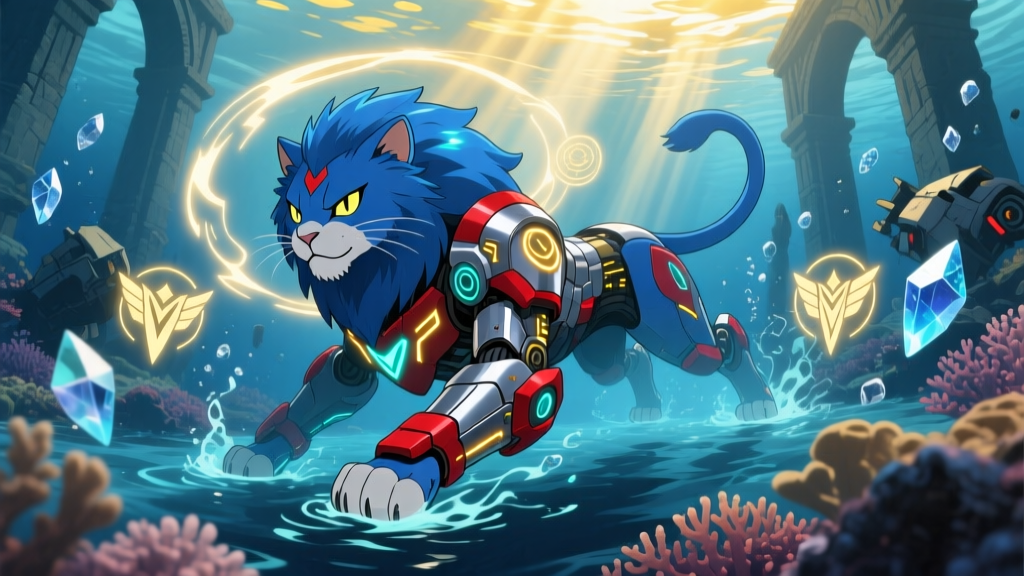
Picture this: a team of barely-trained space cadets is running for their lives from an interstellar empire that has conquered thousands of worlds. They stumble onto a desert planet, find a canyon hiding an ancient mechanical lion submerged beneath the surface, and somehow — against every conceivable odd — the lion chooses one of them. That is how audiences first meet the Blue Lion in Voltron: Legendary Defender, and it is the moment that sets the entire saga in motion.
Of the five mechanical beasts that make up the titular super-robot, the Voltron Blue Lion occupies a peculiar place. It was the first Lion discovered in the show's premiere, the first to accept a pilot, and arguably the most emotionally intelligent machine the series ever put on screen. Yet for years, online discourse has treated it as "just the water one" or "the leg." That shortchanges what Studio Mir and DreamWorks actually built into this character — because yes, the Blue Lion is a character, with personality, preferences, and a stubbornness that rivals any human cast member.
This piece traces the Blue Lion's full arc across Legendary Defender's eight seasons, from its oceanic hiding spot on Earth to its place in Voltron's right leg, its relationship with two very different pilots, its surprising combat toolkit, how it diverges from the 1981 Beast King GoLion original, and the collectibles landscape that keeps it relevant on fans' shelves today.
Lance McClain and the Lion That Picked Him
Before he ever climbed into a cockpit, Lance McClain was a cargo pilot at the Galaxy Garrison — not a fighter pilot, not a hotshot, just the guy delivering supplies while his classmates trained for combat. His file said "adequate." His instructors probably said "loud." Lance had the kind of swagger that masked genuine insecurity: he talked big, cracked jokes, and privately wondered whether he belonged in the same room as Keith Kogane.
When the team finds the Blue Lion half-buried in a desert canyon on Arus in Season 1, Episode 1 ("The Rise of Voltron"), the lion does something the other four do not. It reaches out. It sends a telepathic pulse — a vision of a lion drinking from a stream — directly into Lance's mind, guiding him to its location. The other Paladins had to earn their lions through trials of character or combat. Lance got a dinner invitation.
Princess Allura later explains that the Lions are sentient, each choosing a pilot whose temperament matches its own. The Blue Lion, she says, is "the most accepting of the Lions." That single line became the defining trait fans latched onto: the Blue Lion does not demand perfection. It demands openness. Lance was brash and often insecure, but he was also the most emotionally transparent person on the team. He felt things loudly. The Blue Lion responded to that honesty.
"The Blue Lion chose Lance first. Not because he was the best pilot or the strongest fighter, but because he was the most willing to be chosen. That is a very different kind of qualification." — Allura, paraphrased across Season 1 arc
Their partnership was not frictionless. Throughout Season 1, Lance struggled with the Blue Lion's responsiveness — it would sometimes hesitate, sometimes act on its own, and Lance interpreted that as rejection. The episode "The Legend Begins" (S1E11) reveals the lion's history: it was originally piloted by a Blue Paladin ten thousand years prior, and it had been waiting alone in that desert canyon for a new partner. Ten millennia of solitude is a long time to develop trust issues, even for a sentient war machine.
The bonding arc across Seasons 1 and 2 is quietly one of the best character relationships in the series. Lance learns that the Blue Lion is not a tool that obeys commands; it is a partner that requires mutual respect. By the end of Season 2, Lance can telepathically sense the lion's moods, and the lion responds to his instincts in combat faster than voice commands could ever allow.
Aquatic Specialist: What the Blue Lion Actually Does in Combat
Every Voltron Lion has an elemental association, and the Blue Lion's is water. In Defender of the Universe (1984), this translated to a "freeze ray" and not much else. Legendary Defender expanded the toolkit considerably, giving the Blue Lion a combat identity that extends far beyond shooting ice beams at Galra cruisers.
The Blue Lion's primary ranged weapon is a powerful mouth-mounted energy beam — a concentrated blue plasma stream that Lance aims by syncing his Bayard (the Paladins' shape-shifting personal weapon) with the lion's targeting systems. The Bayard itself, when used outside the cockpit, takes the form of a long-barreled rifle, a fitting complement to Lance's self-image as a sharpshooter.
But the Blue Lion's signature ability is its aquatic operational capacity. It can submerge, pressurize, and fight underwater in ways the other four Lions simply cannot. The episode "Taking Flight" (S2E4) demonstrates this when the Blue Lion pursues a Galra vessel into an ocean trench, navigating crushing depths and limited visibility while the rest of the team watches from the surface. The Red Lion can fly through an asteroid field at Mach 12. The Yellow Lion can dig through bedrock. But neither can follow the Blue Lion below a hundred fathoms.
Full Combat Loadout
Beyond the signature mouth beam and underwater mobility, the Blue Lion carries several additional systems:
- Tail-mounted laser cannon — a secondary ranged weapon that fires in a wide arc, useful for covering the Lion's blind spot during dogfights.
- Freeze beam — inherited from the original series, this cryogenic projector can immobilize targets or create temporary ice platforms in zero-gravity environments. It appears sporadically, mostly when the plot demands a creative solution to a movement problem.
- Sonic Cannon — referenced in supplementary material and merchandise descriptions as a "gigantic" weapon system, though it appears rarely on screen. Community speculation ties this to the Blue Lion's contribution when Voltron forms its weapon configurations.
- Enhanced agility — the Blue Lion is consistently portrayed as one of the faster and more maneuverable Lions in atmospheric flight, trading raw speed (Red's domain) for tighter turning radiuses and better low-altitude handling.
The Right Leg: Role in Voltron's Formation
When the five Lions combine to form Voltron, the Blue Lion locks into the right leg position — attaching to the Black Lion's right hip via magnetic clamps and energy couplings. This is identical to the configuration in the original Voltron: Defender of the Universe, which itself was inherited from Beast King GoLion (1981).
The right leg is not a glamorous position. The Black Lion forms the torso and head, the Red Lion becomes the right arm (which wields the iconic Blazing Sword), and the Yellow and Green Lions fill out the left leg and left arm respectively. The Blue Lion, forming the right leg, is structural — it provides stability, balance, and locomotion for the combined form. Without a functional right leg, Voltron cannot stand, cannot advance, and cannot deliver the finishing strikes that require full-body momentum.
In practical terms, this means that during formation sequences, the Blue Lion is often the anchoring point. When Voltron lands after a formation mid-flight, the right leg touches first. When the combined form charges forward for a sword strike, the right leg drives the pivot. It is a role that rewards consistency over flashiness — which, fittingly, mirrors Lance's own arc from "loud guy who wants attention" to "reliable teammate who holds the line."
The formation sequence itself is one of the show's most satisfying recurring visuals. The Blue Lion tucks its legs and rotates 90 degrees, slots into position with a satisfying magnetic clunk, and the combined form stabilizes. The entire sequence takes roughly eight seconds of screen time, and Legendary Defender never once made it feel routine across 78 episodes.
The Great Lion Switch: Allura Takes the Helm (Season 3)
Here is where things get interesting. At the start of Season 3, Shiro is missing, Keith takes over the Black Lion, Lance moves to the Red Lion, and Princess Allura — who had never piloted a Lion before — steps into the Blue Lion's cockpit. This was not a cosmetic swap. It fundamentally changed the Blue Lion's on-screen identity.
Allura's connection to the Blue Lion was rooted in her Altean heritage and her relationship with her father, King Alfor, who had originally commissioned the Lions' creation. The Blue Lion, being "the most accepting," was the natural entry point for a new pilot who had no prior combat flying experience. It chose her quickly, without the prolonged bonding period it had required with Lance.
Under Allura's piloting, the Blue Lion's combat style shifted. Allura was methodical, strategic, and unafraid of close-quarters engagement. Where Lance favored ranged attacks (consistent with his rifle Bayard), Allura pushed the Blue Lion into more aggressive positions, using its agility to close distance and its freeze beam to control battlefield positioning. The lion itself seemed to respond to her Altean energy — its eyes glowed brighter, its movements became more fluid, and its freeze beam output increased noticeably in later seasons.
Some fans viewed the switch as disrespectful to the Lance-and-Blue-Lion dynamic that the first two seasons had carefully built. Others saw it as a natural evolution: the Blue Lion's defining trait is acceptance, and Allura needed acceptance more than anyone else on the team at that point. She was grieving her father, losing her homeworld, and stepping into a war she had watched from the sidelines for ten thousand years. The Blue Lion took her in. That tracks.
Legendary Defender vs. GoLion: How the Blue Lion Changed Across 35 Years
The Blue Lion in Voltron: Legendary Defender is the great-great-grandchild of the Blue Lion from Beast King GoLion (1981, Toei Animation), which was repackaged as Voltron: Defender of the Universe (1984, World Events Productions). The core concept — blue mechanical lion, water element, forms part of a combining robot — has survived intact. Almost everything else has been overhauled.
| Attribute | GoLion / DotU (1981/1984) | Legendary Defender (2016) |
|---|---|---|
| Design Philosophy | Mechanical, angular, super-robot aesthetic. Resembles a stylized robot in lion shape. | Organic, animalistic. Looks like an actual big cat rendered in metal and energy. |
| Pilot | Tsuyoshi Seidou (GoLion) / Sven (DotU early) / Lance (DotU later) | Lance McClain (S1–S2), Allura (S3–S8) |
| Personality / Sentience | Minimal. Functions as a vehicle with limited AI responses. | Fully sentient. Communicates telepathically, displays emotions, makes autonomous decisions. |
| Water Abilities | Freeze ray. Basic underwater operation. | Expanded freeze beam, deep-ocean combat, hydrodynamic flight, ice platform creation. |
| Combination Position | Right leg (identical) | Right leg (identical) |
| Bayard / Personal Weapon | N/A (concept did not exist) | Lance's Bayard = long-barreled rifle; later upgraded to a powered cannon in Season 5. |
| Hiding Location | Castle of Lions (Altea/Arus) | Submerged in a desert canyon on Arus; later lore ties it to Earth's oceans |
| Lore Depth | Sparse. Backstory delivered through exposition dumps. | Extensive. Origin tied to King Alfor, Altean alchemy, and the original Paladins. |
The most consequential change is the sentience upgrade. In GoLion and the 1984 Defender of the Universe, the Lions are essentially elaborate vehicles — they have some autonomous functions (the Blue Lion famously "found" its pilot in a few episodes), but they do not communicate, emote, or make choices. Legendary Defender reimagined them as fully conscious entities with individual personalities. The Blue Lion became warm, curious, and occasionally stubborn. It nuzzled Lance like a housecat. It purred when its systems were stable. It growled at threats before weapons were even armed.
The visual redesign is equally dramatic. The GoLion Blue Lion looks like a toy — blocky, geometric, with flat color panels and sharp angles. The Legendary Defender version has musculature visible beneath its armor plating, a more feline face with expressive eyes, and articulation points that allow it to move with the fluidity of an actual predator. When it runs, you can see the mechanical tendons engaging. When it lands, the impact dampeners compress visibly. Studio Mir put serious thought into making a robot that moves like a living animal.
One detail that long-time fans appreciate: the lion-switching mechanic. In the original series, pilot changes were rare and usually driven by production necessity (Sven was injured, so Lance took over Blue). In Legendary Defender, the Season 3 switch was a deliberate narrative choice that honored the original's flexibility while adding emotional weight. The Lions allow new pilots. They are not reassigned; they consent.
What the Blue Lion Represents in the Team Dynamic
Each Voltron Lion carries symbolic weight that reflects its pilot's role in the team. The Black Lion is leadership. The Red Lion is courage (and, in Lance's case, rivalry-driven ambition). The Yellow Lion is selflessness. The Green Lion is patience and analytical thinking.
The Blue Lion's symbolic domain is harder to pin down, and that ambiguity is partly intentional. Fans have proposed "loyalty," "adaptability," "empathy," and "acceptance" as its core trait. The strongest case, based on textual evidence from the show, is acceptance — both giving and receiving. The Blue Lion accepted Lance when he felt unworthy. It accepted Allura when she was raw with grief. And it asked its pilots to accept themselves: Lance to accept that he did not need to be Keith to be valuable, Allura to accept that she could fight rather than only lead from behind.
In tactical terms, the Blue Lion often serves as the team's emotional anchor. When the Paladins argue — and they argue constantly in the early seasons — it is usually the Blue Lion's pilot who mediates. Lance, for all his bluster, was the team's social glue. He remembered birthdays. He checked on people. He defused tension with bad jokes that somehow worked. When Allura took over the Blue Lion, she brought a different kind of emotional steadiness: the quiet authority of someone who had watched civilizations fall and decided she would not let another one go.
This is why the Blue Lion's position in Voltron's formation makes thematic sense. The right leg is not flashy. It does not hold the sword or fire the chest cannons. It supports. It carries weight. It provides the foundation that lets the rest of the body do spectacular things. The Blue Lion has always been about holding things together — the team, the formation, and occasionally the entire universe.
Collectibles: Putting the Blue Lion on Your Shelf
If you want a physical Blue Lion, the market offers a surprisingly wide spread of options — from sub-$10 impulse buys to four-figure die-cast masterpieces. Here is what is out there.
Playmates Toys — Basic Blue Lion
The entry point. Released alongside Legendary Defender's premiere in 2016, this is a roughly 5-inch figure priced around $9.99. Build quality is surprisingly solid for the price point: reviews from The Geekiary noted it survived repeated drops without damage, the head bobs on a spring, the mouth opens, and the legs link together for a jump-stance gimmick. The elbows have basic articulation. It is not a display-grade figure, but it is a fun desk toy and an excellent starting point for younger fans.
Playmates Toys — Metal Defender Collection (Die-Cast)
The step up. This version incorporates substantial die-cast metal content, giving it a satisfying heft that the basic figure lacks. Released in 2017, it retailed around $19.99–$24.99 and is aimed at collectors who want something that feels premium without breaking the bank. The articulation is similar to the basic version, but the weight and surface finish make it a much better shelf piece. The Blue Lion in particular benefits from the metal treatment — the ocean-blue paint catches light differently on die-cast surfaces than on injection-molded plastic.
Playmates Toys — 18" Combining Edition
The big one. This set includes all five Lions at a scale that allows them to combine into an 18-inch Voltron figure. The Blue Lion in this set is significantly more detailed than the standalone versions, with improved articulation at the shoulders, hips, and jaw. Individual Lions retail around $30–$40, while the full set commands $150–$200. The combining mechanism is satisfying but requires some patience — the connection points are tight by design to ensure the combined form holds its pose.
Bandai — Soul of Chogokin GX-71 GoLion / Voltron
The grail. Bandai's Soul of Chogokin line is the gold standard for super-robot collectibles, and the GX-71 GoLion (rebranded as Voltron for Western markets) is one of the line's crown jewels. Priced around $400–$500 at retail and significantly more on the secondary market, this is a fully die-cast, highly articulated figure that includes all five Lions with individual weapons, swap-out face plates, and a display stand. The Blue Lion in this set is a work of art: every panel line is crisp, the paint application is flawless, and the die-cast weight makes it feel like you are holding an actual piece of military hardware. Forbes called it "the definitive toy of Voltron" in a 2017 review, and that assessment has not aged poorly.
Official Store and Specialty Items
The official Voltron store (store.voltron.com) carries an eclectic mix of Blue Lion merchandise beyond traditional action figures. As of recent catalog listings, this includes a Blue Lion collectible ring ($240), specialty glassware (Blue Lion themed, produced in collaboration with craft breweries), and enamel pin sets. The 40th anniversary of the franchise in 2024 also produced limited-edition gift sets that bundle the classic and Legendary Defender Blue Lions together.
For fans who want something handmade, the Etsy community has produced a steady stream of unofficial but high-quality Blue Lion items: 3D-printed display models, custom-painted figures, embroidered patches, and resin statuettes. Quality varies enormously, so buyer reviews are essential before committing.
The Underrated Legacy of a Mechanical Cat
Strip away the combining robot, the space battles, and the intergalactic politics, and the Blue Lion's story is fundamentally about trust. A machine that waited ten thousand years for someone to talk to. A pilot who was never sure he deserved the seat. A princess who needed something steady when everything else was falling apart. These are small, intimate character beats buried inside a giant robot anime, and they are the reason the Blue Lion has outlasted the franchises that tried to replace it.
Voltron: Legendary Defender ended in 2018 after eight seasons and 78 episodes. The Blue Lion appeared in nearly every one of them, sometimes as a background element, sometimes as a plot driver, and always as a reminder that the most important bond in any team is the one between a person and the thing they chose to believe in. Even if that thing is a ten-ton metal cat with a freeze ray and an attitude.
Frequently Asked Questions
Who pilots the Blue Lion in Voltron: Legendary Defender?
Lance McClain pilots the Blue Lion during Seasons 1 and 2. Starting in Season 3, Princess Allura takes over the Blue Lion while Lance moves to the Red Lion. This switch persists through the end of the series in Season 8.
What position does the Blue Lion occupy when forming Voltron?
The Blue Lion forms Voltron's right leg. It attaches to the Black Lion's right hip during the combining sequence. This position has remained consistent across every iteration of the franchise, from 1981's GoLion through Legendary Defender.
What are the Blue Lion's main weapons and abilities?
The Blue Lion's primary weapons are its mouth-mounted energy beam, a tail-mounted laser cannon, and a freeze/cryogenic beam. Its signature capability is underwater combat operation — it can fight at extreme ocean depths where no other Lion can follow. Lance's personal Bayard weapon takes the form of a long-barreled rifle when used outside the cockpit.
How is the Legendary Defender Blue Lion different from the original 1984 version?
The biggest differences are sentience and design. The original GoLion/Defender of the Universe Blue Lion was essentially a vehicle with minimal AI. The Legendary Defender version is fully sentient, communicates telepathically with its pilot, displays emotions, and makes autonomous decisions. Visually, the newer version has a more organic, animalistic design with visible musculature and feline movement patterns, compared to the original's blocky, geometric super-robot aesthetic.
Why is the Blue Lion called "the most accepting" of the Lions?
This characterization comes from Princess Allura in Season 1. Unlike the other Lions, which require their pilots to prove themselves through trials or combat, the Blue Lion chooses its pilot based on emotional openness and willingness to bond. It accepted Lance immediately upon their first meeting, sending him a telepathic vision that guided him to its location. It later accepted Allura just as quickly when she needed a Lion in Season 3.
What collectible figures of the Voltron Blue Lion are available?
The main options range from the Playmates Toys basic figure (~$10) to the Metal Defender die-cast version (~$20–$25), the 18-inch Combining Edition set (~$150–$200 for all five Lions), and the premium Bandai Soul of Chogokin GX-71 (~$400–$500). The official Voltron store also carries specialty items including a Blue Lion ring ($240), enamel pins, and glassware. Limited-edition 40th anniversary sets were released in 2024.
Was the Blue Lion the first Lion discovered in the series?
Yes. In the premiere episode "The Rise of Voltron" (Season 1, Episode 1), the team discovers the Blue Lion first, hidden in a desert canyon on the planet Arus. It reaches out telepathically to Lance, making it both the first Lion found and the first to actively choose its pilot. The remaining Lions are located over the course of the first few episodes.