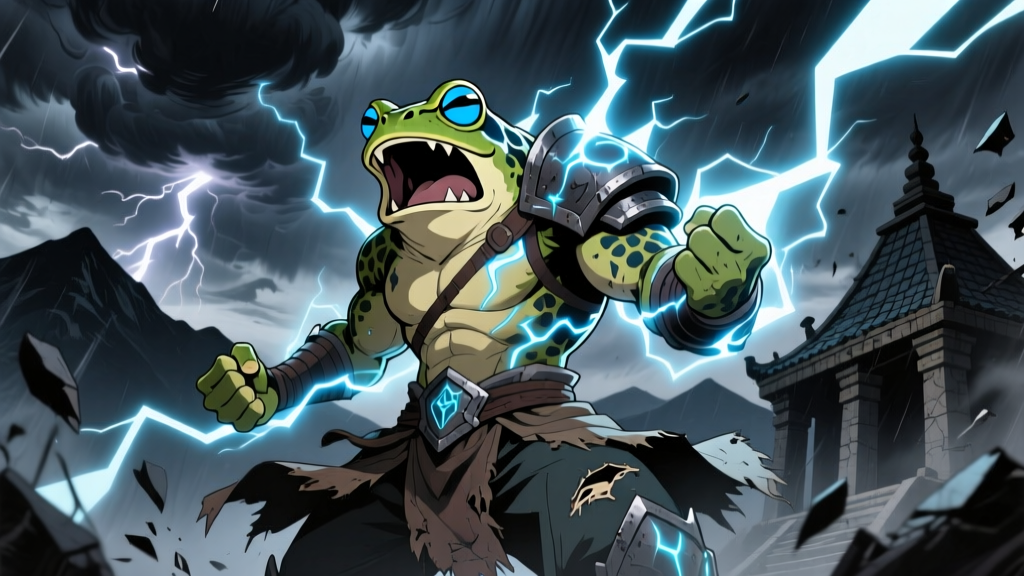
The first time I saw a frog holding a hammer crackling with divine energy, I thought it was a joke. A green, slimy amphibian standing barely six inches tall, swinging a weapon forged in Asgardian lightning. The image stuck with me for years. That absurd juxtaposition — the lowliest swamp creature wielding cosmic power — captures something oddly compelling about the thunder frog archetype that keeps surfacing across comics, anime, tabletop games, and collectible shelves.
What makes the thunder frog concept so persistent? Maybe it's the contrast itself. Frogs occupy a strange space in human imagination: they're small, often dismissed, sometimes comical. But put armor on one, give it a weapon or elemental power, and suddenly you have a character that defies expectations. The thunder frog isn't just a meme — it's a recurring motif that spans decades and media, showing up in places you'd never expect.
Throg: Marvel's Frog Worthy of Mjolnir
The story of Throg begins in a New York City park in 1985. Walter Simonson, then writing what many consider the definitive Mighty Thor run, decided to turn the God of Thunder into a frog. Not metaphorically. Literally. In Mighty Thor #364 (cover-dated February 1986), Thor Odinson finds himself transformed into an amphibian after a battle with the villainous Kurse. He lands in Central Park, confused and diminutive, where he encounters a colony of frogs under siege by sewer rats.
Here's where the narrative gets interesting. Thor, still in frog form, doesn't lose his worthiness. When he encounters a shard of Mjolnir, the hammer responds to him. The shard transforms into Frogjolnir, a tiny but fully functional version of the legendary weapon. Thor becomes Throg — still the God of Thunder, just significantly more compact and considerably greener.
"Whosoever holds this hammer, if he be worthy, shall possess the power of Thor." That enchantment didn't specify a species requirement. A frog could be worthy too. — Walter Simonson, Mighty Thor #364 (1986)
Throg's story didn't end as a one-off gag. The character resurfaced multiple times over the decades. In 2009, Marvel launched Pet Avengers, a series featuring animal versions of Marvel heroes. Throg became a core member, fighting alongside Lockheed the dragon, Redwing the falcon, and Thoreau the turtle. The Pet Avengers ran for multiple miniseries between 2009 and 2019, with Throg consistently appearing as the team's powerhouse.
The original Throg's true identity deserves clarification. Two characters have held the title. The first was simply Thor himself, cursed into frog form. The second, introduced later, was Simon Walterson — a human who had been transformed into a frog and eventually proved himself worthy of a Mjolnir fragment. Walterson's Throg appeared in Unworthy Thor storylines and maintained the character's relevance well into the 2010s.
Why Throg Works as a Character
Throg succeeds because Simonson played the concept completely straight. The artwork doesn't wink at the audience. Throg fights with genuine fury, swings Frogjolnir with conviction, and commands respect from other frogs who see him as a warrior. The comedy emerges from the situation's absurdity, not from the character being a punchline. When Throg leads his frog colony into battle against rats the size of wolves, the stakes feel real within the story's logic.
Collectors have noticed. Mighty Thor #364 remains a sought-after issue, with CGC-graded copies in 9.0+ condition selling between $80 and $150 on the collector's market as of 2024. Hasbro released a Marvel Legends Throg figure in 2021 as part of their Marvel Retro line — a 3.75-inch figure that sold out within weeks and now trades for $35-50 on secondary markets.
Frog Warriors in Anime: From Comedy Soldiers to Lightning Heroes
While Western comics gave us Throg, Japanese anime and manga took the frog warrior concept in a distinctly different direction. The most prominent example remains Keroro Gunso (known internationally as Sgt. Frog), a series that ran from 2004 to 2011 in anime form, with Mine Yoshizaki's manga continuing well beyond that.
Keroro and his platoon — Giroro, Tamama, Kururu, and Dororo — are alien frogs from the planet Keron who invade Earth. The invasion goes poorly. Keroro ends up enslaved by a human teenager. But the series never abandons the military frog premise. Giroro, the platoon's weapons specialist, embodies the serious amphibian soldier archetype. He carries an arsenal of alien weaponry, maintains a meticulous combat loadout, and approaches every situation with tactical precision. He's also, objectively, a frog in a helmet.
The Keronians represent something specific in anime culture: the frog as organized military force rather than chaotic swamp creature. Their rank structure, uniform design, and combat doctrine parody real military hierarchies while maintaining the absurdist humor that defines the genre. A new Keroro Gunso anime adaptation was announced for Fall 2026, indicating the franchise still resonates with Japanese audiences two decades after its debut.
Tsuyu Asui: The Frog Hero Done Right
My Hero Academia approached the frog warrior concept from a superhero angle. Tsuyu Asui, hero name Froppy, possesses a Quirk that grants her all frog-based abilities: enhanced jumping (she can leap approximately 200 meters horizontally), tongue extension up to 20 meters, wall-clinging, limited regeneration, and mild venom secretion. She's also consistently ranked among the series' most competent combat strategists.
What makes Froppy notable in the thunder frog conversation is her integration of frog abilities with genuine combat innovation. During the Kamino Ward incident and subsequent arcs, she combines her natural amphibian physiology with support gear that amplifies her mobility — essentially making her a lightning-fast striker who fights like a frog-themed superhero. The character's popularity in merchandise tells its own story: Good Smile Company's Nendoroid Froppy sold over 50,000 units in its initial production run.
Electric Amphibians: Frog Characters That Shock
The thunder frog concept finds its most literal expression in video games, particularly in the Pokemon franchise. The introduction of Bellibolt in Pokemon Scarlet and Violet (2022) gave us perhaps the purest "thunder frog" ever designed: an Electric-type frog Pokemon whose body literally generates electricity through expanding and contracting its elastic belly.
Bellibolt's design philosophy is remarkably specific. The Pokemon resembles a rotund frog with stubby limbs, bulbous eyes, and a distinctive belly that functions like a biological capacitor. When Bellibolt battles, its belly expands and contracts, generating electrical current. Its signature ability, Electromorphosis, converts damage taken into electric-type attack power — essentially turning pain into lightning.
The Electric Frog Lineage in Pokemon:- Politoed (Gen 2, 1999) — Water-type frog with leadership abilities; the original amphibian commander
- Electivire (Gen 4, 2006) — Not strictly a frog, but its amphibian design language and electric typing make it adjacent
- Seismitoad (Gen 5, 2010) — Water/Ground toad with vibration-based attacks; the brawler amphibian
- Bellibolt (Gen 9, 2022) — Pure Electric-type frog; the definitive thunder frog Pokemon
The pattern across these designs shows Game Freak gradually iterating toward the pure thunder frog concept. Politoed commanded rain. Seismitoad generated earthquakes. Bellibolt simply becomes lightning. Each generation moved closer to the direct electricity-frog synthesis that fans had been requesting for years.
Beyond Pokemon: Frogs With Voltage in Other Games
The thunder frog concept extends beyond Nintendo's flagship franchise. Dark Souls II features a memorable boss encounter with a giant frog creature in the Shrine of Amana — an amphibian monstrosity that attacks with leaping strikes and area-of-effect water attacks. While not electrically themed, the encounter established that frog-like enemies could serve as legitimate threats in hardcore action games.
Indie titles have embraced the concept more directly. The roguelike Amphibian Adventure (2023) features electric frogs as mid-boss enemies that chain lightning attacks between puddles. Mobile games like Frog Knight and various idle RPGs regularly include thunder frog variants as collectible characters, typically ranked as A-tier or higher units due to their electric damage type advantage against water and flying enemies.
Tabletop Frogs: Bullywugs, Kuo-Toa, and the Warrior Amphibian Tradition
The frog warrior archetype has deep roots in tabletop roleplaying games. Dungeons & Dragons introduced the Bullywug in the original Fiend Folio (1981) — frog-like humanoids that inhabit swamps and attack intruders with crude weapons and overwhelming numbers. Bullywugs established the template: amphibian physiology combined with primitive warfare tactics.
Then came the Kuo-Toa, introduced in the Shrine of the Kuo-Toa module (1978) and refined through multiple editions. These fish-frog humanoids worship gods of their own invention, can sense invisible creatures through electrical sensitivity in their skin, and produce electric shocks when threatened. The Kuo-Toa are, essentially, thunder frogs in Lovecraftian packaging — amphibian warriors with literal electric abilities and a genuinely alien psychology.
The tabletop miniature market has responded accordingly. Etsy alone hosts dozens of frog warrior miniatures, with individual 28mm Bullywug warriors selling for $8-15 each and full sets of four painted frog warriors commanding $40-60. Companies like Reaper Miniatures, WizKids, and independent sculptors on Kickstarter regularly produce frog warrior minis. The Kickstarter for Frogfolk: Swamp Warriors (2023) raised $47,000 from 1,200 backers — modest by Kickstarter standards, but indicative of a dedicated niche audience.
| Character | Franchise | Year Introduced | Electric Ability | Warrior Status |
|---|---|---|---|---|
| Throg (Simon Walterson) | Marvel Comics / Pet Avengers | 1986 | Lightning via Frogjolnir | Avenger-tier hero |
| Keroro Platoon | Keroro Gunso / Sgt. Frog | 2004 | Alien weaponry (not electric) | Military invasion force |
| Tsuyu Asui (Froppy) | My Hero Academia | 2014 | Enhanced mobility (not electric) | Pro Hero |
| Bellibolt | Pokemon Scarlet/Violet | 2022 | Belly-generated electricity | Competitive battler |
| Kuo-Toa | Dungeons & Dragons | 1978 | Electric skin shock | Religious warriors |
| Bullywugs | Dungeons & Dragons | 1981 | None (physical combat) | Swarm tactics raiders |
Collectibles and Merchandise: The Market for Frog Warriors
The collectible market for frog warrior characters reflects genuine demand rather than manufactured hype. Hasbro's Marvel Legends Throg figure mentioned earlier represents mainstream acknowledgment of the character's cult status. But the real activity happens in niche markets.
Gaming miniature collectors form one pillar. The painted Bullywug chieftain miniatures on eBay regularly sell for $25-40 per piece, with rare metal editions from the 1980s commanding $75+. These aren't casual purchases — they're acquisitions by dedicated tabletop players and painters who view frog warriors as staple enemies for swamp-based campaigns.
Anime merchandise forms another pillar. Keroro Gunso figures, while less common in Western markets, maintain steady production in Japan. Bandai's Keroro plush and model kits continue to appear in Akihabara shops, and vintage Sgt. Frog merchandise from the anime's 2004-2011 peak has become collectible. A complete set of five Keronian platoon figures in original packaging trades for approximately 15,000-20,000 yen ($100-135) among dedicated collectors.
Then there's the 3D printing revolution. Sites like Cults3D and Thingiverse host hundreds of frog warrior models, ranging from simple cartoon frogs with swords to elaborate armored amphibian knights. The most popular designs — like the "Frog Paladin" series by designer ToadInArmor — have been downloaded over 10,000 times each. Home printing has democratized access to frog warrior collectibles in ways that traditional manufacturing never could.
The Design Language of Thunder Frogs
Across all these iterations, certain design elements recur with remarkable consistency. The thunder frog character typically features:
- Compact, powerful build — even when humanoid, they're shorter and stockier than human characters
- Elemental energy markers — glowing patterns, sparks, or visible electricity coursing through their bodies
- Weapon integration — the frog doesn't just have natural abilities; it wields manufactured weapons (hammers, swords, staffs)
- Military or warrior insignia — armor, rank markings, or tribal war paint
- Color coding — predominantly green with yellow/gold electric accents, establishing visual shorthand for the thunder frog concept
This consistency across independent creators suggests the thunder frog archetype has achieved a kind of visual grammar that audiences recognize immediately. You see a green frog with lightning and a weapon, and you know exactly what you're getting.
The Amphibian Warrior Archetype: Why It Resonates
Stepping back from specific characters, the broader amphibian warrior archetype serves a particular function in fiction and game design. Frogs occupy an ecological niche that translates well to warrior characters: they're ambush predators, they thrive in environments humans find hostile (swamps, wetlands, underground), and their physical capabilities — explosive jumping, tongue strikes, camouflage — read as combat abilities when exaggerated.
The "thunder" modifier adds something specific. Lightning represents sudden, overwhelming force — exactly how frogs hunt. A frog sits motionless for minutes, then explodes into motion with a single strike. Lightning works the same way: accumulation of charge, then instantaneous discharge. The thunder frog character synthesizes these two forms of sudden violence into something coherent.
This resonance explains why the archetype persists across cultures. Japanese creators developed Keroro and Froppy independently of American creators developing Throg and D&D's Kuo-Toa. Yet all arrived at similar conclusions about what makes a frog warrior compelling. The archetype exists because it fills a specific narrative need: the underestimated fighter who combines alien biology with martial prowess.
The frog warrior occupies a unique space in character design — cute enough for merchandise, threatening enough for combat, and weird enough to remain memorable. That three-way tension is why we keep seeing them. — Character designer commentary, Game Developers Conference panel on creature design (2024)
Where the Thunder Frog Goes From Here
Several developments suggest the thunder frog archetype will remain relevant. The 2026 Keroro Gunso anime revival brings frog warriors back to mainstream anime audiences. Marvel's continued use of Throg in Pet Avengers crossovers maintains the character's visibility. Pokemon's commitment to amphibian designs — with each generation adding new frog and toad species — ensures regular thunder frog content.
The tabletop miniature market shows no signs of slowing either. With 3D printing becoming more accessible and Kickstarter enabling small-batch production, independent designers can create frog warrior armies that would have been impossible to manufacture a decade ago. The $47,000 raised by Frogfolk: Swamp Warriors suggests a viable economic model for niche amphibian content.
What fascinates me most is how the concept keeps mutating. Throg started as a joke that became genuine mythology. Keroro began as military parody and evolved into a cultural touchstone. Bellibolt took the "electric frog" idea that Pokemon had circled around for 20 years and finally committed to it fully. Each iteration adds something to the archetype, making the thunder frog concept richer and more defined with each appearance.
The next thunder frog might come from an indie game. It might emerge from a tabletop campaign. It might be a new Pokemon or a surprise Marvel crossover. But it will arrive, because the concept has proven too useful, too resonant, and too entertaining for creators to leave alone. Frogs with lightning aren't going anywhere.
Questions People Ask About Thunder Frogs
Is Throg an official Marvel character or just a joke?
Throg is absolutely an official Marvel character. He first appeared in Mighty Thor #364 (1986), written by legendary Thor writer Walter Simonson. The character has appeared in over 40 Marvel publications, starred in the Pet Avengers series, and received official merchandise including a Hasbro Marvel Legends figure. While the concept originated as humor, Marvel treats Throg as a legitimate character within their continuity.
What makes Bellibolt the definitive "thunder frog" Pokemon?
Bellibolt is a pure Electric-type frog Pokemon introduced in Generation 9 (2022). Unlike previous amphibian Pokemon that combined electric abilities with other types, Bellibolt's entire design centers on electricity generation through its expanding and contracting belly. Its signature ability Electromorphosis and access to moves like Thunder and Thunderbolt make it the most electrically-focused frog Pokemon to date. It's also competitively viable, appearing in tournament play regularly.
Are there thunder frog characters in tabletop RPGs beyond D&D?
Yes. Pathfinder features the Boggard — frog-like swamp dwellers with various combat abilities. The indie RPG Amphibian Warlords (2021) centers entirely on frog-folk factions battling for control of wetland territories. Additionally, many homebrew D&D campaigns create custom electric frog enemies inspired by the thunder frog archetype, and several popular supplements on DMs Guild include lightning-wielding frog creatures for encounter design.
Why do so many games feature frog enemies in swamp areas?
Frogs naturally inhabit wetlands, making them ecologically appropriate enemies for swamp biomes. From a game design perspective, frog enemies offer distinct movement patterns (jumping attacks), visual readability (green against muddy backgrounds), and scalable difficulty (small frogs as fodder, giant frogs as bosses). The amphibian warrior archetype also allows designers to add weapons and armor to creatures that would otherwise be simple wildlife, creating more tactical variety in encounters.
Where can I buy frog warrior miniatures for tabletop gaming?
Major sources include Etsy (hand-painted custom minis, $8-60 per set), Reaper Miniatures' official catalog, WizKids' Nolzur's Marvelous Miniatures line, and Kickstarter campaigns like Frogfolk: Swamp Warriors. For 3D printing, Cults3D and MyMiniFactory offer digital frog warrior models ranging from $3-15 per STL file. Games Workshop's Warhammer line has also included various amphibian creatures in their ranges over the years.