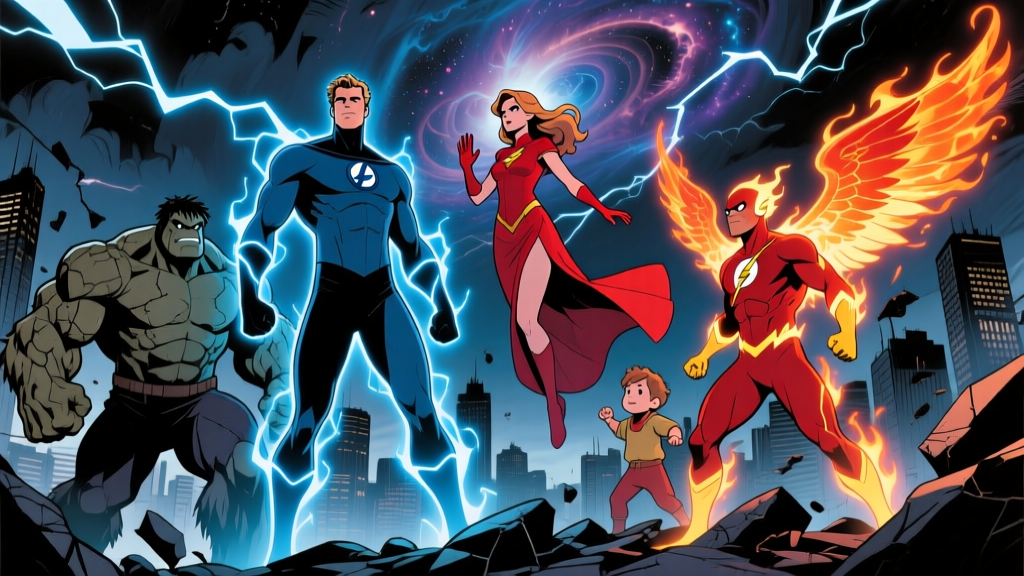
Sometime in late 1961, Stan Lee sat at his desk and decided he was going to quit comics. His wife Joan told him something that changed the industry: if you're leaving anyway, write the kind of story you actually want to tell. The result was Fantastic Four #1 — a comic where the heroes argued, didn't wear costumes, and treated saving the world like a dysfunctional family road trip. It sold through the roof. Marvel Comics, then a second-tier outfit operating out of a single Manhattan office, suddenly had a hit that would reshape superhero storytelling for the next six decades.
The fantastic 4 team wasn't supposed to work. Four people crammed into a rocket, bombarded by cosmic rays, and transformed into monsters — one of them literally made of rock. No secret identities that mattered. No brooding loner act. Just a scientist, his girlfriend, her hotheaded brother, and their best friend, all stuck under one roof in the Baxter Building, yelling at each other between apocalypses. That formula — superpowers married to genuine interpersonal friction — became the DNA of the entire Marvel Universe.
A Rocket, Some Cosmic Rays, and a Bad Decision
The origin story is deceptively simple. Reed Richards, a brilliant but reckless scientist, wants to beat the Communists into space. He rounds up his fiancée Sue Storm, her younger brother Johnny, and his college roommate Ben Grimm for an unsanctioned launch. The ship's shielding can't handle the cosmic radiation belt. They crash-land back on Earth, and each person's body has been fundamentally rewritten at the cellular level.
What makes this origin different from Spider-Man's radioactive spider or the Hulk's gamma bomb is the group dimension. Nobody chose this. Ben Grimm certainly didn't ask to become a walking boulder. The accident binds them together not just as a team but as people sharing a trauma they can never individually process. Reed carries the guilt. Sue carries the emotional labor of holding everyone together. Johnny treats it like the greatest thing that ever happened to him. And Ben — well, Ben just wants to be human again, and that desire has powered some of the best storytelling Marvel has ever produced.
"It's clobberin' time!" — Ben Grimm's catchphrase, first appearing in Fantastic Four #22 (1964), has been ranked among the top 10 most iconic lines in comic book history by Comic Book Resources and Wizard Magazine.
Jack Kirby's art on those early issues gave the book a raw, almost uncomfortable energy. His Fantastic Four didn't pose — they lurched, grappled, and filled every panel with physical urgency. Combined with Lee's dialogue-heavy scripting (the "Marvel Method" meant Kirby essentially plotted the story visually, and Lee filled in words after), the comic read like nothing else on the newsstand. By issue #3, they had costumes. By issue #5, they had Doctor Doom. The foundation was set.
The Four Pillars: Who These People Actually Are
Reed Richards — Mister Fantastic
Reed is arguably the smartest human being in the Marvel Universe, which makes him fascinating and infuriating in equal measure. His body stretches — he can elongate, flatten, reshape himself into parachutes, trampolines, containment vessels. But his real superpower and his real flaw is his compulsion to solve everything intellectually. He created the Negative Zone portal. He built the Bridge, a device that peers into alternate realities. He once tried to "fix" the multiverse itself during the 2015 Secret Wars event, and he kind of pulled it off.
The catch is that Reed routinely makes catastrophic decisions without consulting anyone. The Illuminati storyline — where Reed, Black Bolt, Doctor Strange, Iron Man, Black Panther, and Namor secretly decide the fate of the multiverse — put Reed in moral territory that most heroes wouldn't touch. He destroyed alternate Earths to save his own. He didn't tell Sue. When she found out, it nearly ended the marriage. That's the kind of character writing that elevates the fantastic 4 team above standard superhero fare: the stakes are cosmic, but the wounds are deeply personal.
Sue Storm — The Invisible Woman
Sue Storm spent the first decade of the comic being written as a damsel. She could turn invisible and project force fields, but early writers used her primarily as someone for villains to kidnap. That changed dramatically when John Byrne took over writing and art duties in 1981. Byrne's Sue discovered that her force fields could be used offensively — she could create bubbles inside a villain's body, collapse air in someone's lungs, generate concussive blasts powerful enough to stagger the Hulk.
By the late '80s and into the '90s, Sue had become arguably the most powerful member of the team in raw combat terms. She held the team together during Reed's absences, raised two children (Franklin and Valeria Richards) while managing a superhero career, and served as the emotional anchor that kept the group from fracturing. In Jonathan Hickman's 2009–2012 run, Sue is the one who tells Reed, plainly and devastatingly, that his secret-keeping has broken her trust. That scene in Fantastic Four #605 is a masterclass in using superhuman characters to tell recognizably human stories.
Johnny Storm — The Human Torch
Johnny is the youngest, the loudest, and the one who treats the whole superhero thing as the best gig on Earth. He flies, wreaths himself in flame, and can go supernova — reaching temperatures around 1,000,000°F at his absolute peak, hot enough to melt through virtually any known material. He's also impulsive, vain, and prone to starting fires (literally and metaphorically) that the rest of the team has to put out.
What makes Johnny compelling beyond the flashy powers is his growth arc. He started as a teenager who saw the accident as a gift. Over decades, he's dealt with the death of multiple romantic partners, the weight of being Reed's brother-in-law (a relationship that has ranged from playful to deeply strained), and periods where he was the only active member of the team. During the period when Reed and Sue were separated, Johnny essentially stepped up as Ben Grimm's primary partner, and their dynamic — the hothead and the rock, constant banter masking genuine love — became the emotional center of the book.
Ben Grimm — The Thing
Ben Grimm is the heart of the Fantastic Four, and possibly the most tragic character in Marvel's stable. A former test pilot and football player, Ben was transformed into a rock-covered powerhouse with enough strength to trade punches with the Hulk — he's been measured at Class 85+ strength levels, meaning he can lift well over 85 tons. He also lost everything that made him feel human: his appearance, his comfort in his own skin, the ability to walk through a door without people screaming.
Ben's storyline has consistently been the best writing in the book. In the 1980s, he discovered he could revert to human form, but only by concentrating — and the psychological implication was devastating. His subconscious preferred the Thing form because it matched how he saw himself. That single revelation, explored in Fantastic Four #245 (1982), turned a monster comic into a meditation on body dysmorphia and self-worth. Ben's romantic relationship with blind sculptor Alicia Masters — who fell in love with him as the Thing and had no basis for comparison to his human form — remains one of the most emotionally honest love stories in superhero comics.
Power Profiles at a Glance
| Member | Alias | Primary Powers | Notable Feat | Key Weakness |
|---|---|---|---|---|
| Reed Richards | Mister Fantastic | Elasticity, shape-shifting body | Rebuilt the multiverse post-Secret Wars (2015) | Emotional detachment, moral overreach |
| Sue Storm | Invisible Woman | Invisibility, psionic force fields | Solo defeat of Galactus-level threats using internal force fields | Emotional burden, trust erosion |
| Johnny Storm | Human Torch | Pyrokinesis, flight, nova burst | Nova Flame at ~1,000,000°F; space combat without life support | Impulsivity, oxygen-dependent flame |
| Ben Grimm | The Thing | Rock-like skin, Class 85+ strength | Fought Champion of the Universe to a standstill; survived direct Celestial impact | Psychological self-image, limited agility |
Storylines That Redefined What a Superhero Comic Could Be
Six decades of publication means an enormous amount of story, but a handful of arcs stand apart — the ones that changed how readers and creators thought about the fantastic 4 team.
The Galactus Trilogy (Issues #48–50, 1966)
Stan Lee and Jack Kirby introduced Galactus — a planet-eating cosmic entity — and his herald, the Silver Surfer. Before this arc, superhero villains were bank robbers and mad scientists. Galactus was something else entirely: a force of nature with no malice, just hunger. The story elevated the Fantastic Four from street-level adventurers to cosmic guardians and introduced a mythology that Marvel still draws on. According to Marvel's internal sales records from the era, issue #48 moved over 340,000 copies, an extraordinary number for the time.
"This Man, This Monster" (Issue #51, 1966)
Often cited as the single greatest issue of any Marvel comic. A stranger steals Ben Grimm's powers and his identity. Ben, human for the first time in years, has to decide whether he wants them back. The answer, when it comes, isn't about strength or heroism — it's about loyalty. Reed Richards walks into the Negative Zone to save the imposter, knowing the odds of return are negligible, and Ben follows because that's who he is. Fifteen pages. No cosmic stakes. Just a man deciding what he owes the people he loves. Lee later said it was the story he was most proud of.
John Byrne's Complete Run (Issues #232–293, 1981–1986)
Byrne took over a book that was hemorrhaging readers and rebuilt it from the ground up. He gave Sue Storm her offensive force-field abilities. He explored the Franklin Richards problem — a child born to Reed and Sue with reality-warping potential so vast it scared the Avengers. He introduced Alpha Flight crossover dynamics, sent the team into the Negative Zone multiple times, and wrote a Doctor Doom story ("The Price of Doom," issue #247) that is still considered the definitive take on Marvel's greatest villain. Sales climbed from roughly 180,000 copies per issue when Byrne started to over 260,000 by the middle of his run, according to distribution data compiled by The Comics Journal.
Jonathan Hickman's Sci-Fi Epic (Issues #570–611, 2009–2012)
Hickman treated the Fantastic Four as a vehicle for hard science fiction. Reed builds a council of alternate-reality versions of himself. The team encounters the Council of Reeds, beings from parallel universes who all share Reed's intellect but none of his moral restraint. Franklin Richards is revealed to be a universal-level mutant. The story culminates in the team's confrontation with the Nu-World and feeds directly into Hickman's Avengers run and the 2015 Secret Wars. It's dense, demanding reading — and it proved that a Fantastic Four book could be intellectually ambitious without losing sight of the family at its center.
How the Team Actually Functions
The thing that separates the Fantastic Four from the Avengers or the X-Men is that it was never meant to be a team in the institutional sense. There's no charter, no rotating membership, no government oversight. It's a family that happens to have superpowers. Their internal structure breaks down along clear lines:
- Reed leads by intellectual authority — he designs the missions, builds the tech, and formulates strategy. But his track record on communication is abysmal.
- Sue routinely overrules Reed on moral and tactical grounds. She's the de facto second-in-command who actually commands when it counts.
- Johnny is the wildcard who breaks tension with humor and occasionally saves everyone's life by accident.
- Ben is the conscience — the one who says what everyone is thinking but nobody wants to hear. He also serves as the team's primary physical defender.
Their headquarters has historically been the Baxter Building in Manhattan — a 35-story structure that's been destroyed and rebuilt at least four times in publication history. The building itself is almost a fifth character: it houses Reed's labs, the team's living quarters, Franklin and Valeria's rooms, and the hangar for the Fantasticar. When writer Dan Slott took over in 2018, he introduced a new Baxter Building with a public-facing "Fantastic Four Museum" on the ground floor, acknowledging that in-universe, these are celebrities. New Yorkers wave at Johnny when he flies overhead. Kids leave drawings for Ben at the front door.
The family dynamic creates storytelling possibilities that team books can't replicate. When Reed and Sue's marriage hit rough patches, it affected every issue. When Johnny married — briefly — it was a team event. When Ben finally found stability with Alicia Masters, the entire book shifted in tone. Even the kids matter: Franklin Richards, with his reality-altering abilities, and Valeria, who is intellectually Reed's equal at age seven, aren't sidekicks. They're integral to the narrative.
Roster Changes and the Years Without the Four
For a team called the "Fantastic Four," the lineup has been surprisingly fluid over the decades. While Reed, Sue, Johnny, and Ben are the core, there have been significant periods where one or more original members were absent.
- 1986: Ben Grimm temporarily left the team. She-Hulk (Jennifer Walters) replaced him, bringing a radically different energy — confident, flirtatious, and unbothered by the cosmic weirdness around her.
- 1989–1990: Crystal of the Inhumans served as a recurring member during a period when Sue was recovering from complications related to Franklin's birth.
- 2002: During Mark Waid and Mike Wieringo's run, Ben temporarily lost his powers and was replaced by Storm of the X-Men, creating a fascinating cross-franchise dynamic.
- 2013–2014: In Matt Fraction's run, Reed and Sue were absent for an extended arc, with Scott Lang (Ant-Man) and Medusa of the Inhumans filling in alongside Johnny and Ben.
- 2015–2018: The entire book went on hiatus after Secret Wars. The Fantastic Four were, in-universe, believed dead — exploring the multiverse. During this period, Marvel published no Fantastic Four comic for roughly two and a half years, the longest gap in the title's history.
- 2022–present: Dan Slott's run concluded and was followed by Ryan North's series, which restored the core four while introducing Doom as a reluctant ally rather than antagonist — a shift that divided fandom.
| Substitute | Replaced | Era | Issues |
|---|---|---|---|
| She-Hulk | Ben Grimm | 1986 | #265–275 |
| Crystal | Sue Storm | 1989–1990 | #326–334 |
| Storm (X-Men) | Ben Grimm | 2002 | Vol. 3 #60–66 |
| Ant-Man (Scott Lang) | Reed Richards | 2013–2014 | Vol. 4 #6–16 |
| Medusa | Sue Storm | 2013–2014 | Vol. 4 #6–16 |
Doctor Doom: The Fifth Member Who Refuses to Join
You can't discuss the fantastic 4 team without discussing Victor Von Doom. He appeared in issue #5, and from that moment he became inseparable from the team's identity. Doom is not a typical villain. He's the head of state of Latveria, a genius who rivals Reed intellectually, and a man whose hatred for Richards is matched only by his genuine belief that he alone can save humanity. He's been right about that more than once.
During the 2015 Secret Wars, Doom absorbed the power of the Beyonders and held together what remained of the multiverse as Battleworld. He saved everything. Reed eventually restored the multiverse using Franklin's reality-altering power combined with Molecule Man's energy, but the event fundamentally changed Doom's relationship with the team. In the 2018 relaunch, Doom actively tries to become a hero — he even asks Reed for help repairing his scarred face, a request Reed grants. It's a quiet, extraordinary moment: two men who have spent fifty years trying to destroy each other, sitting in a lab, and one of them saying, "Help me."
Doom's arc in Ryan North's 2022 series took this further. Doom joined the team's orbit as an ally — uneasy, resentful, but present. For fans who grew up reading Doom as the ultimate antagonist, seeing him eat breakfast in the Baxter Building alongside Franklin and Valeria was genuinely disorienting. It also proved that the Fantastic Four's greatest strength has always been its willingness to let relationships evolve, even the ones that seem carved in stone.
The MCU Adaptation: First Steps and What Comes Next
The Fantastic Four's history in live-action film is, to put it charitably, complicated. The unreleased 1994 Roger Corman production was shelved before theatrical release. The 2005 Tim Story film earned $333 million worldwide against a $100 million budget — profitable, but critically panned and largely dismissed by fans. The 2015 Josh Trank reboot was a notorious production disaster, grossing just $167 million against a $120 million budget and earning a 9% rating on Rotten Tomatoes.
Marvel Studios' The Fantastic Four: First Steps, directed by Matt Shakman and set for release in July 2025, represents the franchise's fourth attempt at getting these characters right — and the first under the MCU banner. The cast features Pedro Pascal as Reed Richards, Vanessa Kirby as Sue Storm, Joseph Quinn as Johnny Storm, and Ebon Moss-Bachrach as Ben Grimm. Julia Garner plays Shalla-Bal, a version of the Silver Surfer, and Ralph Ineson has been cast as Galactus.
The retro-futuristic aesthetic shown in trailers — a world that looks like the 1960s imagined the future — signals that Marvel is leaning into the optimistic, exploratory spirit of the Lee/Kirby originals rather than the grimdark tone of the 2015 attempt. Shakman, who directed every episode of WandaVision, has a track record of blending genre homage with emotional sincerity. Early footage suggests a Baxter Building that feels lived-in, a team that bickers like family, and a Galactus that reads more as cosmic inevitability than mustache-twirling villain.
"The Fantastic Four is a story about a family that happens to have superpowers, not a team of superheroes that happens to know each other." — Kevin Feige, Marvel Studios president, during a 2024 press event.
The stakes for this adaptation are enormous. The Fantastic Four are woven into the fabric of Marvel's comic universe — they introduced Black Panther, the Inhumans, the Silver Surfer, Galactus, and the concept of the multiverse itself. If First Steps works, it opens the door to cosmic-level storytelling that the MCU has been building toward since Endgame. If it stumbles, Marvel risks burning out one of its most foundational properties for a third consecutive time.
Why This Team Still Matters After All These Years
There's a reason the Fantastic Four have survived sixty-plus years of publication, multiple reboots, and more creative team changes than any sensible franchise should endure. The core concept is bulletproof: four people who love each other, who are bound together by an accident none of them chose, navigating a universe that keeps throwing impossible situations at them. They don't have a code of conduct. They don't recruit. They don't vote on membership. They just show up for each other, messily and imperfectly, because that's what families do.
The fantastic 4 team works because it's specific in a medium that often rewards generic. Reed's stretching is a metaphor for a mind that can't stop reaching. Sue's invisibility reflects how often she's been overlooked despite being the most powerful person in the room. Johnny's fire is youth and recklessness burning without restraint. And Ben's stone exterior is every person who's ever felt trapped in a body or identity that doesn't match who they are inside. These aren't just powers. They're portraits.
As the MCU prepares to introduce its version of the team, the comics continue to evolve. The characters have been written by hundreds of creators across thousands of issues, and the best of those stories share a common thread: they treat the Fantastic Four not as a superhero team that needs saving the world to justify its existence, but as a family whose relationships are the story. The cosmic rays, the Negative Zone, Doctor Doom — all of that is window dressing. The real adventure is watching four people try, and sometimes fail, and then try again, to be good to each other.
Common Questions About the Fantastic 4 Team
Who founded the Fantastic Four?
Reed Richards assembled the team for an unauthorized space mission in 1961's Fantastic Four #1, created by Stan Lee and Jack Kirby. Reed recruited his fiancée Sue Storm, her brother Johnny, and his college roommate Ben Grimm. The mission was intended to reach space before the Soviet Union, but cosmic radiation transformed all four passengers.
Who is the most powerful member of the team?
In terms of raw destructive capability, Sue Storm's force fields are arguably the most potent weapon the team possesses — she can create concussive blasts, internal disruptions, and shields that have withstood attacks from Galactus-level threats. However, Franklin Richards, Reed and Sue's son, is a reality-warper whose power level exceeds anything the core four can produce. Among the original members, Ben Grimm's physical strength (Class 85+) and Johnny Storm's nova flame (approximately 1,000,000°F) make them the heavy hitters in direct combat.
Has anyone permanently replaced an original member?
No substitute has permanently displaced an original member. Every replacement — She-Hulk, Crystal, Storm, Ant-Man, Medusa — has been temporary, tied to specific story arcs or absences. The core four always reunite. The longest stretch without the full lineup was the 2015–2018 publishing hiatus, when the entire title went dormant after Secret Wars.
How many Fantastic Four movies have been made?
Three completed films exist: the unreleased 1994 Roger Corman production (never theatrically distributed), the 2005 Fantastic Four and its 2007 sequel Rise of the Silver Surfer directed by Tim Story, and the 2015 reboot directed by Josh Trank. Marvel Studios' The Fantastic Four: First Steps (2025) is the first MCU entry. In total, that's four released or near-released adaptations across thirty years.
What is Doctor Doom's relationship to the team?
Victor Von Doom was Reed Richards' college classmate before becoming the monarch of Latveria and the team's primary antagonist. His rivalry with Reed is personal as much as intellectual — Doom blames Reed for the accident that scarred his face. In recent years, particularly during Dan Slott's and Ryan North's comic runs, Doom has shifted toward uneasy ally status, even briefly operating alongside the team. He remains one of Marvel's most complex characters: a villain whose ego is matched only by his genuine capacity for heroism.
Where should a new reader start with Fantastic Four comics?
For classic storytelling, the Galactus Trilogy (issues #48–50) and "This Man, This Monster" (#51) are essential. For modern readers, Jonathan Hickman's run starting at issue #570 offers a self-contained entry point with contemporary pacing and art. Mark Waid and Mike Wieringo's run (Vol. 3 #1–19, 2002–2003) strikes an excellent balance between classic optimism and modern sensibility. Dan Slott's 2018 relaunch is also accessible and designed for readers jumping in fresh.