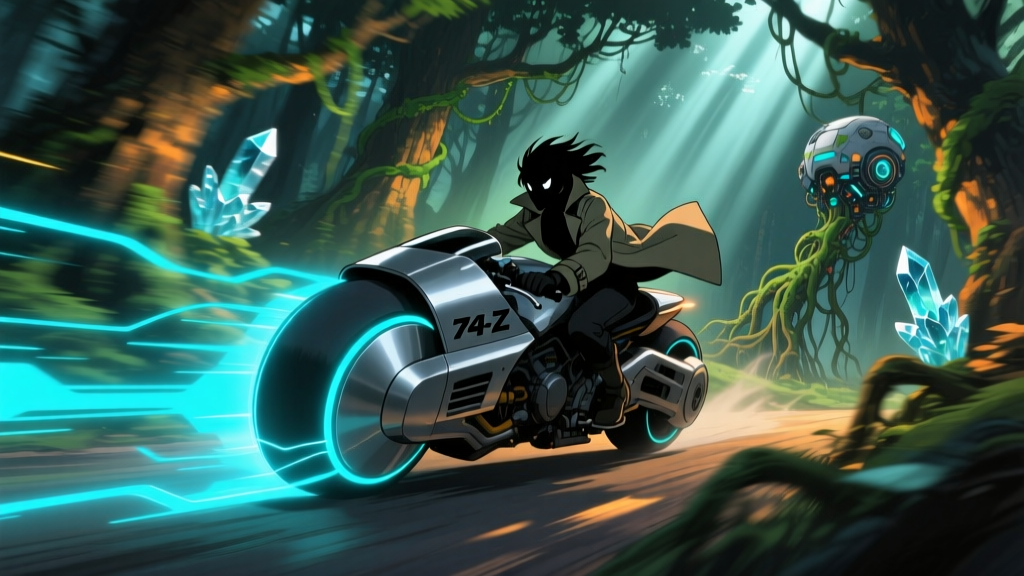
Picture this. You're twelve years old, sitting cross-legged on a carpet that definitely hasn't been vacuumed this week, and the TV is playing Return of the Jedi for what might be the fortieth time. The Ewoks are doing their thing, the Emperor is being menacing, and then — Luke and Leia steal a pair of speeder bikes and tear through a redwood forest with scout troopers chasing them. John Williams' score kicks into that frantic brass theme. Trees blur. Blaster bolts streak green past the camera. A scout trooper wraps his bike around a trunk and goes down in a shower of sparks.
That sequence runs about five minutes on screen. It took months of painstaking work by Industrial Light & Magic, a Steadicam operator walking through actual redwood groves at roughly one frame per second, and a set of custom-built fiberglass props that weighed barely more than a bicycle. The 74-Z speeder bike didn't just give Return of the Jedi its most electrifying action beat. It gave science fiction cinema one of its most enduring vehicle designs — a machine so visually clean that it became a staple across video games, collectibles, and cosplay for the next four decades.
The Machine Behind the Chase
In Star Wars canon, the 74-Z speeder bike rolls off the production line of Aratech Repulsor Corporation, a manufacturer with a long history of building repulsorlift vehicles for military clients. The bike measures 3.3 meters in length — roughly the span of a compact car — and achieves a maximum atmospheric speed of 500 km/h (about 310 mph). A single pilot operates the craft, gripping a control yoke that manages both altitude via repulsorlift output and forward thrust through lateral thruster arrays.
The armament is straightforward: a forward-mounted light blaster cannon fixed to the nose, with limited articulation. There's no heavy turret, no proton torpedo launcher, no deflector shield generator worth mentioning. The 74-Z was built for speed and agility, not sustained combat. In the original West End Games roleplaying sourcebook Star Wars: The Roleplaying Game (1987), the bike's stats listed it with a repulsorlift operation skill requirement and a price tag of approximately 5,750 credits new — cheap enough that the Empire could deploy them in squadrons without blinking.
What makes the 74-Z interesting from a design standpoint is how little there is to it. A narrow central chassis connects twin repulsorlift pods to the pilot seat. The blaster cannon sits between two forward sensor vanes. There's no cockpit enclosure, no windscreen, nothing between the rider and the air rushing past at half the speed of sound. That exposed riding position was a deliberate choice by the film's production designers — it made the speeder bike look dangerous, improvised, almost motocross-like. The pilot leans into turns, absorbs G-forces with their body, and relies on reflexes rather than armor plating.
“The speeder bike had to read instantly on screen. No explanation needed. You see the shape, you understand what it does: it goes fast and the person riding it is exposed. That visual shorthand is what made the Endor chase work.”
— Joe Johnston, concept artist and visual effects art director, interviewed in The Making of Return of the Jedi (1983)
The bike also carries a rear-mounted steering vane for lateral control and a small maneuvering thruster array that allows the pilot to make sharp directional changes at speed. In the lore, the Empire deployed 74-Z bikes on the forest moon of Endor specifically because the dense tree cover made larger vehicles impractical. Scout troopers — also called biker scouts — used the bikes to patrol the perimeter around the shield generator protecting the second Death Star. When Leia, Luke, and Han's strike team needed to prevent those scouts from alerting the garrison, they commandeered the bikes. That decision gave cinema one of the greatest pursuit sequences ever committed to film.
Faking 500 km/h With a Walking Camera
Here's where the story gets genuinely clever. When ILM set out to create the speeder bike chase for Return of the Jedi (released May 25, 1983), they faced a basic physics problem: nothing was actually moving fast. No vehicle on set traveled anywhere near the speed the audience needed to believe. The solution was to make the forest move instead.
A Steadicam operator was sent to the redwood groves of Northern California — specifically areas around the Jedediah Smith Redwoods State Park and other old-growth forest locations used for Endor exteriors. The camera was undercranked, meaning it recorded at a frame rate significantly below the standard 24 frames per second. The operator literally walked through the trees at a steady pace. When that footage was played back at normal projection speed, every subtle camera movement was compressed and amplified. A gentle pan became a violent blur. Tree trunks whipped past the lens. The forest floor streaked into motion-blur lines that sold the illusion of extreme velocity.
This technique sounds simple in theory, but the execution required extraordinary precision. The Steadicam rig itself weighed roughly 20 kilograms with the camera body and lens, and the operator had to maintain absolutely consistent movement while navigating uneven forest terrain — roots, ferns, fallen logs. A single stumble would ruin the plate. Multiple takes were shot to ensure the background footage matched the angles and lighting needed for the compositing work back at ILM.
Blue Screen, Rocking Props, and a Lot of Patience
For close-up shots of Luke (Mark Hamill) and Leia (Carrie Fisher) riding, the production relied on blue screen compositing. The actors sat on a stationary speeder bike prop at ILM's facility, while the forest plate footage was projected behind them. Crew members physically rocked and tilted the prop to simulate the bumps and swerves of high-speed travel through dense woodland. The actors sold the illusion with their body language — leaning forward, reacting to invisible obstacles, gripping the controls with white knuckles.
The speeder bike props themselves were constructed from a combination of fiberglass shells, aluminum framing, and salvaged motorcycle parts. They needed to look convincing at close range while remaining light enough for crew members to manipulate between takes. Multiple props were built — at least three hero bikes for close-up work and several lighter stunt versions for wider shots where the bikes crash or are destroyed.
The final chase sequence layered three distinct production techniques into one seamless five-minute set piece:
- Background plates: Steadicam footage captured at undercranked frame rates (well below 24 fps) in Northern California redwood groves, creating extreme motion blur when played back at normal speed.
- Blue screen compositing: Actors mounted stationary props at ILM while crew members physically rocked the bikes, matted over the forest plates for close-up riding shots.
- Practical pyrotechnics: Breakaway prop bikes rigged with miniature explosive charges, filmed at high frame rates for slow-motion crash sequences and composited into the forest environment.
The crash shots — like the famous moment where Luke uses his lightsaber to sever a scout trooper's steering vane, sending the bike spiraling into a tree trunk — were achieved through a combination of practical pyrotechnics on set and ILM's optical compositing. Miniature explosive charges were placed on breakaway prop bikes, filmed at high frame rates to slow down the debris, and then composited into the forest plates. The resulting shots feel visceral in a way that purely digital destruction rarely achieves, even forty years later.
• • •From Prop Sketch to Cultural Icon
The 74-Z speeder bike's visual design traces back to the concept art department at Lucasfilm. Joe Johnston, who served as visual effects art director on the original trilogy, produced early sketches that drew from racing motorcycles, military scout vehicles, and the kind of stripped-down functionality you'd find in a dirt bike stripped to its frame. The bike's elongated silhouette, with its twin engine pods flanking a narrow pilot position, hit a sweet spot between familiar and alien — it read as a motorcycle, but one built for a world without roads.
Ralph McQuarrie, the legendary conceptual artist behind much of Star Wars' visual identity, also contributed to the broader vehicle design language of the Endor sequences. The weathered, utilitarian aesthetic — scratched gray plating, exposed wiring, Imperial-standard olive drab color scheme — fit seamlessly into the "used future" philosophy that defined the original trilogy. Nothing in the Star Wars universe looks brand new. Everything has scratches, dents, and blast marks. The 74-Z was no exception, and that lived-in quality made it feel real in a way that polished, chrome-plated sci-fi vehicles never did.
One detail that often goes overlooked: the sound design. The distinctive whine of the 74-Z's repulsorlift engine was created by Ben Burtt, the sound designer responsible for virtually every iconic audio element in the original trilogy. Burtt layered recordings of high-performance motorcycle engines with processed electrical hums and filtered them through pitch-shifting to create something that sounded fast even at idle. When the bikes accelerate during the chase, the engine sound climbs through a frequency range that triggers the same adrenaline response as a real engine revving. It's psychoacoustic engineering disguised as a movie sound effect.
The 74-Z on the Digital Battlefield
The speeder bike's transition from film prop to playable vehicle began in earnest with the Star Wars: Battlefront series. Pandemic Studios' original Battlefront (2004) included Endor as a playable map and let players commandeer 74-Z bikes as the Imperial faction. The handling was intentionally twitchy — the bikes were fast but fragile, and collisions with terrain or other players frequently ended in spectacular explosions. That fragility was by design: the bike was a glass cannon that rewarded skilled piloting and punished careless steering.
DICE's Star Wars Battlefront (2015) reboot brought the 74-Z into the Frostbite engine era, and the Endor map became one of the most anticipated environments in the game. Players could hop on speeder bikes and weave through procedurally placed tree trunks, firing the light blaster cannon at Rebel targets. The handling model drew polarized reactions. At full throttle, the bike approached 500 km/h in-game, but steering sensitivity at that speed made precise navigation through the forest a white-knuckle experience. Some players loved the challenge. Others considered the bikes more useful as mobile cover — a wall of metal you could hide behind while on foot.
Battlefront II (2017) expanded the vehicle roster and refined the speeder bike's handling curve, though community sentiment remained split. Speeder bikes occupied an awkward middle ground: too fast for casual play, too fragile for competitive modes, but endlessly fun for anyone who just wanted to recreate the Endor chase with friends online.
Beyond the Battlefront franchise, the 74-Z has appeared in Star Wars: Squadrons as a brief cameo, in Jedi: Fallen Order (2019) and Jedi: Survivor (2023) as environmental props in Imperial outposts, and in numerous LEGO Star Wars titles where the bike's handling is comically forgiving by comparison. The LEGO Star Wars: The Skywalker Saga (2022) version of the Endor chase lets players relive the sequence with the series' trademark humor intact, right down to Ewoks accidentally triggering speeder bike crashes.
Collecting the Chase: Hasbro, LEGO, and Hot Wheels
For collectors, the 74-Z speeder bike occupies a peculiar space: it's one of the few Star Wars vehicles that translates cleanly across every product category, from six-inch action figure accessories to diecast metal replicas. Each manufacturer has taken a different approach to capturing the bike's essence, and the results range from impressive to genuinely jaw-dropping.
Hasbro Black Series: The Centerpiece Vehicle
Hasbro's Black Series Speeder Bike with Biker Scout was originally released around 2015 as part of the 6-inch scale vehicle line. This was no small accessory — the bike measured over 14 inches in length and came packaged in the Empire-styled black and blue window box that defined the Black Series' premium branding. The included Scout Trooper figure featured the updated biker scout helmet sculpt with the distinctive angular visor, and the bike itself included a functioning (non-firing) blaster cannon mount and detailed engine pod sculpting with painted weathering.
In 2020, Hasbro released an updated Amazon-exclusive version: the Black Series Speeder Bike, Scout Trooper & The Child. This set paired the iconic vehicle with Grogu from The Mandalorian, bridging the classic trilogy with the Disney+ era. The bike sculpt received minor tooling updates, and the set became a popular gift item during the holiday season, with secondary market prices climbing to $80–$120 within a year of release.
LEGO: Building the Chase Brick by Brick
LEGO has tackled the speeder bike in multiple sets across different eras, but the definitive release arrived in 2023: LEGO 75353 Endor Speeder Chase Diorama. This 608-piece set retailed at $79.99 and included three minifigures — Princess Leia, Luke Skywalker (in his Endor poncho/ camouflage outfit), and a Scout Trooper. The diorama recreates the forest pursuit with two speeder bikes and a detailed Endor forest backdrop featuring printed tree trunk elements and fern pieces.
LEGO designers publicly noted that the speeder bike shape had always been one of the trickiest Star Wars vehicles to translate into brick form. The bike's narrow profile and elongated engine pods fight against the fundamental geometry of LEGO bricks. The 75353 design used a combination of Technic pins and System bricks to achieve a more accurate silhouette than any previous LEGO speeder bike, including the earlier 75036 Utapau Troopers set and various battle pack releases. The result was a display piece first, playset second — which is exactly what the adult collector market wanted.
Hot Wheels: Star Wars at 1/64 Scale
When Mattel's Hot Wheels brand acquired the Star Wars license around 2015, they launched the Starship Select diecast line, which included a 1/64 scale Speeder Bike. The model featured a diecast metal body with plastic detail parts, and it came with a display stand — technically a "flight stand," even though the speeder bike is a ground vehicle. Multiple variants followed, including a biker scout-piloted version and a weathered "battle damage" edition.
The Hot Wheels speeder bike proved popular as a desk ornament and display piece. At roughly $7–$10 retail, it was the most affordable way to put a screen-accurate 74-Z on your shelf, and collectors often bought multiples to recreate chase formations on their display cases.
Comparing the Major Collectibles
| Product | Manufacturer | Scale | Approx. Price | Release Year | Standout Feature |
|---|---|---|---|---|---|
| Black Series Speeder Bike + Biker Scout | Hasbro | 1:12 (6-inch scale) | $59.99 | 2015 | Detailed weathering paint, large display footprint |
| Black Series Speeder Bike + Scout Trooper & The Child | Hasbro | 1:12 (6-inch scale) | $54.99 | 2020 | Crossover with The Mandalorian, updated tooling |
| 75353 Endor Speeder Chase Diorama | LEGO | Minifigure scale | $79.99 | 2023 | 608-piece diorama, 3 minifigures, forest backdrop |
| Starship Select Speeder Bike | Hot Wheels | 1:64 | $7–$10 | 2015 | Diecast metal, affordable display piece |
| 74-Z Speeder Bike Expansion (Legion) | Asmodee / FFG | Legion tabletop | $24.99 | 2018 | Miniatures wargaming, unpainted, high detail sculpt |
| Prices reflect original MSRP at launch. Secondary market values may differ significantly, particularly for discontinued releases. | |||||
If you're starting a collection from scratch, the Hot Wheels diecast at $10 is the obvious entry point — low commitment, high shelf appeal. The Black Series bike remains the most visually impressive single-vehicle release, especially if you can find it below aftermarket pricing. And the LEGO 75353 diorama hits the sweet spot for builders who want a display piece that captures the scene, not just the vehicle.
The Cosplay and Fan-Build Community
Beyond commercial products, the 74-Z speeder bike has become a cause celebre in the fan-build community. Life-size replicas appear regularly at Star Wars Celebration, Dragon Con, and the 501st Legion's charity events. Builders have documented their processes on platforms like Instructables and dedicated forums, sharing CAD files for 3D-printed components, wiring diagrams for LED-lit engine pods, and finishing techniques for achieving the screen-accurate weathered Imperial gray.
One of the most documented builds is the Negative Eleven Speeder Bike Project, which chronicled a full-scale replica using a combination of fiberglass layup, 3D-printed detail parts, and repurposed motorcycle handlebars for the control yoke. The build took approximately 18 months of weekend work and cost roughly $2,500 in materials — a fraction of what a professional prop house would charge, but still a serious investment of time and money. The finished bike was detailed enough to fool casual observers into thinking it was a screen-used prop. Typical full-scale builds like this one share a common parts list:
- Fiberglass or PETG shells for the main body and engine pod fairings
- Aluminum or steel tube framing for structural integrity
- Repurposed motorcycle handlebars and control grips for the yoke assembly
- LED strips wired into the engine pods for the signature repulsorlift glow
- Weathering washes and dry-brushing to replicate the screen-accurate Imperial gray finish
There's something specific about the speeder bike that draws builders in. Unlike an X-wing or the Millennium Falcon — which require enormous workshop space and engineering ambition — a speeder bike is roughly human-scale. You can build it in a garage. You can sit on it. You can photograph yourself in full scout trooper armor straddling the seat, and the result looks like a behind-the-scenes photo from 1982. That accessibility is rare in Star Wars prop replication, and it's a major reason the 74-Z remains one of the most commonly built vehicles in the cosplay community.
Your Speeder Bike Questions, Answered
What are the exact specifications of the 74-Z speeder bike?
The 74-Z is manufactured by Aratech Repulsor Corporation. It measures 3.3 meters in length, achieves a maximum speed of 500 km/h in atmosphere, seats one pilot, and mounts a forward-facing light blaster cannon. In the West End Games RPG sourcebook (1987), the retail price is listed at 5,750 credits new.
Where was the speeder bike chase actually filmed?
Background plate photography took place in the old-growth redwood forests of Northern California, including areas near Jedediah Smith Redwoods State Park. Blue screen compositing with the actors was completed at ILM's facilities. The entire chase sequence runs approximately five minutes of screen time in Return of the Jedi (1983).
How did the filmmakers create the illusion of such high speed?
The primary technique involved undercranking: filming a Steadicam walking through the forest at a frame rate well below the standard 24 fps. When played back at normal speed, the compressed footage produced intense motion blur and a heightened sense of velocity. Actors on blue screen stages were composited over these plates with physical rocking of the stationary prop to enhance the effect.
Which video games let you ride the 74-Z speeder bike?
The most notable appearances are in the Star Wars Battlefront series — Pandemic's original (2004), DICE's reboot (2015), and Battlefront II (2017). The bikes also appear as drivable vehicles in LEGO Star Wars titles and as environmental props in Jedi: Fallen Order (2019) and Jedi: Survivor (2023).
What is the best LEGO set featuring the speeder bike?
LEGO 75353 Endor Speeder Chase Diorama (2023) is the most comprehensive release: 608 pieces, 3 minifigures (Leia, Luke, Scout Trooper), two speeder bikes, and a detailed forest backdrop. It retailed at $79.99 and is considered a display-focused set aimed at adult collectors.
How much does the Hasbro Black Series speeder bike cost today?
The original 2015 release (Speeder Bike + Biker Scout) carried an MSRP of $59.99, but discontinued status has pushed secondary market prices to $80–$150 depending on condition and packaging. The 2020 Amazon-exclusive set (with The Child) retailed at $54.99 and trades in a similar aftermarket range.
• • •Forty-plus years after Return of the Jedi hit theaters, the 74-Z speeder bike still holds a particular grip on the imagination. It's not the biggest vehicle in Star Wars. It's not the most heavily armed or the most technologically impressive. It's a naked frame with an engine and a gun, and somehow that simplicity made it unforgettable.
The Endor chase remains one of the finest action sequences in the franchise because it was built on physical craft — real cameras moving through real forests, real actors reacting to real forces, real pyrotechnics shattering real props. The 74-Z speeder bike is at the center of that craft, a prop so well-designed that it transcended its origins as a fiberglass shell on a forest set and became a cultural object in its own right: studied in design schools, replicated in garages, collected on shelves, and ridden through digital forests by millions of gamers.
If you've ever held a Black Series speeder bike in your hands, or clicked together the LEGO version, or watched the Endor chase with the volume up and felt your pulse match the repulsorlift whine — you know exactly what this machine is. It's not a prop. It's not a toy. It's a piece of cinema that earned its place in the culture, one undercranked frame at a time.