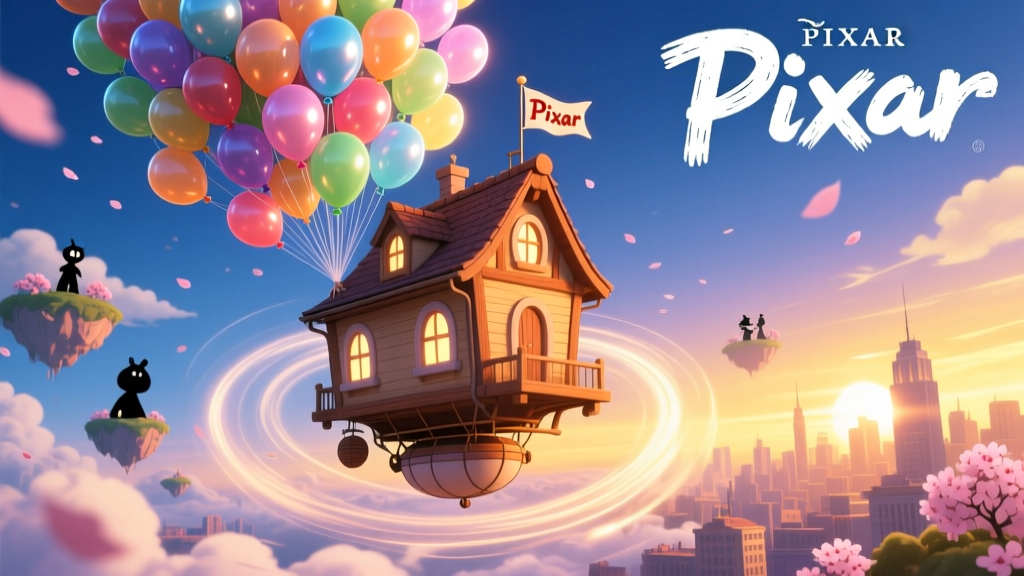
Somewhere between the opening montage that makes every adult in the theater quietly sob and the part where a Golden Retriever starts talking through a collar translation device, there is a single image burned into the brains of roughly 735 million people worldwide: a small wooden house, paint peeling, chimney slightly crooked, yanked off its foundation by a riotous bouquet of colorful balloons. That image — the Up house balloons moment — is arguably the most iconic visual in Pixar’s entire catalog. And it almost didn’t happen the way you remember it.
This isn’t just a story about an old man and a flying bungalow. It’s about the engineering obsession inside Pixar’s render farm, the real-world physicists who proved the concept half-right, the collectors who will pay $400 for a resin replica, and the strange cultural gravity that turned a cartoon house into a universal symbol for adventure, grief, and the stubborn refusal to let go.
The Render Farm Nightmare That Became a Breakthrough
When director Pete Docter first pitched the concept of a house lifted by balloons to his team at Pixar Animation Studios in Emeryville, California, the reaction was somewhere between excitement and quiet panic. The problem wasn’t artistic — everyone agreed the image would be stunning. The problem was computational. Each individual balloon needed its own geometry, its own shader, its own physics simulation for wind, buoyancy, and string tension. And they couldn’t just animate a handful. To make the cluster look dense enough to plausibly hoist a two-story house, they needed thousands.
The final count, confirmed in Pixar’s own production notes and later cited in a Wired magazine breakdown (2011), was 10,927 individually rendered balloons in the hero lift-off sequence. That number wasn’t arbitrary. Pixar’s technical directors ran early tests with 500 balloons and found the cluster looked sparse and unconvincing. At 2,000 balloons, the silhouette read better but the interior of the cluster felt hollow during camera fly-throughs. By the time they reached roughly 10,000, the density matched what the art department had painted in their concept art — a thick, bursting bouquet where you couldn’t see through the middle.
Rendering that many deformable objects with ray-traced shadows and global illumination pushed Pixar’s render farm to its limits. Each frame of the lift-off sequence took an average of 22 hours to render on the studio’s cluster, which at the time ran approximately 5,000 processor cores. For context, a typical dialogue scene in Up rendered in roughly 4 to 6 hours per frame. The balloon cluster was five times more expensive, computationally, than anything else in the film.
“We had a technical director whose entire job, for almost eight months, was balloons. Just balloons. She wrote custom simulation code, tweaked buoyancy models, and argued with animators about how much sway was realistic versus how much looked good on screen.”
— Pete Docter, interview with The Los Angeles Times, May 2009
The team developed a proprietary simulation system that treated each balloon as a soft-body object with variable helium fill. Balloons at the top of the cluster, which would catch more wind, had slightly different motion parameters than those buried in the middle. Strings were simulated as constrained particle chains — not rigid lines — so they’d flex and tangle naturally. The result was a cluster that behaved like a real mass of helium balloons: shifting, jostling, occasionally catching on each other in ways that felt organic rather than choreographed.
The Balloon Color System
Pixar didn’t just render thousands of balloons — they built a color distribution algorithm. The art department specified a palette of roughly 20 balloon colors, weighted so that warm reds, oranges, and yellows dominated the outer edges of the cluster (catching sunlight), while cooler blues and purples appeared deeper inside (where light scattered through layers of latex). This wasn’t pure physics simulation; it was art direction disguised as physics. The human eye reads the cluster as “real” partly because the color gradient mimics how light actually penetrates a dense mass of translucent objects, but mostly because it looks beautiful in every single frame.
Could It Actually Work? The Physics Question Nobody Could Ignore
Almost immediately after Up premiered on May 29, 2009 — opening the Cannes Film Festival earlier that month as the first animated film ever to do so — the question hit physics departments and internet forums alike: how many real balloons would it take to lift a real house?
The film gives us some clues. Carl Fredricksen’s house is a modest two-story structure, roughly 1,500 square feet, based on a real Victorian bungalow style common in San Francisco’s Sunset District. Estimating the weight requires assumptions about construction materials, but most structural engineers put a wood-frame house of that size at approximately 80,000 to 120,000 pounds (36,000 to 54,000 kg) depending on foundation type, roofing, and interior furnishings.
A standard 11-inch latex party balloon filled with helium generates roughly 0.03 pounds (14 grams) of lift. Simple arithmetic gets you to a staggering number:
| House Weight | Lift per Balloon (11" latex) | Balloons Required | Helium Cost Estimate (2024) |
|---|---|---|---|
| 80,000 lbs (light frame) | 0.03 lbs | ~2,667,000 | ~$11–14 million |
| 100,000 lbs (average) | 0.03 lbs | ~3,333,000 | ~$14–17 million |
| 120,000 lbs (heavy) | 0.03 lbs | ~4,000,000 | ~$17–21 million |
| Sources: Lift calculations based on helium buoyancy at sea level (1.02 g/L). Helium pricing from BLM Federal Helium Reserve data, 2024. House weight estimates per NAHB (National Association of Home Builders) construction standards. | |||
So Pixar used 10,927 balloons on screen, but in reality Carl would have needed somewhere between 2.6 and 4 million standard party balloons to get his bungalow off the ground — and helium costs alone would have bankrupted him before he ever reached Paradise Falls. The film sidesteps this problem entirely, and honestly, that’s the right call. Nobody walks into an animated film for the physics.
National Geographic Actually Flew a House (Sort Of)
In March 2011, National Geographic’s “How Hard Can It Be?” series attempted what might be the most ambitious stunt in the network’s history: build a lightweight house and fly it with helium balloons. The project brought together a team of scientists, structural engineers, and two world-class balloon artists — the kind of people who sculpt 40-foot dragons for Macy’s Thanksgiving Day Parade.
The structure they built wasn’t Carl Fredricksen’s Victorian bungalow. It was a purpose-built frame measuring 16 feet wide, 16 feet tall, and 14 feet deep, constructed from ultra-lightweight materials including balsa wood, thin plywood, and fabric walls. Total weight came in at roughly 3,000 pounds — about 1/30th of a real house. Even at that weight, the team needed 300 large weather balloons, each measuring approximately 4 to 8 feet in diameter when inflated. These weren’t party balloons. Weather balloons are made of thick neoprene or latex and can hold significantly more helium, generating several pounds of lift each.
The flight itself lasted roughly one hour over the California desert before the structure was brought down in a controlled landing. The house reached an altitude of approximately 10,000 feet. It was, at the time, the largest balloon-cluster flight ever recorded with a manned structure attached. Two trained balloonists rode inside the house during the flight, monitoring altitude and managing ballast.
The National Geographic team documented one problem that Pixar’s animators had anticipated two years earlier: balloon cluster dynamics. In the film, Pixar’s simulation showed that a large cluster of balloons doesn’t just float straight up — it spreads, twists, and creates unpredictable lateral forces. The real-life team experienced exactly this. Crosswinds at 3,000 feet pushed the cluster sideways, and several balloons burst due to pressure changes as altitude increased. By the time the house reached 8,000 feet, roughly 15% of the original balloons had failed.
The Balloon Burst Problem
Here’s something the film never shows: latex balloons expand as they rise. At sea level, atmospheric pressure is roughly 14.7 psi. At 10,000 feet, it drops to about 10.1 psi. A balloon that measures 11 inches in diameter at ground level will expand to approximately 14 to 15 inches at that altitude — and most party balloons burst somewhere between 14 and 16 inches of stretch. This means Carl’s balloon cluster, as depicted in the film, would have progressively exploded as it gained altitude, shedding balloons faster than it gained lift. The real solution would involve using high-altitude balloons made of thicker material with a higher burst threshold, or dramatically over-inflating at ground level and accepting ground-level losses. Neither option looks as good on screen as what Pixar delivered.
The Collectibles Market: Owning a Piece of the Flight
If the Up house balloons image carries emotional weight — and given the film’s $735 million box office haul and two Academy Awards, it clearly does — then the merchandise market around it is surprisingly deep. Here’s what the collector ecosystem looks like as of mid-2026:
LEGO Disney & Pixar ‘Up’ House (Set 43217) remains the anchor product. Released as part of the Disney 100 Years of Wonder celebration, this 598-piece set retails at $59.99 and includes a partial balloon cluster built from translucent colored studs — red, orange, yellow, blue, and green. It’s not a perfect recreation (598 pieces can’t replicate 10,927 balloons), but the silhouette is instantly recognizable. Secondary market prices for sealed sets have held steady around $65–$75, which suggests moderate collector interest without speculative inflation.
Resin and die-cast replicas occupy the premium tier. Companies like Gentle Giant Studios and various Etsy artisans produce hand-painted resin models of the house with wire-and-silk balloon clusters. Prices range from $80 to over $400 depending on size and detail. The most sought-after versions include LED lighting inside the house windows and individually wired balloons that can be posed at different angles.
Disney Parks exclusive pins have become their own sub-market. A Europe-promo exclusive pin featuring the balloon house, originally distributed at Disney Store events in 2019–2020, trades between $45 and $90 on pin-trading communities. Limited-edition lithographs from the film’s original 2009 release, signed by Pete Docter, have sold at auction for $600 to $1,200.
- LEGO 43217 — 598 pieces, $59.99 MSRP, widely available
- Funko Pop! Carl with Balloon House — ~$12–$15, high production run
- Hand-crafted resin replicas (Etsy) — $80–$400+, variable quality
- Disney Parks LED table lamp — $40–$60, periodically restocked
- Signed lithographs (2009) — $600–$1,200 at auction
- Exclusive trading pins — $45–$90 on secondary market
Why This Specific Image Won’t Leave Us Alone
Animation history is full of iconic images — Mickey’s ears, Totoro on a bus-cat, the Iron Giant’s hand reaching from a lake. But the Up house balloons image has achieved something unusual: it functions as a standalone symbol, completely detached from the film’s plot. People who have never seen Up recognize the house. Toddlers who can’t name Carl Fredricksen will point at the image and say “balloon house.”
Part of this is pure visual design. The silhouette — a small rectangular form buried beneath an enormous, colorful cloud — reads clearly at any size. It works as a 16-pixel favicon and it works as a 40-foot parade float. The color contrast (warm browns and whites of the house against saturated balloon colors) creates a focal point that the eye locks onto immediately. And the shape language is inherently joyful: circles on top of a rectangle is the most basic “happy” composition in visual design, the same geometry behind a smiley face.
But the deeper reason is emotional. The house in Up isn’t just a vehicle. It’s Carl’s marriage, his grief, his entire life compressed into four walls and a picket fence. When the balloons lift it, the audience reads the image as liberation — not just a house flying, but a person finally letting go of the weight that pins him down. That emotional subtext is what makes the image stick. It shows up on mural walls in Brooklyn, tattooed on forearms in Tokyo, printed on wedding invitations in Seoul. It has become shorthand for “the adventure you’ve been putting off.”
Pixar’s marketing team understood this early. The film’s poster — the one with just the house floating against a clean blue sky, no characters visible — tested higher with focus groups than any poster featuring Carl or Russell. People didn’t need the characters to feel the story. The house and the balloons told them everything.
The Real House That Inspired It
For fans who want to visit the closest thing to Carl’s house on Earth, there’s a well-documented parallel: a small house at 10277 Gertrude Street in La Mesa, California, that closely resembles the animated version. Built in the 1930s, this single-story bungalow with its distinctive front porch and peaked roof became an internet sensation after Up’s release when fans noticed the architectural similarity. The owner, Edith Macefield (whose story of refusing to sell her home to developers actually inspired Carl’s character arc), passed away in 2008 — just before the film premiered. The house has since been renovated and is no longer recognizable, but its legacy lives on in fan photography and the confirmed statements from Pixar’s production team that Macefield’s story directly influenced the screenplay.
The Technical Legacy: What Pixar Learned From 10,927 Balloons
The balloon simulation work on Up didn’t disappear after the film shipped. Pixar’s proprietary simulation tools evolved into more generalized soft-body dynamics systems that appeared in subsequent productions. The cloth simulation in Coco (2017), the hair physics in Brave (2012), and the complex particle systems in Elemental (2023) all trace technical lineage back to the balloon cluster R&D.
More specifically, the team developed a technique called “cluster instancing” — a method of rendering thousands of similar but non-identical objects by creating a base geometry and applying per-instance randomization to scale, color, and deformation parameters. This approach let them render 10,927 balloons without building 10,927 unique models. That same instancing technique later appeared in open-source renderers like Blender’s Geometry Nodes system, where it’s now a standard tool for any artist who needs to populate a scene with varied objects — trees in a forest, rocks on a beach, or yes, balloons in a cluster.
The balloon R&D from Up didn’t stay locked inside one film. Here’s where Pixar’s soft-body simulation work resurfaced in later productions:
- Brave (2012) — Merida’s hair required 1,500+ individually simulated curls using soft-body dynamics derived from the balloon string-tension code
- Coco (2017) — Alebrije spirit creatures featured deformable wing membranes; cloth simulation on 200+ character garments used per-instance instancing
- Soul (2020) — The abstract “You Seminar” environments required thousands of instanced geometric shapes with individualized shaders
- Elemental (2023) — Fire and water particle systems with cluster-level physics directly descended from the balloon buoyancy models
The film’s production budget was approximately $175 million, and it grossed $735.1 million worldwide (Box Office Mojo, 2024 adjusted figures). It won the Academy Award for Best Animated Feature and Best Original Score (Michael Giacchino). It was the first animated film to open the Cannes Film Festival. And the single most expensive sequence to produce was the four-minute lift-off scene where 10,927 balloons tear a house from its foundation and carry it into the clouds.
Worth every rendered frame.
Questions People Actually Ask About the Up House Balloons
How many balloons did Pixar actually render in Up?
Pixar rendered 10,927 individually simulated balloons for the house lift-off sequences. This number was confirmed in production notes and later cited by multiple technical publications. Each balloon had its own physics parameters including buoyancy, wind response, and string dynamics.
How many real balloons would it take to lift a house?
Using standard 11-inch latex party balloons filled with helium, you’d need between 2.6 million and 4 million balloons to lift a typical 1,500-square-foot wood-frame house (80,000–120,000 lbs). Each party balloon provides about 0.03 pounds of lift. The helium alone would cost $11–$21 million at 2024 prices.
Did National Geographic really fly a house with balloons?
Yes. In March 2011, National Geographic built a lightweight 16×16×14-foot structure weighing approximately 3,000 pounds and lifted it with 300 large weather balloons over the California desert. The house reached 10,000 feet altitude and flew for about one hour with two balloonists aboard.
What is the most expensive Up house collectible?
Signed limited-edition lithographs from the 2009 theatrical release, autographed by director Pete Docter, have sold for $600 to $1,200 at auction. Hand-crafted resin replicas with LED lighting and individually wired balloons can reach $400+ on artisan marketplaces like Etsy.
Is the Up house based on a real building?
The house design draws from Victorian bungalow styles common in San Francisco. Additionally, the story of Edith Macefield of La Mesa, California — an elderly woman who refused to sell her home to commercial developers — directly inspired Carl Fredricksen’s character arc, according to confirmed statements from Pixar’s production team.
What LEGO set recreates the Up house?
LEGO set 43217 (“Disney and Pixar ‘Up’ House”) is a 598-piece set released for the Disney 100 Years of Wonder celebration. It retails at $59.99 and includes a partial balloon cluster made from translucent colored LEGO studs.