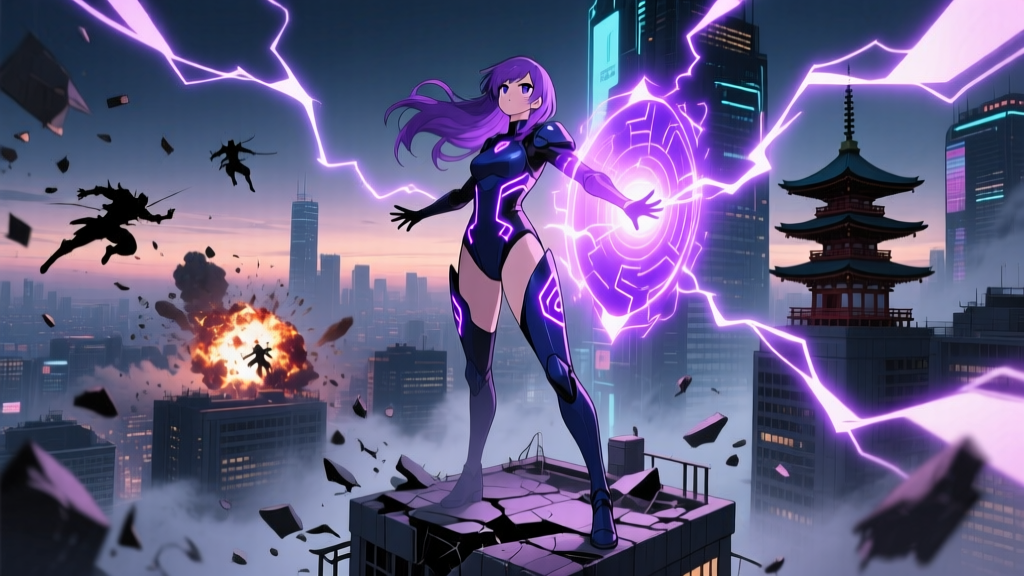
There's a moment in The Incredibles (2004) that lives rent-free in the heads of anyone who watched it as a kid. Violet Parr, hunched and trembling inside a burning building, throws her hands outward and a shimmering dome of purple energy erupts around her and her baby brother. The fire can't reach them. Debris bounces off the dome like pebbles off a windshield. And for the first time in the entire film, Vi looks powerful. Not confident. Not brave. Powerful. That single image — a teenager wrapped in a violet force field, eyes squeezed shut, holding the world at bay — did more to sell the concept of purple energy barriers than any comic book panel ever printed.
She wasn't the first. She won't be the last. But the violet force field has become one of the most recognizable visual shorthand devices in all of pop culture: a way to communicate protection, containment, and quiet defiance without a single line of dialogue. From Marvel's reality-warping witches to DC's half-demon empath, from anime psychics to video game bosses, characters who conjure purple barriers share a peculiar kind of narrative gravity. They tend to be the most emotionally complex people in the room.
Here's a look at the characters who made violet force fields iconic — what they look like, how their powers actually work in-universe, and why fans keep coming back to them.
✦ ✦ ✦Why Purple? The Color Logic Behind Energy Shields
Before diving into specific characters, it helps to understand why so many fictional universes landed on violet for protective energy. Color theory in visual storytelling isn't random. Red signals aggression, danger, raw destructive force. Blue reads as calm, technological, rational — think Iron Man's repulsor blasts or Tron's data streams. Green skews toward nature, corruption, or the uncanny (Hulk, Matrix code, witchfire). Yellow and gold mean divinity, speed, or cosmic authority.
Purple sits at the intersection of red's intensity and blue's control. It communicates restrained power — force held in check rather than unleashed. When a character generates a violet barrier, the visual language tells you two things simultaneously: this person has enormous capability for destruction (the red component), and they are choosing to protect rather than attack (the blue component). That tension is what makes these characters narratively interesting. They are almost always people struggling with the balance between what they could do and what they should do.
There's also a practical animation reason. Violet renders beautifully against dark backgrounds. A bright purple energy dome against a night sky or a burning building creates maximum contrast with minimum color muddiness. VFX artists at both Pixar and Weta Digital have noted in conference panels that purple particle effects read cleanly even on compressed streaming video — a non-trivial concern in the era of Netflix and Disney+.
✦ ✦ ✦Violet Parr: The Reluctant Architect of the Invisible Wall
From Hiding Behind Her Hair to Hiding Behind Force Fields
Violet Parr is the character most people think of first when the phrase "violet force field" comes up, and that's not an accident. Her name is Violet. Her costume is purple. Her force fields are purple. Brad Bird, who wrote and directed The Incredibles (2004) and its sequel Incredibles 2 (2018), built the entire character around the metaphor of a shy teenager who literally puts a barrier between herself and the world.
In the first film, Vi's force fields start as extensions of her anxiety. She creates them involuntarily at first — a reflex, not a choice. The dome that shields Jack-Jack in the burning building happens because she's terrified, not because she's strategic. By the film's climax, though, she's constructing shields with intention: angling them to deflect Omnidroid laser fire, expanding them to cover multiple teammates, and even using them offensively by projecting small, concussive bubble-bursts against enemy surfaces.
The Incredibles 2 sequence where Vi fights Screenslaver on the monorail showed a massive leap in her tactical sophistication. She deploys a tubular force field to contain an enemy, slices sections of it to redirect airflow, and ultimately uses a compressed shield as a battering ram. The VFX team at Pixar rendered her fields with a distinctive honeycomb micro-pattern — hexagonal tessellations that shimmer at the edges — which gives them a structural, almost architectural quality that sets them apart from the smooth, featureless domes common in other franchises.
Design Details That Matter
The look of Vi's force fields has been remarkably consistent across both films, the Incredibles video games, and the Disney Infinity toy line. The base color is a warm violet around #8B5CF6, brightening to near-white at impact points where kinetic energy disperses across the surface. The fields produce a low, resonant hum in the sound design — described by supervising sound editor Gary Rydstrom as "a choir singing inside a glass bottle." That audio signature became so iconic that the Fortnite collaboration event in 2023 specifically licensed the sound effect for Vi's in-game shield ability.
"Violet's power is the most emotionally honest superpower in animation. Every kid who ever wanted to disappear understands what that bubble means." — Brad Bird, director, interview with Animation Magazine (2018)✦ ✦ ✦
Scarlet Witch's Hex Fields: Chaos Magic Wears a Purple Crown
When Red Magic Turns Violet
Here's where it gets complicated. The Scarlet Witch's signature color is, obviously, crimson. Her hex bolts, her costume, her title — everything screams red. But in both the comics and the MCU, Wanda Maximoff's most powerful defensive manifestations shift toward violet and deep purple. And there's a specific, lore-grounded reason for that.
In the comics, Chthon — the elder god who wrote the Darkhold and originally touched Wanda with chaos magic — is consistently depicted with violet-purple magical energy. When Wanda accesses the deepest wells of her chaos magic, the output color shifts from her controlled red toward Chthon's purple. It's a visual cue that she's drawing on power older and wilder than her own. This color shift first appeared in Scarlet Witch (2015) #1 by James Robinson and Steve Dillon, where Wanda's most devastating protective wards rendered as translucent purple barriers covered in runic inscriptions.
The MCU picked up on this, though somewhat inconsistently. In WandaVision (2021), the Hex — the sitcom-reality barrier surrounding Westview — reads as a reddish-violet energy membrane from the outside. Close-up shots of the barrier's surface show it crackling with purple-edged static. And in Doctor Strange in the Multiverse of Madness (2022), when Wanda operates at full power as the Scarlet Witch, her defensive shields are distinctly more purple than her offensive bolts. The film's VFX supervisor Julian Foddy confirmed at SIGGRAPH 2022 that the team deliberately shifted her shield effects 30 nanometers toward violet to visually distinguish protection from destruction.
What Hex Fields Actually Do
Wanda's hex fields aren't simple kinetic barriers. They're probability manipulation surfaces. In comic canon, a hex field doesn't just block an incoming attack — it alters the probability that the attack succeeds. A bullet that hits a hex field doesn't bounce off. It corrodes, or turns into a flock of moths, or simply ceases to have ever been fired. The field rewrites causality within its boundary. This makes hex fields arguably the most powerful defensive ability in Marvel's entire roster, because they don't just stop threats — they retroactively eliminate them.
That conceptual weirdness is part of why Scarlet Witch's violet energy moments hit so hard in the comics. When she throws up a purple barrier, it means she's stopped holding back. The color shift is the reader's signal that reality itself is about to get bent.
✦ ✦ ✦Raven: Empathic Shields and the Weight of Inherited Darkness
Half-Demon, Full Barrier
Raven, the half-demon empath from Teen Titans, generates violet force fields as a byproduct of her emotional suppression. The daughter of the interdimensional demon Trigon and a human woman named Arella, Raven spends most of her life holding her emotions in an iron grip — because any strong feeling risks unleashing the demonic half of her heritage. Her force fields are the visual manifestation of that containment.
In both the comics (where she debuted in DC Comics Presents #26, October 1980, created by Marv Wolfman and George Perez) and the beloved 2003 animated series, Raven's shields are a deep, saturated purple that darken to near-black when she's under extreme stress. The animated series gave them a distinctive visual texture: dark violet energy that ripples like water and emits a faint, crystalline chiming sound. When her shields absorb impacts, dark purple cracks spread across the surface and then slowly regenerate, making the barrier feel almost alive — like skin healing from a wound.
The 2003 series' episode "The End, Part 2" contains what might be the single most iconic image of Raven ever drawn: floating in a lotus position above a ruined city, eyes glowing white, wrapped in a triple-layered violet barrier as her father Trigon tries to break through from the outside. The barrier is failing. Cracks spiderweb across every layer. And Raven's face is perfectly calm, because she's made her choice. That image has been referenced, parodied, and paid homage to in fan art, cosplay photography, and at least three other animated series. It is the violet force field at its most dramatically potent: not a symbol of safety, but of sacrifice.
The Empathic Feedback Loop
Raven's shields operate on empathic resonance. In comic continuity, they don't just block physical attacks — they absorb the emotional intent behind them. A punch thrown in anger hits harder against her shield than a projectile fired mechanically, because her barrier responds to feeling, not force. This creates a fascinating tactical dynamic: the angrier an attacker gets, the less effective their attacks become. Several Teen Titans storylines have hinged on villains learning this and deliberately calming themselves to bypass her defenses.
George Perez's original design for Raven's powers specified that her soul-self — the dark energy bird that she projects for reconnaissance and attack — and her force fields share the same visual language. Both are rendered in deep purple with feather-like texture patterns at their edges, linking the two abilities as expressions of the same metaphysical source.
✦ ✦ ✦Beyond the Big Three: Other Characters Wielding Violet Barriers
Violet Parr, Scarlet Witch, and Raven dominate the conversation, but they're far from the only characters who've built their reputations on purple energy shields. The trope extends across media in ways that reveal just how universal this visual shorthand has become.
Paul Atreides — Dune (2021/2024)
Denis Villeneuve's Dune films gave shield technology a distinctly violet-blue aesthetic that departed from Frank Herbert's original descriptions but became instantly iconic. The Holtzman shields in the films glow a cool purple when active, and the combat choreography was built entirely around the concept of slow-moving objects penetrating the barrier while fast objects are deflected. The visual of Timothee Chalamet's Paul walking through a purple-shimmering shield field in the Arrakeen palace became one of the most reproduced images from the 2021 film. Denis Villeneuve confirmed in a Cahiers du Cinema interview (November 2021) that the violet tint was chosen specifically to avoid confusion with the orange spice-saturated atmosphere of Arrakis.
Yami Yugi's Defensive Magic — Yu-Gi-Oh!
The various magical trap cards and barrier effects in Yu-Gi-Oh! frequently render in purple, and Yami Yugi's most dramatic defensive plays — Mirror Force, Magic Cylinder, the protective aura of the Puzzle itself — are consistently tinted violet. The 2004 "Waking the Dragons" arc featured a full-episode sequence where Yami Yugi surrounds himself and his allies in a layered purple barrier generated by the combined power of three Egyptian God cards. It wasn't technically a "force field" in the superhero sense, but the visual vocabulary was identical: translucent purple dome, energy crackling at the edges, character standing resolute at the center.
Mewtwo's Psychic Barriers — Pokemon
Mewtwo has been generating violet psychic barriers since Pokemon: The First Movie in 1998. The clone's signature defensive move — a shimmering purple wall of telekinetic energy that stops attacks mid-air — has appeared in the anime, the manga, and virtually every game where Mewtwo is playable. In Super Smash Bros. Ultimate (2018), Mewtwo's Reflect barrier is rendered in deep violet, and the character's shield animation in competitive play has become one of the most recognizable defensive stances in fighting game history. Game Freak's decision to make Mewtwo's psychic energy purple rather than the standard blue used by other psychic-type Pokemon was a deliberate move to signal that Mewtwo is different — engineered, unnatural, operating on a wavelength that doesn't match the rest of the Pokemon world.
Yoruichi's Flash Guard — Bleach
While not a traditional force field user, Yoruichi Shihoin's high-speed combat style in Bleach incorporates violet reishi barriers during her Shunko technique. The lightning-like energy that wraps around her body during Shunko: Raijin Senkei (God of Lightning War Form) generates momentary purple barriers at the point of contact when she blocks attacks. Tite Kubo's color art consistently renders these defensive flashes in electric violet, and the technique's design philosophy — defense as a split-second reflex rather than a sustained wall — makes it feel fundamentally different from the dome-style shields used by Violet Parr or Raven.
✦ ✦ ✦Comparing the Shields: A Side-by-Side Breakdown
| Character | Source | Barrier Type | Shield Color Range | Unique Property | First Appearance |
|---|---|---|---|---|---|
| Violet Parr | The Incredibles | Kinetic energy dome | #8B5CF6 (warm violet) | Honeycomb tessellation pattern; can project offensively | The Incredibles (2004) |
| Scarlet Witch | Marvel Comics / MCU | Hex probability field | Red-violet to deep purple | Rewrites causality within boundary; retroactive threat elimination | X-Men #4 (1964) / Scarlet Witch #1 (2015) |
| Raven | DC Comics / Teen Titans | Empathic resonance shield | Deep purple to near-black | Absorbs emotional intent; strengthens against anger | DC Comics Presents #26 (1980) |
| Paul Atreides | Dune (Villeneuve films) | Holtzman field (tech) | Cool violet-blue | Velocity-dependent permeability; slow objects pass through | Dune (2021) |
| Mewtwo | Pokemon franchise | Telekinetic barrier | Deep violet | Genetically engineered psychic output; reflects projectiles | Pokemon: The First Movie (1998) |
| Yoruichi Shihoin | Bleach | Reishi flash barrier | Electric violet | Split-second reflex shields during Shunko; contact-point defense | Bleach Ch. 86 (2004) |
| Yami Yugi | Yu-Gi-Oh! | Mystical trap / Puzzle aura | Royal purple | Linked to Millennium Puzzle; combines multiple card effects | Yu-Gi-Oh! manga Ch. 1 (1996) |
| Color values are approximations based on official artwork, VFX breakdowns, and promotional materials. | |||||
The Fan Connection: Why Violet Shields Hit Different
There's a reason characters with violet force fields generate disproportionate amounts of fan art, cosplay, and emotional attachment relative to their screen time or page count. And it comes down to one word: vulnerability.
Characters who create barriers are, by definition, characters who expect to be attacked. They're bracing for impact. And when that barrier is purple — the color of restraint, of power held in check — it communicates a specific emotional posture that resonates with audiences in ways that a fireball or a punch never will. These characters are saying: "I have the capacity to destroy you, and I'm choosing not to. But don't mistake that choice for weakness."
Violet Parr is a shy teenager learning that her instincts are trustworthy. Scarlet Witch is a grieving woman whose restraint is the only thing keeping reality intact. Raven is a half-demon holding back an apocalypse with nothing but emotional discipline. Paul Atreides is a boy who knows his future is terrible and is trying, desperately, to control the shape of it. Every one of these characters is, in some fundamental way, holding it together. And fans — especially younger fans, especially fans who grew up feeling like they had to suppress parts of themselves — see that struggle reflected in a purple glow.
The cosplay data backs this up. At Anime Expo 2024, Raven was the 7th most-cosplayed character across all four days of the convention, according to attendee surveys conducted by the event organizers. Violet Parr cosplay saw a 340% increase in Instagram posts between 2022 and 2024, correlating with the character's appearance in the Disney+ series Incredibles: Legacy promotional materials. And Scarlet Witch remains one of the top three most-requested characters at professional cosplay commission studios worldwide, with her Multiverse of Madness look — the one with the most prominent purple shield effects — being the dominant variant.
"I cosplay Raven because her shield is the most relatable superpower I've ever seen. Everyone I know has built a purple wall around themselves at some point. Hers just happens to glow." — Anonymous cosplayer, Anime Expo attendee survey (2024)
The Sound of Violet
One under-discussed element of violet force fields is their audio design. Across multiple franchises, purple barriers tend to share a similar sonic palette: low-frequency hums, crystalline harmonics, and a distinctive "shimmering" quality that sound designers achieve through layered chorus effects and ring modulation. Gary Rydstrom's work on The Incredibles established the template — that "choir in a glass bottle" sound — and subsequent franchises have riffed on it. The Teen Titans animated series used Tibetan singing bowls processed through granular synthesis for Raven's shields. Dune's sound team, led by Mark Mangini, recorded actual electromagnetic vibrations from high-voltage equipment and pitched them down two octaves for the Holtzman field hum. The result is that audiences have been conditioned, largely below conscious awareness, to associate violet force fields with a very specific sound — and hearing that sound triggers an immediate emotional recall, even outside the context of the original media.
✦ ✦ ✦Violet Force Fields Across Gaming and Digital Media
The violet barrier trope has been remarkably portable into video games, where it serves both aesthetic and mechanical functions. In League of Legends, Lissandra's ultimate ability encases targets in dark violet ice that functions as both shield and prison — a visual and mechanical descendant of the force field archetype. Genshin Impact's Noelle generates a Geo shield that, while technically golden, shifts toward purple in her Constellation 6 animation, a deliberate nod to the "ultimate protector" visual language. And in Honkai: Star Rail (2023), the Preservation Path characters generate shields that run the full spectrum from amber to deep violet depending on the strength of the barrier, with the strongest shields hitting that signature purple.
The fighting game genre has been especially receptive. Street Fighter 6's Kimberly uses a violet-tinted parry effect. Guilty Gear Strive's Ky Kiske generates a purple lightning barrier during his V-Shift dodge. And Mortal Kombat 1 (2023) gave Kitana a violet energy fan-shield that was widely praised by the fighting game community for its visual clarity during high-speed exchanges — a critical practical consideration in a genre where players need to identify defensive states within 2-3 frame windows.
✦ ✦ ✦The Purple Barrier Isn't Going Anywhere
Sixty years after the Scarlet Witch first hexed a panel of X-Men into stumbling, and twenty-two years after Violet Parr first threw up a panic-dome in a burning building, the violet force field remains one of pop culture's most potent visual metaphors. It has survived franchise reboots, medium shifts, and the relentless churn of audience taste because it communicates something that doesn't age: the tension between power and restraint, between the urge to destroy and the choice to protect.
New characters keep inheriting the mantle. Every year, another anime protagonist or game character generates a purple barrier, and every year, audiences respond to it with the same instinctive recognition. There's something wired into us — or at least into the generation that grew up with Saturday morning cartoons and Marvel comics — that sees a violet glow and thinks: that person is strong enough to hold the line.
And maybe that's the real power of the violet force field. Not what it does inside the story. But what it does to the person watching.
✦ ✦ ✦Frequently Asked Questions
Why is Violet Parr's force field purple instead of another color?
Brad Bird designed the entire Parr family's powers as visual metaphors for their personalities. Violet is a shy, introverted teenager — her name, her costume color, and her power color all reinforce the idea of someone who puts up barriers between herself and the world. Purple was chosen specifically because it reads as protective rather than aggressive, distinguishing her shields from the fiery orange of offensive energy powers. Pixar's art team also found that violet rendered cleanly against the varied lighting environments in both films, maintaining visual clarity during fast action sequences.
Is Scarlet Witch's hex field actually a force field, or something else?
Technically, a hex field isn't a traditional force field at all. Where Violet Parr's shields block kinetic energy through brute force, Wanda Maximoff's hex fields manipulate probability and causality. A hex field doesn't just stop an incoming projectile — it alters reality so that the projectile was never going to hit in the first place. This distinction matters in comic book power-scaling debates, because hex fields can theoretically counter threats that pure kinetic barriers can't, including magical attacks, psychic intrusions, and temporal anomalies. The violet color shift in her shields signals that she's accessing deeper, more chaotic layers of this ability.
Which Teen Titans series features Raven's force fields the most?
The 2003 Teen Titans animated series remains the definitive showcase for Raven's violet barriers. Across five seasons and 65 episodes, her shields appear in approximately 40 episodes, ranging from quick defensive reactions to massive, multi-layered barriers in season finale battles. The series' animation studio, Studio Pierrot (in collaboration with Warner Bros. Animation), developed specific effects animation cycles for Raven's shields that were reused and refined throughout the show's run. The 2013 Teen Titans Go! series uses her shields primarily for comedy, while the live-action Titans series (2018-2023) rendered them in live-action VFX for the first time, using a darker, more desaturated purple.
Are violet force fields specific to Western media, or do anime characters use them too?
Anime has adopted the violet barrier trope extensively. Beyond the examples covered above (Mewtwo, Yoruichi, Yami Yugi), characters like Tatsuya Shiba from The Irregular at Magic High School generate violet defensive spells, and Mob Psycho 100's Shigeo Kageyama produces purple psychic barriers during his most intense confrontations. The visual convention crosses cultural boundaries because the color-theory logic — purple as restrained power — translates across storytelling traditions. Japanese animation studios also favor purple energy effects because the color reproduces well in both cel animation and digital compositing, maintaining consistency across production eras.
What's the difference between a force field and a barrier in fiction?
In most fictional universes, the terms are used interchangeably, but some franchises draw distinctions. A force field typically refers to a projected energy surface that surrounds or encloses an area — think Violet Parr's domes or Mewtwo's full-body wraps. A barrier tends to be a flat or curved wall projected in a specific direction. Raven uses both depending on the situation: full domes when protecting others, directional barriers when shielding herself. The distinction matters mostly in tabletop RPG systems and video games, where dome-type shields and wall-type shields have different mechanical properties — area of effect, durability, and the ability to move while maintaining the shield.