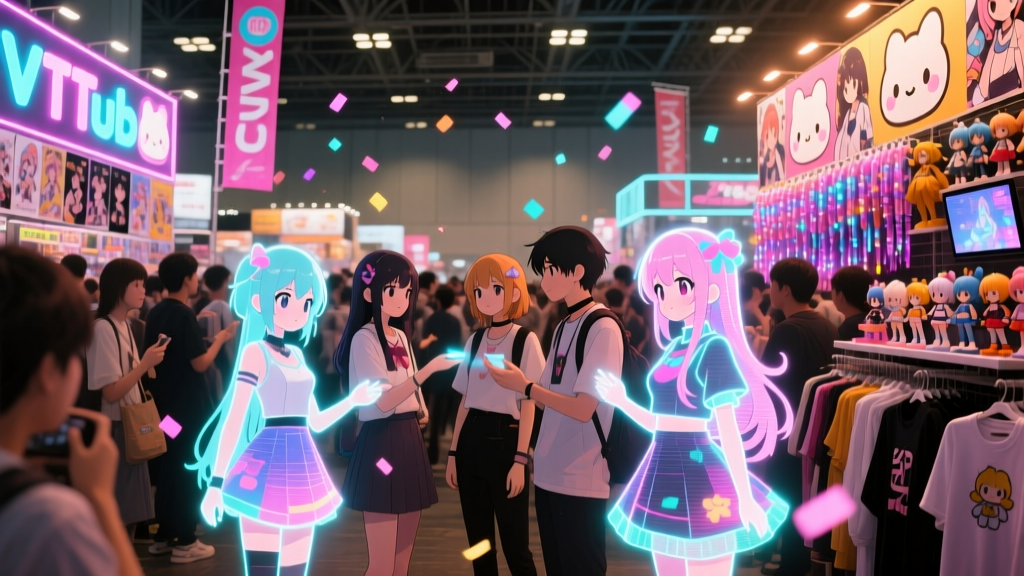
VTubers didn’t “enter” anime fandom—they detonated it like a timed kunai in the middle of Comiket’s main hall.
Let’s get one thing straight: VTubers are not “anime characters come to life.” They’re not mascots. They’re not voice actors hiding behind avatars. They’re a new species of cultural organism—part performer, part algorithmic feedback loop, part collective hallucination sustained by Discord pings and Patreon tiers. And they’ve rewritten the social contract of anime fandom faster than Studio Ghibli could animate a falling leaf.
I remember watching Kizuna AI’s 2016 “Hello, World!” video on YouTube—crude Miku-style rig, glitchy lip-sync, zero production value—and thinking, This is either the dumbest thing I’ve seen this week or the first tremor before the quake. It was the latter. Within two years, Hololive’s Gawr Gura had more subscribers than My Hero Academia’s official channel. By 2023, VTuber-related revenue—merch, collabs, live concerts, virtual goods—surpassed ¥120 billion in Japan alone. That’s not “side hustle” money. That’s studio-budget money. That’s “we just greenlit a 24-episode season with no script but three million fans already know the lore” money.
The Business Model: Subscription as Ritual, Not Transaction
Forget “supporting your favorite creator.” VTuber economics run on sacramental capitalism. Subscribing isn’t about access—it’s about membership. Tiered subs (¥500, ¥1,000, ¥5,000) don’t unlock features; they confer status symbols: special emotes that only appear when you type “GuraPunch”, name reads during streams, exclusive Discord roles (“Gura’s First Wave”), even randomized voice lines triggered by your donation amount (“Gura says ‘Mmm… thank you, [Your Name]-san’”).
This isn’t Patreon 2.0. It’s Shinto shrine economics: you give, the kami notices, and the ritual reinforces the bond. When Gawr Gura hit 4 million subs in 2022, her celebratory stream wasn’t a concert—it was a matsuri, complete with digital torii gates, fan-submitted omamori animations, and a synchronized “Gura-ya!” chant echoing across 200,000 concurrent chats. The platform isn’t YouTube. It’s a digital jinja.
And yes, it’s wildly profitable—but not because fans are gullible. Because the model mirrors how anime fandom already operates: devotion as labor. Cosplayers spend months stitching uniforms. Doujinshi artists burn midnight oil drawing headcanons. VTuber fans? They translate streams in real time, archive lore spreadsheets, mod OBS plugins to sync fan art with stream audio. Their “payment” is participation—not consumption.
Parasocial Relationships: When “Senpai Noticed Me” Stops Being a Joke
Anime has always flirted with parasocial fantasy. Remember the “notice me, senpai” meme? It was satire—until VTubers made it structural.
Take Nijisanji’s Tsukumo Sana. Her “shy genius” persona—stammering through math explanations, blushing at praise, hiding behind her hair—wasn’t scripted quirk. It was calibrated vulnerability. She’d pause mid-sentence, glance off-cam, whisper, “I’m… scared to say this, but…” Then she’d confess a tiny insecurity: “I rewatched my last stream. I sounded weird.” Fans didn’t just empathize—they corrected. They flooded her comment section with “You sounded perfect,” “We love your voice,” “No, *we’re* the weird ones.” The loop closed: exposure → reassurance → deeper attachment.
This works because VTubers operate in real-time ambiguity. Is that blush from the rig’s emotion engine—or did the talent actually flush? Was that flustered laugh pre-recorded or genuine? The uncertainty isn’t a bug. It’s the feature. It forces fans to project meaning onto gaps—exactly how otaku have read subtext into every frame of Clannad since 2007.
But here’s what anime fandom never had before: reciprocity. When Hololive’s Mori Calliope rapped over a fan-made beat and tagged the creator, it wasn’t PR. It was canonization. When VTubers shout out fan edits in streams—“This edit gave me chills, look at the timing!”—they’re not acknowledging skill. They’re validating collaborative authorship. The fan isn’t consuming lore. They’re co-writing it.
Creative Expression: From Consumption to Co-Creation
Anime fandom used to be hierarchical: studios create → fans interpret → doujin circles expand. VTubers flattened that pyramid. Their avatars aren’t locked assets. They’re open-source archetypes.
Consider the “Nekomimi VTuber” trope. It started with early Nijisanji talents—cat ears, tail physics, playful tone. But fans didn’t just cosplay them. They forked the concept: “What if nekomimi was a stoic samurai?” “What if it was a tired nurse working night shifts?” “What if it was non-binary and used they/them pronouns in every bio?” These weren’t AU fanfics. They were modding instructions—shared via GitHub repos, Blender rigs, and Discord channels teaching rigging for Unity Live2D.
VTuber tech democratized character design. You no longer needed Toei Animation’s budget to build a world. A $300 rig, free VTube Studio, and 200 hours of learning Blender could birth a character with richer backstory than half the leads in Boku no Hero Academia Season 6. And crucially—the community demanded depth. When a new talent debuted with “just cute avatar + ASMR,” fans roasted them: “Where’s the trauma? The hidden power? The tragic backstory involving a lost sibling and a cursed bento box?” Anime fandom’s narrative literacy didn’t vanish. It migrated—into VTuber lore docs, timeline wikis, and TikTok theories dissecting a 3-second eye twitch as foreshadowing.
Bridging the Pacific: Not “Localization”—But Cultural Re-Synthesis
Western anime fans used to wait. Wait for subtitles. Wait for dubs. Wait for merch imports. VTubers obliterated that latency—not by translating content, but by building bilingual ecosystems from day one.
Take Hololive English’s Ayunda Risu. Her debut stream wasn’t “Hi, I’m Risu, here’s my Japanese bio translated.” It was a 90-minute interactive session where she asked fans to vote on her first English phrase (“Risu’s Rule #1: Never skip breakfast!”), then challenged them to submit breakfast memes—which she animated into her next stream’s intro. The language barrier wasn’t crossed. It was dissolved into shared ritual.
More radically: VTubers forced platforms to adapt. YouTube added multi-language auto-captions trained on VTuber speech patterns (not news anchors). Twitch rolled out real-time translation overlays after seeing 40% of Hololive EN chats containing Japanese phrases mixed with English slang (“Maji? Yabai desu ne!”). Even Crunchyroll pivoted—its 2023 “VTuber Collab Festival” wasn’t a panel. It was a hybrid event: Japanese talents streamed live while Western fans submitted fan art that appeared as AR filters during their performances.
This isn’t “global fandom.” It’s fractured unity. A Filipino fan edits a VTuber’s stream with Tagalog subtitles while a Tokyo high schooler uses that same edit to practice English. A German fan draws a crossover of Gawr Gura and Neon Genesis Evangelion’s Rei Ayanami—then submits it to Hololive’s official art contest, winning a shoutout from the talent herself. The “bridge” isn’t between cultures. It’s between practices: editing, translating, theorizing, cosplaying—all happening simultaneously, all feeding the same engine.
The Irony No One Mentions
Here’s the uncomfortable truth: VTubers succeeded where anime studios failed because they embraced what anime fandom always was—a collective fiction sustained by belief.
Studios chase “realism”: better CGI, motion capture, photoreal textures. VTubers lean into the uncanny: jittery eye movements, exaggerated mouth shapes, limbs that bend like rubber. Why? Because imperfection signals presence. A perfectly rendered face feels distant. A slightly off-rigged blink feels human—like the moment in Serial Experiments Lain when the Wired glitches, reminding you someone’s watching from the other side.
VTubers didn’t change anime fandom. They revealed its core operating system: that we don’t love anime for its polish—we love it for the cracks where our imagination leaks in. The rig’s glitch. The subtitle’s typo. The doujinshi’s headcanon. The VTuber’s “oops, my ear fell off” laugh.
So no—VTubers aren’t “the future of anime.” They’re the fandom’s id, finally given a microphone, a motion-capture suit, and 3 million people screaming “WE HEAR YOU” back.
And if you’re still waiting for the “real” anime to start again?
Look down at your chat window.
You’re already in it.