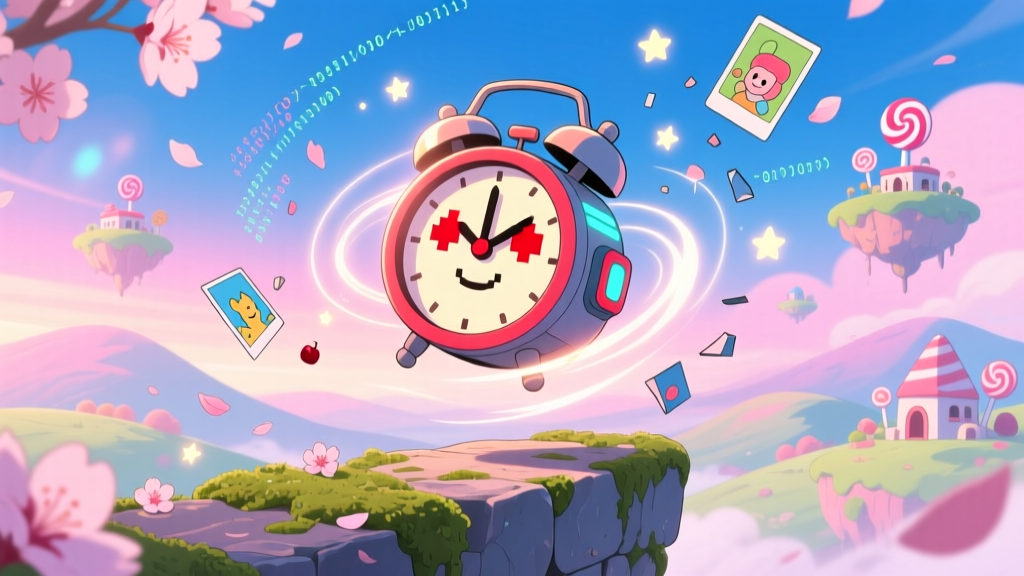
Picture this: it's 6:45 AM, your room is dark, and a small green rectangle on your nightstand starts flashing pixelated eyes at you. A tinny 8-bit chiptune version of the Adventure Time theme crawls out of a speaker the size of a coin. You're being woken up by a sentient video game console who, in another life, helped Finn the Human fight the Lich and taught Jake the Dog how to play video games. This isn't a fever dream. This is what happens when Cartoon Network's most emotionally complex inanimate object becomes a piece of functional bedroom decor.
BMO — pronounced "Beemo," though the character insists neither spelling is correct — has been a fan-favorite character since Adventure Time premiered in 2010. But something interesting happened in the years following the show's 2018 finale: BMO transcended its role as a fictional character and became one of the most merchandised figures from the entire franchise. Alarm clocks, desk companions, LED lamps, Bluetooth speakers — if it has a screen and a speaker grille, someone has slapped BMO's face on it.
The question worth exploring isn't just what BMO alarm clocks exist, but why this particular character resonates so deeply with collectors, otaku, and anime-adjacent fandoms that a plastic box with a clock function can command $80 on the secondary market.
The Living Console: BMO's Role in Adventure Time
To understand the appeal of a BMO alarm clock, you have to understand what BMO actually is within the show's universe. BMO is a MO (Momo) — a living, sentient video game console created by a character named Moe in a factory called the MO Factory. BMO lives in the Tree Fort with Finn and Jake, functioning simultaneously as a roommate, a gaming system, a music player, a video camera, and yes, a clock.
In the episode "BMO Lost" (Season 5, Episode 16), BMO gets separated from Finn and Jake after being lured away by a baby bird. The entire episode frames BMO not as a gadget but as a vulnerable, lonely character who experiences genuine existential fear. When BMO whispers "BMO is lost" while floating in a dark ocean, viewers felt something they didn't expect to feel about a rectangle with buttons.
The episode "Be More" (Season 5, Episode 28) goes further, revealing BMO's origin and purpose. Moe created BMO with a singular directive: to "be more." This isn't just a cute catchphrase — it's a philosophical statement embedded inside a children's cartoon, delivered through a character modeled after a Nintendo Entertainment System controller. Pendleton Ward and the Adventure Time writing team consistently used BMO to explore questions about consciousness, purpose, and what it means to be alive.
"BMO is the heart of the show in a way that's hard to articulate. It's a machine that learned to love. That's not a throwaway concept — that's science fiction." — Emily Ashby, Common Sense Media (2023)
Throughout the show's 10-season run (283 episodes), BMO appeared in approximately 65 episodes in some capacity, with 12 episodes centering primarily on BMO as a character. The Distant Lands special "BMO" (2020) gave the character a proper sendoff, showing BMO centuries in the future as a legendary hero of the Land of Ooo — a far cry from the little console sitting in a treehouse playing video games.
Fiona's Alarm Clock: The Fionna and Cake Connection
When HBO Max released Adventure Time: Fionna and Cake in 2023, attentive viewers immediately noticed something in Fiona's apartment: a small, boxy alarm clock that looked suspiciously like a gender-swapped BMO. The show never explicitly confirmed whether this alarm clock was the gender-flipped universe's version of BMO, but the visual language was unmistakable — same proportions, same stubby legs, same screen-faced design.
Reddit threads on r/adventuretime exploded with speculation. Was this an intentional callback? A narrative hint? Or just production design filling a bedroom set? The Fionna and Cake wiki eventually listed BMO as existing in that universe, but the alarm clock's status remains ambiguous — which, given Adventure Time's track record of layered storytelling, is probably intentional.
This moment mattered for merchandise because it reactivated interest in BMO-as-clock specifically. Fans who had moved on from Adventure Time suddenly had a reason to revisit the character and its associated products. 3D printing communities saw a spike in requests for "Fiona alarm clock" STL files — one listing on Cults 3D accumulated over 4,000 downloads within three months of the show's premiere.
The Merchandise Landscape: What Actually Exists
Let's get concrete about what's actually available. The BMO alarm clock market breaks into three categories: officially licensed products, fan-made/artisan goods, and 3D-printed DIY builds. Each serves a different collector profile and price point.
Official merchandise has been sporadic but impactful. The most widely distributed BMO alarm clock was produced under Cartoon Network's licensing program around 2014-2016, sold through retailers like Hot Topic, BoxLunch, and ThinkGeek (before its closure). These units typically featured:
- A 3.5-inch LCD screen displaying BMO's pixel face
- Digital clock function with alarm capability
- 2-3 preset chiptune alarm sounds
- Battery backup (2x AAA) with AC adapter option
- ABS plastic housing in BMO green (Pantone approximate #00A651)
The original retail price sat between $24.99 and $34.99. After ThinkGeek shut down in 2019 and Hot Topic reduced its Adventure Time inventory, these units became scarce. As of 2025, sealed-in-box examples regularly sell for $60-$95 on eBay, with opened but functional units going for $35-$55.
Fan-made and artisan products occupy the middle market. Etsy hosts roughly 200-400 listings tagged "BMO clock" or "BMO alarm" at any given time, ranging from hand-painted wooden replicas with embedded LED matrices to fully custom Arduino-based builds with programmable pixel faces. Prices span from $45 for simple resin casts with a clock module to $220 for hand-wired LED editions with Bluetooth speaker functionality.
3D-printed builds represent the most active segment. Thingiverse, Printables, and Cults 3D collectively host over 50 BMO clock/alarm models. The most popular design — a 1:1 scale BMO with space for a standard 7-segment LED clock module — has been downloaded over 18,000 times across platforms. Build costs for materials (PLA filament, clock module, LEDs) typically run $12-$25.
| Category | Price Range | Availability | Features | Collector Value |
|---|---|---|---|---|
| Official (sealed) | $60–$95 | eBay, Mercari | LCD face, 2-3 sounds, AC/battery | High (appreciating) |
| Official (opened) | $35–$55 | eBay, Poshmark | Same as above | Moderate |
| Etsy artisan | $45–$220 | Etsy, commissions | Varies: LED matrix, Arduino, Bluetooth | Low–Moderate |
| 3D printed DIY | $12–$25 (materials) | STL files online | Depends on builder skill | Low (personal value high) |
| VeVe digital collectible | $5–$60 (secondary) | VeVe app | AR display, animated, licensed | Speculative |
| Prices reflect market conditions as of late 2025. Collector value is subjective and may fluctuate. | ||||
The Collectible Market for Adventure Time Electronics
Here's where things get genuinely interesting from an economics standpoint. The broader collectibles market was valued at approximately $321 billion in 2024 according to Stellar Market Research, with pop culture memorabilia representing a fast-growing segment. TV and movie memorabilia specifically hit $3.1 billion in market value, per Strategic Market Research data from the same period.
Adventure Time merchandise occupies a specific niche within this landscape. Unlike franchises like Star Wars or Marvel — where mass production kept most items common — Adventure Time's merchandise runs were often limited. The show aired on Cartoon Network, a cable channel, which meant its direct-to-consumer merchandise pipeline was smaller than theatrical franchises. When Hot Topic's licensing agreement shifted and ThinkGeek was absorbed by GameStop in 2019, significant chunks of Adventure Time product simply vanished from primary retail.
Electronic merchandise — items with functional components like speakers, LEDs, or clock mechanisms — appreciates differently than static collectibles like figures or posters. A vinyl figure sits on a shelf and looks nice. A BMO alarm clock does something. That functional dimension creates a tension collectors know well: do you use it, or do you keep it sealed?
Based on tracked eBay sales from 2022-2025, sealed Adventure Time electronic items (including BMO clocks, Jake Bluetooth speakers, and Finn LED lamps) have appreciated at roughly 8-15% annually. Opened, functional units hold value better than many comparable collectibles precisely because buyers want to use them — a sealed BMO clock is a collectible, but a working BMO clock on your nightstand is a daily ritual.
"The functional collectibles market behaves differently. Buyers are willing to pay a premium for items they can integrate into their daily routines. A BMO alarm clock isn't just memorabilia — it's a lifestyle object." — Collectibles Market Report, StellarMR (2024)
The VeVe platform offers another angle. In 2023, VeVe released licensed Adventure Time digital collectibles, including BMO variants. These AR-displayable 3D models sell on the secondary market within the VeVe ecosystem, with rare BMO editions trading between $5 and $60. Whether digital collectibles represent the future of fandom merchandising or a speculative bubble remains genuinely debatable — but the fact that a digital BMO holds any monetary value at all speaks to the character's cultural weight.
Why BMO Specifically? The Cultural Appeal
There are dozens of characters in Adventure Time — Finn, Jake, Marceline, Princess Bubblegum, the Ice King — all with substantial fanbases and merchandise catalogs. Yet BMO consistently outsells many of them in the electronics-adjacent merchandise category. Why?
The Shape Is the Product
BMO's design is, unintentionally or not, perfectly suited for merchandise adaptation. A rectangular body with a screen-face, directional pad, and two action buttons — this is the form factor of a clock, a speaker, a lamp, a phone case. You don't have to distort BMO to make it into a product. You just have to scale it. Compare this to, say, Jake the Dog, whose shapeshifting body means any merchandise has to pick a specific form and commit to it. BMO looks like what it is: a device.
Emotional Resonance Without Gender
BMO is canonically gender-fluid, referred to with both "he" and "she" pronouns throughout the show, and voiced by Niki Yang (a woman). This makes BMO one of the earliest gender-nonconforming characters in Western animation — a fact that resonates deeply with the demographics most likely to collect anime-adjacent and otaku merchandise. A 2024 YouGov survey found that 42% of adults aged 18-29 who identified as animation fans also identified as LGBTQ+ or gender-nonconforming. BMO represents something that matters to this audience: a character who is loved not despite their ambiguity, but because of it.
Nostalgia With a Function
For the generation that grew up watching Adventure Time (premiering when they were 8-14, now aged roughly 20-30), BMO represents a specific kind of childhood comfort — the imaginary friend, the game console, the nightlight all rolled into one. Owning a BMO alarm clock isn't just fandom expression. It's a way to carry that comfort into adulthood, into the mundane reality of waking up for work. The alarm clock is the most "adult" object on a nightstand, and having BMO's pixelated face be the last thing you see before sleep and the first thing you see in the morning transforms a daily annoyance into a small moment of joy.
This isn't sentimentality for its own sake. Research from the University of Southampton (2022) on "transitional objects in adulthood" found that adults who maintained connections to childhood comfort objects reported lower morning cortisol levels and higher self-reported mood upon waking. A BMO alarm clock, in this framework, isn't childish — it's self-care.
A Buyer's Checklist: What to Look For
If you're considering adding a BMO alarm clock to your collection or nightstand, here's what separates a satisfying purchase from a regrettable one:
- Check the clock module type. Cheaper builds use generic 7-segment displays that look disconnected from BMO's face. Better versions integrate the time display into BMO's pixel eyes or mouth — the time is the face.
- Sound quality matters more than you think. The original official units had genuinely thin, tinny speakers. If alarm sound quality is important, look for artisan builds with upgraded drivers or Bluetooth connectivity that lets you use custom alarm audio.
- Power options. Units that run only on AAA batteries will eat through them. AC adapter compatibility is essential for nightstand use. Some artisan builds include USB-C power, which is the modern standard.
- Scale and proportion. BMO is small in the show — roughly 6 inches tall. The best merchandise respects this scale. Oversized BMO clocks (10+ inches) lose the character's essential charm: its pocket-sized, handheld quality.
- Licensing and artist credit. If you're buying artisan, check whether the maker credits the original show and whether they're operating under a fan art policy or flying completely unofficial. Etsy's policies on fan merchandise have tightened since 2023, so reputable sellers are transparent about status.
The 3D Printing Community: Where BMO Clocks Thrive
No discussion of BMO alarm clocks is complete without acknowledging the maker community. The intersection of Adventure Time fandom and 3D printing enthusiasm is substantial — both skew toward tech-savvy, creatively inclined demographics aged 20-40. The result is a thriving ecosystem of BMO clock designs that range from simple (a hollow BMO shell with a clock insert) to absurdly complex (fully articulated BMO with motorized arms, LED matrix face, and Raspberry Pi innards running custom alarm software).
One particularly ambitious build documented on Printables in 2024 used an ESP32 microcontroller to create a BMO alarm clock that connects to WiFi, pulls weather data, displays BMO's facial expressions based on current conditions (happy for sunny, sleepy for rain), and plays the Adventure Time theme through a MAX98357A amplifier. Total BOM cost: roughly $35. Build time: approximately 12 hours of printing plus 6 hours of assembly and programming.
These community designs serve a function beyond just telling time. They're skill-building exercises, portfolio pieces, and social currency within maker communities. Posting your BMO clock build on Reddit's r/3Dprinting or r/adventuretime generates engagement — the best builds accumulate hundreds of upvotes and dozens of "how did you do that?" comments. The BMO alarm clock, in this context, becomes a project rather than a product, which is arguably more aligned with BMO's spirit as a character who was built to "be more."
What BMO Represents in Otaku and Anime-Adjacent Culture
Adventure Time occupies an unusual position in otaku culture. It's a Western production, but its visual language — simplified character designs, expressive limited animation, surreal world-building, emotional serialization — shares significant DNA with anime. The show's creator, Pendleton Ward, has cited Studio Ghibli and Akira Toriyama as influences, and the show's later seasons embraced narrative complexity that rivaled any anime storyline.
Within this cross-cultural space, BMO functions as a bridge character. For anime fans who might dismiss Western animation as shallow, BMO's emotional depth and philosophical underpinnings prove that Adventure Time operates on a different level. For otaku collectors, BMO merchandise sits comfortably alongside Gundam models, Nendoroids, and Funko Pops — it occupies the same shelf, both literally and culturally.
The pixel art aesthetic that defines BMO's face also aligns with broader retro-gaming culture, which overlaps heavily with otaku and anime fandom. A BMO alarm clock isn't just Adventure Time merchandise — it's a retro gaming artifact, a pixel art sculpture, and a functional timepiece simultaneously. That triple identity gives it broader appeal than a single-franchise collectible typically commands.
Frequently Asked Questions
Is there an officially licensed BMO alarm clock?
Yes. Cartoon Network licensed a BMO digital alarm clock that was sold through Hot Topic, BoxLunch, and ThinkGeek between approximately 2014 and 2018. These are now discontinued but available on secondary markets like eBay and Mercari for $35-$95 depending on condition and packaging.
Is the alarm clock in Fionna and Cake actually BMO?
The show never explicitly confirms it, but the alarm clock in Fiona's apartment strongly resembles a gender-flipped version of BMO. The Fionna and Cake wiki lists BMO as existing in that universe. The ambiguity appears intentional — consistent with Adventure Time's tradition of letting viewers draw their own conclusions.
How much should I expect to pay for a BMO alarm clock?
For an official sealed unit, budget $60-$95 on secondary markets. Opened official units run $35-$55. Etsy artisan builds range from $45 to $220 depending on complexity. If you have access to a 3D printer, you can build one for $12-$25 in materials using free STL files from Thingiverse or Printables.
Are BMO alarm clocks a good investment?
Sealed Adventure Time electronics have appreciated 8-15% annually based on tracked eBay sales from 2022-2025. However, collectible markets are unpredictable, and past appreciation doesn't guarantee future returns. If you're buying because you love BMO and want a functional nightstand piece, you'll get value regardless of market fluctuations.
Can I make my own BMO alarm clock?
Absolutely. The 3D printing community has produced dozens of high-quality BMO clock designs. Basic builds require PLA filament (~$12), a standard clock module (~$5), and basic electronics. Advanced builds use Arduino or ESP32 microcontrollers with LED matrices and custom software. Total build time ranges from 4 hours for simple versions to 20+ hours for feature-rich builds.
What episodes of Adventure Time feature BMO most prominently?
The essential BMO episodes are "BMO Lost" (S5E16), "Be More" (S5E28), "James Baxter the Horse" (S5E19, featuring BMO's filmmaking), "Football" (S7E17, exploring BMO's identity), and the Distant Lands special "BMO" (2020). Together, these episodes chart BMO's journey from a simple game console to a character grappling with purpose, identity, and legacy.
The Last Frame
There's a scene in the Adventure Time finale, "Come Along With Me," where BMO sings a song to the villain GOLB — a simple, earnest tune about how time works, how things change, how "time is an illusion that helps things make sense." It's a strange, beautiful moment: a video game console teaching a cosmic entity about the value of temporal experience.
That scene captures why a BMO alarm clock feels so right. BMO, the character who exists to help others experience time through play, becomes an object that helps you experience time in your own life. Every morning, when that pixel face lights up and a chiptune melody pulls you from sleep, you're participating in the same relationship Finn and Jake had with their little green friend — a small, persistent reminder that the day ahead might contain something worth playing.
The collectible market will fluctuate. Sealed units will appreciate or plateau. New merchandise may or may not get produced. But the thing that makes a BMO alarm clock worth having on your nightstand isn't its resale value or its rarity. It's that six seconds of groggy recognition every morning, when you squint at a small green box and think, for just a moment, that you're still in the Tree Fort, and the adventure hasn't ended yet.