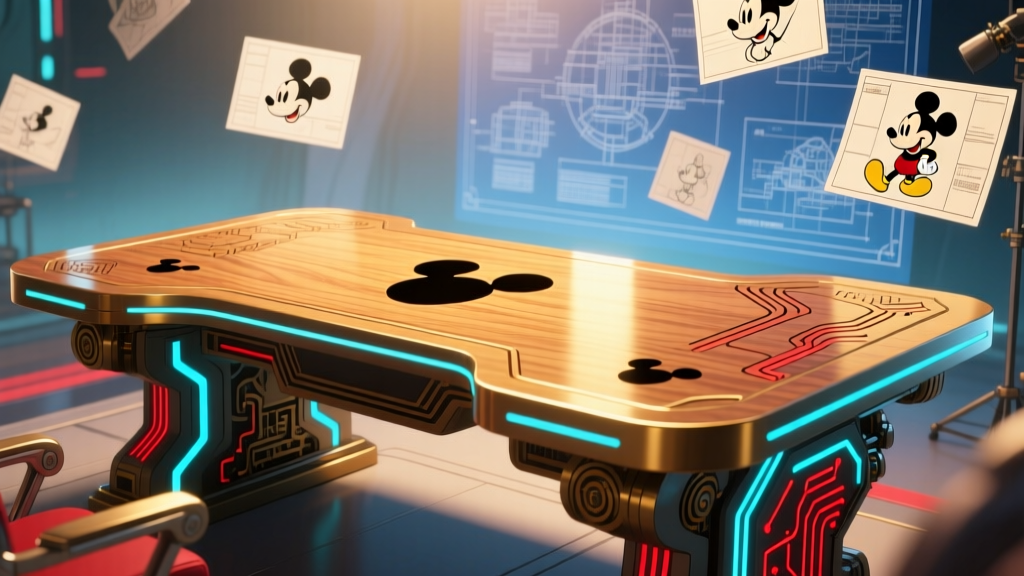
How a German-born modernist designed the workstation where Disney's Golden Age came to life — and why collectors pay five figures to own one.
SenpaiSite Archives Otaku Culture 12 min readPicture the scene: It's 1940, inside the brand-new Walt Disney Studios in Burbank, California. Sunlight streams through north-facing windows onto rows of identical wooden desks, each one six feet wide and solid as an oak. Hunched over one of them, an animator named Eric Larson is drawing the flight sequence of a hippo in a tutu for Fantasia. His pencil scratches across paper pinned to a tilted drawing board, illuminated from below by a glass light box built directly into the desk's surface. Nearby, a cigarette smolders in a stainless-steel guard, its ash destined for a recessed tray. This is the Kem Weber animation desk — and it is, without exaggeration, the workstation where the Golden Age of American animation was born.
Before we talk about the desk itself, we need to talk about the man who designed it, because Karl Emanuel Martin "Kem" Weber was not your typical furniture maker. Born in Barmen, Germany, in 1889, Weber apprenticed under Bruno Paul in Berlin before emigrating to the United States in 1914. By the 1930s, he had become one of the most influential modernist designers on the West Coast, pioneering what would come to be known as Streamline Moderne — a design language that fused Art Deco's geometric elegance with the aerodynamic curves of ships and airplanes.
Weber ran in the same creative circles as architects Richard Neutra and Rudolph Schindler. He designed interiors for shops, theaters, and private homes across Southern California. But his most consequential commission came in 1938, when Walt Disney personally hired him to design every piece of furniture for the studio's new Burbank campus — a sprawling, 51-acre complex that would become the nerve center of the world's most famous animation studio.
A Commission Without Precedent
Walt Disney didn't just want desks. He wanted a "holistic design where architecture included interiors and furnishings," as animation historian David A. Bossert documented in his 2018 book Kem Weber: Mid-Century Furniture Designs for the Disney Studios. The Burbank studio was a quantum leap from the cramped Hyperion Avenue facility the company had outgrown. With profits from Snow White and the Seven Dwarfs (1937) funding construction, Disney envisioned a "near-utopian animation academy, a kind of grove of cartooniana," as one historian described it — a campus purpose-built for the 1,500-person armada of artists, inkers, and technicians who would produce the studio's next generation of feature films.
Weber was given extraordinary latitude. He designed not just animation desks, but layout desks, story desks, paint tables, office furniture, filing cabinets, and even the studio's employee cafeteria seating. Every piece reflected his Streamline Moderne philosophy: clean lines, functional elegance, and a stubborn refusal to sacrifice beauty for utility. The animation desk was his masterwork.
"It was the basic, Kem Weber Animator's Desk, big, wide, and solid as a rock." — Animator quoted in Collectors Weekly, describing the desk's first impression
The Anatomy of a Masterpiece
What made the Kem Weber animation desk so remarkable wasn't any single feature — it was the way dozens of thoughtful details came together in a single piece of furniture. Let's walk through the design, component by component.
The Drawing Surface and Light Box
The centerpiece of the desk was its adjustable drawing board, set into a recessed well that measured approximately 11.5 square feet of total working surface across the full desk. The board could be tilted to various angles, allowing animators to find their preferred working position whether they were roughing out keyframes or cleaning up final linework. Beneath the drawing surface sat a glass-paneled light box — an essential tool for animators who needed to trace and refine drawings by seeing previous frames through their current sheet of paper. This wasn't an afterthought; it was integrated directly into the desk's structure, wired and positioned for optimal illumination without casting shadows on the animator's hands.
Materials and Construction
Weber specified birch plywood as the primary material — a deliberate choice that balanced durability, weight, and the warm aesthetic he wanted for the studio's interiors. The desks were manufactured by Peterson Showcase, a Burbank-based firm that built them to Weber's exacting specifications. Construction was modular: the desks could be disassembled into sections, which was essential for moving them through the studio's corridors and into the animation building's upper floors.
The birch was finished in a warm, honey-toned stain that complemented the studio's Streamline Moderne architecture — curved concrete walls, porthole windows, and sweeping horizontal lines. Even in a room full of them, the desks didn't feel industrial. They felt crafted.
The Details That Made It Special
Here's where Weber's obsessive attention to the animator's daily experience becomes almost touching:
- Recessed drawer pulls that doubled as bottle openers: Weber designed the drawer pulls to be flush with the desk surface, preventing animators from catching their sleeves or arms on protruding hardware during long drawing sessions. As a bonus — or perhaps as the primary intention — the pulls were shaped to function as bottle openers, a nod to the studio's hard-drinking culture.
- Stainless-steel cigarette guards: In the 1940s, virtually every animator smoked at their desk. Weber incorporated stainless-steel cigarette rests into the desk's surface, protecting the birch from burns and providing a dedicated spot for a smoldering Lucky Strike.
- Integrated bulletin board: Many desks featured an attached bulletin board above the work surface, allowing animators to pin up reference images, model sheets, and sequence charts within their peripheral vision.
- Pencil tray: A dedicated tray — often personalized by individual animators — held pencils, erasers, and other tools. Eric Larson's personal pencil tray, which survived with one desk, became a prized collector's artifact decades later.
- Mirrors: Some desks included small mirrors, a tool animators used to check facial expressions and proportions by studying their own reflections while drawing characters.
| Specification | Detail |
|---|---|
| Designer | Karl Emanuel Martin "Kem" Weber (1889–1963) |
| Manufacturer | Peterson Showcase, Burbank, California |
| Production Period | 1939–1940s (with continued use through the 1960s) |
| Primary Material | Birch plywood with warm-toned stain finish |
| Width | Approximately 66 inches (6 feet / 168 cm) |
| Depth | Approximately 36 inches (91 cm) |
| Height | Approximately 30 inches (76 cm), adjustable |
| Working Surface | ~11.5 square feet including integrated light box well |
| Key Features | Adjustable tilt drawing board, glass light box, recessed drawer pulls (bottle openers), stainless-steel cigarette guards, bulletin board, pencil tray, mirror |
| Construction | Modular design for disassembly and transport |
| Variants | Standard Animator's Desk, Compact Animator's Desk, Layout Desk, Story Desk, Paint Table |
| Sources: Heritage Auctions listings; Bossert (2018); Collectors Weekly research. | |
The Golden Age at Work
The desks arrived at the Burbank studio in 1939–1940, just as Disney was entering what animation historians universally call its Golden Age. The first features produced on these desks read like a greatest-hits list of American cinema: Pinocchio (1940), Fantasia (1940), Dumbo (1941), and Bambi (1942). Every frame of these films — and the dozens of shorts, package films, and features that followed through the 1940s and 1950s — was drawn, refined, and approved on a Kem Weber animation desk.
The animators who used them were the legendary "Nine Old Men" — Disney's core team of directing animators that included Les Clark, Ollie Johnston, Frank Thomas, Milt Kahl, Ward Kimball, Eric Larson, John Lounsbery, Wolfgang Reitherman, and Marc Davis. These men spent eight, ten, sometimes twelve hours a day at these desks, producing the character performances that defined an art form. The desk wasn't just furniture; it was the animator's primary instrument.
The Human Scale of Animation: A single second of animation at 24 frames per second required up to 24 individual drawings. A feature-length film like Pinocchio (88 minutes) could require over 100,000 finished drawings — each one created by hand, at a Kem Weber desk, under the glow of its light box.
Variants for Different Roles
Weber didn't design a single desk and call it done. He created specialized variants for different roles within the animation pipeline:
- Standard Animator's Desk: The flagship model with full drawing board, light box, and all the signature features.
- Compact Animator's Desk: A smaller version for studios or departments with tighter floor plans.
- Layout Desk: Designed for layout artists who planned scene composition and camera angles.
- Story Desk: Built for storyboard artists who worked with pinned-up panels rather than individual animation drawings.
- Paint Table: Specialized for the Ink and Paint department, where cels were colored by hand.
This systematic approach to furniture design — creating a coherent visual language across an entire suite of purpose-built tools — was decades ahead of its time. It anticipated the "design system" thinking that wouldn't become mainstream in product design until the late 20th century.
Where Are They Now?
Here's the part that makes collectors and animation historians wince: most of the original Kem Weber animation desks were destroyed. When the Disney studio modernized its operations in the 1960s — transitioning from hand-drawn animation toward xerography and new production methods — the massive six-foot desks were seen as obsolete relics. They were enormous, heavy, and ill-suited to the evolving workflows. Many were simply thrown away or sold off for scrap.
The survivors are few, and they fall into several categories:
Museum and Archive Pieces
The most prominent surviving desk belongs to the Walt Disney Archives. In December 2015, Disney completed a meticulous restoration of Walt's personal office suite — Suite 3H, located on the third floor of the Animation Building on the Burbank lot. The restoration returned the space to its appearance circa 1966, the year of Walt Disney's death. Kem Weber's original furniture was central to the restoration, including a desk, chair, lamp, and clock that had been preserved in the Archives' collection.
The office suite opened as a permanent exhibit for Disney employees and D23 Gold Members (Disney's official fan club), with rotating displays that have featured Weber's broader furniture designs. A separate animation desk has appeared in traveling exhibitions, including the "Treasures of the Walt Disney Archives" show that toured institutions like the Ronald Reagan Presidential Library.
Private Collections and Auctions
Original Kem Weber Disney animation desks surface at auction rarely, and when they do, they command serious prices. A documented example sold at Heritage Auctions in December 2021: a Weber-designed animator's desk with an attached bulletin board, mirrors, the original cigarette guard, and — critically — Eric Larson's personal pencil tray. The lot sold for $13,145, exceeding its pre-sale estimate. These desks are almost never available through conventional antique channels; most surviving examples have been in private hands for decades, passed between collectors who understand their significance.
"Working with the original materials helped us understand Walt's genius — the way he thought about every detail of the creative environment." — Rebecca Cline, Director of the Walt Disney Archives, on the Suite 3H restoration
Replicas and Reproductions
The scarcity and cost of original desks have fueled demand for high-quality reproductions. In 2024–2025, Paragon FX Group — a specialty collectibles manufacturer known for screen-accurate prop replicas — announced a 1:6 scale model of the Kem Weber animation desk, developed in collaboration with the Walt Disney Archives and The Walt Disney Company. The replica, constructed from wood with meticulous attention to detail, recreates the desk's light box, drawer pulls, bulletin board, and even the animator's chair at miniature scale.
For full-size replicas, the situation is more complicated. No official full-scale reproduction has been licensed, but several skilled woodworkers and furniture makers have undertaken personal projects to recreate the desk based on surviving examples, archival photographs, and the detailed documentation in Bossert's book. Online woodworking communities feature threads where craftspeople share their attempts, often spending hundreds of hours and significant material costs to match Weber's original specifications. The modular construction, birch plywood, and integrated light box present genuine engineering challenges that separate serious reproductions from superficial tributes.
Collector's Quick Reference: Valuation Factors
- Provenance: Desks that can be traced to specific animators (like Eric Larson's) command premium prices.
- Completeness: Original light box, cigarette guard, bulletin board, and drawer hardware dramatically affect value.
- Condition: Many surviving desks show heavy wear from decades of use — pencil marks, paint stains, and cigarette burns are considered "honest wear" by some collectors but reduce value for others.
- Documentation: Studio records or photographic evidence placing the desk in a specific animator's office add significant value.
- Current market: Original desks typically sell in the $5,000–$15,000+ range at major auction houses, with exceptional provenance pushing higher.
Why This Desk Matters Beyond Disney
The Kem Weber animation desk isn't just a piece of Disney memorabilia. It's a case study in how physical workspace design shapes creative output — a lesson that resonates far beyond animation.
Consider the context: in 1939, most office furniture was designed for clerical work — typing, filing, correspondence. The idea of designing a specialized workstation for a creative professional was genuinely radical. Weber approached the animator's desk the way an industrial designer approaches a cockpit: every control within reach, every surface optimized for its specific task, every distraction minimized. The light box eliminated the need for separate tracing equipment. The recessed drawer pulls prevented snags during rapid drawing. The cigarette guard protected the work surface without requiring the animator to reach for an ashtray.
This philosophy — that the tool should disappear into the work — is the same principle that drives modern UX design, ergonomic workspace planning, and the entire "flow state" movement in creative productivity studies. Weber was solving the same problem that companies like Herman Miller, Steelcase, and IDEO would tackle decades later: how do you design an environment that makes creative work easier?
The desk also represents a vanishingly rare moment in industrial history when a single designer was given complete authority over an entire creative facility's furnishings. Today, we might call this a "design system" or "environment design." In 1939, it was simply Kem Weber, a drafting table, and Walt Disney's trust.
The Scholarly Record
For those who want to go deeper, the definitive resource on the Kem Weber animation desk is David A. Bossert's Kem Weber: Mid-Century Furniture Designs for the Disney Studios (2018), published through CalArts-affiliated channels. Bossert, a former Disney animator and creative director himself, spent years documenting every piece of furniture Weber designed for the studio, photographing surviving examples, and interviewing the descendants of animators who still owned their desks. The book includes detailed technical drawings, archival photographs of the studio interiors, and a comprehensive catalog of known surviving pieces.
Additional scholarship appears in Bossert's articles for Cartoon Research and his presentations at animation history conferences, where he has argued that Weber's contribution to Disney's Golden Age has been systematically underappreciated. The furniture wasn't just functional — it created a visual and tactile environment that reinforced the studio's creative culture. When animators walked into a room filled with warm birch desks, each one outfitted with precision tools for their specific craft, they were inhabiting a physical manifestation of Walt Disney's belief that great work requires great conditions.
Preserving the Legacy
The story of the Kem Weber animation desk is, at its core, a story about the tension between preservation and progress. The studio that built these desks eventually discarded most of them in pursuit of newer, more efficient production methods. The same industry that created hand-drawn animation's masterpieces largely abandoned the craft in favor of computer-generated imagery. Today, the surviving desks serve as physical anchors to an era when every frame of movement was drawn by a human hand, on paper, at a wooden desk with a light box underneath.
For the animation community — and for the growing population of Disney enthusiasts, otaku, and collectors who study the material culture of their favorite franchises — the desk is more than furniture. It's a relic of a specific moment when art, craftsmanship, and industrial design converged in a single object. It's the place where Bambi first learned to walk, where Dumbo first spread his ears, and where Peter Pan first took flight.
If you ever get the chance to see one in person — at the Disney Archives, in a traveling exhibition, or in the home of a very fortunate collector — take a moment to run your hand across the drawing surface. You'll feel the grain of the birch, the slight depression where decades of pencils pressed into paper, and maybe, if you look closely, a faint scorch mark where someone's cigarette burned a little too long while they were lost in the work of making something move.
Frequently Asked Questions
Did Walt Disney himself use a Kem Weber animation desk?
Not exactly. Walt Disney was not a hands-on animator by the time the Burbank studio opened in 1940. His role was that of a producer, storyteller, and creative director. However, his personal office suite (Suite 3H) was furnished with Kem Weber-designed furniture, including desks, chairs, and other pieces. The animation desks themselves were used by the studio's staff animators — the "Nine Old Men" and their colleagues.
How many original Kem Weber Disney animation desks still exist?
The exact number is uncertain, but it is believed to be very small — likely fewer than two dozen confirmed survivors. The majority were destroyed or discarded during the studio's modernization in the 1960s. The Walt Disney Archives holds at least one in its collection, and others are in private collections. They surface at auction only occasionally, typically once every few years.
Can I buy a full-size replica of the Disney animation desk?
As of 2026, there is no officially licensed full-size reproduction available for purchase. Paragon FX Group has released a 1:6 scale replica in collaboration with Disney, which is the closest officially sanctioned reproduction. Several independent woodworkers have built full-size replicas based on archival documentation and Bossert's book, but these are personal projects rather than commercial products.
What makes the Kem Weber desk different from a standard animation desk?
Standard animation desks of the era were often simple tilt-top tables with a light source added as an aftermarket modification. The Weber desk was purpose-built from the ground up for the animation workflow: integrated light box, recessed hardware to prevent snagging, built-in storage, cigarette guards, bulletin board, and mirror — all unified in a single Streamline Moderne design. The difference is comparable to a custom-built workstation versus a folding table with a lamp.
Where can I see an original Kem Weber Disney animation desk in person?
The Walt Disney Archives' Suite 3H exhibit at the Burbank studio occasionally hosts viewings for D23 Gold Members. Traveling exhibitions like "Treasures of the Walt Disney Archives" have included animation desks at venues like the Ronald Reagan Presidential Library. Heritage Auctions and Prop Store occasionally display lots before sale. Check the Walt Disney Archives and D23 websites for current exhibition schedules.
What book should I read to learn more about the desk and its design?
The definitive resource is Kem Weber: Mid-Century Furniture Designs for the Disney Studios by David A. Bossert (2018). Bossert, a former Disney animator and creative director, provides comprehensive documentation of every furniture piece Weber designed for the studio, including technical drawings, archival photographs, and provenance records for surviving examples.