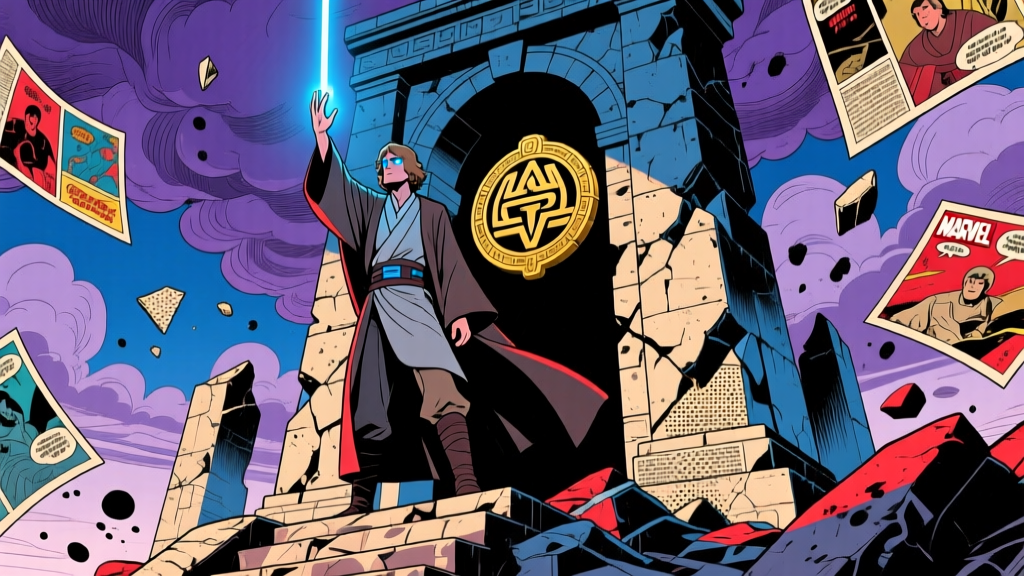
The summer of 1983 was electric for Star Wars fans. Return of the Jedi had just demolished box office records, pulling in $309 million worldwide and cementing George Lucas's space opera as the defining franchise of the decade. But while audiences were still buzzing about the Emperor's demise and Vader's redemption, Marvel Comics was working on something special — a four-issue miniseries that would become the definitive comic adaptation of the original trilogy's finale.
Here's what most people don't realize: the Return of the Jedi comic book 1983 adaptation wasn't just another licensed cash-grab. It was a carefully crafted piece of sequential art that brought together some of the industry's finest talent, operating under intense deadline pressure and the watchful eye of Lucasfilm. The result? A comic that still holds up four decades later, both as a faithful retelling of the film and as a standalone piece of Star Wars storytelling.
The Dream Team Behind the Adaptation
When Lucasfilm needed a creative team to adapt Return of the Jedi, they didn't have to look far. Archie Goodwin and Al Williamson had already proven their Star Wars credentials with the acclaimed newspaper comic strips that ran from 1980 to 1984. Goodwin, a veteran writer who'd cut his teeth at Warren Publishing and Warren's Creepy and Eerie magazines, understood how to translate cinematic action into sequential panels without losing momentum.
Williamson, on the other hand, was Lucasfilm's first choice for Star Wars illustration work. The artist had spent decades building a reputation as one of the industry's most technically proficient draftsmen, heavily influenced by Alex Raymond's legendary Flash Gordon strips. His clean linework and mastery of figure drawing made him uniquely suited to capture the likenesses of Harrison Ford, Mark Hamill, and Carrie Fisher while still delivering dynamic action sequences.
The full creative team assembled for this project reads like a who's-who of 1980s comics talent:
- Writer: Archie Goodwin
- Penciller: Al Williamson
- Inker: Carlos Garzon
- Colorists: Christie Scheele and Bob Sharen
- Letterer: Ed King
- Cover Artist: Bill Sienkiewicz
Bill Sienkiewicz's cover art deserves special mention. Known for his experimental approach to comic art, Sienkiewicz delivered covers that captured the epic scope of the film while adding his distinctive stylistic flair. His painted covers for the miniseries remain some of the most iconic Star Wars comic covers ever produced, blending photorealistic portraiture with bold, impressionistic backgrounds.
From Magazine to Miniseries: The Publication Journey
The Return of the Jedi comic book 1983 adaptation actually hit shelves twice, in two different formats. The first version appeared in Marvel Super Special #27, a magazine-format publication that hit newsstands in May 1983 — the same month the film premiered. This oversized edition featured the complete adaptation in a single package, priced at a hefty $2.25 (roughly equivalent to $7 today when adjusted for inflation).
But Marvel wasn't done. Recognizing the commercial potential of the property, they reprinted the adaptation as a standard four-issue miniseries, which began shipping in October 1983 and concluded in January 1984. Each issue carried a cover price of $0.60 and ran approximately 22 pages, making it accessible to the typical young comic reader who might have balked at the magazine's premium price point.
"The Return of the Jedi miniseries is a reprint book that serialized the Marvel Super Special adaptation. It gave kids who couldn't afford the magazine a chance to own the story in a format they could collect month to month."
— Comic book historian commentary, ClassicComics.org forums
The miniseries format proved wildly successful. According to circulation data from the era, the first issue alone sold over 500,000 copies across all printings — a staggering number that reflected both the Star Wars brand's power and Marvel's distribution muscle in the direct market.
Breaking Down the Four-Issue Run
Each issue of the miniseries covered a distinct act of the film, with chapter titles that evoked the pulp serials that inspired George Lucas's original vision:
| Issue | Chapter Title | Cover Date | Key Events |
|---|---|---|---|
| #1 | In the Hands of Jabba the Hutt | October 1983 | Luke's rescue attempt, Rancor pit, Sarlacc |
| #2 | The Emperor Commands | November 1983 | Vader and Emperor arrive, Death Star II |
| #3 | Mission to Endor | December 1983 | Ewok village, shield generator assault |
| #4 | The Final Duel | January 1984 | Throne room battle, Vader's redemption |
Goodwin's scripting had to condense a two-hour film into roughly 88 pages of comic storytelling. This meant making tough choices about which scenes to expand and which to compress. The Jabba's Palace sequence, which opens the film with nearly 30 minutes of screen time, gets a tighter treatment in the comics — but Goodwin and Williamson manage to preserve the tension of Luke's confrontation with the Hutt while streamlining some of the more leisurely establishing shots.
Where the Comic Diverges from the Film
Any adaptation faces the challenge of translating a visual medium into another visual medium — but comics operate under fundamentally different rules than cinema. The Return of the Jedi comic book 1983 version makes several notable departures from its source material, some born of necessity and others representing genuine creative choices.
The most obvious difference lies in pacing. The film's leisurely opening at Jabba's Palace, which builds tension through extended sequences of droids wandering through corridors and elaborate musical numbers, gets compressed significantly. Goodwin understood that comic readers in 1983 expected forward momentum on every page, and Williamson's art delivers action beats with machine-like efficiency.
Character interiority also plays a larger role in the comic. Where the film relies on Mark Hamill's performance to convey Luke's internal conflict during the throne room scenes, the comic uses caption boxes and thought balloons to externalize his struggle. This was standard practice for 1980s comics, but it gives the adaptation a slightly different emotional texture — more introspective, more explicitly psychological.
One sequence that the comic handles particularly well is the Battle of Endor. The film's crosscutting between space combat, ground assault, and the throne room confrontation creates a symphony of parallel action that would be nearly impossible to replicate exactly in static panels. Instead, Williamson and Goodwin chose to focus on key moments, using splash pages for the Death Star's destruction and smaller panel grids to convey the chaos of the Ewok ambush. The result feels less like a shot-for-shot reproduction and more like a reimagining tailored to the strengths of the comic medium.
The Art Question: Likeness vs. Style
Al Williamson faced an impossible task: render recognizable portraits of three of the biggest movie stars on the planet while maintaining his own artistic voice. His solution was to aim for what comic art historians call "suggestive likeness" — capturing the essential features and body language of the actors without attempting photorealistic reproduction.
Williamson's Han Solo reads as Harrison Ford through posture and expression rather than exact facial features. His Luke Skywalker carries Mark Hamill's intensity through body language and the set of his jaw. This approach allowed Williamson to maintain the fluid, dynamic storytelling that made his newspaper strips so acclaimed, rather than getting bogged down in reference-photo accuracy that would slow down his production schedule.
The Williamson Aesthetic: Flash Gordon Meets a Galaxy Far, Far Away
To understand why Al Williamson's work on the Return of the Jedi comic book 1983 adaptation matters, you have to understand his place in comics history. Williamson emerged from the EC Comics generation of the 1950s, working alongside legends like Wally Wood and Frank Frazetta on science fiction titles like Weird Science and Incredible Science Fiction. His early work was characterized by an almost obsessive attention to anatomical detail and a mastery of ink wash techniques that gave his pages a painterly quality rare in mainstream comics.
By the time he took on Star Wars, Williamson had already spent years drawing Flash Gordon strips — the very property that inspired George Lucas to create Star Wars in the first place. This circular relationship gave Williamson's Star Wars work a unique authenticity. When he drew the throne room of Jabba's Palace, he was drawing on decades of experience rendering alien landscapes and exotic architecture. When he illustrated lightsaber duels, he brought the same compositional principles he'd honed drawing Flash Gordon's battles against Ming the Merciless.
Carlos Garzon's inking complemented Williamson's pencils beautifully. Garzon maintained the clarity of Williamson's linework while adding depth through strategic use of solid blacks and crosshatching. The result was art that reproduced cleanly on the newsprint paper that comics were printed on in 1983 — a technical consideration that modern readers often overlook but which was crucial to the visual impact of the finished product.
Collector Values and Market Performance
For collectors, the Return of the Jedi comic book 1983 miniseries represents an interesting corner of the Star Wars memorabilia market. While these issues don't command the astronomical prices of the original 1977 Star Wars #1 (which can fetch over $1,000 in high grade), they've maintained steady value appreciation over the past decade.
Here's what the current market looks like for collectors hunting these issues:
| Issue | Near Mint (9.4) | Very Fine (8.0) | Fine (6.0) |
|---|---|---|---|
| #1 | $45-65 | $20-30 | $10-15 |
| #2 | $25-40 | $12-18 | $6-10 |
| #3 | $25-40 | $12-18 | $6-10 |
| #4 | $30-50 | $15-22 | $8-12 |
| Complete Set (1-4) | $120-180 | $55-80 | $28-40 |
Marvel Super Special #27, the magazine-format original, typically commands higher prices — ranging from $75 to $150 in Near Mint condition, reflecting its larger page count, superior paper stock, and status as the "first appearance" of the adaptation.
CGC-graded copies (Certified Guaranty Company) command premiums, with 9.8 specimens of issue #1 occasionally selling for $200 or more on eBay. The key factors affecting value remain condition, cover centering, and spine integrity — the same considerations that apply to any Bronze/Copper Age comic.
Legacy and Historical Significance
The Return of the Jedi comic book 1983 adaptation occupies a pivotal position in Star Wars comics history. It represented the culmination of Marvel's original Star Wars line, which had been running since 1977. After this miniseries, Marvel would continue publishing Star Wars comics until 1986, but the golden age of the original Marvel run was effectively over.
Dark Horse Comics would later reprint the Goodwin/Williamson adaptation in the 1990s as part of their Classic Star Wars line, introducing it to a new generation of readers. These reprints featured digitally recolored art and, in some editions, additional pages that expanded on scenes from the film. The adaptation has since been reprinted multiple times in various trade paperback collections, most recently as part of Marvel's omnibus editions celebrating their original Star Wars run.
What makes this adaptation historically significant isn't just its commercial success or its artistic quality — though it excels in both areas. It's the fact that it represents a moment when mainstream comics could still function as a genuine mass medium, reaching hundreds of thousands of readers with stories that complemented rather than competed with their cinematic source material.
Frequently Asked Questions
Is the 1983 Return of the Jedi comic considered canon?
Following Disney's 2014 canon reset, the 1983 adaptation was reclassified as part of the "Star Wars Legends" continuity. However, it remains an important historical document and is generally considered a faithful adaptation of the film's events. Elements from the comic that align with the film remain canon by extension.
How many pages is the complete adaptation?
The four-issue miniseries totals approximately 88 pages of story content. The original Marvel Super Special #27 magazine format contained the complete adaptation in a single 68-page publication (including ads and supplementary material).
Did Al Williamson work on any other Star Wars comics?
Yes. Williamson and Goodwin produced Star Wars newspaper comic strips from 1980 to 1984, adapting both The Empire Strikes Back and creating original stories. Williamson also provided covers and artwork for various Star Wars publications throughout the 1980s. His work is widely regarded as some of the finest Star Wars illustration ever produced.
What's the difference between Marvel Super Special #27 and the 4-issue miniseries?
The content is essentially identical. Marvel Super Special #27 was a magazine-format publication (8.5" x 11") that presented the complete adaptation in one issue. The four-issue miniseries reprinted the same story in standard comic book format (6.625" x 10.25"), serialized monthly. The miniseries added new covers by Bill Sienkiewicz and slightly reformatted the art to fit the smaller page size.
Where can I read the 1983 adaptation today?
The adaptation has been reprinted in several trade paperback collections over the years. Marvel's recent Star Wars: The Original Marvel Years Omnibus volumes include the Return of the Jedi adaptation alongside the rest of the original run. Digital versions are also available through Marvel Unlimited and various digital comics platforms, including VeVe's digital collectible comics app.
Why did the comic come out after the movie?
The film's May 1983 release and the comic's October debut might seem like an unusual gap, but this was standard practice for movie adaptations of the era. The Marvel Super Special #27 magazine actually hit newsstands the same week as the film's premiere, while the monthly miniseries followed the typical production and distribution schedule for comic books, which required several months of lead time.
The Return of the Jedi comic book 1983 adaptation stands as proof of what happens when talented creators are given the space to interpret source material through their own artistic lens. Goodwin and Williamson didn't just trace frames from the movie — they reimagined the story for a different medium, bringing their decades of experience to bear on one of the biggest pop culture properties of the century. Four decades later, their work still resonates with readers who appreciate comics that respect their audience's intelligence while delivering the spectacle that made Star Wars a cultural phenomenon.