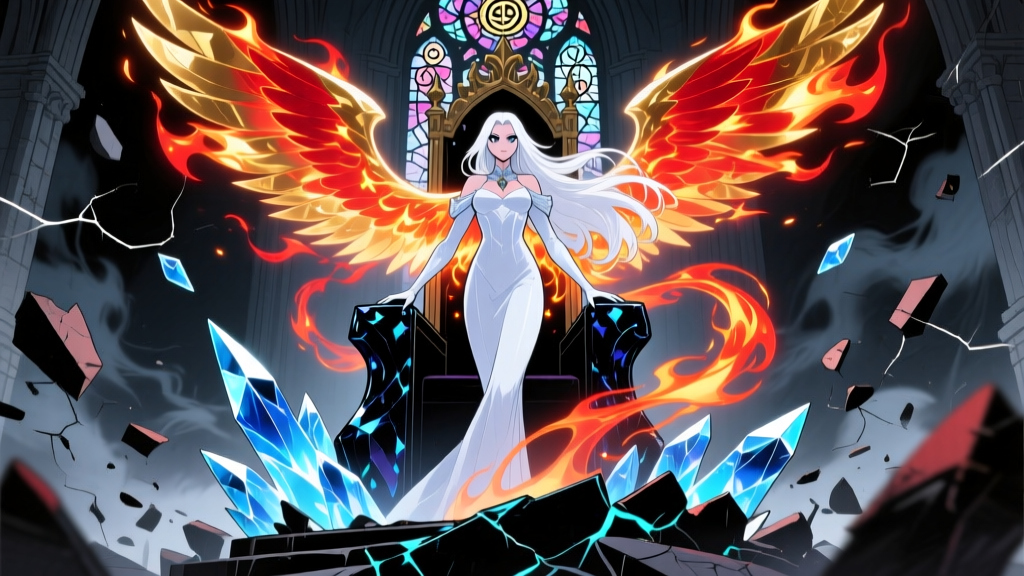
The Phoenix Force has burned through dozens of hosts across Marvel's publication history. Jean Grey. Madelyne Pryor. Rachel Summers. Even Wolverine got a turn. But few pairings have generated as much debate — or as much unease — as the moment the cosmic flame split into five pieces in 2012's Avengers vs. X-Men and one of those fragments landed squarely inside the mind of Emma Frost.
Emma was never the obvious choice. She wasn't bonded to the Phoenix from childhood like Jean. She didn't share a bloodline connection like Rachel. She was a telepath with a diamond body, a trust fund, and a moral flexibility that made her one of the most dangerous people on Krakoa — or anywhere else. And yet, when that shard of cosmic fire settled behind her sternum, something remarkable happened: she might have been the most effective Phoenix host the X-Men ever produced.
That effectiveness is exactly what should terrify you.
The Day the Phoenix Shattered Into Five
Here's the setup. Hope Summers — the so-called mutant messiah — was the Phoenix Force's intended host. The entity was racing toward Earth at a speed that made interception almost impossible. The Avengers wanted to contain Hope. The X-Men, led by Scott Summers, believed she was their species' last real shot at survival after the decimation of House of M left fewer than 200 mutants alive on the planet.
Tony Stark built a suit of armor specifically designed to disrupt the Phoenix's approach. In Avengers vs. X-Men #5 (written by Brian Michael Bendis, 2012), Stark fired the armor's Phoenix-disruption beam. It worked — sort of. Instead of destroying or deflecting the Phoenix Force, the blast shattered it into five discrete fragments. Each fragment bonded with a different mutant standing on the battlefield.
The Phoenix Five were born in that instant:
- Cyclops (Scott Summers) — field commander, tactical mind, already prone to moral certainty
- Emma Frost — Omega-level telepath, diamond-form body, former villain turned X-Man
- Namor — Atlantean king, temper that makes Wolverine look diplomatic
- Colossus (Piotr Rasputin) — gentle soul inside an unstoppable metal body
- Magik (Illyana Rasputin) — Colossus's sister, ruler of Limbo, sorceress with a dark streak
Notice something about that list? Emma Frost is the only one whose primary mutation is telepathic. She's also the only one whose power set overlaps almost completely with Jean Grey's. That's not a coincidence the narrative lets you forget.
Emma Frost Made the Most Terrifying Phoenix Host
The Telepathic Baseline Before the Flame
Most Phoenix hosts experience a power boost that manifests as raw energy — fire, flight, matter manipulation. The Phoenix Force is, at its core, a psionic entity. It amplifies what's already there. For Emma Frost, that meant the Phoenix didn't just give her more power. It gave her better power.
Emma's telepathy already ranked among the strongest on Earth before the Phoenix fragment arrived. She could read minds across planetary distances, project astral forms, create telepathic illusions indistinguishable from reality, and — in a move that still gets debated in comic forums — once mentally dominated the entirety of the Hellions squad simultaneously during her White Queen days in Uncanny X-Men #132-134 (Chris Claremont, 1980).
Global Peace Through Psychic Force
Add Phoenix amplification to that baseline, and you get a telepath who could reshape global consciousness. And she did.
During the Phoenix Five's brief utopian phase — roughly issues #6 through #9 of AvX — Emma used her Phoenix-enhanced telepathy to end armed conflicts by simply making soldiers unwilling to fight. She walked into war zones and the guns stopped. Not because she destroyed them. Because every person holding a weapon suddenly, inexplicably, didn't want to pull the trigger anymore.
"She didn't end wars by burning the combatants. She ended them by rewriting their willingness to hate. That's a level of psychological intrusion that makes mind-reading look like a parlor trick."
— Analysis from Marvel's Phoenix: The Untold Story retrospective, 2018
That passage captures the core tension of Phoenix Force Emma Frost. The things she accomplished were, by any humanitarian metric, good. Wars stopped. People who had been trying to kill each other for decades put down their weapons and went home. But she did it by reaching into seven billion minds and adjusting the settings without asking permission.
The Phoenix didn't corrupt Emma by making her evil. It corrupted her by confirming what she already suspected: that she knew better than everyone else, and that her judgment should be final.
Diamond and Flame: The Power Interaction That Shouldn't Work
One of the stranger details about Emma Frost's Phoenix hosting involves her secondary mutation — the organic diamond form. Since New X-Men #116 (Grant Morrison, 2001), Emma has been able to transform her entire body into a flexible organic diamond substance. The tradeoff has always been explicit: diamond form grants near-invulnerability and superhuman strength but completely shuts down her telepathy. You get the fortress, but you lose the radio.
The Phoenix Force ignored that rule.
As a Phoenix host, Emma could maintain her diamond form and continue using telepathy simultaneously. The Phoenix energy essentially bridged the gap between her two mutations, allowing the psionic output to flow through the crystalline structure of her diamond body. In visual terms, this produced some of the most striking artwork in the entire AvX run — Emma Frost as a faceted diamond figure wreathed in cosmic flame, light refracting through her body at angles that turned her into a living prism of Phoenix fire.
From a power-scaling perspective, this made Phoenix Emma arguably the most dangerous member of the Phoenix Five in direct confrontation:
| Host | Primary Power Boost | Key Feat | Weakness |
|---|---|---|---|
| Cyclops | Optic blasts → cosmic energy projection | Defeated World War Hulk-era Hulk single-handedly | Increasingly unstable judgment |
| Emma Frost | Telepathy → global mental domination + diamond synergy | Ended multiple global conflicts telepathically; defeated Thor in combat | Psychological arrogance amplified |
| Namor | Aquatic powers → ocean-level environmental control | Flooded Wakanda (leading to catastrophic retaliation) | Temper; first to lose control |
| Colossus | Organic steel → Phoenix-forged metal body | Matched Juggernaut-level physical force | Emotional conflict with sister Magik |
| Magik | Sorcery + teleportation → Limbo-Phoenix fusion | Opened portals across dimensions simultaneously | Dark magic amplified Phoenix corruption |
Emma defeating Thor deserves its own paragraph. In Avengers vs. X-Men #9, Thor — a being who has fought Celestials, traded blows with the Hulk for hours, and survived the vacuum of space — engaged Phoenix Emma Frost. She dismantled him. Not through brute force, which would have been a losing proposition against the God of Thunder, but through a combination of Phoenix-enhanced telepathic assault and diamond-form physical resilience. Thor couldn't break her body, and he couldn't shield his mind. That's the White Queen's specialty: finding the one vulnerability you can't protect and pressing it until something gives.
The Jean Grey Problem: Two Telepaths, One Flame
You can't discuss Phoenix Force Emma Frost without addressing the other telepath in the room. Jean Grey's relationship with the Phoenix is foundational — the original Dark Phoenix Saga from Uncanny X-Men #129-138 (Claremont and Byrne, 1980) established the Phoenix-Jean bond as one of Marvel's defining cosmic narratives. Over the decades, that bond has been retconned, resurrected, and re-examined so many times that Marvel's own continuity guides have trouble keeping track.
But the core comparison people want to make is simple: Jean is the Phoenix's "true" host, and Emma was an accident.
That framing undersells what happened in AvX. The Phoenix Force didn't accidentally bond with Emma Frost. When the entity shattered into five pieces, each fragment sought a compatible host. The Phoenix is a psionic entity — it gravitates toward telepathic resonance. Emma's mind, already one of the most powerful on Earth, was a natural landing pad. The Phoenix didn't settle for Emma. It chose her.
The rivalry between Jean and Emma extends well beyond Phoenix hosting. Both women loved Scott Summers. Both served as headmistresses of mutant schools. Both are Omega-class telepaths whose power profiles are nearly identical on paper. The difference has always been philosophical: Jean approaches telepathy as an intrusion that requires restraint. Emma approaches it as a tool that requires competence.
Side-by-Side: The Two Great Phoenix Telepaths
| Aspect | Jean Grey | Emma Frost |
|---|---|---|
| First Phoenix bonding | X-Men #101 (1976) | AvX #5 (2012) |
| Phoenix connection type | Innate / metaphysical bond | Fragment absorption (external event) |
| Primary manifestation | Raw cosmic energy, telekinetic surge | Psionic amplification, mental domination |
| Secondary mutation interaction | Telekinesis enhanced proportionally | Diamond form + telepathy merged (rule-breaking) |
| Corruption arc | Dark Phoenix — destructive rampage, self-sacrifice | Dark Phoenix — ideological extremism, Professor X's death |
| Post-Phoenix recovery | Multiple resurrections; Phoenix accepted as destiny | Guilt, incarceration, eventual return to X-Men |
The key difference sits in that corruption arc. When Jean went Dark Phoenix in 1980, the manifestation was visceral and explosive — she consumed a star, destroyed an inhabited moon, and ultimately chose suicide on the Moon's surface rather than risk killing again. It was operatic. It was tragic. It was fundamentally about a good person losing control of an alien power she never asked for.
Emma's Dark Phoenix corruption in AvX was quieter and far more disturbing. She didn't lose control. She became more of herself. The Phoenix amplified her existing conviction that her way was the correct way, that her moral framework — flexible, pragmatic, unapologetic — should be imposed on the world. She didn't burn cities. She made decisions about who deserved to think what. And she did it calmly.
That's the version of Phoenix corruption that keeps comic scholars writing essays. Jean's Dark Phoenix was a natural disaster. Emma's was a policy decision.
The Professor X Murder and What It Revealed
The Phoenix Five's utopian phase ended predictably. One by one, the hosts began losing their grip. Namor flooded Wakanda in a fit of rage — an act that destroyed one of the most technologically advanced nations on Earth and killed untold numbers of civilians. Colossus and Magik fell to their own corruptions. The Phoenix fragments were eventually consolidated, through combat and manipulation, into Cyclops alone.
But the most consequential act of Phoenix Emma Frost came before that consolidation. In Avengers vs. X-Men #11, Emma — operating as a Dark Phoenix host alongside Cyclops — participated in the confrontation that led to Professor Charles Xavier's death. Scott Summers, consumed by the full Phoenix Force, killed his mentor. Emma was present, complicit, and arguably instrumental in the psychic environment that made the murder possible.
The fallout was immediate. The X-Men fractured. Cyclops was imprisoned. Emma was arrested by the Avengers and held in custody — a development that All-New X-Men #1 (Bendis, 2012) addresses directly when the original five X-Men are brought forward in time and learn what happened to their teacher.
Emma's response to her incarceration reveals something important about her character that the Phoenix arc merely highlighted rather than created. She didn't deny responsibility. She didn't claim the Phoenix made her do it. In subsequent issues, particularly during the All-New X-Men trial storyline, Emma argued that the Phoenix had simply given her the means to do what she already believed was necessary. The Phoenix didn't change her values. It removed the constraints that prevented her from acting on them.
"The Phoenix didn't make Emma Frost a villain. It made her a god. And the terrifying thing is that she was already halfway to believing she should be one."
— Character analysis, X-Men: The Art and Making of the Animated Series companion materials, 2015
After the Fire: Emma Frost's Post-Phoenix Arc
The Phoenix left scars. Not physical ones — Emma's diamond form healed, as it always does. The damage was relational and political. She had been part of a team that killed Charles Xavier, the man who founded the school where she taught, the dream she had ostensibly dedicated herself to protecting.
The Krakoa Recalibration
In the years following AvX, Emma Frost's characterization shifted noticeably. Writers like Brian Michael Bendis (in All-New X-Men) and later Jonathan Hickman (in House of X / Powers of X, 2019) wrote Emma as someone carrying a specific kind of guilt — not the guilt of having done something unforgivable, but the guilt of having been proven wrong about her own judgment. Emma had always believed she could handle more power than anyone else. The Phoenix gave her that chance, and she failed.
Hickman's Krakoa era (beginning 2019) gave Emma a fascinating post-Phoenix role. As one of the Quiet Council's most politically savvy members, Emma Frost on Krakoa operated with the kind of restraint she'd never shown before the Phoenix incident. She was still ruthless. She was still manipulative. But there was a caution in her — a willingness to let other people make decisions, even bad ones, that the pre-Phoenix Emma would never have tolerated.
That caution reads as trauma response to anyone paying attention. Emma Frost learned, at the cost of Charles Xavier's life, that unlimited power doesn't require unlimited confidence. It requires the opposite. And she's never quite recovered from that lesson.
The writers who shaped Emma's post-Phoenix characterization each emphasized different facets of her recovery:
- Brian Michael Bendis (All-New X-Men, 2012–2015) — focused on Emma's guilt and her confrontation with the time-displaced original X-Men
- Tom Taylor (Injustice 2 tie-ins, various X-titles) — emphasized Emma's political maneuvering as a shield against emotional vulnerability
- Jonathan Hickman (House of X / Powers of X, 2019) — reframed Emma as a Quiet Council strategist whose Phoenix-era restraint made her more dangerous, not less
- Matthew Rosenberg (X-Men: Phoenix, 2023) — explored the Phoenix's lingering psychic residue in Emma's mind and her complicated relationship with the entity's legacy
What a Full Phoenix Bond Would Mean for Emma
The Phoenix Five each received a fragment — roughly one-fifth of the entity's total power. That fraction was enough to make Emma Frost capable of defeating Thor and reshaping global consciousness. The question that lingers in Marvel's narrative background: what happens if Emma Frost ever receives the complete Phoenix Force?
No writer has explored this scenario in mainline continuity, and there's a reason for that restraint. A complete Phoenix bond requires a host whose telepathic capacity can accommodate the entity's full scope. Jean Grey has done it — with results ranging from the godlike to the catastrophic depending on the era. Rachel Summers managed it in the Days of Future Past timeline. Madelyne Pryor achieved something close during Inferno (1989).
Emma Frost's telepathy is, by Marvel's own power rankings, comparable to Jean's in raw capacity. Her mental discipline — honed through decades of operating in hostile psychic environments, surviving telepathic combat with entities like Cassandra Nova and Onslaught — would theoretically make her one of the most stable complete hosts available. The diamond form's interaction with Phoenix energy, already proven during AvX, would likely produce unique manifestations that no other host could replicate.
But stability isn't Emma's problem. Perspective is. The Phoenix amplifies intent, and Emma's intent has always been tangled up with control, superiority, and the unshakable belief that her solutions are better than yours. A complete Phoenix bond wouldn't temper those traits. It would validate them on a cosmic scale.
Imagine an Emma Frost with the full Phoenix Force deciding — calmly, rationally, with perfect logical justification — that certain people should think differently. Not through violence. Through adjustment. That's the scenario that no Marvel writer has dared to put on the page, and it's the one that every serious X-Men reader has considered at some point.
The White Queen's Cosmic Legacy in X-Men Lore
Phoenix Force Emma Frost occupies a strange position in X-Men canon. She's not the definitive Phoenix host — that title will always belong to Jean Grey, whose metaphysical connection to the entity predates most of the X-Men's existence. But Emma's tenure as a Phoenix host produced some of the most intellectually honest writing about what cosmic power actually does to a person who already thinks they deserve it.
The AvX event itself has been revisited and recontextualized multiple times since 2012. Marvel's 2023 X-Men: Phoenix limited series by Matthew Rosenberg explored the Phoenix's return and its history with various hosts. The event's legacy informed Hickman's entire Krakoa run, where the Phoenix's absence was as notable as its presence — a cosmic force conspicuously uninvolved in mutant governance, as if the entity itself was giving the species space to figure things out without its interference.
For fans who came to X-Men through the animated series, the games, or the MCU's upcoming mutant integration, Phoenix Force Emma Frost represents one of the franchise's most compelling what-ifs. She's the host who proved that the Phoenix doesn't just amplify power. It amplifies character. And character — the messy, arrogant, brilliant, deeply flawed character of Emma Frost — is what makes the X-Men worth reading about in the first place.
Emma Frost never asked for the Phoenix. But then, she's never been the type to ask for anything she planned to take anyway.
Questions Readers Keep Asking
Was Emma Frost actually a Phoenix host, or just powered by it?
She was a genuine Phoenix host. The distinction matters in Marvel lore. Being "powered by" the Phoenix implies a temporary energy transfer — like borrowing a battery. Hosting means the Phoenix fragment bonded with Emma's psionic signature, integrating with her consciousness on a level that changed both the host and the entity. Every member of the Phoenix Five was a true host. The fragment inside Emma wasn't a loan. It was a piece of a cosmic entity that chose her mind as a home, however briefly.
Could Phoenix Emma Frost beat Jean Grey?
At equal Phoenix power levels — say, each hosting one-fifth of the entity — Emma has demonstrated advantages that Jean hasn't. The diamond form gives Emma a physical defense that Jean's telekinesis-based protection can't match. Emma's telepathic style is also more aggressive and less constrained by ethical hesitation. In AvX, Phoenix Emma defeated Thor, while Phoenix Cyclops (with equal fragment power) struggled against comparable opposition. That said, Jean's deeper metaphysical connection to the Phoenix means she can access abilities that Emma can't — like Phoenix resurrection and timeline manipulation. Raw fight? Emma probably wins. Cosmic scope? Jean still holds the edge.
Why did the Phoenix choose Emma Frost specifically?
The Phoenix Force is a psionic entity. When it shattered into five fragments during AvX #5, each piece sought a compatible psionic host. Emma Frost is one of the strongest natural telepaths on Earth — an Omega-level mutant whose mental capacity rivals Jean Grey's. From the Phoenix's perspective, Emma's mind was a viable anchor point. The entity doesn't evaluate moral fitness. It evaluates capacity. And Emma had more capacity than almost anyone else on that battlefield.
Did Emma Frost regret killing Professor X?
Emma's response to Xavier's death was characteristically complicated. She expressed guilt — not the dramatic, self-flagellating kind that Cyclops exhibited, but a quieter acknowledgment that her judgment had been wrong. In All-New X-Men and later Death of Inhumans-adjacent storylines, Emma demonstrated a caution she'd never shown before. She didn't beg forgiveness. She adjusted her behavior. For Emma Frost, that adjustment was the most honest form of regret she was capable of offering.
Has Emma Frost been a Phoenix host since AvX?
Not in mainline Marvel continuity (Earth-616). Since the 2012 event, Emma Frost has not re-bonded with the Phoenix Force. She's appeared in Phoenix-adjacent stories — including the 2023 X-Men: Phoenix series — but as a non-host character. Various alternate-universe stories and What-If scenarios have explored Phoenix Emma in different contexts, but the primary Marvel universe has kept her separate from the entity since AvX. Whether that separation holds depends entirely on which writer gets the next Phoenix event.