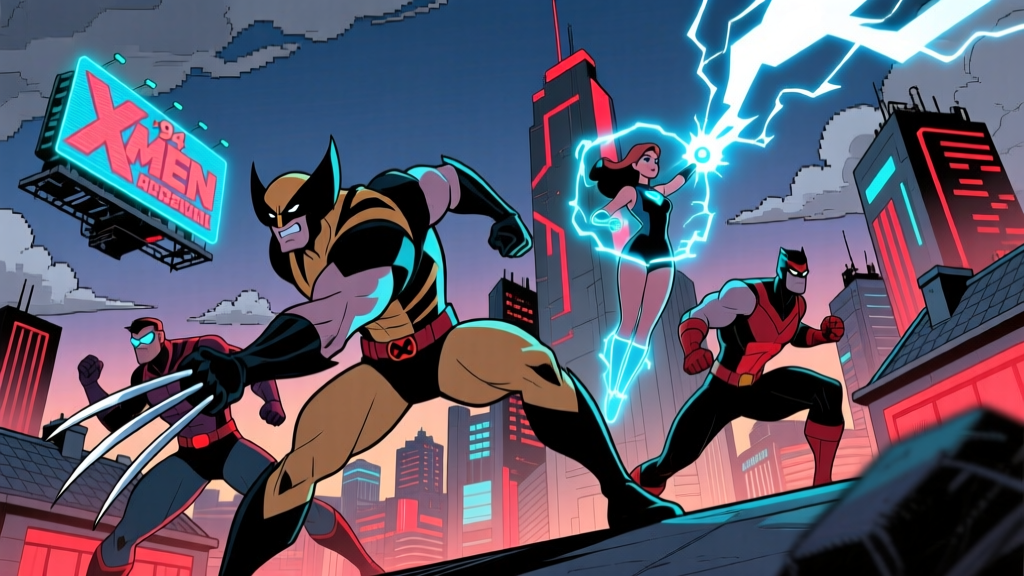
It's 1992. You're cross-legged on a carpet that probably smells like fruit snacks, the TV is humming static for half a second before Fox Kids kicks in, and then — those horns. That guitar. A theme song that hits you in the chest like a Sentinel's fist. Five mutants stride through a cityscape in matching yellow-and-blue spandex, and for the next twenty-two minutes, nothing else in the world matters. That was the spell X-Men: The Animated Series cast on an entire generation, and thirty-two years later, we're still living in its afterglow.
Before this show existed, the X-Men were a comic-book concern — huge among readers, invisible to everyone else. The 1989 Pryde of the X-Men pilot had died quietly, and Marvel's animation track record in the early '90s was, to be generous, embarrassing. Nobody in the industry expected a Saturday morning cartoon about mutants fighting for a world that hates them to become a cultural event. But that's exactly what happened when X-Men: The Animated Series premiered on October 31, 1992, and it changed the rules for what animated television could get away with.
The Production Gamble That Shouldn't Have Worked
Here's a detail most retrospectives skip: the show almost didn't exist. Fox Kids president Margaret Loesch greenlit the project in 1991, reportedly over the objections of her own programming staff, who thought a show built around prejudice, identity, and moral ambiguity would fly over kids' heads. Loesch, a former Marvel Productions executive, had spent years trying to get an X-Men cartoon made. She knew the property had teeth. She also knew that by 1992, the X-Men comic — driven by Chris Claremont's nearly seventeen-year run and the explosive sales of X-Men #1 (1991), which moved over 8.1 million copies — was a pop-culture juggernaut waiting to break into the mainstream.
The production landed at Graz Entertainment (later renamed Saban Entertainment's animation arm), with Eric Lewald and Julia Lewald as story editors and Larry Houston directing. The voice cast included Cathal J. Dodd as Wolverine, a role he would define for decades; Lenore Zann as Rogue; Cal Dodd doubling as various bit parts; and the late Norm Spencer as Professor X, whose gravelly warmth became the moral compass of the series. The budget was modest — roughly $350,000 per episode for the first season, which was mid-range for network animation at the time — but the team punched above it with a design philosophy that leaned hard into comic-book panels rather than the rubbery, squash-and-stretch aesthetic that dominated children's TV.
Will Meugniot, the show's supervising producer and a veteran of G.I. Joe and Transformers, pushed for what he called "illustrated radio" — dense, dialogue-heavy scripts with cinematic framing that assumed the audience was smart enough to follow. It was a creative bet that paid off in ways the network didn't anticipate.
Storytelling That Refused to Talk Down to Kids
The first two episodes aired as "Night of the Sentinels," a two-parter that set the tone with startling clarity. Within the first ten minutes, the show established: a government-sanctioned robot army is hunting mutants, Professor Xavier runs a school that doubles as a paramilitary base, Wolverine has metal bonded to his skeleton and a temper to match, and the entire mutant experience is one of being feared by the people you're trying to protect. That's a lot of thematic furniture to cram into a Saturday morning timeslot, and the show never once paused to explain it in simple terms. It trusted you to keep up.
What made the series unusual wasn't just that it tackled heavy subject matter — plenty of '90s cartoons gestured at social commentary. It was the specificity of the storytelling. "Welcome to the Jungle," a second-season episode, followed Morph through a psychological breakdown after being presumed dead, dealing with trauma and identity loss in a way that had no precedent in children's animation. "One Man's Worth," another second-season standout, presented a time-travel narrative where Professor Xavier's assassination in the past creates a dystopian future — a concept ripped from the pages of "Days of Future Past" and adapted with remarkable fidelity.
"We weren't writing for children. We were writing for anyone who would watch. The network gave us notes, sure, but they mostly left us alone because the ratings were strong. We used that freedom recklessly."
The show also did something that still feels radical: it let its characters lose. Not every episode ended with the good guys triumphant. Jean Grey succumbs to the Phoenix Force. Wolverine fails to save people he cares about. Cyclops watches the woman he loves get consumed by a cosmic entity and has to carry on. The emotional stakes were real because the show was willing to follow through on consequences, a quality that separated it from the reset-button storytelling of most animated series then and now.
The Dark Phoenix Saga: Adapting the Unadaptable
Every X-Men fan has a relationship with the Dark Phoenix Saga. In the comics, Chris Claremont and John Byrne's 1980 storyline is considered one of the foundational texts of modern superhero fiction — a cosmic tragedy about power, corruption, and sacrifice that ends with Jean Grey's death on the Moon. The 2006 film, X-Men: The Last Stand, reduced it to a subplot. The 2019 film, Dark Phoenix, tried again and somehow managed to make it worse. But in 1994, a Saturday morning cartoon with a fraction of those budgets got it right.
The five-part "Dark Phoenix Saga" aired during the show's third season (technically branded as the second production season due to Fox's scheduling chaos). The adaptation made necessary compromises: the Hellfire Club became the Inner Circle, the Shi'ar Empire's role was streamlined, and some of the cosmic scale was necessarily reduced. But the emotional core — Jean's slow corruption by the Phoenix Force, the X-Men's desperate attempts to save her, and the final confrontation — survived intact.
What's remarkable about this adaptation is how it handled Jean Grey's agency. The Phoenix isn't something that happens to Jean; it's something she chooses, moment by moment, as the power seduces her. The animation during her transformation sequences — the fire reflecting in her eyes, the gradual shift from green Phoenix flames to the red-black corruption of Dark Phoenix — remains some of the most visually inventive work in '90s American animation. And the finale, where Jean rejects the Phoenix and sacrifices herself rather than risk becoming a threat, carries genuine weight because the show spent five episodes building her internal struggle.
How the Animated Dark Phoenix Compared to the Comics
| Element | Claremont/Byrne Comics (1980) | Animated Series (1994) |
|---|---|---|
| Episode/Issue Count | 9 issues (Uncanny X-Men #129–137) | 5 episodes (Season 3) |
| Hellfire Club | Full roster: Shaw, Frost, Pierce, Selene | Reduced to Inner Circle; Shaw and Emma Frost featured |
| Jean's Fate | Commits suicide on the Moon with a Kree laser | Rejects the Phoenix; body placed in stasis (later returns) |
| Shi'ar Empire | Central role; Imperial duel on the Moon | Mentioned briefly; Lilandra appears but the empire's role is minimized |
| Dazzler | Appears in Hellfire Club sequence | Absent entirely |
| Emotional Core | Jean's love for Scott vs. cosmic corruption | Faithful adaptation; adds Madelyne Pryor subplot |
Fatal Attractions: Magneto Gets the Respect He Deserved
If the Dark Phoenix Saga proved the show could handle cosmic tragedy, "Fatal Attractions" proved it could handle moral complexity without flinching. Airing during the third season as a two-parter, this arc adapted one of the most celebrated X-Men comic stories of the 1990s: Magneto's return as a sympathetic antagonist who may actually be right.
The animated version streamlined the comic's sprawling crossover but preserved its essential question: what happens when the villain's grievance is legitimate? Magneto, voiced with theatrical menace by David Hemblen, doesn't monologue about world domination. He talks about survival. He points to the Sentinel program, to mutant registration acts, to the daily violence mutants face from ordinary humans, and he asks Xavier — calmly, almost gently — what exactly the dream of peaceful coexistence has gotten them. The show doesn't pretend he's wrong. It just shows you why Xavier can't accept his methods.
The visual design of "Fatal Attractions" also deserves attention. Magneto's asteroid base, Avalon, was rendered with a stark, brutalist aesthetic that contrasted sharply with the X-Mansion's warm wood panels and bookshelves. The color palette shifted to cold blues and steel grays whenever Magneto dominated a scene, reinforcing his isolation. And the sequence where Wolverine's adamantium is ripped from his skeleton — a moment lifted directly from the comics — was animated with a visceral intensity that had parents writing letters to Fox. The network's Standards and Practices department flagged it. The production team fought to keep it in. They won.
This arc also introduced the idea that the X-Men's unity was fragile. Wolverine leaves the team after the adamantium extraction, beginning a solo storyline that wouldn't resolve for over a season. Cyclops and Jean's relationship strains under the weight of her Phoenix trauma. Storm questions Xavier's leadership. The show was building a universe where actions had consequences that rippled across episodes, a serialized approach that was virtually unheard of in children's animation at the time.
That Theme Song — and Why It Still Wrecking-Ball Your Nervous System
Let's talk about the horns.
Four notes. Da-da-da-DAAA. If you grew up in the '90s, those notes are hardwired into your brain stem alongside your Social Security number and your locker combination. The X-Men: The Animated Series theme song, composed by Shuki Levy, Haim Saban, and Ron Wasserman, is a 76-second piece of music that accomplishes something most film scores can't manage in two hours: it makes you feel something immediately and completely.
The composition is deceptively simple. A horn-driven fanfare opens over a shot of the X-Men logo, then the guitars kick in — power chords that underscore each character introduction. Wolverine's claws snikt. Cyclops fires an optic blast. Storm summons lightning. Rogue flies through a wall. Each gets roughly four seconds of screen time, enough to establish their power and personality without a word of dialogue. The whole thing is a masterclass in visual economy, and it taught a generation of kids who the X-Men were before a single line of story dialogue aired.
The theme's cultural impact is difficult to overstate. When Disney+ revived the franchise as X-Men '97 in 2024, the decision to re-record the original theme rather than compose a new one was treated as non-negotiable by the creative team. Showrunner Beau DeMayo confirmed in interviews that testing alternate theme music produced immediate negative reactions from audiences. The horns were the X-Men. You couldn't have one without the other.
"That theme song did more for mutant awareness than thirty years of comic books. It's the Pachelbel's Canon of superhero music — you hear it and something in you just responds."
Defining the X-Men for a Generation That Didn't Read Comics
Between 1992 and 1997, X-Men: The Animated Series aired 76 episodes across five seasons on Fox Kids. During that run, it reached an estimated weekly audience of 4.5 million viewers at its peak (Nielsen data, 1993–94 season), making it one of the highest-rated animated programs on American television. For context, that's roughly the audience size of a mid-tier primetime sitcom — except this was a cartoon airing on Saturday mornings and weekday afternoons, timeslots that networks traditionally considered low-value.
The show's success triggered a merchandising explosion that rivaled anything Disney was doing at the time. Toy Biz, which held the master toy license for Marvel properties, generated an estimated $120 million in X-Men animated-series-branded merchandise in 1993 alone, according to industry reports in Toy & Hobby Retailer. Action figures, trading cards, lunch boxes, bedding, school supplies — the X-Men animated aesthetic became inescapable. The yellow-and-blue team uniforms, designed for the show and loosely based on the comic costumes of the era, became the default visual shorthand for the X-Men in the public consciousness.
For millions of viewers, this show was the X-Men. Not the Claremont/Byrne comics. Not the Grant Morrison run. Not the films. When these viewers eventually encountered the source material, they did so through the lens of what the cartoon had taught them: Wolverine is the breakout character. Magneto is sympathetic. Jean Grey dies. Professor X is a moral absolutist. The animated series created a template that every subsequent adaptation has had to contend with, and none has fully escaped.
By the Numbers: X-Men TAS in Context
- 76 episodes produced across 5 seasons (1992–1997)
- 4.5 million peak weekly viewers (Nielsen, 1993–94)
- $120 million in licensed merchandise revenue (1993, Toy Biz)
- 13 main characters voiced across the series run
- 31 years between the original finale (1997) and the X-Men '97 premiere (2024)
X-Men '97: The Revival Nobody Saw Coming
When Disney+ announced X-Men '97 in November 2021, the reaction ranged from cautious optimism to outright skepticism. Animated revivals had a spotty track record — DuckTales (2017) had succeeded brilliantly, but Animaniacs (2020) had stumbled, and the idea of recapturing the magic of a '90s cartoon three decades later felt like a recipe for disappointment.
Showrunner Beau DeMayo, a lifelong X-Men fan who had previously written for The Witcher: Nightmare of the Wolf, approached the revival with a philosophy that can only be described as reverent disruption. The show would continue directly from the original series' cliffhanger finale — Xavier and Lilandra departing for the Shi'ar Empire, the X-Men leaderless and uncertain — while updating the animation to modern standards and expanding the narrative scope. The original voice cast was brought back where possible, with replacements cast for characters whose voice actors had passed away or retired. Cal Dodd returned as Wolverine. Alison Sealy-Smith took over as Storm from the late Iona Morris. Chris Potter was replaced by Ray Chase as Gambit, and the late Tony Jay's Mister Sinister was inherited by Chris Britton.
The results exceeded expectations so thoroughly that they surprised even Disney's internal projections. X-Men '97 premiered on March 20, 2024, and became the most-watched animated series premiere in Disney+ history, pulling in an estimated 18 million viewing hours in its first five days (per Disney's internal metrics reported to Variety, March 2024). The first season's Rotten Tomatoes score settled at 98% from critics and 95% from audiences — numbers that place it among the highest-rated animated series of any kind, not just superhero cartoons.
What made X-Men '97 work wasn't nostalgia, although the show deployed it skillfully. It was the willingness to escalate. Episode 5, "Remember It," destroyed Genosha — the mutant island nation — in a sequence of staggering violence that killed thousands of on-screen characters, including several fan favorites. The episode aired on the same week that the X-Men films had largely avoided depicting mutant genocide at scale, and the animated series' willingness to show it in vivid, horrifying detail felt like a direct rebuke to the live-action franchise's tendency to sanitize its own stakes.
Original Series vs. X-Men '97: The Evolution
| Aspect | X-Men: TAS (1992–97) | X-Men '97 (2024) |
|---|---|---|
| Animation Style | Cel animation; AKOM studio (South Korea) | Digital 2D with compositing; Studio Mir |
| Episode Length | ~22 minutes (broadcast slot) | 28–42 minutes (streaming flexibility) |
| Content Rating | TV-Y7 (children's programming) | TV-14 (mature themes, violence) |
| Continuity | Standalone arcs; some serialization | Direct continuation; heavy serialization |
| Platform | Fox Kids (broadcast) | Disney+ (streaming) |
| Theme Song | Original composition (Levy/Saban/Wasserman) | Re-recorded arrangement, faithful to original |
The Legacy Nobody Can Escape
Thirty-two years after that first Saturday morning broadcast, the fingerprints of X-Men: The Animated Series are everywhere. The 2000 X-Men film directed by Bryan Singer borrowed its core cast lineup — Wolverine, Cyclops, Jean Grey, Storm, Professor X, Magneto — directly from the cartoon's roster, and Hugh Jackman has said in interviews that he watched episodes of the show to prepare for his portrayal of Logan. The yellow-and-blue costumes that the MCU's X-Men will presumably eventually wear? Those entered the cultural bloodstream through the cartoon, not the comics, where the team wore a rotating wardrobe of Chris Claremont's increasingly impractical designs.
More importantly, the show proved that animated storytelling could carry serialized, emotionally complex narratives — a lesson that Avatar: The Last Airbender, Star Wars: The Clone Wars, and Invincible would later build upon. When Eric Lewald told interviewers that the team "wasn't writing for children," he wasn't being dismissive of young audiences. He was articulating a principle that has since become an industry standard: respect the viewer's intelligence, and they will reward you with attention that transcends demographic categories.
The X-Men have always been a metaphor for the marginalized — mutants as stand-ins for anyone who has been told they don't belong, that their difference is dangerous, that assimilation is the price of acceptance. The animated series took that metaphor and made it legible to eight-year-olds without diluting it. That might be its greatest achievement: it taught a generation that being different isn't a flaw to overcome. It's a power to wield. And sometimes, the world will hate you for it anyway, and you fight for it regardless.
That's not a children's show. That's a life philosophy, delivered between commercials for Fruit Roll-Ups and G.I. Joe action figures.
Questions People Still Ask About X-Men '94
Why is the animated series called "X-Men '94" when it started in 1992?
The "X-Men '94" nickname comes from the show's cultural peak in 1994, when the Dark Phoenix Saga aired, merchandise sales hit their highest point, and the series became a genuine mainstream phenomenon. The name was popularized online in the 2010s as fans distinguished the original animated series from later adaptations. The 2024 revival, X-Men '97, continued this naming convention by referencing the year after the original's timeline ended.
Did X-Men: The Animated Series follow the comics closely?
The show adapted major comic arcs — Dark Phoenix, Fatal Attractions, Days of Future Past, the Phalanx Covenant — but frequently condensed, rearranged, or combined storylines for television. Characters who never met in the comics appeared together, and some arcs were invented entirely for the show (such as the extensive Apocalypse storyline). The approach was closer to "inspired by" than strict adaptation, though the most celebrated episodes tended to be the ones closest to their source material.
Why was the show cancelled in 1997?
The cancellation was a combination of declining ratings (a natural erosion after five seasons), Fox Kids' shifting programming strategy toward newer properties, and reported tensions between the production team and network executives over content restrictions. The final episode, "Graduation Day," ended on a cliffhanger — Xavier departing for the Shi'ar Empire — that went unresolved for 27 years until X-Men '97 picked up the thread.
Is X-Men '97 canon to the original series?
Yes. X-Men '97 is explicitly a continuation of the original animated series, not a reboot. It picks up directly from the cliffhanger ending of the 1997 finale and features the same character designs, updated animation, and returning voice cast members. Showrunner Beau DeMayo has described it as "season 6" of the original show in spirit, though it carries a separate title for branding purposes.
Where can I watch the original X-Men animated series?
The complete series is available for streaming on Disney+ in most regions. Physical media releases include DVD box sets released by Buena Vista Home Entertainment (2006–2009), though these are out of print. Select episodes have also appeared on digital storefronts like Amazon Prime Video and Apple TV for individual purchase.
SenpaiSite — Otaku Culture Division — June 2026