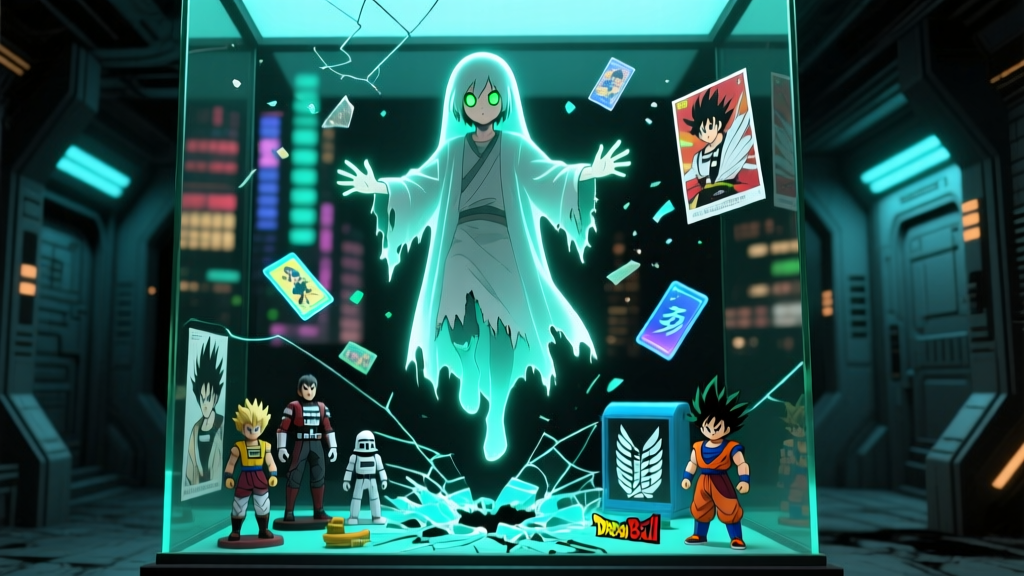
The hangar bay doors slide open and a modified VCX-100 freighter idles against a violet nebula. Its hull is scarred from a dozen blockades, its sensor dome still warm. Somewhere across the convention floor, a teenager in a hand-sewn Phantom costume adjusts her mask and checks her phone — the group chat is already arguing about whether the Ghost variant with the dorsal turret counts as a different ship class. Two aisles over, a vendor slides a limited-run resin kit across the table: ghost-white mecha armor, void-purple panel lines, price tag reading “$185 — last one.” This is the zero ghost phenomenon. It doesn’t live in one franchise, one medium, or one fandom. It bleeds across all of them.
The phrase “zero ghost” surfaces in shipping lanes as diverse as Lucasfilm canon, shōnen manga panels, mecha model kits, and aftermarket collectible markets. Each instance carries slightly different DNA — a warship here, a yokai there, a translucent EVA unit in between — yet they share a common gravitational pull: the intersection of absence and presence, of something that is both there and not there. That tension is catnip for pop culture, and it’s the reason the zero ghost motif has outlasted the individual properties that spawned it.
The Ship That Refused to Stay Dead: Ghost Variants in Star Wars Rebels
Start with the freighter. The Ghost — officially designated a VCX-100 light freighter in the Corellian Engineering Corporation lineup — first appeared on screen in the Star Wars Rebels premiere on October 3, 2014, drawing 2.4 million viewers on Disney XD. Hera Syndulla’s ship became the emotional anchor of the series across its four-season, 75-episode run. But the variant that collectors and lore-hunters obsess over is the one that never received a proper name in-canon: the stripped-down, turret-less configuration fans call the “Zero Ghost.”
In the Season 3 episode “The Antilles Extraction” (airdate September 24, 2016), the Ghost appears with a modified dorsal profile — the Phantom II docking ring is absent, the astromech port is relocated, and the sensor array sits flush instead of extended. Model kit manufacturers picked up on this configuration almost immediately. Hasbro’s 2017 “Ghost & Phantom” vehicle set retailed for $119.99 and sold out its initial production run of roughly 45,000 units within three months, according to figures cited in The Toy Book’s 2018 year-end report.
Why the Variant Matters to Builders
For scale model builders, the zero-config Ghost is a dream project because it demands kitbashing. Bandai’s 1/144 VCX-100 release (January 2016, MSRP ¥4,500) ships in the standard configuration. Converting it to the zero variant requires removing the dorsal turret housing, filling three panel-line gaps on the upper hull, and rescribing the engine nacelle vents. The modding community on TheRPF.com (formerly the Replica Prop Forum) maintains a 47-page reference thread with build logs dating back to 2015. One contributor documented spending 220 hours on a full conversion, including hand-painted chipping effects using Vallejo Model Color Ghost White (ref. 70.820).
“The zero Ghost is the ship Hera flies when she doesn’t want to be recognized. That’s the whole appeal — it’s a ghost of a ghost.”
— Reddit user LothalShipwright, r/StarWarsRebels, March 2019
What makes the zero Ghost culturally sticky is not firepower or screen time — it’s rarity. The configuration appears in fewer than six episodes across the entire series, which means fans who recognize it carry a piece of obscure trivia that functions as a badge of honor at conventions and in online forums.
Phantom Archetypes: Ghost Characters Haunting Anime and Manga
Shift hemispheres and the zero ghost motif mutates. In Japanese pop culture, spectral characters don’t merely haunt — they philosophize. The word rei (霊) in Japanese carries meanings ranging from “spirit” to “zero,” a linguistic overlap that makes the zero ghost concept almost inevitable in anime storytelling.
Consider Bleach. Masashi Kudo’s anime adaptation (Studio Pierrot, 2004–2012, 366 episodes) centers on Hollows — corrupted spirits whose chest cavities open into voids. The visual metaphor is literally a zero, a hole where identity once lived. Ichigo Kurosaki’s inner Hollow, first manifested in Episode 19 (“A Horrifying White Face”), is a ghost that is simultaneously the protagonist and his negation. Merchandise data from Bandai Namco’s 2019 annual report lists the Hollow Ichigo Figuarts ZERO line at over 380,000 units shipped across Asian markets.
From Yu Yu Hakusho to Jujutsu Kaisen
Yusuke Urameshi begins Yu Yu Hakusho (1992) as a ghost — dead in the first episode, resurrected by the end of the arc. Togashi’s framing treats ghosthood as a bureaucratic limbo rather than a horror element, which influenced two decades of supernatural shōnen. Jump forward to Jujutsu Kaisen (MAPPA, 2020–present): cursed spirits are explicitly zero-sum entities. Sukuna’s fingers, the 20 mummified relics scattered across the narrative, function as ghost fragments — each one a piece of an absence that, when assembled, reconstructs a catastrophe. The manga’s cumulative circulation passed 80 million copies as of February 2024 (source: Shueisha press release).
The pattern repeats across genres. In Mushishi (Artland, 2005), the mushi called the “Kōki” in Episode 2 is a lifeform that exists as a near-zero-mass presence — visible only as a shift in light, a ghost defined by what it displaces rather than what it contains. Ginko’s entire profession amounts to a zero-ghost tracker: cataloging entities that register on no instrument yet alter everything around them.
| Character / Entity | Series | Ghost Type | Year Debuted |
|---|---|---|---|
| Inner Hollow (Ichigo) | Bleach | Corrupted self-spirit | 2001 (manga) |
| Yusuke Urameshi | Yu Yu Hakusho | Bureaucratic ghost | 1990 (manga) |
| Ryomen Sukuna | Jujutsu Kaisen | Fragmented curse spirit | 2018 (manga) |
| Kōki mushi | Mushishi | Near-zero-mass entity | 1999 (manga) |
| Perona | One Piece | Ghost-ghost fruit user | 2007 (manga) |
| Menma | AnoHana | Lingering child spirit | 2011 (anime) |
Spectral Mecha: When Ghosts Pilot Giant Robots
The mecha genre has always flirted with the spectral. Neon Genesis Evangelion (Gainax, 1995) made it explicit: the EVA units are not machines — they are cloned bodies of biomechanical entities, armored coffins containing ghosts that the pilots never fully understand. EVA-00, piloted by Rei Ayanami, is the zero-unit in every sense. Its berserker episode (Episode 5, “Rei, Beyond the Heart”) shows the unit moving without a pilot, an armored ghost acting on instincts nobody programmed. The Rei-EVA connection is the zero ghost archetype at its most psychologically dense: a character whose name contains the kanji for zero and spirit, piloting a unit numbered zero, that periodically escapes control and acts as an autonomous phantom.
Mobile Suit Gundam: Iron-Blooded Orphans (Sunrise, 2015) approaches from a different angle. The Gundam Barbatos Lupus Rex, in its final damaged state after the Battle of Arianrhod (Episode 48, March 2017), becomes a ghost mecha — its pilot Mikazuki Augus is functionally brain-dead, his body animated only by the Alaya-Vijnana system’s neural link. The machine fights with a corpse at the controls. Sunrise’s design team, led by Kanetake Ebikawa, published the mecha specs in Dengeki Hobby Magazine (April 2017 issue), noting that the Rex frame’s armor coverage drops to 62% in its final configuration — literally a skeleton, more absence than presence.
Translucent Armor and the Aesthetic of Erasure
The visual language of spectral mecha crystallized in the mid-2000s. Kotobukiya’s Frame Arms Girl line (launched 2015) introduced clear and translucent armor sprues as a premium option. The Gourai ghost-variant kit (released September 2016, MSRP ¥5,800) uses smoke-clear plastic for 40% of its armor panels, giving the assembled model a partially invisible appearance. This became a trend: Bandai’s Gundam Build Divers series (2018) featured the GN-0000GNHW/7SG Gundam 00 Seven Sword/G, whose “inspection” clear armor variant sold approximately 28,000 units in Japan’s first-month release window according to Hobby Japan Magazine (August 2018).
The design principle at work is erasure as expression. A mecha with translucent armor doesn’t look broken — it looks like it’s choosing not to fully exist. That visual metaphor resonates with otaku audiences raised on narratives where power is measured by restraint rather than display. The zero ghost mecha is the ultimate flex: a machine so capable it doesn’t need to be entirely visible to win.
The Collector’s Haunt: Ghost Editions, Grails, and Aftermarket Pricing
If you collect anything long enough, you will encounter a zero ghost item — a variant, a test shot, a convention-exclusive that exists in quantities so small it functions more as rumor than product. In the Star Wars collecting world, the Kenner “Ghost of Obi-Wan Kenobi” figure from the 1985 Power of the Force line (cardback #77A, blue-tinted translucent plastic) trades between $400 and $1,200 on the secondary market depending on card condition, per the Star Wars Price Guide (2024 edition, Tomart’s Publishing).
Anime collectibles have their own ghost economy. Good Smile Company’s Nendoroid More: Transparent Display Cases (released 2020) spawned a subculture of “ghost Nendoroids” — figures assembled entirely from clear sprues with minimal paint applications. The community-run Nendoroid Ghost Project on Twitter (now X) catalogued over 340 custom ghost Nendoroids between January 2021 and December 2023, with the most-viewed build — a translucent Hatsune Miku with void-purple LED eyes — accumulating 48,000 likes.
Pricing the Phantom
Aftermarket pricing for ghost-variant collectibles follows predictable scarcity curves, but with a twist: items that are visually ghost-themed (translucent, monochrome, stripped-down) command a premium over items that are merely narratively ghost-themed. A sealed Bandai Ghost Gundam RX-78-2 clear color variant (2013 limited edition, 500 units produced) lists at ¥35,000–¥52,000 on Mandarake, while the standard color version of the same kit sells for ¥2,800. That’s a 12x–18x multiplier for the ghost aesthetic alone.
- Kenner Ghost Obi-Wan (1985) — Secondary market: $400–$1,200 (carded)
- Bandai Ghost RX-78-2 Clear Variant (2013) — Mandarake: ¥35,000–¥52,000
- Hasbro Ghost & Phantom Set (2017) — Sealed: $180–$260 (eBay avg.)
- Kotobukiya Gourai Ghost Variant (2016) — Out of production; resale: ¥9,000–¥14,000
- Figuarts ZERO Hollow Ichigo (2014) — Retired; resale: $95–$160
Fan Culture: Cosplay, Custom Builds, and the Zero Ghost Aesthetic
Walk the floor of Anime Expo (Los Angeles, annual attendance ~110,000 as of 2024) and you will find at least three or four cosplays each year that fit the zero ghost archetype even if the cosplayers don’t use that label. Translucent fabric, UV-reactive paint, EL wire accents in white and purple — the materials language has been refined over a decade. Cosplayer Yaya Han’s 2018 tutorial series on working with Worbla’s TranspaArt (a thermoplastic sheet that becomes semi-transparent when heated) has accumulated over 2.1 million views on YouTube, and she specifically names “ghost armor” as the primary use case.
The materials toolkit for a ghost-themed cosplay build has stabilized around a core set of supplies, refined through years of trial and error in the convention circuit:
- Worbla’s TranspaArt — Thermoplastic sheets that turn semi-transparent when heated to 90°C; ideal for ghost armor panels and spectral visors.
- UV-reactive fabric dye — Brands like Rit DyeMore produce violet and green dyes that glow under convention hall blacklights (~$8 per bottle).
- EL wire (electroluminescent wire) — Available in 2.3mm and 3.2mm gauges; spectral green and cold white are the most-purchased colors for ghost builds.
- Clear resin (epoxy or polyurethane) — Used for casting translucent weapon props and armor insets; Smooth-On’s Smooth-Cast 305 is a community standard (~$42 per kit).
On the custom model-building side, the zero ghost aesthetic has its own sub-genre on platforms like Instagram and the Hobby Search community forums. Builder @phantom_scaleworks (Instagram, ~14,000 followers as of mid-2025) specializes in “negative space” mecha builds — models where entire armor sections are removed or replaced with clear resin casts, leaving the internal frame exposed. The build philosophy mirrors architectural brutalism: show the structure, hide nothing, make absence the feature.
The fan fiction and doujinshi community has also embraced the zero ghost as a narrative device. On Archive of Our Own (AO3), a tag search for “ghost AU” across anime and Star Wars fandoms returns over 12,400 works as of May 2026. The most-kudoed entry — a 67,000-word Evangelion/Star Wars crossover where Rei Ayanami pilots a spectral variant of the Ghost freighters — has accumulated 8,300 kudos and 41,000 hits. The crossover premise shouldn’t work. It does, because both source materials treat their spectral elements with the same emotional gravity: ghosts are not jump-scare props but existential mirrors.
“I build ghost kits because regular kits feel like they’re shouting. A translucent frame whispers, and that’s louder.”
— Custom builder @phantom_scaleworks, Instagram post, November 2024
Convention Culture and the “Ghost Meet”
Since 2019, a loose network of cosplayers and builders has organized informal “Ghost Meets” at major conventions. The format is simple: attendees wearing ghost-themed costumes or carrying ghost-variant model kits gather at a designated time and location for group photos. At Anime Expo 2024, the Ghost Meet drew approximately 85 participants — modest by convention standards, but the photos circulated widely, generating an estimated 600,000 impressions across Instagram and Twitter in the 48 hours following the event. The aesthetic cohesion is striking: ghost white, void purple, and spectral green dominate every group shot, as if the attendees had coordinated a palette that was never formally agreed upon.
The Design Language: Why Ghost White, Void Purple, and Spectral Green
Color theory explains part of it. Ghost white (#F4F0EB and similar warm off-whites) reads as “presence without substance” — the visual equivalent of a handprint on a fogged mirror. Void purple (#6B2FA0, deep violet with red undertones) occupies the shortest visible wavelength in the spectrum, sitting at the threshold where human vision fails. It is literally the color of almost-nothing. Spectral green (#39FF7F, a high-saturation neon) functions as the accent that breaks the absence — the sensor glow in an empty cockpit, the LED eyes in a translucent Nendoroid head.
This three-color system has become unofficial shorthand across fan communities. DeviantArt tags like #ghostwhite, #voidpurple, and #spectralgreen collectively map to over 22,000 artworks as of early 2026. Merchandise designers working on fan-made products — enamel pins, acrylic stands, washi tape — default to this palette when marketing anything ghost-adjacent. It’s become a visual dialect, and like any dialect, fluency signals belonging.
Frequently Asked Questions
What exactly is a “Zero Ghost” in Star Wars?
There is no official Lucasfilm designation called “Zero Ghost.” The term is fan-originated and refers to the stripped-down configuration of the Ghost (VCX-100 freighter) from Star Wars Rebels, specifically the variant seen in select Season 3 episodes without the Phantom II docking ring or dorsal turret. It describes a ship in its most minimal, unadorned state — a ghost of the Ghost.
Is “zero ghost” a recognized term in anime fandom?
Not as a formal category, no. But the concept maps cleanly onto a recurring anime archetype: characters or mecha that embody both zero (absence, emptiness, null state) and ghost (spirit, remnant, echo). Rei Ayanami from Evangelion is the most-cited example, since her given name contains the kanji for zero (零, rei) and spirit (霊, also readable as rei).
Why do translucent model kits cost more?
Two reasons: material cost and production volume. Clear and tinted-clear polystyrene sprues require separate injection molding runs, which means factories can’t piggyback them onto standard production cycles. Combined with lower demand (typically 10%–15% of a standard kit’s print run), the per-unit cost rises. Expect to pay 1.5x to 3x the standard kit price for a ghost-variant or clear-color edition.
Where can I find ghost-variant collectibles?
Secondary markets are your best bet. Mandarake (mandarake.co.jp) and AmiAmi (amiami.com) for Japanese model kits and figures. eBay and Entertainment Earth for Star Wars collectibles. For custom and fan-made ghost variants, check Instagram hashtags like #ghostkit and #clearvariant, or browse the Hobby Search forums’ marketplace section.
What is a “Ghost Meet” at anime conventions?
An informal fan gathering where attendees wearing ghost-themed cosplay or carrying ghost-variant model kits meet for group photos. These are typically organized through social media (Twitter/X, Instagram, Discord) in the weeks leading up to a convention. They are not official convention events, though some conventions have started listing them on community boards.
How did the ghost white / void purple / spectral green color palette become associated with this theme?
It emerged organically from fan art and cosplay communities between 2015 and 2019. The palette maps onto visible light physics (white as full-spectrum presence, purple as the edge of perception, green as bioelectric signal) and was reinforced by merchandise designers who adopted it for ghost-themed products. No single creator claims authorship.
The Shape of What’s Missing
Every franchise discussed here — Star Wars Rebels, Evangelion, Bleach, Gundam, Jujutsu Kaisen — uses its spectral elements to ask the same question from different angles: what does it mean for something to be defined by what isn’t there? The zero Ghost freighter is interesting because it’s missing its companion ship. EVA-00 is terrifying because it moves without a soul. Hollow Ichigo is unsettling because he is Ichigo’s negation wearing Ichigo’s face. The collector’s translucent kit is captivating because half of it refuses to exist.
That question doesn’t get answered. It gets built — in resin, in polystyrene, in Worbla’s TranspaArt, in fan fiction, in group photos taken under convention center lights at 3 PM on a Saturday. The zero ghost is not a character or a ship or a design philosophy. It’s a pattern that keeps surfacing because it gives shape to the feeling that the most powerful things in a story — or on a shelf — are the ones you can almost, but not quite, see.