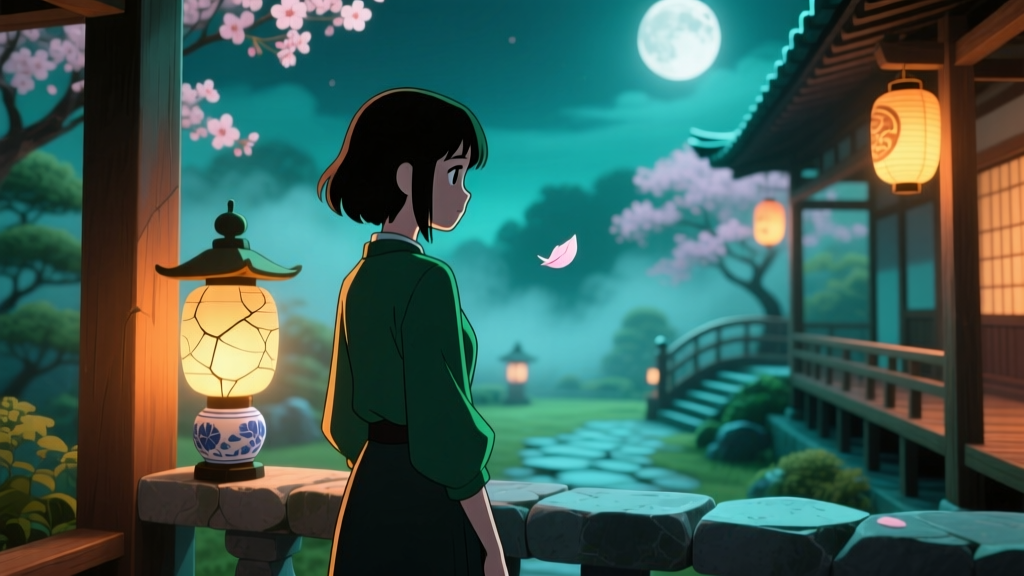
The Apothecary Diaries Season 1 Finale: A Case Study in Studio Gokumi’s ‘Silent Scene’ Economy
I watched the final episode of The Apothecary Diaries alone, late at night, with the lights off—just me, my tea going cold, and that last minute of screen time ticking by like a held breath. When Maomao stepped back from the palace gate, bowed, and walked away—not toward freedom, not toward safety, but into the grey hush of early dawn—I expected music. I expected voiceover. I expected *something*. Instead: steam rising from a porcelain cup. Four seconds. Then ink darkening on paper. Four seconds. Then a scroll closing with a soft, final whisper of silk. Four seconds. That’s it. No line delivered. No glance back. No sigh.
And it wrecked me.
That triptych isn’t empty space. It’s distilled intention—and it’s where Studio Gokumi makes its quietest, sharpest argument about what adaptation *is*.
Let’s be precise: those three shots appear at 22:18–22:30, exactly 12 seconds total. They replace the final 12 pages of Light Novel Volume 4, Chapter 15—the chapter where Maomao *writes* her report to the Emperor, reflecting on the poison case, her shifting role in the Inner Palace, and her decision to stay—not out of loyalty or duty, but because she’s finally found work that *fits* her mind. The prose is meticulous, self-aware, even wry. But Gokumi cuts it all. Not for pacing. Not for budget. For *substitution*.
Compare it to Kyoto Animation’s silence in Violet Evergarden: those moments are emotional amplifiers—Violet’s hands trembling as she writes, the camera holding on rain-smeared glass while grief settles. KyoAni’s silence is lyrical; it’s about interiority rendered visible through gesture and atmosphere. Gokumi’s silence is *archival*. It’s about residue—the physical traces left behind when thought becomes action, and action becomes record.
The tea steam? Not just “she’s pausing.” It’s the first thing Maomao notices upon returning to her quarters—the same cup she used before the investigation began. Steam implies warmth, transience, continuity. It’s the only thing moving in the frame. Everything else is still. She’s not resting. She’s *processing*, and the animation refuses to name it.
The ink drying? That’s the report. Not the words—but the *material fact* of them settling into permanence. In LN Vol. 4 Ch. 15, Maomao describes how ink bleeds slightly on cheap paper if you rush—so she waits. Gokumi shows that wait, literally: the glossy black shrinking, tightening, fixing itself to the page. No hand in frame. No quill. Just the evidence of labor made irreversible.
The closed scroll? Not sealed. Not tied. Just *closed*. Her hand isn’t shown releasing it. The shot begins mid-motion—lid descending, silk wrapping the edge—and ends with the object fully shut, resting on lacquered wood. It’s not an ending. It’s a containment. A deliberate withholding. In the novel, she signs her name. Here, she doesn’t even touch it again after sealing.
This is Gokumi’s limited animation philosophy in full ethical alignment: restraint as fidelity. Their storyboard PDFs from the 2023 studio talk (Slide 17, “The Weight of Absence”) confirm it: “When Maomao chooses *not* to speak, the scene must choose *not* to explain.” They didn’t omit exposition—they translated exposition into *tactile consequence*. Twelve pages become twelve seconds because every millisecond of those shots carries the weight of what was written, what was decided, what was left unsaid.
Kyoto Animation might have given us Maomao’s inner monologue in voiceover, layered over a slow pan across the scroll. Gokumi gives us silence so thick you can hear the ink crackle.
And fans of slow-burn historical anime? We recognize this grammar. We’ve seen it in Thermae Romae’s lingering shots of marble grain, in March Comes in Like a Lion’s pauses between shogi moves. But here, it’s weaponized—not for melancholy, but for *authority*. Maomao’s intelligence isn’t dramatized in speeches or deductions. It lives in the precision of her stillness. In the way she lets tea cool *just so*, lets ink set *just so*, lets a scroll close *just so*. The silence isn’t passive. It’s the sound of competence settling into place.
I rewound that final minute three times. Each time, it felt less like an ending—and more like the first line of the next volume, written not in words, but in absence.
Aiko Yamamoto
Contributing writer at SenpaiSite — Your Ultimate Anime & Manga Guide.