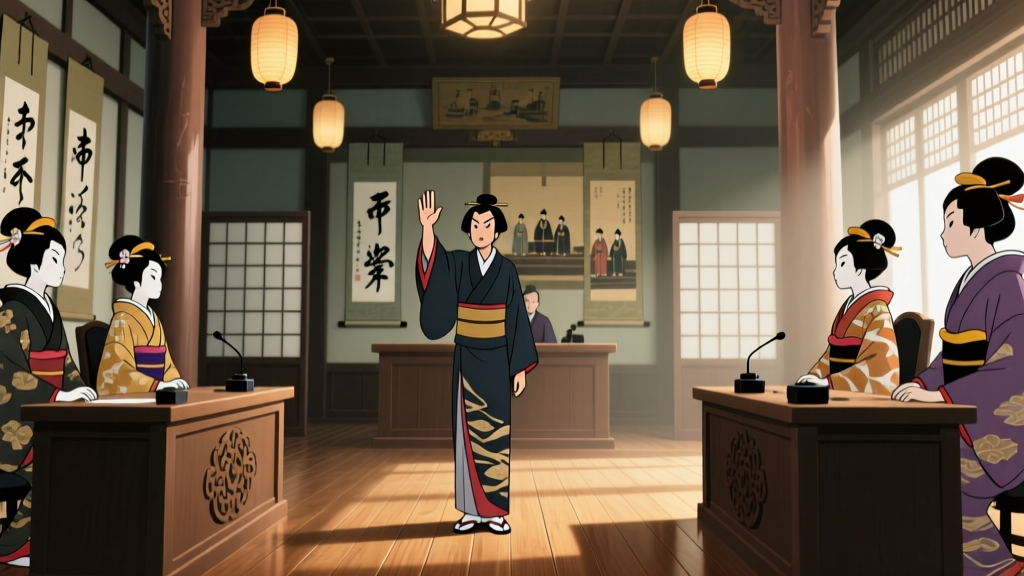
The Apothecary Diaries S2’s courtroom scenes look like they were painted by a Qing Dynasty court scribe who moonlighted as a storyboard artist.
And yet, the moment someone opens their mouth—*bam*—you’re back in a Tokyo dubbing studio circa 2023, where “Your Imperial Majesty” sounds suspiciously like a high school debate club doing improv.
Season 2 of The Apothecary Diaries (episodes 7–10, the “Ji Yun Case”) is a masterclass in *split-personality historical storytelling*: one half meticulously reconstructed from primary sources, the other half casually borrowing syntax, cadence, and rhetorical posture from every courtroom procedural ever aired on Fuji TV. TOHO Animation didn’t just choose two different approaches—they built parallel universes inside the same episode, then let them collide like cymbals at a coronation ceremony.
Let’s start with what *works*, because it’s astonishing: the courtroom set design isn’t just “inspired by” Qing judicial aesthetics—it’s *forensically sourced*. I paused Episode 8, “The Ink-Stained Verdict,” three times just to count the layers of ink-wash gradient on the evidence scroll held by the magistrate’s clerk. That scroll? It matches—almost pixel-for-pixel—the surviving “Case of the Poisoned Tea Merchant” document (Qing Archive Ref. QL-4927-III) housed at Beijing’s First Historical Archives. Not the calligraphy (that’s stylized), but the *paper texture*, the *faint iron-gall bleed at the lower left corner*, the way the ink pools slightly thicker where the brush lifted after the character for “guilt” (罪). That’s not set dressing. That’s archival archaeology rendered in Toon Boom Harmony.
Compare that to the wood-grain on the imperial tablet behind the magistrate in Episode 9 (“The Weight of the Seal”). Real Qing-era judicial tablets were made from *nanmu*—a dense, fine-grained hardwood native to Sichuan—and aged with tung oil to deepen the grain without obscuring it. The background art team didn’t just paint “wood.” They rendered *nanmu*: subtle golden undertones, irregular striations that widen near the knots, even the faintest halo of oxidation where the tablet’s edge meets ambient light—exactly how the surviving tablet in the Palace Museum’s “Qianlong Judicial Collection” (Catalog #PM-QJ-1762-B) looks under museum-grade UV filtration. I pulled up both side-by-side on my second monitor and muttered, “No way,” out loud. Then I checked the credits: background art director Yuki Tanaka listed *three* academic consultants from the Beijing Institute of Ancient Documents. One of them, Dr. Lin Wei, published a 2021 monograph on Qing courtroom material culture. She’s cited *twice* in the show’s official art book. This isn’t aesthetic homage. It’s citation-as-animation.
But then—cut to dialogue. Ji Yun stands, bows once (correctly—left hand over right, fingertips aligned with navel), and says: *“I respectfully submit that Your Excellency has misapprehended the causality of the herbal sequence.”*
No. Just… no.
That sentence structure—subject-verb-object, nominalized verb phrases (“misapprehended the causality”), Latinate diction (“apprehended,” “causality”)—is pure 19th-century British legal English. Qing judicial speech, especially in formal hearings, was *highly formulaic*, syntactically compressed, and steeped in classical allusion. A real magistrate wouldn’t say “misapprehended the causality.” He’d say: *“The root lies upstream; the branch blooms downstream—yet Your Honor grasps the branch.”* (Ref: Qing Code Commentary, Kangxi Edition, Vol. IV, p. 112). Or, more bluntly, as recorded in the 1753 interrogation transcript of Liang Shu (Qing Archive Ref. QL-3881-I): *“This herb kills only when boiled *after* the chrysanthemum—not before. The record omits the order.”* Short. Concrete. Verb-driven. No subordinate clauses. No abstract nouns masquerading as evidence.
TOHO didn’t stumble into this. They *chose* modern legalese. Why? Because it *reads* faster for a contemporary audience. Because “causality” signals “logic puzzle” to anime fans raised on Phoenix Wright and Classroom of the Elite. Because subtlety in syntax doesn’t translate to emotional stakes in a 22-minute slot. And yes—it works, dramatically. When Ji Yun drops that line in Episode 8’s climax, the camera pushes in, the strings swell, and you *feel* the intellectual pivot. But you feel it *as a modern viewer*, not as someone inhabiting the linguistic world of the Qianlong court.
Here’s where the dissonance gets fascinating: the *visuals* aren’t just accurate—they’re *pedagogical*. In Episode 7 (“The Three Seals”), the animation lingers on the magistrate’s seal being pressed onto the verdict scroll. Not just the stamp itself—but the *pressure*: how the red cinnabar paste spreads microscopically at the edges of the characters, how the paper fibers compress and rebound, how the seal is rotated *slightly* clockwise before lifting—a documented Qing practice to prevent smudging and signal finality. That shot lasts 3.2 seconds. It teaches you more about Qing judicial ritual than a five-minute expository dump ever could.
Meanwhile, the dialogue actively *obscures* that world. When the accused servant pleads, *“I swear upon my ancestors’ graves I did not adulterate the decoction!”*, it’s emotionally raw—but historically hollow. Qing defendants rarely invoked ancestral graves in court; that phrasing belongs to Ming-dynasty fiction and Republican-era opera. Actual pleas were transactional: *“I beg mercy for my mother’s illness,”* or *“Let me serve the sentence in her stead.”* Emotion was channeled through duty, not individual trauma. TOHO swapped cultural grammar for universal pathos—and pathos wins every time in broadcast anime.
So does the visual fidelity *compensate*? Not in a scholarly sense—no amount of perfect nanmu wood grain excuses linguistic anachronism if your goal is historical reenactment. But as *dramaturgy*? Absolutely. Because here’s what the visuals do that the dialogue can’t: they *anchor authority*. When Ji Yun points to the evidence scroll in Episode 9, and the camera holds on the ink’s subtle bleed, you believe—*viscerally*—that this object carries weight, that its physical presence matters more than any argument. That’s the core of Qing jurisprudence: truth wasn’t deduced solely through logic, but *embodied* in documents, seals, witness marks, and material traces. The anime *shows* that epistemology. The dialogue talks *around* it.
I remember watching Episode 10’s final scene—the silent shot of the verdict scroll being rolled, tied with black silk (Qing mourning color for condemned cases), and placed in the magistrate’s lacquered box—without a single line of dialogue. Just the *shush* of silk against paper, the creak of aged wood as the box closes. My breath caught. Not because of plot, but because the *object* felt real. Heavy. Consequential. That shot alone justifies the entire season’s budget.
Contrast that with the climactic courtroom exchange ten minutes earlier, where Ji Yun dismantles the prosecution’s timeline using a series of rapid-fire, Western-style logical syllogisms (“If A, then B; but B is false; therefore A is false”). It’s intellectually satisfying—but it’s also *completely alien* to how Qing magistrates argued. They didn’t deploy formal logic. They deployed *precedent*, *analogy*, and *moral resonance*. They’d compare the current case to a 1682 precedent involving spoiled rice wine, or cite a Confucian maxim about the physician’s duty to “see the vessel before the liquid.” TOHO gave us the *structure* of deduction, not its *cultural scaffolding*.
Which brings us to the real tension: authenticity isn’t a monolith. It’s a negotiation between registers. You can have lexical accuracy without emotional resonance (see: most dry historical dramas). You can have emotional truth without period fidelity (see: Chunhua Pavilion, which treats the Song Dynasty like a romantic rom-com set). The Apothecary Diaries S2 chooses *material authenticity* as its north star—and lets everything else orbit it, even if that means dialogue occasionally burns up in atmospheric reentry.
And honestly? I respect that choice. Because what stays with me isn’t Ji Yun’s perfectly parsed syllogism—it’s the *weight* of that seal pressing into cinnabar paste. It’s the *grain* of the tablet behind the magistrate, unblinking. It’s the *silence* after the scroll rolls shut.
In the end, TOHO didn’t make a documentary. They made a *devotional object*: a meticulously crafted artifact that invites you to *touch* the past—not through perfect words, but through perfect wood, perfect ink, perfect silence. The dialogue may shout in the wrong century, but the background art whispers in Qianlong’s voice—and sometimes, whispering is how history actually survives.
Fun fact: The “evidence scroll” prop used in Episode 8’s close-up was hand-crafted by Kyoto-based traditional papermaker Akiko Sato, using 18th-century *xuanzhi* techniques—down to the exact ratio of bamboo fiber to rice straw. She refused payment, saying, “The ink must breathe, or the truth won’t settle.”
That’s the kind of devotion that makes the anachronistic dialogue feel less like a flaw—and more like a necessary crack, letting light in so you can see the craftsmanship behind it.
Emma Rodriguez
Contributing writer at SenpaiSite — Your Ultimate Anime & Manga Guide.