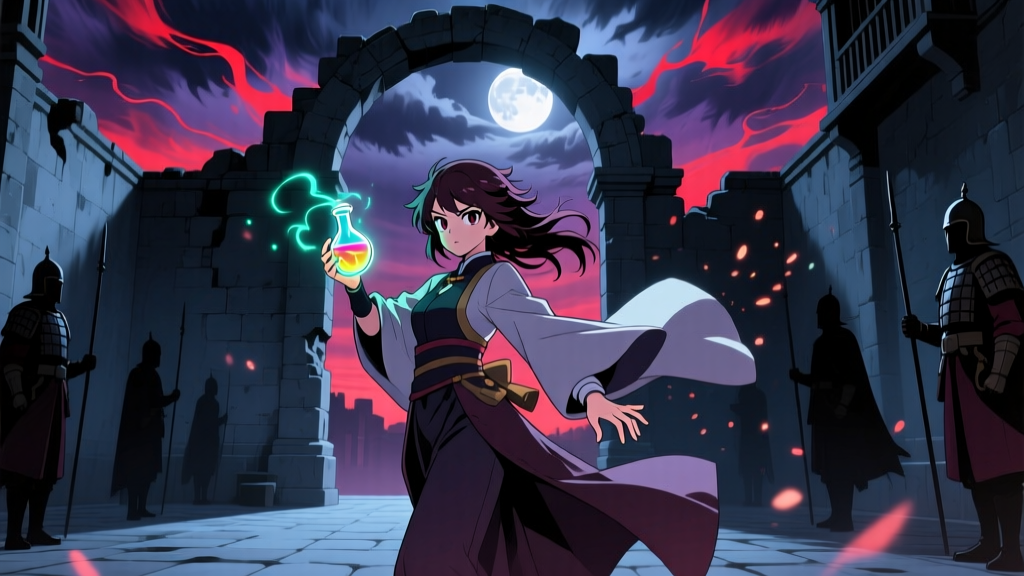
The Apothecary Diaries Season 2: Maomao Doesn’t Bow—She Dissects
Maomao doesn’t kneel when the palace guard demands it. She tilts her head, adjusts her sleeve, and asks if the wound on his left thumb was caused by a rusted latch or a poorly tempered knife blade—then diagnoses the infection before he finishes his stammered reply. That’s the first real scene of The Apothecary Diaries Season 2, and it’s not just exposition. It’s a declaration.
This season doesn’t re-establish Maomao—it refines her. Not as a “strong female lead” in the vague, marketable sense, but as a woman whose intellect is so precisely calibrated that every glance, pause, and measured silence functions like a scalpel: precise, necessary, never showy. Her wit isn’t quippy. It’s forensic.
I remember watching Episode 3—the one where she identifies arsenic poisoning in a ceremonial rice cake by the faint, acrid aftertaste left on the serving spoon—and thinking: this isn’t clever writing. It’s earned. Every deduction builds on what we’ve seen her do before: taste-testing herbs in Season 1, noting how humidity affects powdered cinnabar, memorizing the exact shade of bile in a feverish child. Her knowledge isn’t convenient. It’s cumulative. And Season 2 trusts us to remember.
Her voice hasn’t softened. It’s sharpened.
There’s no “growth arc” where Maomao learns to care more or trust more. She does care—fiercely, quietly—for Jinshi, for Lulun, for the nameless maids who vanish from the Inner Palace without record. But caring doesn’t mean compromising her method. When Jinshi suggests she “soften her tone” with the Head Eunuch, she replies, “Would you ask a surgeon to smile while suturing?” It’s not defiance for its own sake. It’s consistency. Her moral center remains fixed: truth over protocol, evidence over hierarchy, life over decorum.
What *has* shifted is her agency within the system. In Season 1, she solved cases *despite* the palace—slipping through cracks in surveillance, hiding behind anonymity, using others’ assumptions as cover. Now? She solves them *within* the architecture. She’s granted a small apothecary annex inside the Inner Palace—not as a favor, but because the Empress Dowager personally ordered it after Maomao corrected a court physician’s misdiagnosis of chronic joint inflammation (a misdiagnosis rooted in ignoring dietary history and seasonal humidity shifts). The setting doesn’t bend for her. She learns its load-bearing walls—and then repositions herself at the fulcrum.
New mysteries, same ruthless logic
Season 2 introduces three layered investigations, each operating on different frequencies of power:
- The Inkwell Poisonings: A series of slow, debilitating illnesses among junior scribes—symptoms mimicking fatigue and melancholy. Maomao traces it to iron gall ink contaminated with copper sulfate, leaching from corroded storage jars. The culprit isn’t malice, but bureaucratic negligence: the Office of Documents reused jars without proper acid-washing, prioritizing cost-cutting over preservation. This works because it mirrors real historical practices—Ming-era archival records note identical corrosion issues—and because Maomao’s solution isn’t arrest, but redesign: she drafts specifications for glazed ceramic inkwells and trains junior clerks in pH testing. Justice here is infrastructural.
- The “Ghost Perfume” Case: Women in the Consorts’ quarters report phantom scents—jasmine and burnt sugar—followed by migraines and nosebleeds. Maomao isolates the compound: synthetic coumarin, distilled from tonka beans smuggled in via diplomatic gift crates. Its source? A rival faction weaponizing traditional medicine: coumarin thins blood, exacerbating menstrual weakness in women already depleted by restrictive diets and confinement. This mystery forces Maomao to navigate not just chemistry, but gendered exhaustion—how the palace medical system pathologizes fatigue in women while ignoring environmental toxins. Her breakthrough comes not in a lab, but in the laundry yard, smelling residue on linens reused across quarters.
- The Silent Dancer: A gifted performer collapses mid-ritual dance, paralyzed from the waist down. Court physicians declare “spiritual imbalance.” Maomao observes her trembling hands, the specific atrophy in her left calf, and the faint bruising along her spine—then cross-references it with the dancer’s rehearsal schedule and the newly installed jade floor tiles in the West Pavilion. Diagnosis: repeated microtrauma from dancing barefoot on unforgiving stone, compounded by a vitamin B12 deficiency masked by herbal tonics laced with tannins that inhibit absorption. The fix? Rubber-soled slippers (disguised as “spirit-cushioning sandals”) and a dietary revision—delivered not to the dancer, but to the Head of Ceremonial Attire, who controls fabric rations and meal allocations. Power isn’t seized here. It’s rerouted.
None of these cases hinge on villains monologuing. The antagonists are systems: budget constraints, inherited dogma, spatial design, linguistic obfuscation (“spiritual imbalance” vs. “neurological compression”). Maomao wins by naming things correctly—and then building the tools to correct them. That’s the quiet radicalism of this season: healing as act of translation.
A world built in mortar, not mist
The historical texture isn’t wallpaper. It’s structural. The animators didn’t just research Song Dynasty robes—they studied how silk weaves catch lamplight at 3 a.m. during night-shift inventory checks. The sound design layers ambient noise with period accuracy: the clink of bronze weights in the apothecary scale, the hollow thud of lacquered medicine cabinets closing, the low hum of beeswax candles burning low in the East Wing corridors where eunuchs sleep upright in shifts.
Most striking is how the palace functions as a character with its own metabolism. We see the *timing*: the precise hour when the Inner Palace gates lock (not at sunset, but when the third gong sounds at the Bell Tower), the 17-minute window between the morning tea service and the Imperial Audience where Maomao can access restricted herb stores, the way rain alters the acoustics of the West Courtyard—making whispered conversations dangerously audible to those listening from the eaves. This isn’t backdrop. It’s constraint—and Maomao’s genius lies in measuring every constraint like a chemist measures solubility.
Take Episode 7. Maomao needs to test whether a suspect’s ink contains trace mercury—a process requiring distillation. But open flame is forbidden in the Inner Palace archives. So she uses focused sunlight through a polished brass mirror (replicated from extant Song texts on optical instruments), channels the beam through a water-filled quartz vial to intensify heat, and vaporizes the ink sample onto chilled bronze foil. The sequence lasts 92 seconds. No music. Just the hiss of steam, the groan of old wood settling, and the sharp, metallic scent blooming in the air. That’s the show’s thesis statement in miniature: ingenuity isn’t magic. It’s knowing your materials, your space, and your limits—and then working *inside* them with surgical patience.
There’s a moment late in the season—Episode 11—where Maomao stands alone in the newly renovated apothecary annex. Sunlight hits the rows of labeled jars: Chuanxiong, Huangqin, Bai Zhi. Jinshi enters, silent, holding two cups of tea. He doesn’t offer praise. He places one cup beside her mortar and pestle, then opens a ledger to the page where she’s logged side effects of Danggui in postpartum patients. They don’t speak. The camera holds on their hands: hers, stained faintly yellow from turmeric powder; his, calloused from sword practice. That silence isn’t romantic tension. It’s mutual recognition. Two people who operate in systems designed to erase nuance—finally speaking the same language of precision.
The Apothecary Diaries Season 2 refuses the easy arcs. Maomao doesn’t become a court physician. She remains an apothecary—by title, by training, by choice. She doesn’t gain political rank. She gains leverage: the ability to redesign inkwells, mandate slip-resistant flooring, revise dietary protocols. Her victories aren’t promotions. They’re corrections. And in a world built on rigid hierarchies, that might be the most subversive thing of all.
This season doesn’t ask us to believe in a heroine who conquers the palace. It asks us to watch one who maps it—nerve by nerve, tile by tile, molecule by molecule—until the walls themselves begin to listen.