Why does Blue Eye Samurai’s Kyoto glow like a woodblock print—and why does it feel so unnervingly intimate?
Because it’s not trying to light a scene. It’s trying to carve one.
I remember watching Episode 4—the “Night Market at Shijō”—and pausing mid-scene, not because of the action, but because of the shadow. Not the shape of it, not its direction—but its flatness. A sharp, ink-black silhouette of a lantern pole cutting across Michiko’s face as she passes beneath it, with zero gradation, no ambient bounce, no falloff. Her cheek is lit like a stage spotlight; her ear, wrapped in absolute void. My brain flickered: This isn’t how light works. This is how a chisel works.
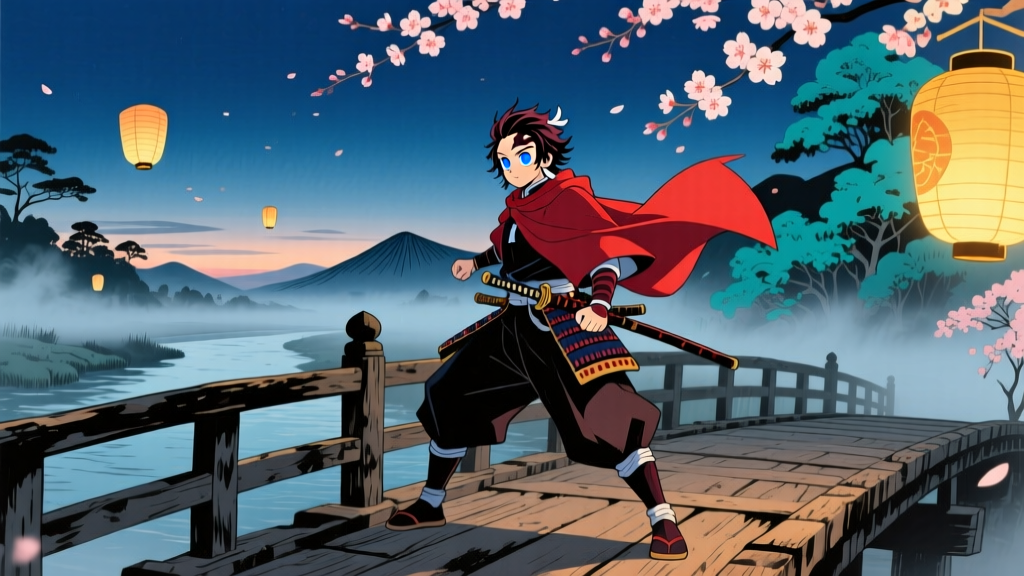
That’s the thesis—not buried, not hedged: Blue Eye Samurai’s nighttime Kyoto sequences (especially Episodes 4 and 8) don’t borrow from ukiyo-e aesthetics as decoration. They obey ukiyo-e’s optical logic as law. Not “inspired by.” Not “evoking.” They enforce its constraints—flat tonal fields, intentional visual paradoxes, rim lighting that reads less like physics and more like key-block registration—and they do it precisely where Western animation would reach for cinematic realism: in the dark.
Ukiyo-e light isn’t illumination—it’s hierarchy
Modern cinematography treats night as a problem to solve: How do we see? How do we feel safe—or unsafe—in the shadows? Ukiyo-e artists treated night as a compositional opportunity: How do we declare what matters?
Look at Hishikawa Moronobu’s Courtesan Reading (c. 1670s). The figure sits under a paper lantern—but her face isn’t softly modeled. It’s carved: a single, luminous plane of unmodulated beige, bordered by a crisp black outline. Her sleeve falls into pure, unbroken black—not because it’s unlit, but because Moronobu needed that sleeve to function as a negative space, a counterweight to the delicate curve of her neck. Light here doesn’t describe volume; it assigns value.
Blue Eye Samurai replicates this logic frame-for-frame. In Episode 8’s rooftop chase—where Michiko pursues the assassin Kaito across tiled eaves—the moonlight doesn’t wrap her shoulders. It *halos* them. Her blue obi glows with an unnatural, electric rim—not from reflected lunar light, but because the animators treated that edge like a bokashi gradient applied by hand: a deliberate tonal shift carved into the print’s key block. The background shrines and pagodas recede not through atmospheric perspective, but through stark, alternating bands of indigo and charcoal—exactly how Suzuki Harunobu layered pigment in his Twelve Months series.
This isn’t stylization. It’s translation. Every decision—from the absence of fill light on Michiko’s undershirt collar to the way smoke from a distant fire dissolves into hatched white lines instead of volumetric gray—answers the same question Moronobu asked his carvers: “What must the eye land on first?”
Contrast isn’t just visual—it’s philosophical
Compare that to Ghost in the Shell: Stand Alone Complex’s noir palette. SAC’s night scenes are masterclasses in cinematic continuity: practical sources (neon signs, dashboard LEDs), motivated shadows (a flicker from a passing train), chiaroscuro that maps psychological tension onto physical space. When Motoko stands in the rain-soaked alley in Episode 22 (“Jungle Cruise”), every droplet on her coat reflects a different source—streetlamp, hologram ad, distant police siren. It’s immersive. It’s legible. It’s cinematic.
Blue Eye Samurai refuses that legibility. Its night isn’t a space to navigate—it’s a surface to read. That’s why Episode 4’s market sequence feels claustrophobic despite wide shots: the lanterns aren’t light sources; they’re glyphs. Their glow doesn’t illuminate the vendor’s wares—it isolates them as discrete pictorial units, like figures in Utamaro’s Three Beauties of the Present Day, each existing in their own tonal island.
And yes—this distances. I felt it. During Michiko’s silent confrontation with her estranged father in Episode 8’s garden, the camera holds wide. Moonlight bleaches the gravel to bone-white; the pine branches above are cut from solid black paper. There’s no subtle shift in her expression visible—no micro-tremor in the lip, no dilation of the pupil. Just her eyes, two perfectly rendered voids within a pale oval. My Western-trained empathy flinched. Where was the subtext? The nuance? Then I remembered: Utamaro didn’t paint sorrow in the eyes. He painted it in the angle of the wrist, the slack of the sleeve, the weight of the stillness. And Michiko’s wrist *does* tremble—just once—as she lowers her teacup. You have to look for it. You have to lean in.
Does fidelity cost emotional access—or deepen it?
It depends on whether you believe emotion lives in the face or in the frame.
The show’s most devastating moment isn’t a close-up. It’s the final shot of Episode 4: Michiko walks away from the market, backlit by a thousand lanterns. Her silhouette is a single, unbroken contour—no texture, no detail, just a woman-shaped absence against radiance. That image doesn’t ask you to empathize with her exhaustion or resolve. It asks you to hold the *weight* of her isolation as a formal fact—like the empty space around a single crane in a Sesshū landscape.
Western audiences conditioned by 20 years of Pixar-level facial performance may initially read this as restraint—or worse, omission. But it’s the opposite: it’s precision. Ukiyo-e artists had no way to render subsurface scattering or dynamic range. So they weaponized limitation. They made absence speak louder than detail.
Blue Eye Samurai does the same. When Michiko removes her mask in Episode 8—not for revelation, but for erasure—the light doesn’t caress her scars. It flattens them into graphic marks, like the engraved lines on a Yoshitoshi print of a warrior bearing wounds. Her pain isn’t performed for our gaze; it’s inscribed.
The real risk isn’t alienation—it’s expectation
The danger isn’t that Western viewers won’t “get” the ukiyo-e logic. It’s that they’ll expect it to serve familiar emotional grammar—and when it doesn’t, they’ll blame the show instead of their own viewing reflexes.
Think of the lens flare in Episode 4’s climax: not the soft, organic bloom of a Cooke S4, but a jagged, geometric burst—three sharp white triangles radiating from a lantern’s flame. It looks “wrong” until you realize it’s mimicking the wood grain artifact left when a carver’s chisel slips near the edge of a key block. It’s not a mistake. It’s a signature.
That’s the quiet brilliance of Blue Eye Samurai: it doesn’t ask for cross-cultural forgiveness. It assumes fluency—not in Japanese history, but in the idea that vision is never neutral. That every choice about light, shadow, and edge is a declaration of what deserves attention, what deserves silence, and what deserves to be carved—not captured.
So no, the Kyoto nights don’t look like reality. They look like a world where reality was edited by hand, one decisive cut at a time. And if that makes your heart beat slower—not faster—that might not be a flaw.
It might be the point.