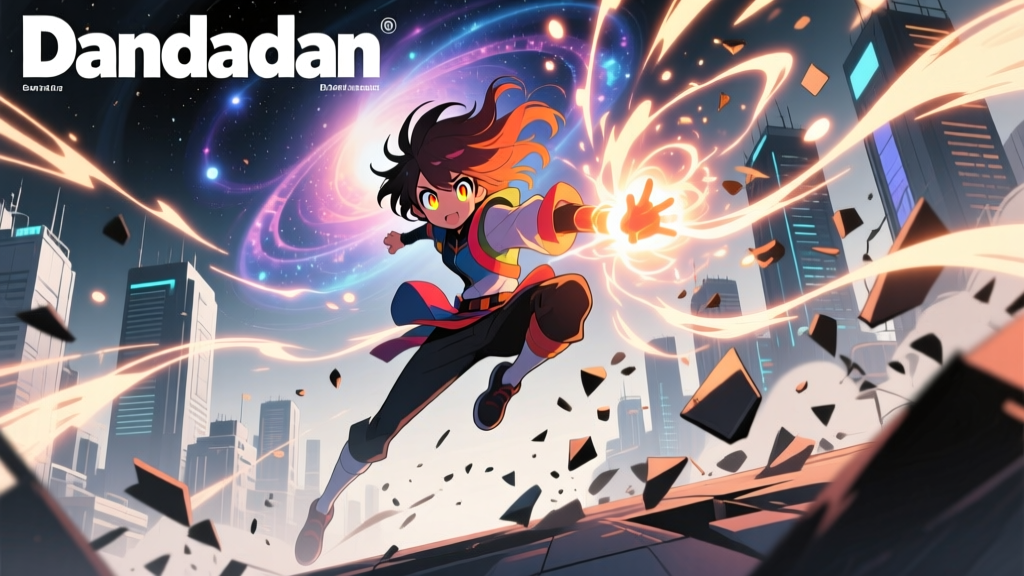
Dandadan — How Science SARU Turned a Chaotic Manga Into the Most Visually Stunning Anime of the Year
Let’s get one thing straight: Dandadan shouldn’t work. Not really. Its manga source is a fever dream of tonal whiplash—alien abductions collide with Onmyōdō exorcisms, romantic comedy beats land mid-exorcism, and every other chapter introduces a new cosmology-defying entity with zero exposition. It’s less “storytelling” and more “controlled detonation.” So when Science SARU announced they’d adapt it? I laughed. Then I watched episode 1—and immediately muted my phone to rewatch the opening sequence three times.
Science SARU didn’t just animate Dandadan. They weaponized its chaos. Every frame feels like a deliberate rebellion against anime convention. The backgrounds aren’t painted—they’re scraped, layered with visible brushstrokes, collage fragments, and hand-scribbled glyphs that pulse under neon lighting. When Momo Ayase levitates during her first spirit-summoning attempt in episode 3, the camera doesn’t track her—it shatters: split screens fracture into six simultaneous angles, each rendered in a different texture—watercolor, charcoal, cel-shaded vector, grainy VHS, ink wash, and glitch-art static—all synced to the bass drop of Masaru Yokoyama’s score. It’s disorienting. It’s exhilarating. It’s 100% Dandadan.
Faithfulness, But Not at the Cost of Breath
The manga’s biggest strength—and weakness—is its relentless density. Panels overflow with footnotes, marginalia, and fourth-wall-breaking asides from creator Yukinobu Tatsu. Science SARU preserves that spirit, but filters it through animation language. Take episode 7 (“The Great Spirit-Beast Hunt”). In the manga, the entire chapter is a single, sprawling two-page spread of overlapping action, dialogue, and scribbled commentary. The anime transforms it into a 90-second tracking shot that starts inside a possessed raccoon’s eye, spirals out through a collapsing shrine roof, flips upside-down mid-air during a punch, then lands—perfectly—in Okarun’s sweat-dampened hairline as he yells, “I’M NOT A THERAPIST!” That’s not adaptation. That’s translation.
They keep the manga’s structural anarchy intact: no recaps, no filler, no “previously on…” Even the credits roll mid-scene—episode 5 ends with Momo mid-confession about her crush on Okarun, only for the title card to slam in *over* her final word, cutting her off mid-sentence. It’s audacious. And it works because the writing never leans on exposition. You learn Okarun’s tragic backstory not through a flashback, but by watching him nervously adjust his glasses while trying—and failing—to cook instant ramen in episode 4. His grief isn’t narrated. It’s baked into the wobble of his chopsticks.
Pacing: Sprinting With Purpose
Some critics called the first cour “rushed.” I call it disciplined. Science SARU knew they couldn’t replicate the manga’s 400-page sprawl in 24 episodes—so they compressed arcs without flattening them. The UFO cult arc (chapters 38–52) becomes episodes 11–13, but instead of trimming character moments, they amplify them: we see Pastor Rokudou’s descent not through monologues, but through subtle visual decay—the color palette around him desaturates over three episodes, until his final confrontation is lit entirely in sickly yellow-green, his skin rendered in flat, cracked cel-shading like drying clay.
And yes—there are omissions. The manga’s extended dive into alien linguistics (chapters 67–71) gets condensed into a single, surreal 45-second sequence in episode 15 where Okarun’s translation app glitches into a cascade of rotating kanji, Sanskrit, and pulsing binary, all while his nose bleeds rhythmically to the beat. Is it “accurate”? No. Is it more emotionally resonant than five minutes of technobabble? Absolutely.
Standout Episodes: Where Form and Fury Collide
- Episode 6 (“The Night of the Unblinking Eye”): A bottle episode set entirely inside a haunted convenience store. The animation switches between hyper-realistic 3D modeling (for the flickering fluorescent lights) and stark, black-and-white silhouette animation (for the spirits). When Momo performs her first solo exorcism, the screen goes completely silent for 12 seconds—just the hum of the freezer and the slow drip of a leaking soda fountain—before the spirits erupt in synchronized stop-motion puppetry. Chills. Real chills.
- Episode 12 (“The Gravity of Absence”): Okarun’s origin story, told entirely in reverse chronological order—from his hospital bed to childhood—with each memory segment animated in the visual style of its era: VHS distortion for teenage years, Super Nintendo pixel art for elementary school, and finally, watercolor smudges for infancy. The final shot—a baby Okarun reaching for a floating dandelion seed that dissolves into stardust—is so quietly devastating, I rewound it twice.
- Episode 19 (“The Spiral Staircase of Nowhere”): The anime’s formalist masterpiece. A 22-minute single-take chase through a non-Euclidian apartment building, where staircases loop into ceilings, doorways open into voids filled with floating manga panels, and time dilates and compresses based on character anxiety. The animators used procedural generation tools to build the architecture in real-time—meaning no two viewings render the same hallway layout. It’s not just visually stunning. It’s philosophically coherent: the setting literally embodies the characters’ unraveling grip on reality.
I remember watching episode 19 and pausing halfway to stare at my ceiling, heart racing—not from plot tension, but from sheer awe at what animation can *do*. This isn’t just “good” animation. It’s argumentative animation. Every smear frame, every chromatic aberration, every decision to break the 180-degree rule is a thesis statement: that emotional truth matters more than literal fidelity, that chaos can be curated, and that the most radical act in mainstream anime right now is refusing to smooth anything over.
Other shows chase polish. Dandadan chases pulse. It’s sweaty, messy, loud, tender, stupid, profound—and unapologetically itself. Science SARU didn’t tame the manga’s chaos. They conducted it. Like a jazz ensemble improvising over a burning manuscript, they turned narrative entropy into something breathtakingly alive.
“The best adaptations don’t mirror their source—they metabolize it.” — Episode 14’s closing text crawl, scrawled in shaky marker over a background of melting film stock.
By that metric? Dandadan isn’t just the most visually stunning anime of the year. It’s the most honest.