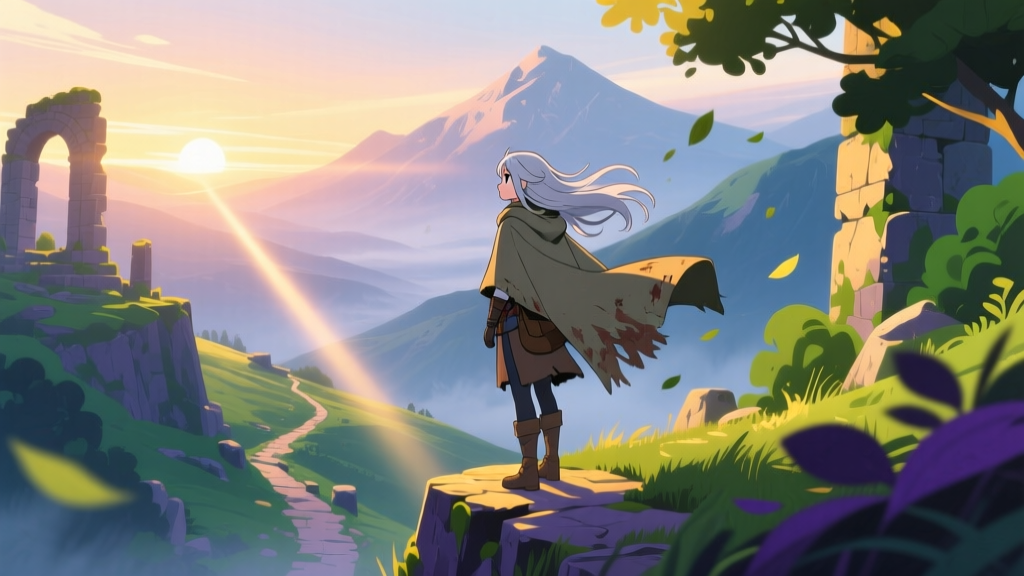
Frieren: Beyond Journey's End — Why Slow-Paced Anime Is a Masterclass in Storytelling
Episode 12. Frieren stands alone at the edge of a cliff, watching snow fall—not as a spectacle, but as something she’s seen thousands of times before. Her expression doesn’t shift. No dramatic music swells. Just silence, wind, and the soft hush of snowflakes hitting bare earth. That moment lasts twelve seconds. Twelve seconds where nothing “happens” by conventional shōnen metrics—and yet, it lands like a gut punch.
This is Frieren: Beyond Journey’s End in microcosm: a fantasy anime that refuses to sprint, even when it’s technically about a journey. While most isekai and adventure anime treat time like currency—spending it on exposition dumps, battle montages, or romantic tension—Frieren treats time like memory: fragile, cumulative, deeply personal.
Let’s be clear: this isn’t “slow” because it’s lazy. It’s slow because it’s precise. Every pause serves an emotional anchor. Every quiet scene—a shared meal with Stark, a walk through autumn woods with Fern, the way Frieren lingers just a beat too long on a human’s aging face—is calibrated to make you feel the weight of centuries. And that weight isn’t abstract. It’s tactile. You see it in the way her fingers hesitate before touching a warm cup of tea—because warmth, for her, is rare and fleeting.
Subverting the Fantasy Script, One Unheroic Moment at a Time
Frieren begins where most fantasy epics end: after the final boss is slain. The hero dies. The party disbands. The world settles into peace—and Frieren, an elf mage who outlives everyone she loves, realizes she never truly *saw* any of it.
That premise alone dismantles three genre pillars at once:
- The “Chosen One” mythos: Himmel—the human hero—is kind, brave, and selfless… but also ordinary. His death isn’t tragic because he was destined for greatness; it’s devastating because he was real. We see him fumble spells, nap mid-quest, and awkwardly compliment Frieren’s hair—only for her to blink, uncomprehending, because elves don’t register compliments the same way humans do. His humanity isn’t framed as weakness. It’s framed as precious.
- The “power progression” treadmill: Frieren is already absurdly strong. She doesn’t need to level up. Instead, she learns how to cast a simple healing spell—not for combat utility, but so she can ease a dying farmer’s pain. Her arc isn’t about becoming stronger. It’s about becoming softer.
- The “quest-as-metaphor-for-growth” cliché: Yes, she sets out to collect magic spells—but the real quest is observational. She watches humans grieve, celebrate, lie, forgive. In episode 18, she spends nearly five minutes observing children playing tag in a village square, her eyes tracking their laughter like a linguist deciphering an unknown dialect. There’s no voiceover. No inner monologue. Just her gaze—and ours—holding space for something small, mortal, and irreplaceable.
I remember watching episode 22—the “Library Arc”—and realizing I’d held my breath for thirty seconds straight. Not during a fight. Not during a revelation. During a scene where Frieren carefully transcribes a crumbling spellbook while a human archivist coughs softly in the next room. Later, we learn he’s terminally ill. She doesn’t offer grand magic. She simply finishes his favorite chapter first. That’s the show’s moral grammar: care isn’t performative. It’s procedural.
Madhouse’s Animation: Stillness as Spectacle
Madhouse didn’t just animate Frieren. They composed it.
Compare its aesthetic to Attack on Titan’s kinetic urgency or Jujutsu Kaisen’s hyper-stylized chaos—and you’ll grasp how radical its restraint is. Backgrounds aren’t just detailed; they’re textured. You see individual brushstrokes in watercolor skies. You notice dust motes catching light in sunlit taverns. In episode 7, when Frieren walks through a field of poppies at dusk, each flower sways at a slightly different speed—not because it’s technically impressive (though it is), but because it makes the world feel lived-in, breathing, impermanent.
The character animation follows the same philosophy. Frieren rarely emotes broadly. Her face moves in micro-shifts: a subtle tightening around the eyes when startled, a fractional dip of the chin when listening intently. When she finally smiles—full-face, unrestrained—in episode 34 (at Fern’s clumsy attempt to bake her a birthday cake), it lands like sunlight breaking through storm clouds. Madhouse earned that moment by withholding it for thirty-three episodes.
Even the action sequences reject flash. Take the battle against the Demon King’s lieutenant in episode 26: no rapid cuts, no speed lines. Just Frieren moving with glacial certainty, her staff tracing arcs of golden light while the camera holds wide, letting us absorb the scale of the ruins, the weight of her solitude, the terrifying beauty of her power. It’s less “fight scene,” more “ritual.” And ritual, like memory, demands presence—not distraction.
The Radical Act of Letting Go
What makes Frieren emotionally devastating isn’t just that elves live long and humans don’t. It’s that the show insists on honoring the asymmetry of grief.
Frieren doesn’t “get over” Himmel. She integrates him. She names stars after him. She mispronounces human idioms he used (“It’s not the end of the world!” → “It’s not the end of the *sky*!”). She keeps his old cloak—not as a relic, but as a blanket for cold nights. These aren’t plot devices. They’re behavioral archaeology: showing how love persists not as flame, but as ember.
The show’s thesis appears in episode 30, during a quiet conversation with Eisen: “I thought immortality meant I’d have endless time to understand people. But understanding isn’t about time. It’s about attention.” That line reframes everything. The pacing isn’t indulgent—it’s pedagogical. Every lingering shot trains us in attention. Every silent exchange asks us to sit with discomfort, ambiguity, tenderness.
“Most stories rush toward endings. Frieren understands that the ending is already here—in every goodbye, every laugh, every cup of tea shared before parting. Its slowness isn’t avoidance. It’s reverence.”
In an industry obsessed with virality, binge metrics, and “content velocity,” Frieren is a quiet act of resistance. It says: some truths cannot be summarized. Some feelings require duration to land. Some farewells need silence to echo.
By the time Frieren finally reaches the “End of the Journey” in the final arc—not a place, but a state of mind—you don’t cheer. You exhale. You close your eyes. You remember the snow on that cliff, the poppies at dusk, the sound of a human’s laugh fading down a sunlit road.
And you realize: the journey wasn’t about getting there.
It was about learning how to stay.