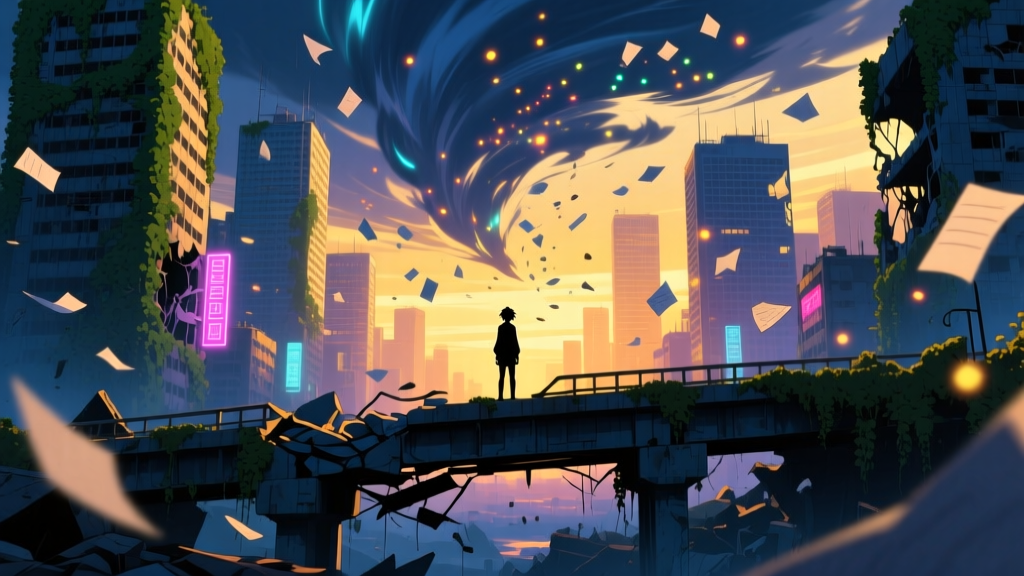
‘Heavenly Delusion’ Season 1’s Environmental Storytelling Fails Its Own Lore—Here’s Where
I watched Episode 1 of Heavenly Delusion in a dim room, rain tapping the window, fully sold on its grim beauty—the cracked concrete of the Tower, the overgrown corridors choked with ivy and dust, the eerie quiet that felt *heavy*, not just empty. By Episode 8, I was rewinding the Forest School cafeteria scene—not because it was haunting, but because I’d just re-read manga Chapter 42 and realized: *nothing here makes sense*. Not physically. Not logistically. Not even in-universe.
That’s the problem. Heavenly Delusion doesn’t build its world—it curates it. Every location is chosen for mood first, coherence second. And when your lore hinges on radiation zones, food scarcity, and decaying pre-Collapse infrastructure, “second” isn’t a luxury. It’s the foundation.
Let’s contrast how Production I.G. handled environmental storytelling in Ghost in the Shell: Stand Alone Complex—a show where every flickering ad banner, every rusted maintenance hatch, every cramped apartment layout reinforced its cyberpunk thesis: tech spreads faster than ethics can catch up. The city *breathed* consequence. In Heavenly Delusion, the ruins breathe atmosphere—and only atmosphere.
Here are three locations where the aesthetic override breaks the fiction:
The Tower: A Radiation Zone That Feels Like a Spa Resort
The Tower is canonically inside Zone 7—a high-radiation exclusion zone where even brief exposure causes epidermal necrosis (manga Ch. 12, confirmed by Dr. Kuroda’s autopsy report in Ch. 33). Yet the anime renders it as sun-dappled, breathable, and *quietly pristine*. Floors 12–15 feature intact HVAC systems humming softly, ceiling panels undamaged, even functional emergency lighting during the blackout in Episode 6. No visible lead shielding. No Geiger counter hum. No dust motes thick enough to suggest decades of unfiltered air circulation.
Compare that to SAC’s Section 9 HQ in the 2002 series: you *feel* the building’s age—the flicker of outdated biometric scanners, the way humidity warps the laminate on hallway doors, the faint ozone smell implied by static-laced audio design. SAC’s environments obey physics *and* policy. The Tower obeys cinematography.
Worse? The manga’s Chapter 42 map reveal—omitted entirely from the anime—shows the Tower anchored at the *epicenter* of Zone 7’s highest gamma spike. The anime doesn’t just skip the map; it visually contradicts it. You see Mirai walk barefoot across marble floors in Episode 4. In the manga? She wears sealed boots *inside* the lower atrium—and still develops a radiation rash on her wrist by Ch. 39.
The Forest School: A Post-Scarcity Fantasy in a Starvation Economy
Canon states: no large-scale agriculture survives outside the Dome. Wild game is scarce. Protein sources are rationed, traded, or scavenged (Ch. 21, Ch. 28). So what do we get in the anime’s Forest School? A full, functioning kitchen with stainless-steel appliances, refrigerated storage (yes—Episode 7 shows frost forming on a freezer door), and shelves lined with sealed tins labeled “Soy-Protein Paste (Batch #Δ-9)” like they’re stocking a Whole Foods.
No explanation. No visible power source. No generator hum. Just… abundance.
SAC didn’t do this. When Section 9 visited the abandoned Saitama hydroponics facility in Episode 19 (“Jungle Cruise”), the rot was *textural*: condensation dripping off corroded pipes, algae blooming in stagnant nutrient trays, a single surviving tomato shriveled on the vine. The environment told you everything: tech failed *here*, and nobody came back to fix it.
The Forest School tells you nothing except: “This looks cool in backlight.” Which is fine—if you’re making a tone poem. But Heavenly Delusion is selling itself as a mystery rooted in cause-and-effect. When Tokio opens that fridge and pulls out a thermos of hot miso soup (Ep. 7, 14:22), it doesn’t deepen the mystery—it erodes trust. Because if *this* exists, why does the Dome ration rice cakes?
The Train Car: A Pre-Collapse Artifact That Forgot Physics
The train car is the most glaring. Manga Ch. 4 confirms it’s a 2041 MagLev commuter unit—designed for vacuum-tube transit, not forest-floor parking. Its chassis should be magnetically levitated, its undercarriage stripped of wheels *entirely*. Yet the anime shows it resting firmly on rusted rails, tilted at a 12-degree angle, with visible pneumatic brake lines and *actual wheel hubs* protruding beneath.
More damning: Episode 12’s interior shot reveals a working analog clock synced to JST—and no visible battery compartment. Even more absurd? The emergency intercom panel lights up *twice*, once during the rainstorm (Ep. 5) and again when Mirai presses it (Ep. 10). No power grid. No solar array. No hand-crank. Just… light.
SAC treated tech like archaeology. Remember the Tachikoma’s damaged optical sensor in Ep. 22? You saw the micro-fracture, heard the stutter in its voice modulator, *felt* the lag before it rebooted. Every malfunction had weight. The train car’s “functionality” has zero weight. It’s set dressing pretending to be lore.
Why This Hurts More Than Most
It’s not that Heavenly Delusion lacks ambition. It’s that its ambition is misdirected. It wants us to feel wonder and dread—but wonder at *what*? Dread of *whom*? When the environment refuses to cohere, the mystery stops feeling deep and starts feeling evasive.
Production I.G. knows how to balance both. SAC’s world felt lived-in *because* its rules were visible—even when hidden. You could reverse-engineer its politics from a security camera’s blind spot. You can’t reverse-engineer Heavenly Delusion’s collapse from its sets. You can only admire their decay.
And that’s the real failure: not that it’s beautiful. But that its beauty comes at the cost of belief.
If you’ve paused mid-episode wondering, *“Wait—how are they *eating*?”* or *“Why hasn’t that roof collapsed yet?”*—you’re not overthinking. You’re responding to the show’s own broken contract.
The manga answers those questions. Patiently. Precisely. With maps, schematics, and footnotes about soil half-life.
The anime? Just turns down the lights and plays the strings louder.
That’s not mystery.
That’s misdirection.
Kenji Park
Contributing writer at SenpaiSite — Your Ultimate Anime & Manga Guide.