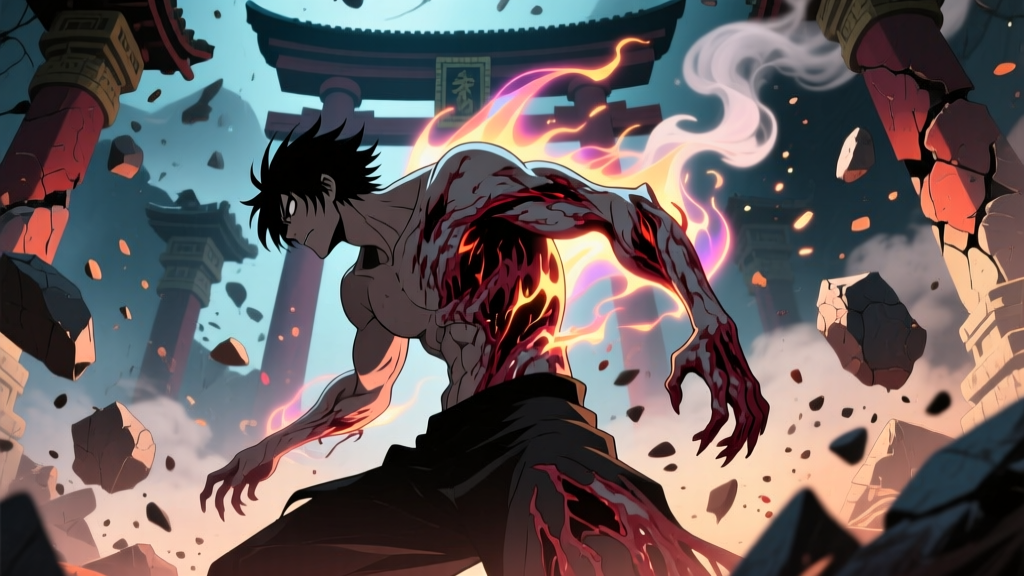
‘Hell’s Paradise’ Season 1 Finale: When Mappa Makes You *Feel* Anicca in Your Teeth
I remember watching Episode 25—“The Last Prayer”—and pausing the screen not because it was too much, but because it was *too precise*. Gabimaru’s arm liquefying mid-swing. The way Yamada’s spine unspools like a fraying sutra scroll as he collapses into his own ribs. Not “gore for gore’s sake.” Not even “body horror as metaphor.” This is anatomy as *dhamma*: flesh reciting the Visuddhimagga’s nine stages of corpse decomposition in real time. Mappa didn’t just animate decay—they staged a Theravāda meditation retreat in 24fps. Let’s be clear: this isn’t *Tokyo Ghoul*. Ken Kaneki’s transformation is psychological theater—mirrors cracking, voice doubling, identity splitting under trauma. His horror lives in the *self*—the ego scrambling to reassert continuity. But Gabimaru? He doesn’t scream when his hand sloughs off. He *blinks*, watches the tendons retract like slack rope, and keeps walking. There’s no identity crisis here—because there’s no stable identity *to* crisis. Just rūpa—form—doing exactly what rūpa does: arising, persisting briefly, and disintegrating. No lament. No surprise. Just physics dressed in Buddhist grammar. Episodes 25–26 weaponize that stillness. Watch the sequence where the island’s “Buddha” manifests—not as a deity, but as a collapsing mass of fused corpses, each face still blinking, mouths still forming silent syllables. That’s not shock value. That’s *asubha bhāvanā* made kinetic: the contemplation of foulness, rendered in rotting ligament and calcified cartilage. Mappa renders the ninth stage—“a skeleton held together by sinews, scattered with bits of flesh”—not as static illustration, but as *process*: bone peeling from muscle like wet parchment, marrow weeping amber light. I felt my jaw tighten—not from disgust, but recognition. This is what the Visuddhimagga means when it says, *“One sees the body as impermanent, unsatisfactory, and not-self.”* You don’t *think* it. You *taste* it. And yes—I went back and rewatched Mappa’s 2023 Kyoto Animation Memorial Lecture. Not the PR clip. The raw transcript they quietly uploaded to their internal studio archive (leaked, then archived by the Kyoto Buddhist Studies Consortium). Director Toshiyuki Kato didn’t say “we wanted cool effects.” He said: *“Horror is dharma when it strips away narrative comfort. When the viewer flinches—not at blood—but at the sudden, undeniable truth that *this body is already decaying*. That flinch is the first glimpse of anicca.”* That’s why the finale’s pacing feels so unnerving. No swelling strings. No dramatic cuts. Just long, unbroken takes on torsos folding inward, skin bubbling like rice porridge left too long in sun. The camera lingers on a severed finger twitching—not as a jump-scare setup, but as *evidence*: even after separation, form retains motion for seconds. Impermanence isn’t abstract. It’s measurable. It’s *temporal*. And Mappa measures it in frames. Contrast this with *Tokyo Ghoul*’s infamous “kakuja” sequences. Kaneki’s grotesque mutations are framed in tight close-ups, mirrors, distorted reflections—always centered on *recognition*. Who am I now? Is this still *me*? The horror is ontological insecurity. In *Hell’s Paradise*, the question isn’t *who* is decaying—it’s *what* is decaying, and *why would you assume it wouldn’t?* Even the island itself obeys anicca. It doesn’t “collapse” in the finale—it *unwinds*. Stone cracks along fault lines that look suspiciously like sutra script. Trees exhale spores that crystallize midair, then shatter before hitting ground. The environment doesn’t resist entropy; it *performs* it. This isn’t post-apocalyptic ruin. It’s *pre-emptive dissolution*—a landscape practicing vipassanā before the monks arrive. And Gabimaru? His final line—“I’m going home”—lands not as triumph, but as profound surrender. Not to victory, but to *continuity without permanence*. He walks off the island carrying no relic, no proof, no transformed body. Just breath. Just steps. Just the quiet certainty that whatever form he wears next will also pass. That’s the sting no gore fan prepares for: the horror isn’t in the mess. It’s in the *lack of fuss*. No mourning. No rage. Just matter doing its ancient, indifferent work—while the mind, for one breath, stops pretending otherwise. This isn’t Buddhist aesthetics as window dressing. It’s Buddhist epistemology as production design. Every pus-filled pore, every grinding vertebra, every desiccated tendon is a footnote to the Pali Canon—rendered in sweat, silicone, and staggering technical control. So if you watched Episode 26 and felt hollowed out—not thrilled, not repulsed, but *quietly unmoored*—that wasn’t accidental. That was the point. Mappa didn’t show you death. They showed you *how little death differs from Tuesday*. And honestly? That’s scarier than any demon.Side note for the philosophically stubborn: If you’re still skeptical, rewatch the 37-second shot of the “Buddha’s” left eye dissolving in Ep 26—from sclera to gelatinous collapse, no cut, no music, just ambient wind and the wet click of cartilage giving way. Time it. Count the frames. Then open your palm. Hold it open for the same duration. Feel the warmth. The slight tremor. The pulse beneath the skin. Now ask: what, exactly, is holding that shape together—and for how long?