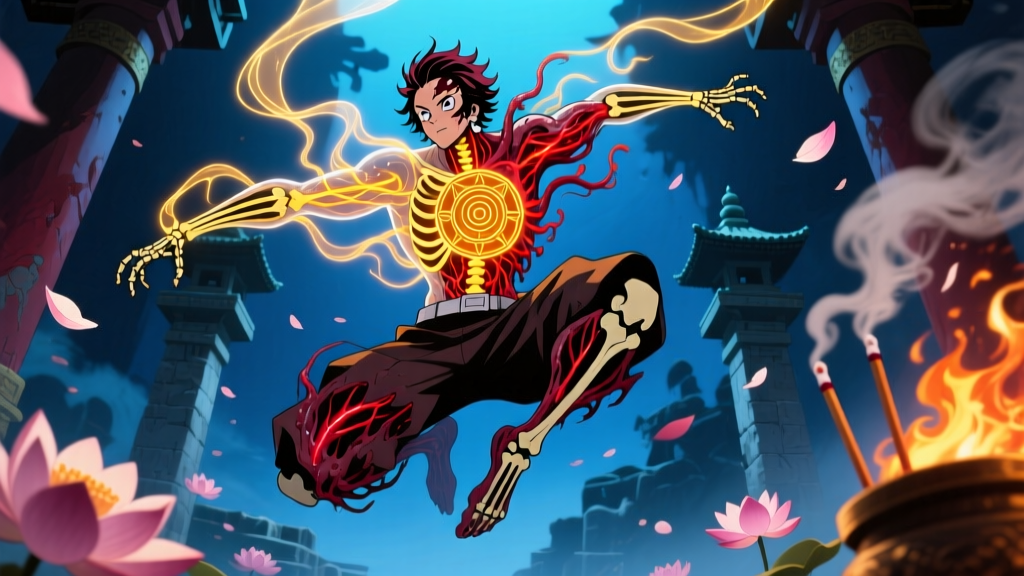
‘Hell’s Paradise’ S2 Opening Sequence: A Studio MAPPA Visual Essay on Body Horror and Buddhist Rebirth
The opening sequence of Hell’s Paradise Season 2 begins not with music—but with a breath. A wet, ragged inhale. Then, a close-up of Gabimaru’s left eye, bloodshot and unblinking, reflected in the cracked surface of a black mirror. As the first synth note pulses—low, resonant, like a temple bell struck underwater—the skin around his iris splits open vertically, peeling back like parchment to reveal not muscle or bone, but bark: dark, fibrous, veined with amber sap. That single shot is the thesis statement. Everything that follows—114 seconds of morphing flesh, dissolving boundaries, and recursive regeneration—isn’t just spectacle. It’s a visual essay in motion, written in collagen and sutra.
Directed by Yukihiro Miyamoto (who also helmed Jujutsu Kaisen S2’s most unsettling Domain Expansions), this OP doesn’t illustrate the show’s plot—it diagrams its metaphysics. Where Season 1’s opening leaned into Edo-period ink-wash aesthetics and martial grandeur, Season 2 abandons narrative signposting entirely. There are no character cameos, no quick cuts to battle stances or weapon reveals. Instead, we watch bodies unmake themselves—not as punishment, but as process.
Let’s walk through the transitions—not as animation beats, but as doctrinal markers:
- Skin → Bark (0:08–0:19): This isn’t metaphorical “hardening.” The epidermis doesn’t thicken—it lignifies. Veins become xylem; pores widen into lenticels. It maps precisely to the Naraka realm—not as eternal fire, but as the suffocating rigidity of karmic fixation. In Buddhist cosmology, Naraka beings aren’t merely tortured; they’re stuck in one mode of perception, unable to soften or adapt. The bark isn’t armor. It’s petrification.
- Bark → Ash (0:20–0:33): A slow, granular dissolution—no explosion, no wind. Just gravity pulling ash downward in silent suspension, then re-coalescing into a skeletal hand gripping a lotus stem. This is Preta territory: the hungry ghosts, whose throats are narrowed to needles, whose hunger is structural, not circumstantial. The ash doesn’t vanish; it accumulates, piling up in hollows, clogging nostrils, filling mouths mid-breath. I remember watching this frame-by-frame and realizing—the ash isn’t falling away from the body. It’s falling into it, like karma sedimenting.
- Ash → Lotus (0:34–0:52): Here’s where MAPPA departs from shock-value body horror. In Jujutsu Kaisen S2, Gojo’s Hollow Purple or Sukuna’s Malevolent Shrine used distortion as dominance—flesh warped to assert control over space and perception. But the lotus here blooms *from* the ash, its petals unfurling with botanical patience, each stamen tipped in gold leaf that glints like sutra script. This isn’t transcendence as escape. It’s rebirth as continuity. The same matter—same carbon, same memory—reconfigured. No erasure. No clean slate.
That continuity is the quiet revolution of this OP. In Episode 12’s climax, when Yamada’s arm regrows after being severed by a cursed tool, the animation doesn’t linger on the gore. It holds on the texture of new skin—translucent, veined with faint blue capillaries, still damp—as if emerging from amniotic fluid. That shot echoes the OP’s final morph: lotus → human hand → lotus again, looping without seam. This isn’t cyclical suffering. It’s cyclical responsibility. Every rebirth carries the weight—and possibility—of the last.
Contrast this with MAPPA’s earlier work. In Jujutsu Kaisen S2, body horror served narrative escalation: Sukuna’s fingers sprouting from Megumi’s back weren’t about rebirth—they were about violation, about an invader colonizing sacred ground. The horror was in the rupture of self. Here, the horror is quieter: in the moment when Gabimaru’s jaw unhinges not to bite, but to exhale a cloud of spores that settle into the soil beneath his feet. There’s no villain. No external curse. Just cause, effect, and the stubborn persistence of life—even when life looks like decay.
Which brings us to the color palette: desaturated ochres, bruised violets, and that recurring, unsettling gold—not the gold of divinity, but of gilding. Of something precious applied thinly over rot. In the 0:58–1:07 segment, a monk’s robe unravels into silk threads that twist into serpents, which then coil into mandalas—only for the mandala lines to blur and bleed into Rokuro’s scar tissue. The art direction refuses hierarchy: sacred geometry and scar tissue share the same pigment, the same grain. This is MAPPA rejecting the “pure vs. impure” binary that haunts so much anime spirituality. Enlightenment isn’t immaculate. It’s patched. It’s scarred. It’s lived-in.
I think what makes this OP land so hard—why fans paused, screenshot, rewatched, and posted frame comparisons to the Bhavachakra—is that it treats Buddhist cosmology not as set dressing, but as choreography. The transitions don’t just represent realms; they perform their logic. When the camera pushes into a dilated pupil and emerges inside a cavernous throat lined with lotus roots, it’s not surrealism. It’s dependent origination made visceral: one condition giving rise to the next, no magic, no deus ex machina—just cause rippling through form.
And yes, it’s stunning to look at. The way light catches the ash motes like suspended incense smoke. The subtle parallax shift when the lotus stem rotates—revealing Sanskrit glyphs carved into its fibers. But beauty here isn’t ornament. It’s argument. Every choice serves the thesis: that liberation isn’t ascension out of the body, but awakening within its relentless, recombinant truth.
By the final frame—Gabimaru’s hand, palm up, holding a single lotus petal that crumbles into ash as the screen cuts to black—the OP has done something rare. It hasn’t sold the season. It hasn’t hyped the fights. It has taught—not with exposition, but with embodiment. You don’t need to know the names of the six realms to feel the weight of Preta hunger or the quiet inevitability of Naraka’s rigidity. You see it in the way bark cracks—not with a sound, but with a sigh.
This works because MAPPA trusts the viewer to sit with discomfort. To watch skin become wood become dust become flower—and understand, viscerally, that none of it is destruction. It’s translation. And in a medium that often treats rebirth as reset button, that’s not just visual storytelling. It’s devotion.