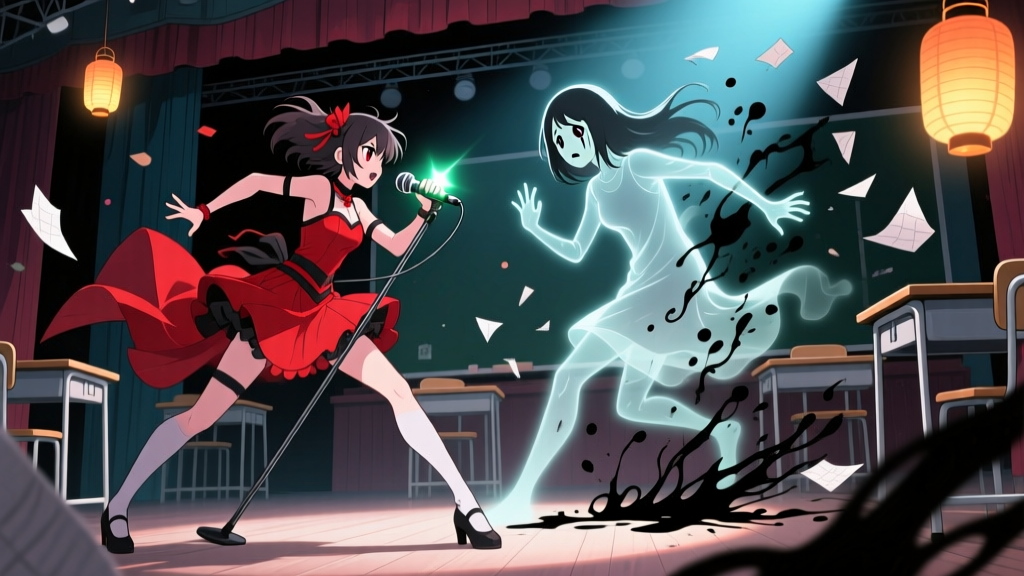
She’s standing alone in a spotlight the size of a dinner plate, barefoot on a black stage. Her left hand grips the edge of a tilted mirror frame—no glass inside—and her right hand trembles as she tries to pull her own reflection into focus. She doesn’t speak yet. She breathes. And then, without turning, she says: “You’re not supposed to be here.” Not to another character. Not to the audience, exactly—but *through* them, like they’re the wall she’s been talking to for three years.
That moment—Episode 14 of the anime ends with Hanako collapsing mid-rehearsal, her vision blurring into watercolor smears; the Takarazuka musical’s Act II opens with that line, delivered at a near-whisper while her knuckles whiten on cold lacquered wood—is where the two adaptations stop sharing a language. Not a translation issue. A medium rupture.
I remember watching the anime’s hospital scene (S1E19) for the third time, struck by how beautifully PA Works renders Hanako’s dissociation: the way background figures melt into soft-focus indigo gradients, how her voiceover drops half an octave and lags just behind her lip movements, like a tape slightly unspooled. It’s tender. It’s precise. It’s also, unmistakably, observed. We watch Hanako from outside her nervous system, even when the camera pushes in so close her eyelash casts a shadow across her cheekbone. The watercolor aesthetic creates emotional distance—not coldness, but containment. Like looking through rain-streaked glass at someone crying in a room you can’t enter.
The Takarazuka Revue doesn’t offer that glass.
They offer a footlight.
In their 2024 Kageki Shojo!! musical, Hanako (played by Top Star Sakura Ruri) spends much of Act II speaking directly to empty chairs arranged in a semicircle downstage left—chairs that, in earlier scenes, held her mother, her ballet instructor, the casting panel that rejected her. They’re not props. They’re witnesses who’ve stayed. And when Sakura-as-Hanako kneels before one, pressing her forehead to its seatback and whispering, “I’m still wearing the shoes you said were too big,” she isn’t performing memory. She’s reenacting trauma as ritual—live, unedited, with sweat-slick palms and a voice that frays at the edges in real time.
This isn’t symbolic substitution. It’s physiological storytelling.
Takarazuka’s rehearsal reports—published in Takarazuka News’s May 2024 special issue—confirm what the performance makes visceral: Sakura trained for six weeks with a clinical vocal coach to replicate *dysphonia*, the voice disorder often triggered by psychological stress. Not mimicry. Not affectation. She learned to deliberately destabilize her laryngeal muscles during sustained high notes—so that when Hanako sings “Kokoro no Kabe” (“Wall of the Heart”) in the second act, the final chorus doesn’t just sound strained; it cracks, mid-phrase, on the word “kowareta” (broken). The note doesn’t recover. The orchestra holds silence for three full seconds while Sakura stays frozen, eyes closed, chest heaving. Then she opens them—not at the conductor, not at her co-star—but straight out, locking eyes with a woman in Row G, Section B, who’d gasped audibly.
That silence isn’t dramatic punctuation. It’s neurological fidelity. Dissociation isn’t always quiet withdrawal. Sometimes it’s the body refusing to cooperate with speech *while the mind is screaming*. The anime shows us Hanako’s inner monologue fading. Takarazuka shows us her vocal cords failing to obey.
The Mirror Frame That Isn’t a Mirror
Let’s talk about that set piece—the tilted, glassless mirror frame that rotates slowly throughout Act II.
PA Works’ anime uses mirrors constantly: Hanako sees herself fractured in dressing-room glass (S1E7), watches her reflection blink slower than she does (S1E12), stares into a puddle after rain until her face dissolves into ripples (S1E16). Each is rendered with painstaking attention to refraction and distortion. But they remain *representational*. They signal dissociation. They don’t generate it.
Takarazuka’s mirror frame does both.
Designed by veteran set artist Miyuki Asami, it’s built from laminated cherry wood with brass hinges, weighted so it rotates at precisely 0.8 rpm—slow enough to feel inevitable, fast enough to prevent comfort. During Hanako’s monologue—the monologue, revised specifically for the musical and absent from both manga and anime—she walks around it three times, each lap faster, each time placing a different object inside its frame: first a pointe shoe (S1E1), then a torn acceptance letter (S1E5), then finally, her own hand, palm-out, trembling violently.
Here’s what the interviews reveal: Sakura didn’t rehearse this sequence with choreography notes. She rehearsed it with trauma-informed movement therapist Dr. Yumi Tanaka, using somatic techniques to trigger and then modulate autonomic arousal. The trembling isn’t acting. It’s neurogenic tremor—her body releasing stored fight-or-flight energy, induced intentionally. When she places her hand in the frame, she’s not “posing.” She’s grounding herself *in real time*, using the frame’s physical edge as tactile anchor while her nervous system recalibrates.
You cannot animate that.
You can’t storyboard tremor that changes millisecond-to-millisecond based on oxygen saturation, cortisol levels, or whether the person in Row G just shifted in their seat. Animation controls variables. Live theatre surrenders to them.
Why Direct Address Changes the Trauma Grammar
The anime’s Hanako speaks to herself, to her diary, to Sarina—but never to *us*. Even in her most vulnerable voiceovers, there’s a grammatical barrier: “I thought…” “I wondered…” “It felt like…” Third-person interiority, even when first-person voiced.
Takarazuka’s Hanako breaks syntax.
Midway through her Act II monologue—after the mirror rotations, after the vocal crack, after she’s wiped sweat from her upper lip with the back of her hand—she steps out of character just enough to say, flatly: “You know what happens when I try to name it. My throat closes. Not metaphorically. Literally. Like swallowing glass.” Then she tilts her head, studies the front row, and adds: “Has that ever happened to you? Or do you only see it in cartoons?”
No pause. No cue for laughter. She holds the question like a scalpel.
This isn’t breaking the fourth wall. It’s dismantling the premise of the fourth wall as a protective membrane. In trauma therapy, naming is exposure. In Takarazuka’s staging, naming becomes *co-regulation*—a shared physiological risk. When Sakura says “swallowing glass,” her larynx visibly constricts. When she asks “Has that ever happened to you?”, her diaphragm drops, inviting the audience to breathe with her. It’s not empathy-by-proxy. It’s nervous-system synchrony, engineered through duration, proximity, and vulnerability.
PA Works’ anime gives us Hanako’s psychology with exquisite fidelity. Takarazuka gives us her neurology.
The Weight of the Uniform
There’s one detail fans rarely discuss: costume weight.
PA Works’ animation team spent months researching the exact drape of Takarazuka’s otokoyaku (male-role) uniforms—the way wool gabardine falls over shoulder pads, how gold braid catches light at 17-degree angles. Their Hanako wears a simplified version: lighter fabric, looser cut, visually legible as “aspirational costume.” It serves the story’s theme of longing.
Takarazuka’s costume department built Sakura’s uniform to match archival 1930s specifications: 1.8kg of layered worsted wool, hand-stitched epaulettes weighing 210g each, collar stiffened with horsehair buckram. During the “Kokoro no Kabe” sequence, Sakura’s shoulders visibly drop 3cm under that weight by the third verse. Her posture shifts from balletic extension to protective hunching—not as character choice, but biomechanical necessity.
That hunch isn’t “sadness.” It’s the body adapting to chronic load. It’s the same adaptation Hanako’s spine underwent during years of silent rehearsals in her mother’s living room—posture as survival strategy, encoded in muscle memory long before cognition caught up.
The anime shows us Hanako’s resolve. Takarazuka shows us her collagen.
What Gets Lost (and Why That Matters)
None of this is a critique of the anime. PA Works’ achievement remains staggering: they translated manga panels into breathing, weather-affected space. They gave us Sarina’s laugh as a sonic texture—bright, staccato, slightly too loud in quiet rooms. They made the theater itself feel like a character with creaking floorboards and dust motes catching afternoon sun.
But they couldn’t give us Hanako’s pulse.
Not literally. Not the thud-thud-thud against her ribs that Sakura lets the audience hear during the monologue’s silent beats—achieved by pressing a contact mic to her sternum, routed live through the house speakers. Not the micro-tremor in her left eyelid when she recounts her audition rejection, captured because Takarazuka’s lighting designer, Akari Sato, programmed a single spotlight to narrow to 12cm diameter for exactly 4.3 seconds, forcing facial muscles to work harder to maintain expression.
These aren’t “enhancements.” They’re constraints made generative. Live theatre’s fragility—its dependence on breath, gravity, fatigue, human error—isn’t a limitation to be overcome. It’s the very architecture of trauma narrative. Because trauma isn’t remembered in perfect recall. It’s remembered in the body’s stubborn insistence on reenactment: the flinch at sudden noise, the stomach clench at certain scents, the voice that vanishes when the past rushes in.
The anime gives us Hanako’s story as elegy.
Takarazuka gives us her story as recurrence.
And recurrence—when rendered with clinical precision and artistic courage—is where healing begins. Not as resolution, but as recognition. Not “she got better,” but “she is still here, breathing, trembling, speaking—even when her voice breaks.”
That’s why, when Sakura-as-Hanako finishes her monologue not with a bow, but by walking offstage left without looking back—leaving the mirror frame rotating slowly, empty, catching light like a wound—the silence afterward isn’t empty. It’s thick with shared physiology. You feel your own throat tighten. You notice your breath has hitched. You realize, with a jolt, that you’ve been holding your shoulders the same way.
That’s not adaptation.
That’s transmission.
“People ask if we ‘add’ emotion to the script. No. We remove protection. The emotion was already in the text. We just stopped letting the body lie about it.”
—Sakura Ruri, in interview with Takarazuka News, May 2024