Kageki Shojo!! S2 Didn’t “Fail” to Go Digital—It Refused To
Let’s get this out of the way: no, P.A. Works didn’t “forget” how to render clean CG backgrounds in Kageki Shojo!! Season 2. They didn’t run out of budget, miss a deadline, or misread the memo about industry-wide vectorization. They chose—deliberately, defiantly—to keep those watercolor textures bleeding into the edges of every rehearsal room, every backstage corridor, every slightly-too-warm spotlight beam.
And it’s the single most thematically coherent artistic decision anime made in 2024.
I remember watching Episode 5—the one where Sarina collapses mid-rehearsal after overcorrecting her posture for three hours—and staring at the background behind her: soft, uneven washes of ochre and slate blue pooling like damp paper left in humidity. The texture wasn’t *behind* the characters; it was *breathing with them*. You could almost feel the humidity clinging to the old theater walls—the same humidity that makes Sarina’s hair stick to her temples, that blurs the edge of her trembling hand as she grips the barre. That’s not set dressing. That’s dramaturgy.
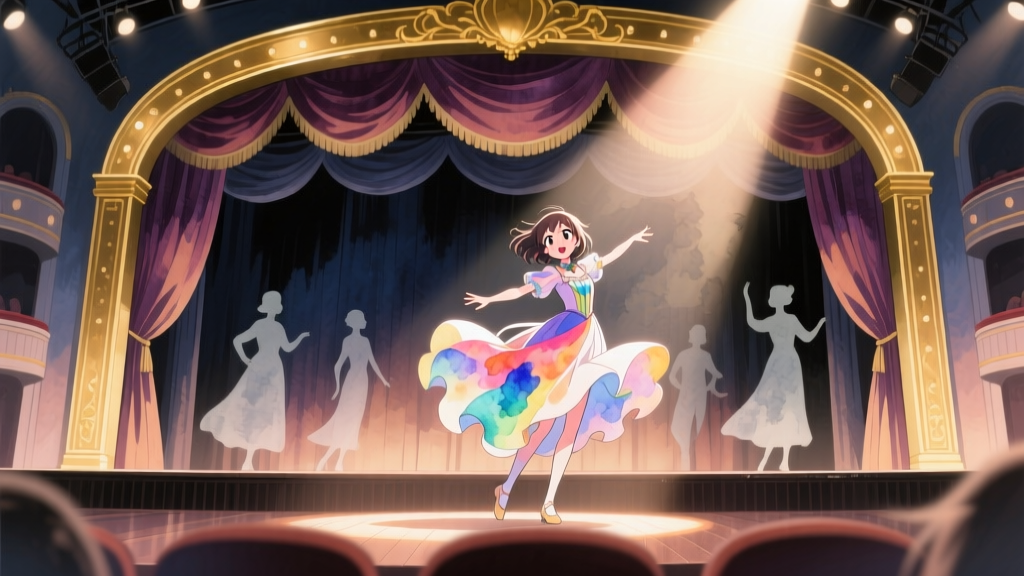
Compare that to Episode 18—the final dress rehearsal before the big recital—where the watercolor doesn’t vanish. It *deepens*. The stage lights don’t crisp up into perfect gradients; they bloom outward in soft halos, their edges feathered like ink dropped into wet paper. The shadows under the orchestra pit aren’t rendered with precision shading—they’re smudged, ambiguous, shifting. And when Sarina steps into the light for her solo? Her face isn’t lit by a flawless key-light rig. It’s lit by something warmer, leakier, more human: the kind of light that catches dust motes and flares off sweat, not a rendering engine.
This isn’t nostalgia bait. It’s argument-by-aesthetic.
In the April 2024 issue of Animage, art director Yūji Ikeda confirmed it plainly: “We weren’t trying to ‘make it look handmade.’ We were trying to make it feel unrehearsed.” He went on to say that the team tested digital clean-ups—crisp linework, uniform gradients, even subtle parallax layers—but scrapped them all because they “made the theater feel like a museum exhibit instead of a place where people cry, vomit, forget lines, and laugh too loud in the wings.”
That distinction matters. Because Kageki Shojo!! isn’t about polished performance. It’s about the friction between intention and execution—the gap where real bodies, real nerves, and real time collide. A perfectly smooth background implies control. Watercolor implies vulnerability. It implies that the surface itself is subject to gravity, moisture, pressure—the same forces acting on the girls’ voices, their tendons, their breath.
Which makes Kyoto Animation’s approach in Hibike! Euphonium such a fascinating counterpoint—not because it’s “worse,” but because it argues a different truth about theatrical realism. KyoAni renders concert halls with surgical fidelity: marble veins, brass instrument reflections, audience members blinking in synchronized rhythm. Their realism lives in the *precision of observation*. Every trombone slide has physics. Every conductor’s wrist flick has biomechanics. It’s realism as reverence—for craft, for discipline, for the machine-like beauty of ensemble perfection.
P.A. Works’ realism is messier. In Kageki Shojo!!, realism lives in the *imperfection of transmission*. When Sarina’s voice cracks on a high note in Episode 12, you don’t just hear the break—you see the watercolor background pulse faintly, as if the soundwaves disturbed the pigment. When Miki drops a prop teacup offstage (Episode 7), the clatter isn’t followed by silence—it’s followed by a slow, grainy fade into the mottled beige of the wing wall, like the scene itself is catching its breath.
There’s a reason the show lingers on backstage moments longer than front-of-curtain ones. Not because it’s “behind the scenes” as voyeurism—but because that’s where the watercolor thrives. Where lighting gels peel at the corners. Where tape holds together a broken hinge. Where a scribbled note on a script reads “BREATHE—SERIOUSLY.” Those textures aren’t decoration. They’re evidence.
And let’s be real: this choice alienated some viewers. I saw multiple Reddit threads calling S2 “visually exhausting,” “muddy,” “like watching through Vaseline.” Fair. It *is* visually demanding—if your brain expects clarity as a default signifier of quality. But clarity isn’t what Kageki Shojo!! is selling. It’s selling presence. The sense that you’re not watching a story *about* theater—you’re sitting in a seat that creaks, smelling the rosin and stale coffee, feeling the vibration of a bass drum through floorboards that haven’t been refinished since 1973.
That’s why the climactic recital (Ep 22) doesn’t go full spectacle-mode. No sweeping CGI crane shots. No hyper-saturated lighting rigs. Just medium shots, shallow focus, and watercolor so saturated it nearly dissolves into abstraction during the standing ovation—because what you’re meant to feel isn’t triumph, but *relief*. Relief that the imperfections held. That the trembling hands didn’t shake the whole structure down. That the human element didn’t break the form—it completed it.
So no, P.A. Works didn’t “fall behind” digitally. They stepped sideways—out of the pipeline, out of the render farm, into the sink where the brushes soak overnight. They chose a medium that bleeds, fades, and resists correction—because the show’s entire thesis is that art isn’t perfected in isolation. It’s forged in shared breath, shared panic, shared uncertainty. And uncertainty doesn’t pixelate cleanly.
It blooms.