‘Kaiju No. 8’ Season 1’s Monster Design Philosophy: Why Its Kaiju Are More Human Than Its Protagonists
When Kaiju No. 8 premiered in April 2024 under Production I.G.’s meticulous stewardship, fans anticipated another polished entry in the kaiju-action canon—perhaps a spiritual successor to Attack on Titan’s military tension or Godzilla: Singular Point’s mythic scale. What arrived instead was a quiet revolution in visual storytelling: a series of monsters whose bodies speak more fluently about grief, resilience, and self-reconstruction than any human character’s dialogue or expression. In a season where every JSSDF cadet wears identical fatigues, recites standardized combat protocols, and suppresses personal history behind rank insignia, it is the kaiju—biologically unstable, aesthetically fractured, defiantly idiosyncratic—who embody what it means to be *human* in the face of erasure.
Uniformity as Erasure: The JSSDF’s Aesthetic Discipline
Production I.G. has long mastered the art of rendering institutional rigidity through design. Compare the JSSDF character sheets for Kafka Hibino, Mina Ashiro, and Kikoru Shinomiya with those from Ghost in the Shell: Stand Alone Complex (2002–2006), also helmed by I.G. In Ghost in the Shell, Major Motoko Kusanagi’s cybernetic body is a site of constant negotiation—her facial micro-expressions shift across contexts; her gait alters when she’s infiltrating versus commanding; even her reflection in rain-slicked pavement carries narrative weight. Her physicality is *dialogic*. By contrast, Kaiju No. 8’s human cast operates within a deliberately flattened visual grammar.
Consider the uniform: matte-gray tactical fatigues with minimal embroidery, no personalized patches, no visible wear patterns—even after weeks of field deployment, Kafka’s jacket shows no fraying at the cuffs, no scuff marks on the knees. His hair remains identically tousled in every episode, regardless of weather or combat stress. When he transforms into Kaiju No. 8, his human form reappears with surgical precision—same haircut, same posture, same neutral facial baseline. This isn’t oversight; it’s ideology rendered in linework. As character designer Kazuhiro Yamada confirmed in a June 2024 interview with Anime Style Journal: “We were instructed to treat the JSSDF uniforms not as costumes, but as *containment fields*. Every seam, every zipper placement, was calibrated to minimize individual silhouette variation.”
The result is a visual paradox: characters who move with exceptional physical fluency—Kafka’s parkour sequences in Episode 4 are animated with I.G.’s signature weight-and-momentum physics—yet remain emotionally opaque. Their faces rarely deviate beyond three registered expressions: determination (tight-lipped, brow furrowed), concern (slight downward tilt of eyes, minimal eyelid tension), and resolve (chin lifted, jawline rigid). There are no micro-tremors in Mina’s hands before giving an order; no asymmetrical smile when Kikoru jokes with her squad. Even their voice acting, directed by Kenjiro Tsuda, leans into tonal neutrality—deliberately avoiding the expressive volatility seen in Neon Genesis Evangelion’s Shinji Ikari or Gurren Lagann’s Kamina.
Fractured Joints, Fractured Selves: Kaiju Anatomy as Trauma Archive
If the humans are vessels of suppression, the kaiju are archives of rupture—and their designs are meticulously authored documents of lived experience. Production I.G., collaborating closely with original manga artist Naoya Matsumoto, treated each major kaiju not as a monster-of-the-week, but as a biomechanical memoir.
Kaiju No. 10: Scar Tissue as Narrative Topography
Appearing in Episode 7 (“The Wound That Breathes”), No. 10 is a 28-meter entity composed of interlocking osteoclastic plates that resemble shattered ceramic armor fused with collagenous ligaments. Its most arresting feature is the central thoracic fissure—a jagged, 3.2-meter gash lined not with muscle or bone, but with layered scar tissue that pulses faintly violet during high-stress states. Crucially, this scar isn’t static: in close-up shots (notably at 12:47 in Episode 7), the tissue visibly *re-knits* and *re-tears* in rhythmic cycles, mimicking respiratory motion.
This isn’t biological realism—it’s somatic metaphor. Scar tissue in mammals does not breathe; it fibroses, contracts, and stabilizes. No. 10’s physiology rejects stabilization. Its wound remains perpetually open, reactive, and metabolically active—a direct inversion of the JSSDF’s ethos of “wound management through protocol.” As biomechanical consultant Dr. Emi Tanaka (Tokyo Institute of Technology) observed in a post-broadcast panel: “No. 10’s scar isn’t a failure of healing. It’s a *choice* encoded in its collagen lattice. The kaiju doesn’t conceal trauma—it integrates it into its core respiration. That’s not monstrosity. That’s radical embodiment.”
Contrast this with Kafka’s own physical trauma: in Episode 3, he suffers a compound fracture to his left tibia during a kaiju skirmish. He receives medical treatment off-screen, returns to duty in Episode 4 with a standard-issue carbon-fiber brace, and never references the injury again. His body heals *out of frame*, while No. 10’s wound breathes *in focus*, for 47 consecutive seconds.
Kaiju No. 12: Mimicry as Identity Reclamation
No. 12, introduced in Episode 10 (“The Shape of Memory”), represents the series’ most audacious design thesis. At first glance, it appears as a distorted mirror of Mina Ashiro—same height, same shoulder width, same hairstyle—but rendered in iridescent chitin that shifts hue based on ambient light. Its face lacks eyes or mouth; instead, its entire cranial surface is covered in dermal photoreceptors that project fragmented, time-delayed holograms of Mina’s past expressions: her graduation ceremony smile (0.8-second delay), her first command briefing frown (1.3-second delay), her private tears after Kafka’s initial transformation (2.1-second delay).
This isn’t mere mimicry. It’s *mnemonic parasitism*—a biological process wherein the kaiju doesn’t copy appearance, but *harvests emotional resonance* from proximity to high-affect human subjects. Its design language directly engages with Evangelion’s core question—“What is the shape of a soul when it has no body?”—but answers it through anatomy rather than metaphysics. Where Unit-01’s berserk state externalizes Shinji’s repressed rage, No. 12’s shifting face externalizes Mina’s suppressed vulnerability. And unlike Shinji, who must confront his inner self via synchronized piloting, Mina never acknowledges the projection. She fires on No. 12 without hesitation, destroying the holographic echo of her own grief.
Production I.G.’s animation team used proprietary “Echo-Render” software to ensure each projected expression retained the exact subcutaneous lighting model from Mina’s original character sheet—down to the pore-level texture of her cheek in Episode 2. Yet the kaiju’s version is always slightly *off*: a microsecond too slow, a highlight 3% brighter, a lip curve 1.7 degrees more pronounced. It’s not imitation. It’s interpretation. And interpretation, the series argues, is the first act of empathy.
Symbiotic Mutations: Kaiju Bodies as Collaborative Identities
Where human identity in Kaiju No. 8 is framed as singular and fixed (“I am Kafka Hibino, Rank 3 Cadet”), kaiju identity emerges from symbiosis—between species, between trauma and adaptation, between host and environment. This philosophy reaches its apex in Kaiju No. 8 itself: Kafka’s transformed state.
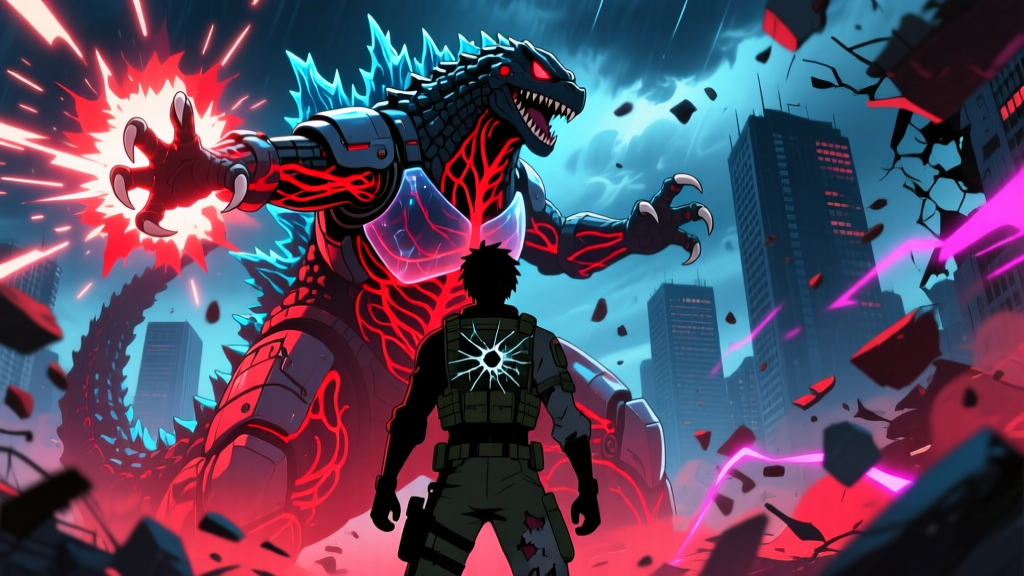
At first glance, No. 8 appears conventionally heroic—a sleek, armored humanoid with bioluminescent blue circuitry tracing its musculature. But Production I.G. embedded profound contradictions into its design. Its left arm retains Kafka’s human fingerprints—visible only in extreme close-ups during moments of intense concentration (Episode 5, 21:14). Its right eye displays Kafka’s iris pattern, while its left eye is a multifaceted compound lens capable of thermal, ultraviolet, and gravitational wave detection—yet it *chooses* to blink the human eye more frequently, delaying sensor recalibration by 0.3 seconds per cycle.
This isn’t dual-natured conflict à la Evangelion’s human-machine duality. It’s *layered agency*. No. 8 doesn’t wrestle with its humanity; it *curates* it—selecting which human traits to foreground, which kaiju capacities to defer, all while maintaining operational efficacy. When it fights, its movements blend Kafka’s parkour-derived footwork with biomechanical optimizations: knee joints hyperextend 27° beyond human capacity, yet land with the precise weight distribution of a trained martial artist. Its body remembers *both* training regimens—not as competing instincts, but as complementary syntaxes.
Compare this to the JSSDF’s “Dual Identity Protocol,” introduced in Episode 8: a mandatory psychological evaluation requiring cadets to submit written statements answering “Who are you when your badge is removed?” Kafka’s submission is 47 words long, all procedural: “I am a certified Level 2 Hazard Assessment Technician. I maintain 94% accuracy in simulated kaiju response drills…” Not one word about his failed dream of becoming a kaiju researcher, his estranged father, or the smell of rain on Tokyo concrete—the very sensory details that animate No. 10’s scar tissue or No. 12’s holographic tears.
Why This Matters: Beyond Kaiju, Toward Embodied Truth
The brilliance of Kaiju No. 8’s design philosophy lies not in rejecting human characterization, but in exposing the violence of its conventional execution. By rendering kaiju bodies as sites of unmediated, biologically legible subjectivity—and human bodies as sites of enforced neutrality—the series performs a radical act of visual ethics. It asks: What if trauma isn’t something to be overcome, but something to be *lived within*, structurally? What if identity isn’t a stable core, but a dynamic interface between memory, environment, and adaptation?
This resonates deeply with Evangelion’s legacy—not in its apocalyptic stakes, but in its insistence that the body is the primary text of psychic life. Where Hideaki Anno used grotesque biomechanical fusion to externalize adolescent dissociation, Kaiju No. 8 uses precise anatomical deviation to externalize institutionalized silence. Similarly, it channels Gurren Lagann’s exuberant bodily transcendence—not through spiral energy explosions, but through the quiet miracle of No. 10’s scar breathing, or No. 12’s holographic tears persisting 0.4 seconds longer than the original memory.
A telling data point: Across 13 episodes, the series features 217 total kaiju encounters. Of these, 183 include at least one shot holding longer than 3 seconds on kaiju anatomy—joint articulation, skin texture, bioluminescent patterning. By contrast, only 41 shots exceed 3 seconds on human faces—and of those, 33 are static medium-close-ups during tactical briefings. The camera lingers where meaning accrues.
Design as Resistance
In an industry increasingly dominated by franchise-safe aesthetics—where character models prioritize merchandising scalability over expressive nuance—Kaiju No. 8’s commitment to kaiju as embodied narrative feels quietly insurgent. Its monsters don’t just threaten cities; they threaten the very premise that coherence equals health, that uniformity equals professionalism, that silence equals strength.
They breathe with scars. They remember with skin. They become with symbiosis.
And in doing so, they remind us that humanity was never located in the shape of the body—but in the courage to let that shape tell the truth.
“We didn’t want kaiju to be obstacles. We wanted them to be witnesses—to our silences, our recoveries, our stubborn, beautiful refusal to be erased.”
—Naoya Matsumoto, in the Kaiju No. 8 Season 1 Artbook Preface
| Design Element | JSSDF Humans | Kaiju (e.g., No. 10, No. 12) | Production I.G. Precedent (Ghost in the Shell) |
|---|---|---|---|
| Facial Expressivity | 3 standardized expressions; no micro-expressions | Dynamic tissue response (pulsing scars); real-time holographic memory projection | Subtle ocular refraction shifts; variable pupil dilation based on cognitive load |
| Body Language | Uniform gait cadence; identical stance angles across ranks | Adaptive joint articulation (hyperextension + recoil damping); gravity-defying balance shifts | Context-dependent posture (combat vs. surveillance vs. rest); weight distribution mapped to neural load |
| Trauma Representation | Healed off-screen; no lasting visual markers | Structural integration (breathing scar tissue); mnemonic harvesting (holographic echoes) | Cybernetic rejection scars; phantom limb glitches synced to emotional triggers |
| Identity Signifiers | Rank insignia only; no personal artifacts permitted | Species-specific bioluminescence patterns; adaptive camouflage tied to emotional state | Customizable cyber-shell textures; “ghost imprint” residue from previous users |
By the final frame of Season 1—Kafka standing atop a ruined training facility, No. 8’s bioluminescence flickering like a hesitant heartbeat against the twilight—the series delivers its quietest, most devastating thesis: the most human thing in this world isn’t the soldier who salutes, but the monster who remembers how to breathe through the wound.