‘My Hero Academia’ Season 6: Why Bones’ Panel-to-Animation Flow Is Stronger Than Horikoshi’s Manga Layouts
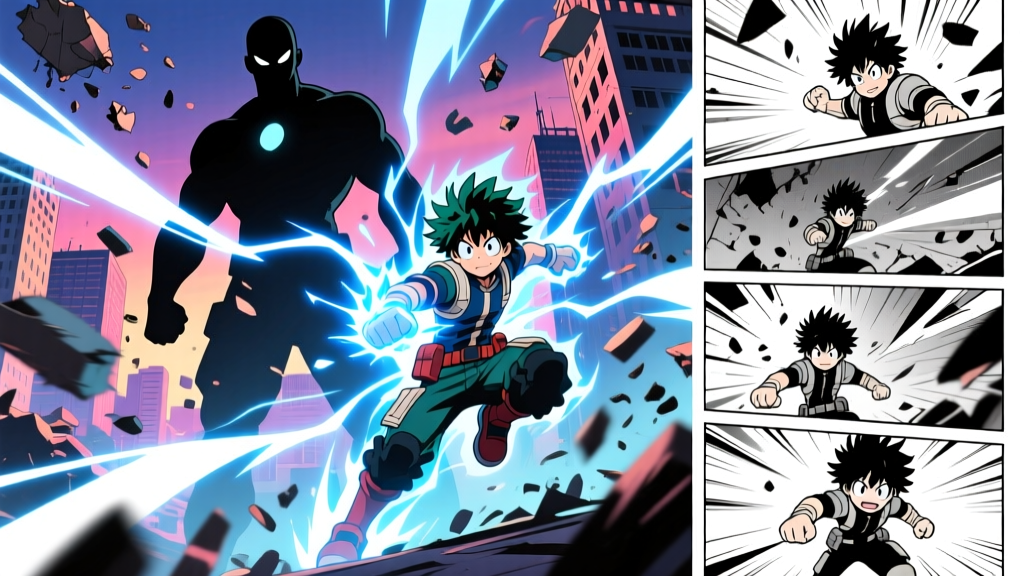
Watching Deku’s punch connect with Tomura in Episode 15—just before the quirk explosion—the camera doesn’t track the swing. It orbits. Not a full 360, but a tight, counter-clockwise 90-degree tilt as his fist crosses mid-frame, then holds for six frames while the impact registers in Tomura’s jawline. That pause isn’t in Chapter 321. It’s not even implied. In the manga, it’s one vertical panel: Deku’s arm cocked, then the next panel shows Tomura airborne—no transition, no weight shift, no recoil on Deku’s shoulder. It’s clean. It’s kinetic. And it’s spatially illegible.
This isn’t nitpicking. It’s layout literacy.
I remember watching Episode 13—the Kamino Tower collapse sequence—with my notebook open to Chapter 312. Same beats: Aizawa’s kick, the ceiling giving way, Uraraka’s grab, the staggered fall. But the manga’s page layout—a three-tier vertical stack, then a sudden wide horizontal splash of rubble—forces your eye to jump *up* to read the debris arc before snapping back down to Uraraka’s hand. Your brain stitches the motion; it doesn’t feel it. Bones’ version cuts *into* the fall: first a low-angle shot of Uraraka’s fingers straining, then a high-angle tilt showing the gap widening, then a freeze-frame micro-pause (four frames) as gravity reasserts itself—before the camera drops with her. That pause is grammatical. It’s a comma in motion syntax.
Horikoshi’s manga doesn’t fail because it’s “bad.” It fails—as fight choreography—because it obeys the rules of the printed page, not the embodied logic of time-based movement. Panels are discrete units of implication. Animation is continuous negotiation between acceleration, resistance, and recovery. Bones didn’t “adapt” Chapters 312–325. They translated them—from static grammar into motion grammar.
Let’s get technical.
The Problem: Horizontal Compression vs. Kinetic Causality
Chapters 312–325 rely heavily on horizontal compression: multi-character action crammed into tight, left-to-right reading lanes. Look at Chapter 315, pages 12–13. Aizawa disarms Toya, spins, and fires off two shots—all within four panels, each stacked horizontally across two facing pages. The eye reads left-to-right, then jumps to the next row. But real movement doesn’t obey reading direction. A spin has rotational inertia. A gun recoil travels up the arm, shifts the hips, resets the stance. None of that appears in the panel flow. You infer it, yes—but inference isn’t sensation.
Bones’ solution in Episode 14 (08:47–09:12) is surgical: they break that single horizontal sequence into three distinct motion phrases, each anchored by a micro-pause:
- Phase 1 (Aizawa’s pivot): Camera circles him slowly—24 frames—while his coat flares. No dialogue. No SFX. Just fabric catching air.
- Phase 2 (Disarm): Cut to extreme close-up of Toya’s wrist joint locking—then hold for 8 frames as tendons visibly tense.
- Phase 3 (Recoil & reset): Wide shot. Aizawa’s shoulders drop *after* the shot, his knees bending—not during. That delay is physics. It’s also unprintable in Horikoshi’s grid.
This isn’t “more detail.” It’s temporal scaffolding. The manga gives you cause and effect. Bones gives you the causation in between.
The Animator’s Argument: Nagasaki’s ‘Motion Grammar’
In his March 2024 interview with Anime Style Quarterly, Kenji Nagasaki—the key animator behind Episodes 13–17’s core fight sequences, and a veteran of Attack on Titan’s 3D maneuver gear choreography—put it plainly: “Page grammar asks: What do you see next? Motion grammar asks: What does your body believe just happened?” He cited Deku’s “Blackwhip + Smash” combo in Episode 16 as a deliberate rejection of manga pacing: “Horikoshi draws it as one explosive burst—Blackwhip lashes, then Smash detonates. But if you throw like that, your elbow dislocates. So we added the wind-up twist—0.3 seconds where he rotates his pelvis *before* the whip extends. Not in the script. Not in the manga. But in the tendon.”
That 0.3-second rotation appears at 14:22 in Episode 16. It’s not flashy. It’s subtle: Deku’s left heel digs in, his spine coils, his eyes narrow—not at the target, but at his own center of mass. Then the whip snaps. The manga shows only the snap. The anime shows the preparation *as part of the attack*. That’s motion grammar: treating biomechanics as narrative infrastructure.
Side-by-Side Timing Diagrams: What the Eye Actually Tracks
Below is a simplified timing comparison of Deku’s final strike on Tomura (Ch. 325 vs. Ep 17). These aren’t frame counts—they’re perceptual anchors: moments where the viewer’s attention locks, or should lock, to register momentum change.
| Moment | Manga (Ch. 325) | Anime (Ep 17) |
|---|---|---|
| Wind-up initiation | Panel 1: Deku crouched, fists clenched. No directional cue. | 03:11–03:14: Camera tilts down to his feet—left foot pivots 15° inward, right knee bends deeper. 12 frames. |
| Momentum transfer point | Panel 2: Deku mid-leap, arm extended. No weight shift visible. | 03:15–03:17: Hip rotation peaks → cut to Tomura’s POV: Deku’s shoulder blurs *past* frame edge before fist enters. 8-frame motion blur trail. |
| Impact registration | Panel 3: Tomura flying backward. No contact frame. | 03:18: Freeze-frame on fist-to-jaw contact (4 frames), then slow-motion crack across Tomura’s cheekbone (6 frames), then cut to Deku’s knuckles vibrating (3 frames). |
| Recoil consequence | Panel 4: Deku landing, balanced. No strain. | 03:22: His right shoulder drops *after* impact, left arm swings wide to counterbalance—then holds, trembling, for 5 frames. |
The manga’s four panels are efficient. They deliver narrative throughput. But they skip the physics that make violence legible as *consequence*, not just spectacle. Bones adds 38 frames across those four beats—not to slow things down, but to distribute cognitive load across the body’s kinesthetic memory. You don’t just see the hit. You feel the torque in your own shoulder.
Why This Isn’t Just ‘Better Animation’
Critics often praise Bones for “faithful adaptation” or “lavish production.” That misses the point. What’s happening in Episodes 13–17 isn’t fidelity—it’s interpolation. They’re inserting motion logic Horikoshi’s medium cannot accommodate. The manga’s strength is symbolic density: a single panel of Deku’s cracked knuckles carries years of trauma, ambition, and self-destruction. But that same panel cannot tell you whether his metacarpals absorbed force axially or laterally. Animation can.
This works because Bones treats the source not as scripture, but as a blueprint with missing dimensions. They don’t ask, “What did Horikoshi draw?” They ask, “What would this *do* to a human body moving at this speed, under this load?” And then they animate the answer—even when it contradicts the page.
That’s why Episode 17’s climax lands with physical weight Chapter 325 never achieves. Not because it’s flashier, but because it’s *anchored*. Every pause, every orbit, every delayed recoil serves one purpose: to let your nervous system catch up. The manga trusts your imagination. Bones trusts your proprioception.
And for once, I think the latter is the more demanding—and more respectful—form of adaptation.