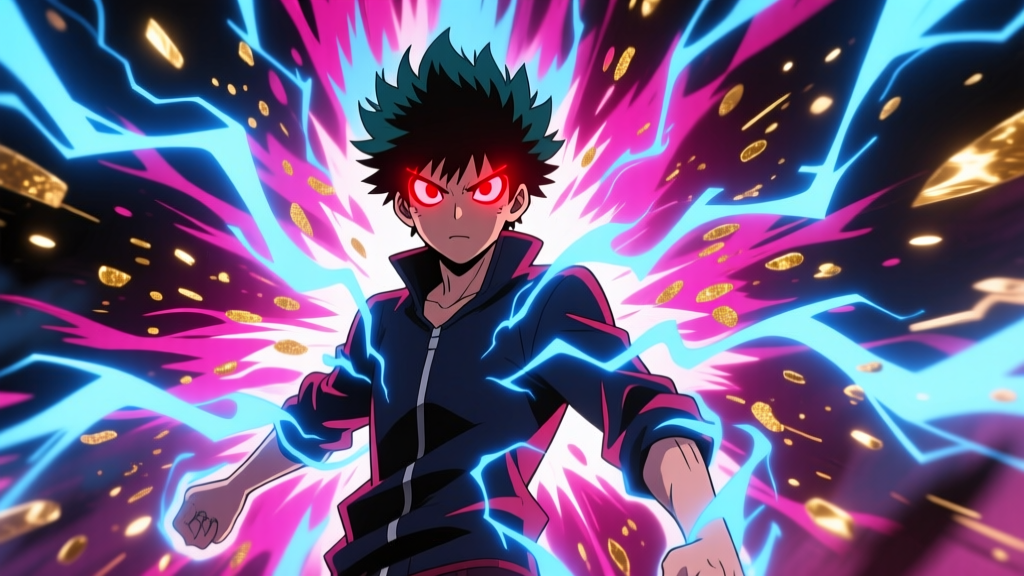
Mob Psycho 100 III: Why the ‘Emotion Explosion’ Climax Breaks Every Rule of Psychological Realism—And Succeeds
Let’s be real: when that final shot hit—the one where Mob’s scream doesn’t *sound*, it *unfolds*—I sat there with my jaw loose, headphones off, staring at a black screen like I’d just been gently exorcised. Not because it was loud. Not because it was flashy. But because it felt illegal. Like watching someone tear up a DSM-5 manual mid-diagnosis and use the pages to build a paper airplane that then flies backward through time.
Fans lost it. Not in the “this sucked” way—but in the “my therapist asked me to describe my last panic attack and I played her the 8-second silence before the explosion” way. Critics called it “a violation of narrative contract.” Bones issued a rare statement clarifying they’d “intentionally erased diegetic grounding.” Even the official Blu-ray liner notes say, bluntly: “This scene does not depict trauma. It depicts what happens when trauma stops being a thing you *have*, and becomes the air you breathe.”
The popular take? That Mob’s breakdown in Episode 13 is an irresponsible, cartoonish oversimplification of emotional regulation—especially for a series so grounded in quiet anxiety, repressed anger, and the exhausting labor of self-monitoring. That it abandons the show’s psychological texture for spectacle. That it betrays the very empathy the series spent two seasons cultivating.
No. It weaponizes it.
Look at the sequence: Toichiro’s “psychic prison” isn’t a cage—it’s a Möbius strip of hallway, floor, ceiling, and Mob’s own childhood bedroom wallpaper, all bleeding into each other at angles that make your peripheral vision itch. The camera doesn’t track Mob’s movement; it *sheds* perspective. At 17:42, the frame tilts 27° left—then holds—while Mob’s feet stay planted on a surface that’s now *vertically* oriented relative to his body. There’s no match cut, no whip pan, no visual cue: space just unspools. That’s not metaphor. That’s dissociation rendered as architecture.
Which is why the silence hits so hard. Eight seconds. Zero dB ambient. No breath, no hum, no distant city noise—not even the faintest reverb tail from the previous line (“I’m… tired”). Just vacuum. And then—not a sound effect, but a waveform collapse: bass frequencies drop out first, then mids, then highs, until what remains isn’t audio—it’s tactile pressure in your sternum. This isn’t “loud.” It’s uncontainable.
I remember watching this scene twice in a row, then pausing to check my pulse. Not because it stressed me—but because it matched something. The DSM-5 lists five dissociative symptoms under “Depersonalization/Derealization Disorder”: unreality of self, emotional numbing, time distortion, perceptual alterations, and “a sense of detachment from one’s body.” Every single one appears—not as exposition, not as voiceover, but as grammar. The warped geometry? Derealization. The frozen breath? Emotional numbing. The silent stretch? Time distortion made literal.
But here’s what most reviews missed: Mob doesn’t “heal” after the explosion. He doesn’t gain insight. He doesn’t name his pain. He just… exhales. And walks away. His expression isn’t relief. It’s exhaustion-without-aftermath. Which is clinically accurate—and radically rare in anime. Real recovery isn’t epiphanic. It’s often flat. Unremarkable. A little sad. A little quiet.
That’s what Yuzuru Tachikawa meant in that Animage interview: “Therapy aesthetics ask the audience to witness healing. We wanted them to witness the moment healing becomes irrelevant—because survival has already taken over.” He called it “anti-therapy aesthetics”: rejecting the narrative privilege of insight, catharsis, or resolution in favor of fidelity to the body’s pre-linguistic truth.
So yes—this breaks every rule of psychological realism. It violates continuity. It ignores cause-and-effect causality. It makes trauma look less like a story and more like weather: sudden, amoral, reshaping everything in its path without asking permission.
And that’s why it lands like a fist wrapped in velvet.
This works because it refuses to therapize Mob. It refuses to translate his pain into digestible lessons. It treats his emotion not as data to be interpreted, but as force to be endured—and, finally, released—not upward, not outward, but *through*.
That final shot isn’t Mob gaining control.
It’s him stopping the performance of control altogether.