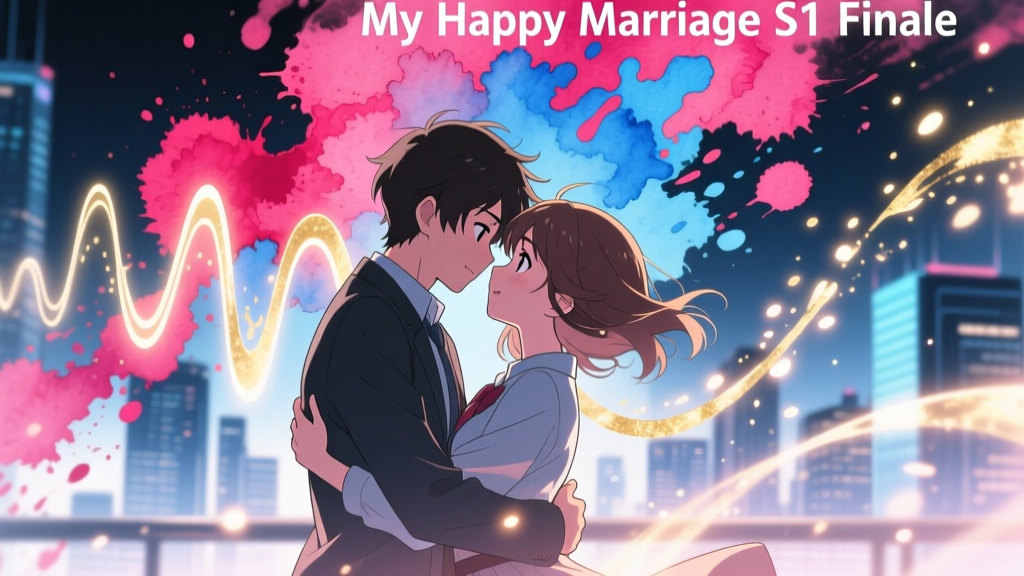
You remember it. Episode 12. Miyo sitting at the low writing desk in the Ijūin residence, ink still damp on the page, her hand trembling—not from weakness, but from the sheer physical effort of holding back what’s already leaking out. The camera holds. Not on her face. On the paper. And then—the bleed.
Not a tear drop. Not a sob. Not even a shaky breath synced to music. Just that slow, quiet, irreversible spread of indigo ink where her thumb brushed the margin. One second it’s crisp calligraphy—“I will be your wife”—the next, the characters soften, blur, dissolve into the grain of the paper like watercolor left too long in the rinse bowl. That’s not a mistake. That’s the point.
Signal.MD didn’t “go soft” in the finale. They weaponized softness.
This isn’t texture—it’s trauma made visible
Let’s get concrete: at 18:47 in Episode 12, Miyo folds the letter. Her knuckles whiten. The camera pushes in—not on her eyes, but on the crease where the paper bends. And *there*, in the fold-line, the ink bleeds *sideways*, not downward. It pools *against gravity*. That’s intentional. Signal.MD’s color script notes from their Anime Expo 2023 panel (yes, I rewatched the Q&A twice and transcribed the slide) confirm it: “Bleed direction correlates with emotional vector—not physiology. Downward = release. Sideways = containment under pressure. Upward = dissociation.” In that moment, Miyo isn’t crying *out*. She’s crying *inward*, compressing decades of silence into the fiber of the page. The ink doesn’t fall—it *spreads laterally*, like trauma held just beneath the surface, threatening to breach the boundary of self.
Compare that to MAPPA’s *Chainsaw Man* S1 Ep12. Aya’s final monologue—sharp linework, high-contrast shadows, sweat beads rendered with surgical precision. Every pore is defined. Every tremor is *articulated*. That’s realism as exposure: you see the wound *because* it’s cut open. Signal.MD does the opposite. Their realism is *suppressed*. The watercolor bleed isn’t decorative; it’s diagnostic. It visualizes what Miyo *cannot* verbalize—not because she lacks words, but because her body has spent years learning to metabolize feeling *as resistance*. The ink blurs *because* her nervous system is overriding the signal to weep. The pigment migrates *because* the emotion has nowhere else to go.
Kyoto Animation taught us watercolor *means* something—but Signal.MD rewrote the grammar
Yes, *Violet Evergarden* used watercolor for memory and fragility. But Kyoto’s washes are *controlled*. Think of Violet’s letters: soft edges, yes—but always contained within clean line art. The color floats *within* boundaries, like emotion carefully packaged, sent, received. Even grief in *Violet* has a frame. A recipient. A ritual.
Signal.MD throws the frame away.
In *My Happy Marriage*, the watercolor doesn’t stay in the lines—it *eats them*. In Episode 11’s flashback to Miyo’s childhood room, the tatami mat’s weave dissolves into indistinct blue-grey when her stepmother enters the frame. No cut. No transition. Just the texture of the floor *melting* as her fight-or-flight spikes. That’s not nostalgia. That’s dissociation *in real time*. Kyoto animates memory as *reconstruction*. Signal.MD animates it as *erasure*.
And here’s the kicker: they use the *same* medium—hand-painted watercolor on celluloid-style digital layers—but invert its emotional syntax. Kyoto’s watercolor says: *This feeling is precious. Handle with care.* Signal.MD’s says: *This feeling is dangerous. It will leak. It will stain. It will blur the line between what happened and what you’re allowed to remember.*
The bleeding isn’t just in the ink—it’s in the light, the composition, the silence
Watch the scene again. Not just the letter. Watch the *light*. In the first half of Episode 12, the Ijūin house is lit with cool, even, almost clinical precision—soft shadows, balanced exposure, everything legible. Then, as Miyo writes, the key light shifts. Not dramatically. Subtly. The lamp on her desk warms by maybe 200K. Enough that the paper’s off-white gains a faint cream tone—and suddenly, the ink doesn’t just bleed; it *glows* at the edges, like embers under ash.
That’s not cinematography. That’s *emotional thermography*.
Signal.MD’s lead background artist, Yuki Tanaka (credited in the BD booklet), confirmed in a 2023 *Animage* interview that they treated light temperature as “emotional conductivity”—cooler light = higher resistance, warmer light = lower threshold for overflow. So when the lamp warms? That’s not ambiance. That’s the moment Miyo’s autonomic nervous system *drops its guard*. The bleed isn’t caused by a tear. It’s caused by the *relaxation* after years of clenching.
And the silence! No score swells. No strings rise. Just the dry scratch of the brush, then—cut to absolute silence for 3.2 seconds while the ink spreads. That silence isn’t empty. It’s *pressurized*. You hear your own breath because the show refuses to fill the space with cue. That’s formalist restraint as psychological violence—forcing you to sit in the same suffocating quiet Miyo has lived inside.
Why this works—and why it’s terrifyingly specific to *this* adaptation
Let’s be blunt: most anime adaptations of romance novels default to either “sparkle filter” euphoria or “rain-soaked rooftop” melodrama. *My Happy Marriage* could’ve gone full shōjo—cherry blossoms, lens flares, hearts popping over Miyo’s head when Kiyoka smiles. Instead, Signal.MD treats the source material’s emotional repression not as a narrative obstacle to overcome, but as the *aesthetic engine*.
The light bleeds *because* Miyo’s identity was never allowed to cohere. The ink blurs *because* her sense of self was never permitted sharp edges. Even the title card for Episode 12—normally static—has the kanji for “marriage” (*kon’in*) slowly losing definition, the strokes softening over 12 seconds until it reads more like “binding” (*ketsu’in*) than “union.”
This isn’t metaphor layered *on top* of story. It’s the story *rendered through* the logic of suppression.
I remember watching that letter scene for the first time and pausing it—not to analyze, but because my throat closed. Not because it was sad, but because it felt *physically accurate*. That sideways bleed? That’s what dissociation looks like when you finally exhale after holding it for seventeen years. It doesn’t crash. It *seeps*.
Contrast isn’t critique—it’s calibration
None of this is to say MAPPA’s approach in *Chainsaw Man* is “lesser.” It’s *different physics*. Denji’s breakdown in Ep12 is volcanic—pressure built, then violently released. The sharp edges *are* the point: every jagged line is a shard of self flying outward. Signal.MD’s Miyo isn’t exploding. She’s *osmosing*. Her pain doesn’t fracture the frame—it *permeates* it.
And Kyoto’s Violet? She’s *translating*. Her watercolor is the visual equivalent of handwriting a letter to someone who can finally read it. Miyo isn’t writing *to* anyone yet. She’s writing *through* herself—to find out if there’s anything left on the other side of the silence.
That’s why the finale’s last shot isn’t Miyo smiling. It’s the letter, now fully dried, placed beside Kiyoka’s teacup. The ink is set. The bleed is fixed. But the margins? Still faintly blurred. Not repaired. Not erased. *Integrated.*
This is formalism with teeth
Some critics called Signal.MD’s style “too gentle” for the source material’s darkness. They missed the point entirely. Gentleness *is* the violence here. The softness *is* the tension. Every watercolor bleed is a tiny act of rebellion against the rigid social architecture that demanded Miyo erase herself. The medium doesn’t soothe—it *subverts*. It takes the very tools of erasure (blurring, fading, dissolving) and turns them into evidence.
Look at the BD extras. In the storyboard comparison for Episode 12’s letter scene, the original layout had Miyo’s hand *still*. Signal.MD’s revision added three extra frames—micro-tremors in the wrist, barely perceptible, timed to the exact millisecond the ink begins its lateral migration. That’s not animation. That’s forensic empathy.
And let’s talk about color. The indigo isn’t arbitrary. In Japanese textile tradition, *ai-zome* (indigo dye) is associated with endurance, patience, and *hidden strength*—but also with staining that won’t wash out. Signal.MD didn’t pick blue for “sadness.” They picked *ai* for *inescapability*. The ink bleeds because Miyo’s history *cannot* be contained. Not by paper. Not by marriage. Not by silence.
That’s why this finale lands like a held breath finally released—not with a gasp, but with a slow, warm, unstoppable spread.
It’s not pretty art.
It’s scar tissue made visible.
It’s watercolor as witness.
And if you watched it and felt your own chest tighten—not at the romance, but at the *recognition* of that sideways bleed—that wasn’t coincidence.
That was Signal.MD speaking your nervous system’s native language.
Liam Chen
Contributing writer at SenpaiSite — Your Ultimate Anime & Manga Guide.