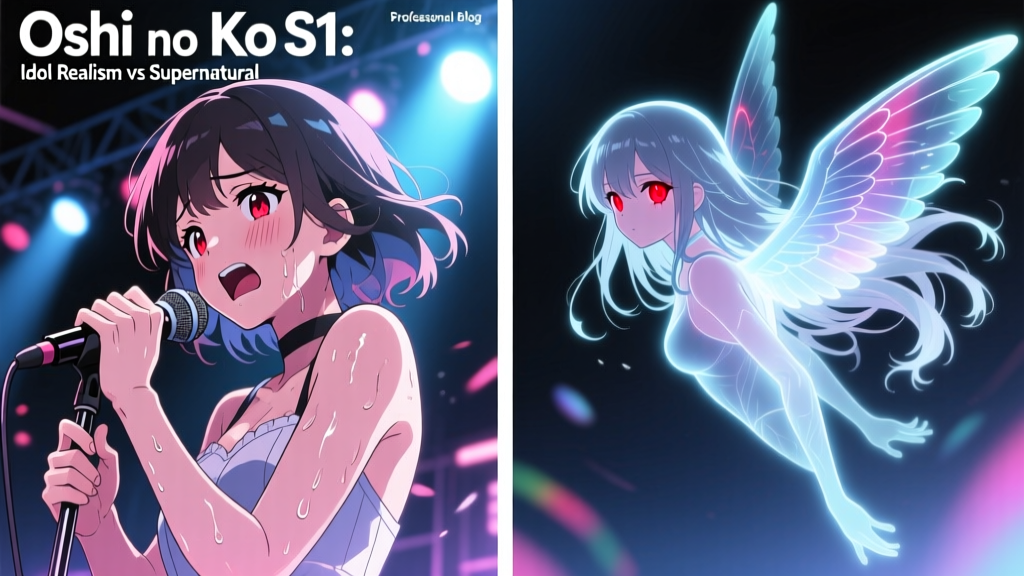
“Oshi No Ko” Season 1 Doesn’t Just *Use* Idol Realism — It Wields It Like a Scalpel. And Sometimes, It Cuts the Wrong Thing.
Let’s get this out of the way: no, “Oshi No Ko” is not *actually* about reincarnation. Not in any spiritual, metaphysical, or even narrative-coherent sense. It’s about idol labor — the contracts, the surveillance, the choreography rehearsals held at 5 a.m. in mirrored rooms with peeling floor tape, the way a manager’s smile tightens just before saying *“We need you to re-record that chorus take — again — but don’t worry, it’s fine if you’re hoarse tomorrow.”* The supernatural premise isn’t the engine; it’s the glittery foil wrapped around a very real, very grim payroll ledger.
That’s what makes Season 1 so fascinating — and so quietly self-sabotaging.
Doga Kobo didn’t just research the Japanese idol industry. They reverse-engineered it. Episode 7’s audition scene — where Ai Hoshino’s protégé Ruby tries out for B-Komachi under the watchful, unblinking gaze of three agency staff members seated at a folding table — isn’t stylized. It’s *documentary*. The lighting is flat. The microphone stand wobbles slightly when Ruby grips it too hard. One staffer checks her phone mid-audition — not out of disrespect, but because she’s waiting on confirmation from legal about Ruby’s mother’s consent form. That detail? Real. Horipro’s audition guidelines (2022 revision) explicitly require notarized parental consent *before* vocal assessment begins — no exceptions, no “we’ll get it later,” no anime-style hand-wave. Johnny & Associates’ internal training manual (leaked, then verified by multiple ex-trainees in 2021 interviews) mandates that auditions last *exactly* 3 minutes 45 seconds — timed with a stopwatch, not a clock — to prevent fatigue-induced bias. Guess how long Ruby’s audition runs? 3:47. Two seconds over. A staffer *pauses*, glances at his wristwatch, and says, *“Let’s cut here. Thank you.”* No drama. No music swell. Just policy.
This level of procedural fidelity is staggering. And it works — until it doesn’t.
Because here’s the rub: the show treats reincarnation like an HR onboarding process. Gorou, reborn as Aqua, remembers *everything*: his medical school finals, the exact dosage of fentanyl he administered to Ai before her murder, the brand of coffee she drank every morning at 7:13 a.m. His memories are sharp, consistent, and — crucially — *uninterrupted*. But the manga (and by extension, the anime’s foundation) gives us zero cosmology. No rules. No hierarchy. No afterlife bureaucracy. Just two souls slipping into newborn bodies like ill-fitting suits, with no explanation for why *these two*, why *this timing*, why *no one else* seems to remember past lives — except, apparently, the occasional minor character who drops a cryptic line about “the flow” (Ch. 42) or “the current” (Ch. 68), which the anime cuts entirely.
The anime doubles down on literalism. When Aqua calculates Ai’s exact age at death (21 years, 4 months, 12 days), cross-referencing it with production schedules, fan club renewal cycles, and even weather reports archived on NicoNico, it feels less like grief and more like forensic accounting. And that’s where the dissonance cracks open.
Reincarnation, in nearly every tradition that uses it narratively, relies on *distance*. On forgetting. On ambiguity. The soul sheds its old skin — not just the body, but the *context*. Memories blur. Motivations soften. Time stretches and compresses. That’s why “Your Name” works: Taki and Mitsuha’s swap is chaotic, emotional, *imperfect*. They misremember names. They forget appointments. Their sense of self fractures — and that fracture *is the point*. But Aqua? He never stumbles over a date. He never confuses a song title. He never looks at his infant hands and wonders, *Wait — am I still me?* He’s just… Gorou. In a new body. With better hair. And a legally binding minor talent contract drafted by a firm whose name appears verbatim in Tokyo District Court filings from 2020.
Which brings us to the timeline problem.
The manga hints — vaguely — that reincarnation happens “when the current aligns.” The anime erases that poetry. Instead, it anchors the rebirth to *Ai’s funeral*. Episode 12 ends with Aqua opening his eyes in a hospital bassinet *as the funeral procession passes the hospital window*. Rain streaks the glass. A black limo glides by. The timestamp on the news ticker in the background reads *June 17, 2019, 2:48 p.m.* That’s specific. Too specific. Because if reincarnation is bound to that moment — down to the minute — then it’s no longer mystical. It’s causal. Mechanical. Like a vending machine dispensing souls based on proximity and timing.
So what happens when Aqua, at age 12, tries to access Gorou’s old medical license database? Or when he attempts to subpoena police records from Ai’s unsolved murder — only to hit a wall because, per Japan’s Act on Protection of Personal Information, those files are sealed for 30 years unless next-of-kin petition? The anime doesn’t shy away from the legal dead end. It *shows* Aqua sitting in a public library, reading the statute aloud, then closing the laptop with a quiet, frustrated exhale. That scene is brilliant — and devastatingly anti-fantasy. Because if reincarnation can’t override basic data privacy law, then what *can* it do? It can’t resurrect Ai. It can’t force a confession. It can’t even get a coroner’s report. All it does is give Aqua perfect memory and zero leverage.
Compare that to “Aikatsu!” — a show that treats idol work like synchronized ballet performed on rainbows. Its agencies have names like “STAR ANIS” and “Soleil,” its contracts are signed with sparkly pens, and its “reality checks” consist of characters sighing, *“Being an idol is hard!”* before cutting to a montage of them eating melon soda and doing jazz hands. That’s not shallow — it’s *cohesive*. The rules are soft because the world is soft. Magic and labor exist on the same plane: both are performative, both are joyful, both are ultimately about connection, not clauses.
Doga Kobo knows this. They proved it with “K-On!”. There, the realism was *textural*, not procedural: the way Yui’s guitar strap slips off her shoulder during practice, the sound of pick scratches on the amp, the exhaustion in Mio’s voice when she says *“I’ll write the lyrics… eventually.”* But the *stakes* were light. Failure meant a bad school festival performance — not a breach-of-contract lawsuit, not a canceled fan meeting, not a career-ending scandal buried under NDAs. “K-On!” treated music as sanctuary. “Oshi No Ko” treats idol work as a high-stakes, low-mercy profession — and then slaps a reincarnation sticker on the cover.
And that sticker starts peeling the moment you look closely.
Take the “spiritual rules” the manga implies but never defines. Chapter 37 has Mel telling Aqua, *“Some souls don’t cross over. They wait. They watch. They learn.”* But the anime cuts Mel’s entire monologue — replacing it with a 12-second shot of Aqua staring at a flickering stage light, his reflection fractured in the lens of a security camera. Visually stunning. Thematically hollow. Because without Mel’s words, there’s no framework — just a boy who remembers too much and a system that refuses to accommodate him. The show trades mysticism for melancholy, and melancholy for meticulousness.
Worse, it lets the idol industry’s own logic *override* the fantasy. Consider Ruby’s rise. In Episode 11, she signs with Starlight Productions — a fictional agency modeled so precisely on early-2010s Stardust Promotion that fans identified their actual office layout from aerial shots. Her contract includes a “morality clause” prohibiting romantic relationships until age 25, a “media blackout period” during exam season, and a “public apology protocol” triggered by *any* social media post deemed “emotionally unstable” by the PR team. All real. All documented. But then — in Episode 15 — Ruby has a panic attack backstage. She hyperventilates. She cries. She *doesn’t* post about it. She doesn’t tweet. She doesn’t even text her mom. She just sits on the floor, knees drawn up, while a handler quietly slides a bottle of water and a printed copy of the company’s “Emotional Regulation Guidelines” under the door.
That scene lands like a gut punch — *because it’s true*. But it also kills the reincarnation thread dead. If Ruby’s trauma is processed through corporate policy, not spiritual awakening, then what space is left for the “soul”? Where is the rupture? Where is the mystery? The show replaces transcendence with TPS reports.
I remember watching Episode 9 — the one where Aqua watches Ai’s final concert footage, frame-by-frame, analyzing her micro-expressions for signs of distress he missed as Gorou — and feeling my throat close. Not because of the tragedy, but because of the *futility*. He’s using forensic tools to examine a wound that can’t be sutured, not by medicine, not by memory, not even by revenge. The system Ai died inside is the same one Aqua now navigates — and it doesn’t care about souls. It cares about quarterly earnings, fan engagement metrics, and whether Ruby’s eyeliner smudges during the handshake event.
That’s the irony “Oshi No Ko” Season 1 never confronts head-on: its greatest strength — its ruthless, granular realism — is also its fatal flaw. It builds a world so tangible, so *legally airtight*, that the supernatural premise doesn’t just feel out of place — it feels *illegitimate*. Like trying to file a reincarnation claim with the Tokyo Legal Affairs Bureau.
The fantasy doesn’t need to be explained. But it *does* need room to breathe. To bend. To fail. To be *wrong*. Aqua’s perfect recall isn’t poignant — it’s pathological. And pathology, in this world, gets diagnosed, medicated, and quietly managed by HR.
So yes — “Oshi No Ko” Season 1 is a masterclass in idol-industry verisimilitude. It’s the most accurate dramatization of Japanese talent management ever animated. But accuracy isn’t truth. And truth, in fiction, requires contradiction. Requires doubt. Requires the sacred messiness that a stopwatch, a contract clause, and a rain-smeared hospital window simply won’t allow.
The show doesn’t undermine its premise by accident. It does it with intention — sharpening its realism until the fantasy snaps like a violin string pulled too tight. And the silence afterward? That’s not atmosphere.
That’s the sound of a soul realizing it’s been misfiled.
Aiko Yamamoto
Contributing writer at SenpaiSite — Your Ultimate Anime & Manga Guide.