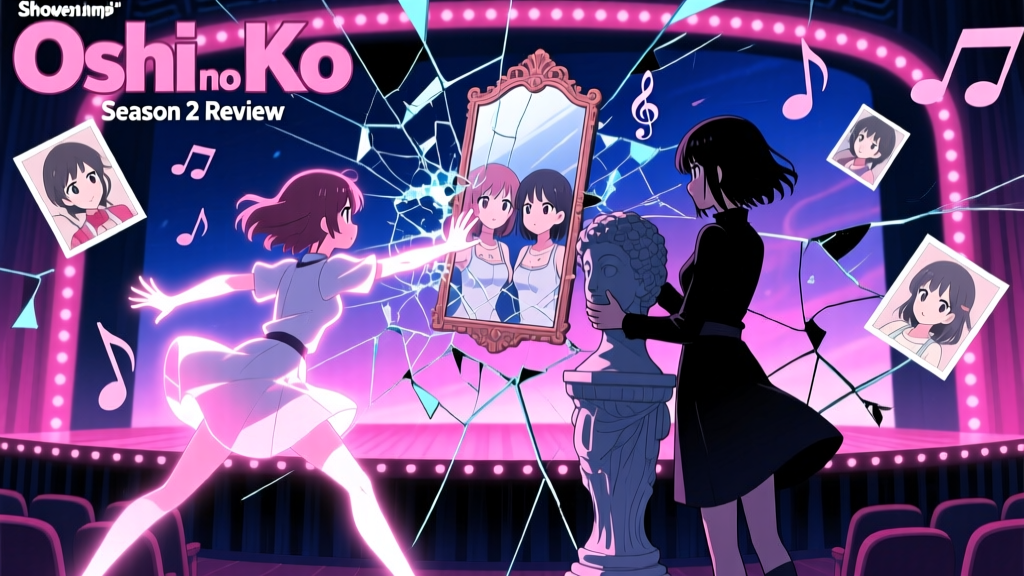
Oshi no Ko Season 2 — The Idol Industry Gets Darker and More Compelling
Season 2 of Oshi no Ko doesn’t ease into its themes—it slams you with them. In episode 1, Ruby stands alone on a soundstage bathed in sterile white light, rehearsing a choreography that feels less like performance and more like ritual sacrifice. Her smile is perfect. Her breathing is controlled. Her eyes—just for half a second—flicker with exhaustion so deep it borders on dissociation. That moment isn’t exposition. It’s the thesis statement.
I remember watching that scene and thinking: This isn’t just about idols anymore. It’s about what happens when you build an entire economy on manufactured vulnerability.
The Industry as Antagonist—Not Metaphor, but Machinery
Season 1 exposed the cracks. Season 2 widens them into chasms—and then drops characters straight in.
Gorou’s dual identity—doctor by day, producer by night—becomes even more morally precarious. His medical license isn’t just a cover; it’s a scalpel he uses to dissect the industry from within. In episode 4, he reviews Ruby’s bloodwork and sleep logs not out of paternal concern alone, but because her physical thresholds directly impact B-Komachi’s viability as a brand. There’s no villainous CEO twirling a mustache here. Instead, we get Mikan’s manager, Yuki, who calmly explains in episode 7 why Ruby can’t attend her own mother’s memorial: “Fan sentiment metrics dipped 12% after last week’s fan meeting. We need stability—not grief.” He says it while adjusting his tie. No malice. Just math.
The show weaponizes mundanity. Contracts are negotiated over matcha lattes. Crisis PR meetings happen in conference rooms with potted ferns. The horror isn’t in the spectacle—it’s in the spreadsheet columns labeled “Emotional Labor Allocation” and “Grief Delay Window.”
Ruby’s Descent Into Agency—And Its Cost
Ruby evolves in ways that make your stomach clench. She doesn’t rebel. She optimizes. By episode 9, she’s editing her own fan letters before they’re published, softening raw emotion into digestible gratitude. She starts scripting her “off-duty” Instagram stories—down to the exact shade of lighting that implies authenticity. When Ai’s old fan club re-emerges online, Ruby doesn’t delete their posts. She analyzes their engagement patterns, identifies their top three emotional triggers (nostalgia, guilt, protectiveness), and tailors B-Komachi’s next single around them.
It’s chilling because it’s believable—and because Ruby knows exactly what she’s doing. Her arc isn’t about losing herself. It’s about building a self that functions *inside* the machine. In episode 12, she stares at her reflection mid-makeup application and whispers, “I’m not pretending. I’m translating.” That line lands like a gut punch. Translation implies fidelity—but fidelity to what? To audience expectation? To survival? To memory?
Ai’s ghost haunts this season—not as a specter, but as infrastructure. Her voice appears in archival BGM loops. Her choreography is re-choreographed, repackaged, re-licensed. In episode 14, Ruby performs Ai’s iconic “Starry Sky” solo during a charity gala—except the stage design replaces stars with flickering LED screens showing real-time social media sentiment heatmaps. The applause is thunderous. Ruby bows, expression serene. The camera holds on her hand gripping the microphone stand—white-knuckled, trembling, utterly unseen.
Aquamarine’s Fracturing—and Why It Matters
If Ruby represents adaptation, Aquamarine embodies collapse. Her storyline isn’t tragic because she fails—it’s devastating because she *succeeds*, then realizes success was never the point.
Her solo debut single “Glass Cage” hits #1 on Oricon. Her interviews are flawless. Her TikTok dance challenges go viral. And yet, in episode 10, she sits in her dressing room, scrolling through fan comments—reading praise like it’s evidence in a trial she didn’t know she was fighting. One comment reads: “You’re so much like Ai-san… it’s comforting.” She closes the app. Opens her notes. Types: “Ask management if ‘comfort’ is a KPI.”
Aquamarine’s unraveling is quieter than Ruby’s recalibration, but no less precise. Her breakdown isn’t a meltdown—it’s a system error. In episode 13, during a live broadcast, she pauses mid-sentence, blinks slowly, and asks the host, “Do you ever wonder what my favorite color *really* is?” The host laughs it off. The stream cuts to commercial. But the shot holds on Aquamarine’s face—the micro-expression of someone realizing they’ve lost access to their own interiority.
That moment crystallizes what makes Oshi no Ko so ruthlessly intelligent: it treats mental erosion not as drama, but as operational risk. Her therapist isn’t a confidante—she’s a compliance officer hired by the agency. Her medication isn’t private healthcare—it’s logged in a wellness dashboard shared with her A&R team.
The Mystery Deepens—Without Distracting From the Point
Yes, the mystery plotline continues: the identity of Ai’s stalker, the origins of the blackmail footage, the true role of the enigmatic film director, Satoru. But crucially, Season 2 refuses to let these threads overshadow its core critique. The stalker isn’t a cartoon villain—he’s a former production assistant whose contract was voided after he questioned unsafe rehearsal conditions. The blackmail footage wasn’t filmed maliciously; it was extracted from unsecured server backups during a routine IT audit. The director? He’s not pulling strings—he’s trying to make a documentary about idol labor, only to have his footage repurposed as leverage.
In episode 16, Gorou watches raw footage of Ai’s final concert—unreleased, unedited, full of missed cues and visible fatigue. He doesn’t watch it for clues. He watches it for proof that she was *tired*. That she was human. That she was working under conditions no person should endure. The mystery isn’t “who did it?”—it’s “what systems made it possible, inevitable, and invisible?”
“We don’t mourn idols. We mourn the idea that anyone could be this perfect—and then realize perfection was the cage.”
— Line delivered by a background extra in episode 11, during a crowd scene at Ai’s memorial service. Not scripted. Improvised. Left in.
Final Thoughts: Not a Warning—A Mirror
Oshi no Ko Season 2 doesn’t ask you to feel bad for idols. It asks you to examine your own complicity—to recognize how your streams, shares, and sentimental purchases feed the very machinery that grinds them down. It’s not cynical. It’s clinical. Compassionate, even—in the way a surgeon is compassionate before making the incision.
The final shot of the season isn’t Ruby smiling onstage or Aquamarine crying in silence. It’s a wide-angle view of the Tokyo Dome parking lot at dawn: dozens of black SUVs idling, drivers waiting, lights reflecting off wet asphalt. Inside each vehicle: another young person, rehearsing lines, checking notifications, swallowing pills, adjusting wigs. No music. No score. Just the low hum of engines—and the quiet, collective intake of breath before the next performance begins.
That’s the real horror. Not that it happens.
But that it’s already happening.
And that you, reader, might be parked in one of those cars right now—just not knowing it yet.