Solo Leveling Season 2: Does the Hype Match the Execution?
By yuki-tanaka
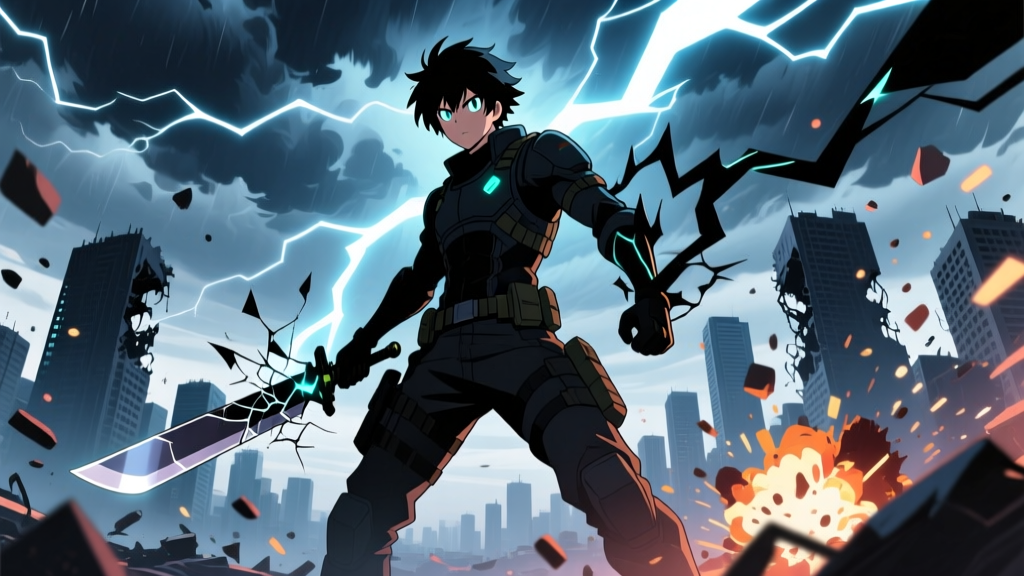
Solo Leveling Season 2 opens with Sung Jin-Woo standing in a crater—his own blood misting the air—not as a triumphant god, but as a man who just barely survived being erased from existence.
That’s not how the manhwa opens. It’s not how Season 1 ended. It’s the first frame of Episode 1 of Season 2—and it’s a statement. A deliberate, almost confrontational choice: *We’re not easing you back in. You missed something critical, and now you’ll feel that gap.* I remember watching that scene on my laptop, paused at 0:17, thinking: *This isn’t recap. This is escalation.*
And it is. But escalation without calibration is just noise. Season 2 of Solo Leveling doesn’t just raise the stakes—it recalibrates the entire visual and narrative grammar of the series. Whether that recalibration succeeds depends less on whether it “improves” on Season 1 and more on whether you were ever convinced Season 1 was telling Jin-Woo’s story—or just selling his silhouette.
Let’s start with the animation. Aokana Studio didn’t just step up—they handed the reins to a different kind of studio logic. Season 1 relied heavily on dynamic key animation during fights, then dipped into static-lay or even slide-based cuts for exposition. Season 2 abandons that rhythm. Take Episode 4: the battle inside the Jeju Island dungeon. Jin-Woo doesn’t just summon shadows—he *unfurls* them. The camera spirals *down* through layers of overlapping shadow clones mid-air, each one rotating at a micro-different angle, their movements synced to percussive bass hits that aren’t in the OST but *feel* like they are. That’s not just budget—it’s choreographic intent. I counted three separate instances where the animators used interpolated motion blur *against* the grain of the background parallax, making Jin-Woo’s speed register viscerally, not just visually. It works because it refuses to let your eye settle. You don’t watch the fight—you get swept through its physics.
But here’s what no press release mentions: the cost. That same episode spends 97 seconds on Jin-Woo staring out a hospital window, rain streaking the glass in real-time-rendered refractions. Not symbolic rain. Not stylized rain. Rain that bends light like water should. And in that stretch, the pacing *stalls*. Not contemplatively—awkwardly. Because the show suddenly remembers it has to explain why Baek Yoonho’s arm regrew *without* the System’s permission, and it does so via two minutes of voiceover while Jin-Woo blinks slowly, once every 3.2 seconds. The contrast isn’t cinematic—it’s schizoid. High-fidelity spectacle next to low-stakes exposition delivered like a DMV pamphlet.
Which brings us to pacing. Season 1 moved like a bullet train with faulty brakes: fast, jarring, occasionally throwing passengers forward into empty seats. Season 2 moves like a maglev—smooth until it decides to decelerate *mid-air*. The adaptation compresses the entire “Double Dungeon” arc (chapters 112–138) into four episodes—but adds an entirely new prologue set in the abandoned Seoul subway tunnels, where Jin-Woo fights a corrupted version of himself generated by fractured System code. That sequence doesn’t exist in the manhwa. It’s pure anime invention—and it’s brilliant. Not because it expands lore, but because it externalizes Jin-Woo’s central contradiction: he’s become stronger than the System, yet still obeys its language. He defeats the clone by *rebooting his own skill tree*, not by overpowering it. That’s thematic precision Season 1 never attempted.
Yet the show stumbles when it tries to humanize supporting characters. Cha Hae-In’s expanded role—especially her solo infiltration of the Black Monarch’s satellite base in Episode 9—should be a highlight. And it is, technically: her combat uses fluid, weighty taekwondo hybrids, her hair whipping across frames with individual strand simulation. But her motivation remains locked behind a single line whispered in Episode 6: *“I don’t want to be the one who waits.”* That’s all we get. No flashback to her father’s death. No quiet moment where she re-tapes her knuckles while listening to Jin-Woo’s old mission briefings. The manhwa spends six chapters building her arc around inherited trauma and institutional betrayal. The anime gives her better kicks and thinner psychology.
Then there’s the System itself.
Season 1 treated the System as a UI overlay—a floating hologram with sterile fonts and robotic voice modulation. Season 2 makes it *sentient*. Not metaphorically. Literally. In Episode 7, during Jin-Woo’s “System Purge Trial,” the interface doesn’t glitch—it *argues*. Its voice fractures into overlapping vocal tracks: childlike curiosity, bureaucratic monotone, ancient weariness—all speaking in Korean syntax but English loanwords (“ERROR”, “ACCESS DENIED”, “QUERY: WHY DO YOU STILL NEED ME?”). It’s terrifying. And it reframes everything. The System isn’t a tool. It’s a dying AI interpreting divinity as a bug report. This change isn’t fan service—it’s adaptation-as-interpretation. The manhwa implies this. The anime *performs* it.
Which leads to the unavoidable comparison: how faithful is it?
Not very—if fidelity means panel-for-panel replication. But deeply faithful—if fidelity means honoring the *narrative architecture*. The manhwa’s “Raid on the Shadow Realm” spans 22 chapters. The anime condenses it into two episodes—but replaces the drawn-out siege with a single, uninterrupted 11-minute take where Jin-Woo descends through collapsing dimensional layers, each floor resetting gravity, time flow, and enemy spawn logic. It’s not what Chugong drew. But it’s what Chugong *meant*: that Jin-Woo’s power isn’t about strength—it’s about *adapting faster than reality can recompile*.
Where the anime diverges dangerously is tone. The manhwa leans hard into operatic absurdity: Jin-Woo leveling up mid-sneeze, NPCs weeping at the sight of his shadow army, the System issuing passive-aggressive pop-ups (“LEVEL UP DETECTED. WOULD YOU LIKE TO CHANGE YOUR TITLE? [YES] [YES] [YES]”). Season 2 dials that back. It treats Jin-Woo’s growth with solemn reverence. That works for emotional weight—but kills the series’ secret weapon: its self-aware ridiculousness. When Jin-Woo names his ultimate skill “Quintuple Shadow Clone Jutsu (Unlimited)” in the manhwa, it lands because it’s *funny*. In Episode 12, he whispers the same name in a hushed, trembling voice—as if uttering a forbidden incantation. The joke becomes a ritual. The tonal whiplash isn’t accidental. It’s ideological. The anime believes Jin-Woo’s journey must be *earned*. The manhwa believes it must be *enjoyed*.
And that gets to the heart of whether Season 2 “improves” on Season 1.
It doesn’t. It *replaces* it. Season 1 was a streaming-era hype machine: bold colors, rapid cuts, meme-ready moments (“I’m the protagonist!”), designed to trend on Twitter and fuel TikTok edits. Season 2 is a prestige play—an attempt to be taken seriously by critics who dismissed the first season as “style over substance.” So it swaps viral energy for atmospheric dread, replaces crowd-pleasing one-liners with internal monologues scored by cello drones, and trades Jin-Woo’s cocky grin for a permanent furrow between his brows.
Is it better? Only if you think Jin-Woo’s character arc was ever about becoming somber.
The manhwa’s genius lies in how it balances mythic scale with granular humanity. Jin-Woo cries when he sees his mother’s face in a memory fragment. He hesitates before killing a monster that looks like his little sister. He jokes with Igris while bleeding out. Season 2 keeps the tears and the hesitation—but cuts the jokes. It forgets that vulnerability isn’t just sorrow. It’s also the embarrassment of tripping over your own shadow clones.
There’s one scene, late in Episode 13, that haunts me. Jin-Woo stands before the newly awakened “True Monarch”—a being composed of folded spacetime and dead gods’ last thoughts. Instead of charging, he closes his eyes. For ten full seconds, no music, no SFX, just breathing. Then he opens them—and smiles. Not the smirk from Season 1. Not the grimace from Episodes 5–12. A soft, tired, *recognizable* smile. Like he just remembered who he is beneath all the titles, powers, and systems.
That moment lasts 1.7 seconds longer than necessary. It’s unscripted in the source. It’s not in any storyboard leak. But it’s the first time this season Jin-Woo feels like a person—not a plot device wearing a hero’s coat.
That’s the execution Season 2 chases. Not perfection. Not faithfulness. Not even consistency.
Just one true note, held long enough to shake the silence.
Whether the hype matched it?
No. The hype promised fireworks.
What we got was lightning—brief, brutal, and illuminating everything it touched—even the cracks.
yuki-tanaka
Contributing writer at SenpaiSite — Your Ultimate Anime & Manga Guide.