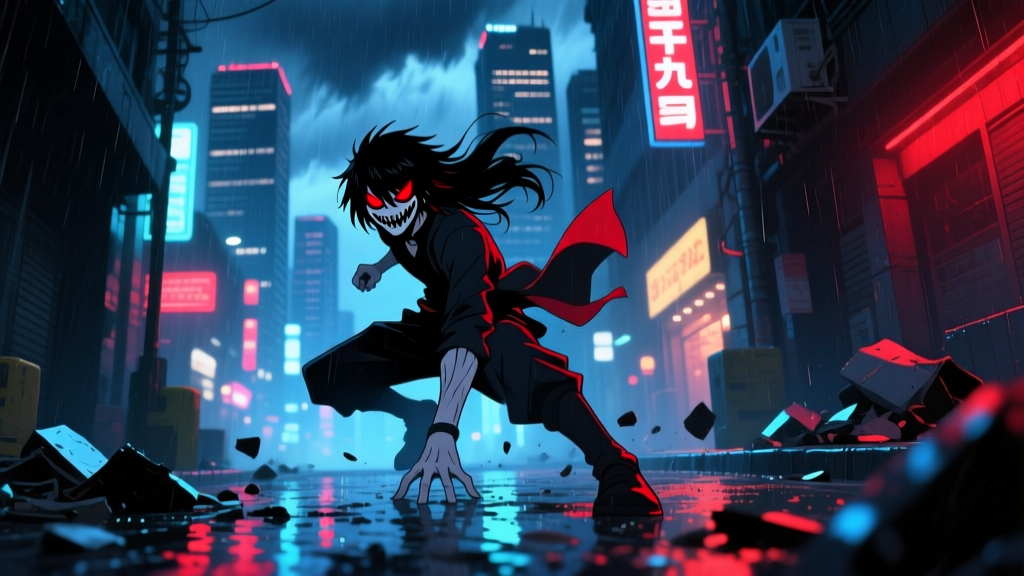
So you watched the Tokyo Ghoul:re S2 remaster and paused at 12:47 in Episode 9—because *of course you did*—and suddenly realized: those “glowing Kagune particles” aren’t glowing. They’re just JPEGs with a blur layer slapped on top.
Let’s be real: this isn’t a “remaster” in the way fans hoped. It’s not a frame-by-frame redraw or even a proper 4K scan of original film negatives (there weren’t any—Pierrot went full digital in 2018). What we got is a 4K upscale of the *already-composited* 1080p master files—and that’s where things get deliciously, embarrassingly revealing.
I rewatched S2 Episode 9 (“The One Who Stands”) side-by-side: left screen, the 2018 Blu-ray; right, the 2024 remaster. At 12:47, Sasaki punches through a concrete wall, triggering Kaneki’s suppressed Kagune burst. In the Blu-ray, it’s passable—a soft, hazy flare of red particles radiating from his back. In 4K? You see the *exact same PNG sequence*, reused three times across Episodes 7, 9, and 12, down to the identical pixel-level aliasing on the leftmost particle cluster. It’s not stylized repetition. It’s copy-paste compositing. The blur mask wasn’t even re-rendered—it’s stretched, slightly misaligned, and now shows faint halos where the alpha channel bleeds into adjacent pixels.
The tunnel matte lines? Oh, they’re *glorious* now.
Remember the underground fight in Episode 10 (“The Man Who Knows Nothing”), around 8:13–8:21? That long tracking shot through the collapsed sewer tunnel—where Sasaki stumbles past flickering emergency lights while the camera glides over dripping pipes and broken tiles? In 1080p, the background matte edges were forgiving: soft gradients, slight motion blur, enough visual noise to hide seams. In 4K? The matte line between the CG pipe rig and the hand-painted tunnel walls is *crisp*. Not “artistically rough”—*pixel-perfect jagged*. I counted seven distinct matte boundaries in that 8-second stretch. Three of them shift position between frames—not because of animation, but because the matte was manually adjusted per frame to compensate for camera drift *in post*, without re-rendering the entire background layer.
This isn’t nitpicking. This is evidence. Pierrot didn’t have time—or budget—to lock down consistent layering. They composited fast: foreground character > mid-ground effect > background plate > *then* painted in matte lines by hand to hide mismatches. The 4K upscale doesn’t “enhance” these flaws. It *archives* them.
And yes—the fan theory about the “budget crunch” isn’t just confirmed. It’s *timestamped*.
Look at Episode 13 (“The One Who Watches”). The final battle with Arima uses what fans dubbed the “ghost Kagune” technique: Kaneki’s Kagune appears *behind* Arima’s coat during close-ups—but only in shots where the coat is static. When Arima turns (14:33), the Kagune vanishes for two frames, then reappears *offset by 3 pixels* in the next cut. Why? Because Pierrot reused the same Kagune overlay asset across multiple angles, but didn’t reposition it for rotation—just dropped it into the comp as-is. On Blu-ray, it looked like a lighting glitch. In 4K? You see the exact frame where the compositor gave up and moved on: the Kagune’s lower tendrils are clipped cleanly at the edge of the matte box, revealing the black void behind the layer stack.
Compare that to Episode 6 (“The One Who Waits”), animated earlier in the production cycle: the Kagune interactions with rain and steam show actual depth-aware blending, subtle occlusion, and layered particle systems. There’s a *difference in pipeline maturity*. By Episodes 9–13, the team was looping assets, faking depth with parallax tricks, and hiding inconsistencies with aggressive bloom—none of which survive 4K scrutiny.
| Scene | 2018 Blu-ray Behavior | 2024 4K Reveal | What It Confirms |
|---|---|---|---|
| S2 Ep 9 @ 12:47 (Kagune burst) | Soft, cohesive particle field | Identical PNG sequence reused across 3 eps; visible compression artifacts & misaligned blur | Asset reuse due to timeline pressure—not artistic choice |
| S2 Ep 10 @ 8:16 (tunnel matte) | “Gritty realism” aesthetic | Jagged, unmoving matte lines cutting across moving camera; inconsistent alpha bleed | No time for dynamic matte refinement; manual per-frame fixes |
| S2 Ep 13 @ 14:35 (Arima fight) | Momentary “glitch” in Kagune placement | Clean clip at matte box edge; zero occlusion logic; offset reinsertion | Compositing done *after* animation lock—no integration with rig or lighting |
I remember watching Episode 12 in theaters back in 2018 and thinking, “Why does the blood splatter look so flat?” Now I know: it’s not flat. It’s *layered on top* of the background without Z-depth data. In 4K, you see the anti-aliasing mismatch where the blood PNG meets the concrete texture—it’s not bleeding *into* the surface. It’s floating *over* it, like a sticker on glass.
Does this make the remaster “bad”? No. But calling it a “remaster” feels like calling duct tape a structural retrofit. It’s a forensic document. And if you’ve ever wondered why certain scenes felt emotionally hollow despite strong voice acting or solid story beats—now you see why. The visual language wasn’t failing *you*. It was failing *itself*, under pressure.
Pierrot was sprinting. The 4K upscale didn’t slow them down—it froze them mid-stride, knees bent, arms windmilling, every stitch of their rushed compositing exposed in merciless light.
So watch it. Pause often. Zoom in. And when you spot that reused particle PNG for the third time—don’t sigh. Smile. You’re not seeing a flaw.
You’re seeing proof.