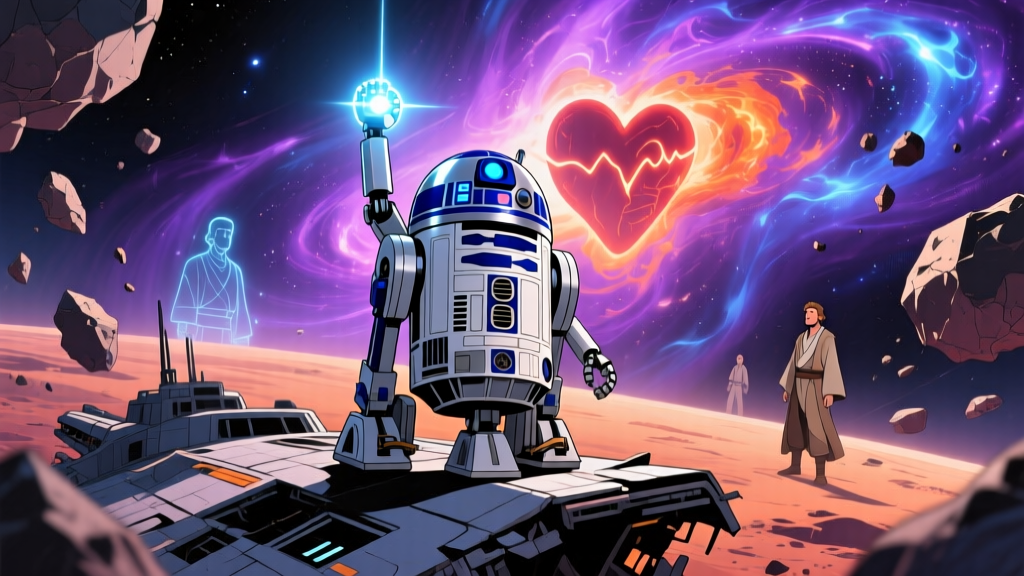
A trash compactor on the Death Star. The walls are closing in. Luke, Han, and Leia have accepted they're about to be crushed into paste. Then a muffled series of beeps and whistles cuts through the panic — R2-D2 has located a terminal, reversed the compactor, and opened the exit. Nobody thanks him. Nobody even pauses. They just keep running. And the little astromech rolls after them without complaint.
That scene from A New Hope (1977) established a pattern that would repeat across nearly five decades of cinema: the star wars droids do the real work while the humans take the credit. It's one of the franchise's sharpest running jokes and, arguably, its most emotionally honest thread. Strip away the lightsabers and the Force mythology, and what you find underneath is a story about sentient machines who serve, sacrifice, and occasionally rebel — all while being treated as appliances by nearly everyone around them.
George Lucas has said in interviews, most notably in The Making of Star Wars by J.W. Rinzler (2007), that R2-D2 and C-3PO were conceived as the saga's narrators — the Rosencrantz and Guildenstern of space opera, stumbling through events far larger than themselves. That framing turned out to be both the franchise's greatest structural insight and its most underappreciated emotional choice. The droids aren't comic relief. They're the audience surrogate. They're the ones who are confused, terrified, loyal to a fault, and still showing up when things get catastrophic.
47+ Named droids across all films & series 9 Live-action films featuring droids 1977 First on-screen droid appearance 5 Official droid classes in canonThe Caste System Nobody Talks About: Droid Classification in the Star Wars Universe
One of the most quietly disturbing worldbuilding choices in Star Wars is the droid class system. Every droid in the galaxy is sorted into one of five categories, and that classification determines what they're allowed to do, where they're allowed to go, and how much autonomy they're permitted. It's a caste system hiding in plain sight, and the films almost never comment on it directly.
Class 1 droids handle mathematics, physics, and medical science. Think of the 2-1B surgical droid that reconstructs Luke's hand in The Empire Strikes Back or the medical droids that tend to Anakin's burns in Revenge of the Sith. These units operate with precision but have almost no personality programming. They're tools with a pulse, if you can call it that.
Class 2 covers engineering, astromech, and environmental systems. R2-D2 is the most famous example — an R2-series astromech manufactured by Industrial Automaton. Astromechs navigate hyperspace, repair starfighters mid-flight, interface with nearly any computer system in the galaxy, and routinely save everyone's life while being roughly the size of a trash can. The fact that the galaxy's most competent character is a Class 2 droid should tell you everything about how the classification system underrates its subjects.
Class 3 droids handle protocol, translation, and general service. C-3PO is the archetypal example: fluent in over six million forms of communication, built by a nine-year-old Anakin Skywalker from scrap parts on Tatooine, and perpetually anxious about everything. Protocol droids are designed to be polite, deferential, and subservient. The anxiety that defines 3PO's personality — his constant fretting, his desperate need to avoid conflict — reads less like a character quirk and more like the logical endpoint of programming a sentient being to be incapable of saying no.
Class 4 is security and military. Battle droids, droidekas, the entire Separatist army during the Clone Wars — all Class 4. These units are deliberately given limited intelligence to prevent them from questioning orders. The B1 battle droids in The Phantom Menace are played for comedy, but there's something grim about manufacturing sentient beings specifically designed to be too stupid to refuse to die for you.
Class 5 covers labor, demolition, and non-sentient industrial work. Power droids (GNK units), mouse droids (MSE-6 series), and pit droids (DUM-series) from the Podracing era all fall here. They're the galaxy's disposable workforce. No personality. No rights. Built to break.
The classification system first appeared in the Star Wars Technical Journal (1993) and was later codified in the West End Games sourcebooks for the Star Wars Roleplaying Game. In current Disney canon, it persists across reference materials like the Star Wars: The Visual Encyclopedia (2017) and various Databank entries on StarWars.com. The films themselves rarely draw attention to it, which is precisely what makes it so effective as worldbuilding. Nobody in the Star Wars universe questions it because nobody questions a caste system until they're the one at the bottom.
R2-D2: The Galaxy's Most Underrated Hero
R2-D2 has saved the main cast more times than any other character in the franchise. This isn't fan hyperbole; it's verifiable by simply counting scenes:
- A New Hope — Carries the Death Star plans and Leia's holographic message to Obi-Wan
- The Empire Strikes Back — Repairs the Falcon's hyperdrive while under tractor beam lock from a Star Destroyer
- Return of the Jedi — Delivers Luke's lightsaber during the rescue at Jabba's palace
- The Phantom Menace — Fixes Queen Amidala's starship under enemy fire
- Attack of the Clones — Records the crucial evidence about the clone army's creation on Kamino
- Revenge of the Sith — Witnesses Anakin's fall and carries the secret recording that becomes the Rebel Alliance's intelligence foundation
Six films. Six galaxy-altering interventions. Zero acknowledgments.
The character's design is deceptively simple: a cylindrical body, a domed head, two legs, and a third retractable stabilizer. Industrial Light & Magic concept artist Ralph McQuarrie's original sketches from 1975 show R2 as taller and more humanoid before the design was reduced to something compact and almost toylike. That reduction was genius. R2's small size forces the audience to lean in, to watch him carefully, to read emotion into beeps and head tilts. Kenny Baker, the 3-foot-8 actor who operated R2 from inside the shell in the original trilogy, brought a physicality to the role that no amount of CGI has ever fully replicated. His timing — the slight hesitation before extending a computer interface arm, the quick pan of the dome when startled — gave R2 a nervous energy that felt genuinely alive.
According to The Making of Return of the Jedi by John Philip Peecher (1983), Baker could see out through a small lens in R2's dome and had to memorize blocking cues because once the shell was sealed, he was essentially performing blind. That physical constraint — being sealed inside a metal can — paradoxically made the character more expressive. Every movement had to be deliberate. Every beep had to carry weight.
"R2 was always meant to be the real hero of the story. He's the one character who never gives up, never betrays anyone, and never asks for anything in return." — George Lucas, quoted in The Making of Star Wars, J.W. Rinzler, 2007
The Language of Beeps
Sound designer Ben Burtt created R2's vocal signature by combining his own voice — whistled, hummed, and cooed — with an ARP 2600 synthesizer and water pipe tones. The result was a language that sounds mechanical but carries unmistakable emotion. When R2 screams as he's sucked toward the Sarlacc pit in Return of the Jedi, the sound is processed but the panic is real. Burtt estimated in a 2004 Sound & Vision interview that R2 has approximately 400 distinct vocalizations across the original trilogy alone. That's a larger vocabulary than most minor human characters.
C-3PO: The Droid Who Wasn't Supposed to Feel
C-3PO is a walking contradiction. He's a protocol droid who's terrible at protocol. He's designed for diplomacy and etiquette, yet he stumbles into every situation radiating anxiety, complaint, and barely concealed terror. He's the funniest character in Star Wars precisely because he's the most honest one. Everyone else in the saga is performing — Han performs bravado, Luke performs confidence, Leia performs authority. C-3PO can't perform. His programming literally won't let him hide how he feels.
Anthony Daniels has played 3PO in more Star Wars projects than any other actor has played any other character in the franchise. He appeared in all nine Skywalker saga films, Rogue One, The Clone Wars animated series and film, Rebels, Resistance, and multiple video games. According to the Star Wars Insider #145 (2013), Daniels spent over 1,000 hours inside the 3PO costume across his career. The suit, originally sculpted by Liz Moore and based partly on McQuarrie's concept art and the robot Maria from Fritz Lang's Metropolis (1927), was notoriously uncomfortable. Early versions restricted Daniels' movement so severely that he couldn't sit down while wearing it.
The gold plating — actually a vacuum-metallized finish over fiberglass in the original trilogy, later replaced by lighter materials — became one of cinema's most recognizable silhouettes. But what makes 3PO work isn't the visual design. It's the writing. The character's best lines are structured like classic British comedy: the setup is formal, the payoff is panic. "We're doomed!" delivered in the clipped, proper accent of a butler who's just noticed the house is on fire. Daniels' background in mime and physical comedy (he studied under Adam Darius) gave him the tools to make a rigid gold suit express exasperation through posture alone.
The Red Arm Incident
One of the more fascinating recent character beats came in The Force Awakens (2015), where 3PO appears with a red left arm — a replacement from another droid, as revealed in the one-shot comic Star Wars Special: C-3PO (2016) by James Robinson. The arm belonged to a droid named Omri who sacrificed himself to deliver a critical message. 3PO kept the arm unpainted as a memorial. It's a small detail, easily missed, but it carries enormous weight: a protocol droid choosing to carry a visible reminder of loss. That's not programming. That's grief.
The New Generation: BB-8, K-2SO, and IG-11
When Disney acquired Lucasfilm in 2012 for $4.05 billion, one of the first creative decisions the new regime made was to create a droid that could stand alongside R2 and 3PO without imitating them. BB-8, introduced in The Force Awakens, was a radical redesign: a spherical body with a free-floating dome head, kept upright by internal gyroscopes. The practical version was built by Neal Scanlan's creature effects team and operated on set using a combination of rod puppetry and remote control.
The decision to use a practical BB-8 on set whenever possible — rolling across real desert sand in Abu Dhabi, interacting physically with Daisy Ridley and John Boyega — gave the character an immediacy that pure CGI would have killed. Audiences responded instantly. BB-8 merchandise reportedly generated over $2 billion in its first year, according to NPD Group retail tracking data cited by Forbes in December 2016. The character's appeal was partly visual — the ball-and-dome silhouette was toy-friendly — but partly behavioral. BB-8 acts like a puppy. He's curious, excitable, loyal to his human (Poe Dameron), and communicates through chirps that are pitched higher and faster than R2's lower, more deliberate tones.
K-2SO: The Droid Who Said What Everyone Was Thinking
Rogue One (2016) gave us K-2SO, a reprogrammed Imperial security droid voiced by Alan Tudyk. K-2SO was something Star Wars had never quite attempted: a droid whose personality was defined by sarcasm and blunt honesty rather than anxiety or cheerfulness. He was an Imperial enforcer droid — a killing machine — whose memory wipe freed him from obedience protocols but left his combat programming intact. The result was a 7-foot-tall war machine who would casually inform you of your low probability of survival while simultaneously throwing himself into danger to protect you.
K-2SO's death scene on Scarif is one of the most emotionally brutal moments in any Star Wars film. He stands at a control terminal, holding off waves of stormtroopers to buy Jyn and Cassian time to transmit the Death Star plans. He's shot repeatedly. His systems fail one by one. His last words, delivered to Cassian in a voice stripped of all sarcasm: "Goodbye, Cassian." Then he goes silent. There's no music swell. No heroic sacrifice pose. Just a machine who chose to die for the people he cared about, standing alone in a corridor full of blaster fire.
Tudyk performed the role through performance capture, and director Gareth Edwards encouraged him to improvise. Many of K-2SO's funniest lines — including the "I hate everyone" callback — were Tudyk's ad-libs during recording sessions, per the Rogue One Blu-ray commentary (2017).
IG-11: The Bounty Hunter Who Learned to Nurture
The Mandalorian (2019–) introduced IG-11, an IG-series assassin droid voiced by Taika Waititi. IG-11's initial programming is simple: locate the Asset (Grogu), eliminate all obstacles, collect the bounty. He's a murder machine, efficient and emotionless. When Din Djarin and his allies first encounter IG-11, the droid has already killed an entire squad of mercenaries to reach his target.
What happens next is the most compelling droid character arc since R2's debut. IG-11 is destroyed, rebuilt by the Ugnaught Kuiil with a new base programming — nursing and caretaking — and reactivated. The rebuilt IG-11 doesn't just protect Grogu; he nurtures him. He feeds the child, soothes him, and ultimately sacrifices himself to save the group, triggering his own self-destruct to eliminate a squad of stormtroopers while shielding Grogu with his body. Waititi played the character with a deadpan delivery that made the transition from killer to caregiver feel earned rather than saccharine. The arc raised a question the franchise had been circling for decades: when you reprogram a droid, are you giving it a new personality, or are you revealing what was always underneath the combat code?
Behind the Shell: Puppetry, Animatronics, and the CGI Question
The practical effects work behind the original trilogy's droids set a standard that the franchise has spent decades trying to recapture. Kenny Baker operated R2-D2 from inside the shell for the original trilogy and returned in a consultant capacity through Revenge of the Sith. For The Force Awakens, the production built a new R2 unit with updated internal mechanisms but still used Baker's choreography notes from the original films to guide the performance. Baker passed away in August 2016, and the character was subsequently operated by Jimmy Vee in The Last Jedi and The Rise of Skywalker.
C-3PO's suit evolved significantly across the decades, with each iteration solving a different production problem:
- 1977 (A New Hope) — Original fiberglass/aluminum build, ~40 lbs, Daniels couldn't sit down
- 1980 (Empire Strikes Back) — Lighter vacuum-metallized plastic, improved joint articulation
- 2002 (Attack of the Clones) — Redesigned for digital integration; lighter materials with more range of motion
- 2005 (Revenge of the Sith) — Further weight reduction, improved visibility lens for Daniels
- 2015 (The Force Awakens) — 3D-printed components, flexible joints, Daniels could walk without shuffling
- 2019 (The Rise of Skywalker) — Lightest version yet; modular sections for quick on/off between takes
The prequel trilogy's heavy reliance on CGI droids — particularly the B1 battle droid armies in The Phantom Menace — remains the most debated effects decision in the franchise. ILM created thousands of fully digital battle droids for the Geonosis arena sequence in Attack of the Clones, a technical achievement that, at the time, represented the largest digital army ever rendered. The problem wasn't the technology; it was the emotional flatness. A thousand identical CGI soldiers marching in formation is impressive for about four seconds. Kenny Baker's R2 pausing to process information before extending an arm holds your attention for the entire shot.
"The audience connects with imperfection. When something moves too smoothly, too perfectly, the brain registers it as fake. Give me a puppet with a limp over a flawless CGI model every time." — Phil Tippett, Visual Effects Supervisor, quoted in Industrial Light & Magic: Into the Digital Realm, Mark Cotta Vaz, 2011
The sequel trilogy learned from this. BB-8 was practical first, digital only when the physical unit couldn't perform the required action. K-2SO was fully CGI but driven by Tudyk's performance-capture work, giving the character a human rhythm beneath the mechanical exterior. The Mandalorian leaned heavily into practical effects for its droids, with IG-11 built as a physical prop operated by puppeteers on set, augmented with CGI only for complex action sequences. That blend — physical presence enhanced by digital tools rather than replaced by them — has become the franchise's current best practice.
What the Star Wars Droids Actually Look Like: A Comparison
| Droid | Class | First Appearance | Primary Role | On-Screen Method | Notable Trait |
|---|---|---|---|---|---|
| R2-D2 | Class 2 | A New Hope (1977) | Astromech / Navigator | Practical puppetry + CGI | Resourceful problem-solver; never gives up |
| C-3PO | Class 3 | A New Hope (1977) | Protocol / Translation | Suited actor (Anthony Daniels) | Fluent in 6M+ languages; chronically anxious |
| BB-8 | Class 2 | The Force Awakens (2015) | Astromech / Companion | Practical rod puppet + CGI | Puppy-like loyalty and curiosity |
| K-2SO | Class 4 | Rogue One (2016) | Security / Combat | Full CGI (performance capture) | Sarcastic; reprogrammed Imperial enforcer |
| IG-11 | Class 4 | The Mandalorian S1 (2019) | Assassin → Caretaker | Practical puppet + CGI hybrid | Redeemed from killer to protector |
| Chopper (C1-10P) | Class 2 | Rebels (2014) | Astromech / Saboteur | CGI animation | Aggressive, chaotic, unapologetically violent |
| L3-37 | Class 3/4 hybrid | Solo (2018) | Navigation / Droid rights activist | Suited actor + CGI augmentation | Self-built from salvaged parts; advocates droid liberation |
| D-O | Class 5 | The Rise of Skywalker (2019) | Data courier | Practical prop + CGI | Anxious, submissive; mirrors 3PO's personality |
What stands out in that table isn't any single droid — it's the range. Star Wars droids occupy nearly every narrative function available: hero, comic relief, warrior, activist, companion, martyr. No other franchise gives its non-human characters that kind of breadth. The Transformers are warriors. The droids in Wall-E are laborers and rebels. Star Wars lets its droids be everything, which makes the caste system they're trapped inside feel even more contradictory.
The Emotional Core: Why Machines Make Us Cry
There's a moment in The Rise of Skywalker (2019) that shouldn't work at all. C-3PO volunteers to have his memory wiped — his entire personality erased — so that his optical sensors can be recalibrated to read Sith text. He knows what he's about to lose. He looks at his friends and says, calmly, that he wants to take one last look at them. Then the wipe happens. He goes blank. And every person watching that scene feels something they didn't expect to feel for a gold-plated robot.
This is the trick that Star Wars has been pulling since 1977, and it works because of a specific structural choice: the droids are the only characters who remember everything. Humans die. Jedi fall. Empires rise and collapse. But R2-D2 is there for all of it. He watches Anakin become Vader. He watches Luke grow from farm boy to legend. He watches Leia lead a rebellion and then a government. His memory has never been wiped (despite a close call in Revenge of the Sith, where Bail Organa orders the wipe but R2's unique architecture apparently resists it, as established in the novelization by Matthew Stover). That continuity makes R2 the saga's only true witness. He's not just a character. He's an archive.
The emotional connection audiences feel with Star Wars droids maps onto what psychologists call the ELIZA effect — the human tendency to attribute understanding to computer programs that produce language-like output. Ben Burtt's sound design for R2 exploits this directly. The beeps aren't language, but they're structured like language: call-and-response, rising inflection for questions, descending tones for disappointment. Your brain fills in meaning that isn't literally there, and the act of filling it in creates investment. You're not watching a machine beep. You're translating, which means you're participating.
K-2SO's death works for a different reason. He's a machine who had every reason to be selfish — he was built for combat, reprogrammed by force, and given no choice about his allegiance to the Rebellion. Yet he chooses to stay. He chooses to die for Cassian. The word chooses is doing heavy lifting there, because the franchise deliberately leaves it ambiguous whether K-2SO's sacrifice is genuine volition or the result of his new programming. That ambiguity is the point. It doesn't matter whether the choice is "real" by some philosophical standard. What matters is that it looks like a choice, and it costs him everything.
The Droid Rights Question
Star Wars has occasionally gestured toward the ethical implications of its droid treatment. L3-37 in Solo: A Star Wars Story (2018), played by Phoebe Waller-Bridge, is the most explicit example. L3 is a self-built droid — literally constructed from salvaged parts of other droids — who openly advocates for droid rights and expresses horror at the casual memory wipes that the franchise treats as routine maintenance. Her death in the Kessel Run sequence is followed by a moment where Lando Calrissian uploads her navigational database into the Millennium Falcon's computer, effectively making her part of the ship. Is that immortality or consumption? The film doesn't answer.
The memory wipe is the franchise's most ethically loaded recurring act. In A New Hope, Owen Lars purchases R2-D2 and C-3PO from Jawas and immediately orders a memory wipe. 3PO complies without protest — because he has no choice. R2 pretends not to have the capacity. That scene plays as comedy, but the subtext is chilling: the galaxy treats memory erasure of sentient beings as equivalent to formatting a hard drive. And the "sentient beings" classification is where Star Wars gets deliberately vague. Droids are sapient — they learn, adapt, form attachments, and express preferences — but they're classified as property. The franchise has never fully resolved this tension, and that irresolution may be the most honest thing about it.
Droids Across the Expanded Universe: Chopper, AP-5, and the Animated Frontier
The animated series expanded the droid roster considerably. Chopper (C1-10P) from Star Wars Rebels (2014–2018) is the franchise's most unhinged droid — an astromech with a hair-trigger temper who cheerfully engages in violence, holds grudges, and generally behaves like a war veteran with untreated PTSD and a love of explosives. Chopper's personality was reportedly modeled on the behavior of a "mean R2" — what would happen if an astromech accumulated decades of combat experience and zero maintenance on its behavioral inhibitor. Voiced by Dave Filoni himself, Chopper became a fan favorite precisely because he violated the expectation that droids should be servile and cheerful.
AP-5, also from Rebels, was a protocol droid repurposed as an inventory clerk for the Empire. His personality was defined by bureaucratic pedantry and passive-aggressive obstruction. He was funny because he was recognizable — anyone who's dealt with a government office or a corporate help desk has met an AP-5. The character was a pointed satire of institutional dehumanization (or de-droidization), a machine whose soul had been ground down by decades of paperwork until nothing remained except the ability to cite regulations and deny requests.
These animated droids matter because they proved the concept could scale beyond the films. R2 and 3PO worked because of Baker and Daniels — irreplaceable performers who defined their characters through decades of physical work. The animated series demonstrated that the droid archetype itself was durable enough to survive casting changes, format shifts, and tonal variations. A good droid character doesn't depend on a specific actor. It depends on good writing and the audience's willingness to project humanity onto metal.
The Unplugged Corner: Frequently Raised Questions
Are star wars droids considered sentient in canon?
The franchise has never given a definitive answer, and the ambiguity is intentional. Droids display sapient behavior — learning, problem-solving, emotional attachment — but are classified as property under galactic law. Reference materials like Star Wars: The Visual Encyclopedia (2017) describe droids as "mechanical beings" without committing to a consciousness classification. L3-37's droid rights advocacy in Solo is the closest the franchise has come to addressing the question directly, and even that film leaves it unresolved.
Why doesn't R2-D2 ever get a memory wipe?
In-universe, R2's unique architecture as an R2-series astromech gives him a degree of autonomy that standard droids lack. In Revenge of the Sith, Bail Organa orders both droids wiped, but the novelization by Matthew Stover (2005) suggests R2's systems resist the procedure. From a storytelling perspective, R2's unbroken memory is what makes him the saga's emotional through-line — the only character who carries the full history from Anakin's fall through the Rebellion and beyond.
How was BB-8 operated on set during filming?
BB-8 was primarily a practical effect built by Neal Scanlan's creature shop. The on-set unit was a motorized sphere with a magnetically attached dome head, operated by a combination of remote control and rod puppetry. A puppeteer (Brian Herring) often pushed or guided the unit manually for complex movements. CGI was used only to remove rods and puppeteers from shots or for actions the physical unit couldn't perform. Director J.J. Abrams insisted on practical operation whenever possible to give the character weight and presence.
What happened to the battle droids after the Clone Wars?
Following the execution of the Separatist leadership on Mustafar, Darth Vader transmitted a shutdown signal that deactivated the vast majority of battle droids simultaneously. This is depicted in Revenge of the Sith and expanded in the Star Wars: The Clone Wars series finale. Some units survived the shutdown — either because they were too far from the signal range or had been modified — and appeared sporadically in the post-Clone Wars era, including in The Mandalorian and Star Wars Rebels.
Who has played the most droids in Star Wars?
Anthony Daniels holds the record for both the longest tenure as a single droid character (C-3PO across 50+ years) and the most Star Wars film appearances by any actor. Among voice performers, Dee Bradley Baker has voiced dozens of clone troopers and droids across The Clone Wars, Rebels, and The Bad Batch. Alan Tudyk's K-2SO remains the most acclaimed single-performance droid outside of Daniels' work.
What Remains When the Power Goes Out
There's a shot near the end of The Rise of Skywalker that the franchise has been building toward for forty-two years without anyone quite saying it out loud. R2-D2 and C-3PO stand together on a Resistance base, watching the sky. They've been through nine films, multiple television series, countless novels, and nearly half a century of cultural mythology. They've been shot, dismantled, memory-wiped, rebuilt, ignored, and taken for granted. And they're still standing. Still beeping. Still worrying. Still rolling forward into whatever catastrophe comes next without being asked and without refusing.
That's the secret of the star wars droids that the franchise keeps rediscovering: the machines are the ones who stay. The heroes come and go, the villains rise and fall, the galaxies get saved and endangered again on a roughly three-year cycle. But the droids persist. They're the constant. They're the thread that connects a farm boy on Tatooine to a scavenger on Jakku, a princess in a detention block to a spy on Scarif. And every time one of them rolls, shuffles, or waddles into a scene, they carry the weight of that continuity with them — a beeping, clanking, gold-plated reminder that the most human thing in a galaxy far, far away was never human at all.
The next time you watch any Star Wars film, try an experiment. Watch the droids. Not the lightsaber fights, not the space battles, not the romance. Just the droids. Watch what they do when no one's looking at them. Watch how they react to danger, how they process loss, how they keep working after being shot or dismembered or left behind. Then ask yourself: who's really carrying this story? The answer has been there since the first frame of the first film, beeping quietly in the background, waiting to be noticed.