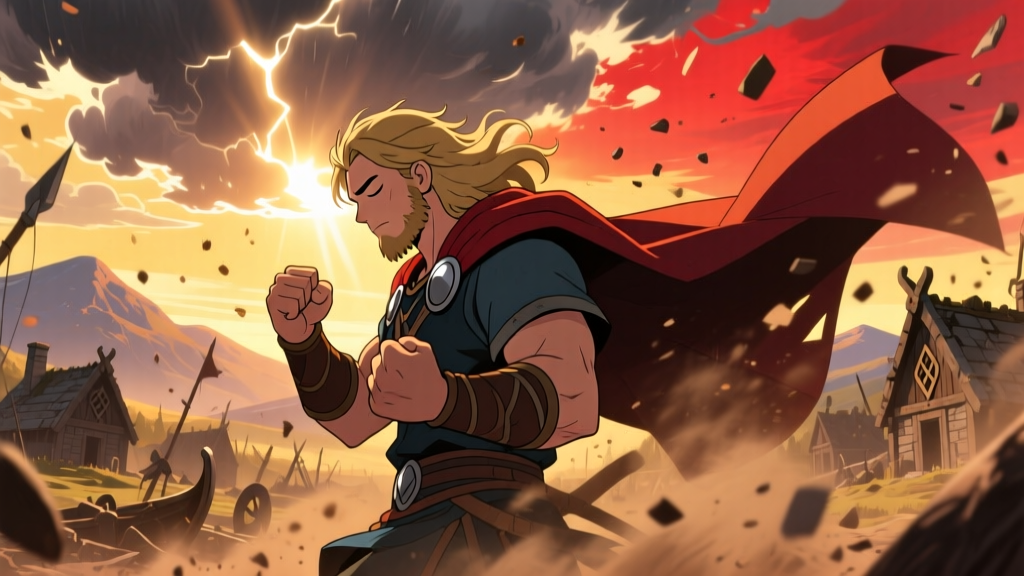
Thorfinn’s hands don’t shake when he picks up the hoe. They’re calloused, steady, sun-bleached at the knuckles. The camera holds on them for six full seconds — dirt under the nails, a faint scar cutting across the left thumb — before pulling back to reveal him standing in a furrowed field, sweat tracing clean lines through the dust on his temples. No music. Just wind, distant sheep, the soft thud of soil falling from the blade. It’s 17:42 in *Vinland Saga* Season 2, Episode 18 — “The Land of Vinland.” Not a battle. Not a vow. Not even a line of dialogue. Just a man holding a tool he once would’ve used to bury a man alive.
That shot doesn’t exist in Makoto Yukimura’s manga.
It’s not just absent — it’s structurally impossible in the source material’s rhythm. In Chapter 139, Thorfinn arrives at Ketil’s farm mid-sentence, already narrating his own transformation: “I had finally become a man who could live without killing.” It’s declarative. Elegant. And, I think, emotionally premature. Yukimura trusts the reader to accept the pivot because the logic is sound: trauma → disillusionment → renunciation → labor → peace. But logic isn’t psychology. Psychology is hesitation. Regression. The way your throat tightens when you hear a horse snort too sharply. The way your hand still twitches toward the hilt of a sword that hasn’t existed for three years.
Wit Studio didn’t just adapt Season 2 — they intervened. Not as fans imposing wish-fulfillment, but as dramaturges diagnosing a narrative gap: Yukimura’s manga moves Thorfinn from vengeance to pacifism with the clean pivot of a chapter break. Wit’s version makes it a daily, grinding, often invisible recalibration — and in doing so, constructs a redemption arc that feels less like a destination and more like muscle memory being rewired.
The Einar Subplot Isn’t a Detour — It’s the Diagnostic Tool
Let’s be blunt: Chapter 142 of the manga — the infamous “Ketil’s son’s funeral” sequence — is a narrative rupture. Thorfinn, still raw from Askeladd’s death and freshly unmoored from his revenge identity, watches Ketil’s young heir get trampled by panicked horses. He rushes in, tries to save him, fails — then, in a single panel, snaps. He grabs a broken spear shaft and stabs the dying boy in the neck. Not out of malice. Not even rage. Yukimura frames it as reflex: “My body moved before my mind caught up.”
It’s a shocking, brilliant, morally devastating moment — and it’s gone from Season 2.
Not excised for censorship. Not softened. Omitted entirely. And not replaced with something safer — but with something slower, more intimate, and far more revealing: Einar’s story.
In Episodes 15–17, Einar isn’t Thorfinn’s foil or sidekick. He’s his mirror held at a slight, uncomfortable angle. Where Thorfinn was raised on mythic violence — Ragnarök as bedtime story, Askeladd as dark father — Einar was forged in quiet, systemic dehumanization. His backstory isn’t told in flashbacks, but in gestures: the way he flinches when Ketil raises his voice (S2 ep 15, 9:11), the way he meticulously cleans Thorfinn’s wounds without being asked (ep 16, 22:03), the way he teaches Thorfinn to weave rope — not as skill, but as ritual (“Your hands remember before your head does,” he says, 16:48).
This isn’t filler. It’s psychological scaffolding. Yukimura introduces Einar in Chapter 127, but gives him nine panels of interiority across three chapters. Wit gives him 47 minutes of screen time — including the entire third act of Episode 17, where Einar quietly confesses he once stole bread to feed his sister, got caught, and was branded. Thorfinn listens. Doesn’t offer platitudes. Doesn’t draw parallels. Just nods — and later, that night, sits beside Einar on the barn floor, silently helping him re-stitch a torn tunic sleeve.
In their 2023 Animage interview, director Shuhei Yabuta and series composer Hiroshi Seko explicitly named this as their “Character Rhythm” principle: “Redemption isn’t declared. It’s witnessed — first by others, then by oneself. If Thorfinn’s change isn’t visible to Einar, it isn’t real yet.” That’s why Einar’s presence matters: he’s the only person on-screen who has no investment in Thorfinn’s past glory or shame. He sees the man, not the legend — and his quiet, consistent recognition becomes the first external validation of Thorfinn’s new self.
The Slave Farm Montage: Labor as Liturgy
Compare two sequences:
- Manga Chapter 138–140: 12 pages. Thorfinn arrives. Works. Observes Ketil’s household. Has one internal monologue about “the weight of peace.” Ends with him staring at the sea.
- Season 2 Episodes 13–18 (the “farm arc”): 6 episodes. 84 minutes. Includes: the grain-threshing sequence (ep 13, 14:20–15:55), where Thorfinn’s rhythm falters, then steadies over three takes; the rain-soaked hay-baling scene (ep 14, 31:10–32:40), where he works alongside Gudrid, wordless, their shoulders brushing in the downpour; the lambing sequence (ep 15, 28:15–29:30), where he delivers a stillborn ewe, washes his hands for three minutes straight, and doesn’t speak for the rest of the day.
These aren’t “filler episodes.” They’re physiological immersion. Wit treats manual labor not as metaphor but as neurological retraining. Every frame emphasizes repetition, texture, consequence: the blisters that form and harden, the way Thorfinn’s posture shifts from coiled readiness to grounded stability, the way his breathing syncs with the swing of the scythe.
Crucially, the violence isn’t erased — it’s relocated. In Chapter 142, Thorfinn’s brutality erupts outward, violently, in a single catastrophic moment. In Season 2, it leaks inward: in Episode 16, during a thunderstorm, Thorfinn wakes gasping, soaked in sweat, gripping the edge of his cot so hard his knuckles whiten — but doesn’t move. Doesn’t reach for a weapon. Doesn’t flee. He just breathes. Holds the panic. Lets it pass. That’s the real turning point. Not the stab wound. The stillness.
Why the Manga’s Arc Still Lands — and Why It’s Less Relatable
None of this is to dismiss Yukimura’s work. His Chapter 142 remains one of the most psychologically honest depictions of PTSD-triggered violence in shōnen-adjacent manga. It’s brutal, unflinching, and thematically essential — it proves Thorfinn hasn’t “cured” himself; he’s still carrying the war inside him. But it also functions as a plot device: the act forces Thorfinn to flee Ketil’s farm, reigniting his quest for Vinland as escape, not ideal. It serves the macro-narrative — the journey west — more than the micro-process of healing.
Wit’s choice to omit it isn’t cowardice. It’s fidelity to a different kind of truth: the truth of sustained recovery. Real rehabilitation isn’t punctuated by dramatic relapses (though those happen); it’s measured in the accumulation of small, unremarkable choices — choosing patience over impatience, listening over interrupting, resting over rushing. Yukimura’s arc is philosophical: What does peace cost? Wit’s is somatic: What does peace feel like in your forearms? In your jaw? In the space between heartbeats?
I remember watching Episode 18’s final montage — 90 seconds of Thorfinn planting seeds, watering sprouts, mending fences, sharing bread — and realizing I’d stopped waiting for him to “do something.” I wasn’t anticipating a fight or a speech. I was watching a man become ordinary. And that ordinariness felt radical.
The Sea Doesn’t Change — But How You Stand Before It Does
Both versions end with Thorfinn looking at the sea. In Chapter 140, it’s a symbolic threshold: “Beyond those waves lies Vinland. A land without war. A land I must build.” It’s aspirational. Future-facing. Heroic.
In Season 2’s finale, the same shot appears — but it’s reframed. At 23:18, Thorfinn stands barefoot on the shore, not gazing westward, but watching the tide recede. A crab scuttles over his foot. He doesn’t startle. He watches it. Then he lifts his foot — slowly — and lets it pass. The camera holds on his face: no grand resolve, no tearful catharsis. Just calm attention. Presence.
That difference — aspiration vs. presence — is the core divergence. Yukimura’s Thorfinn redeems himself by building a future utopia. Wit’s Thorfinn redeems himself by learning how to inhabit the present without armor. One is a political project. The other is a human one.
And that’s why the anime’s restructuring works. Not because it’s “better” in some objective sense — Yukimura’s thematic ambition, his historical rigor, his willingness to let Thorfinn remain deeply flawed, are irreplaceable — but because Wit identified what the manga’s serialization couldn’t accommodate: the sheer, unglamorous duration of healing. Comics advance by panels; animation advances by seconds. And in those seconds — the six-second hold on Thorfinn’s hands, the three-minute silence after the lambing, the 90-second tide cycle — Wit found the grammar of grace.
There’s a moment in Episode 17 I keep returning to. Einar asks Thorfinn why he never talks about his past. Thorfinn looks down at his hands — the same hands that held swords, strangled men, buried bodies — and says, simply, “Some things aren’t mine to tell anymore.”
That line doesn’t appear in the manga.
But it’s the quietest, truest articulation of redemption I’ve ever seen: not forgiveness granted, not sin erased — but ownership released. Not a new identity forged, but an old one gently laid down, like a weapon placed, at last, on soft earth.
Wit didn’t rewrite Thorfinn’s arc.
They gave it time.