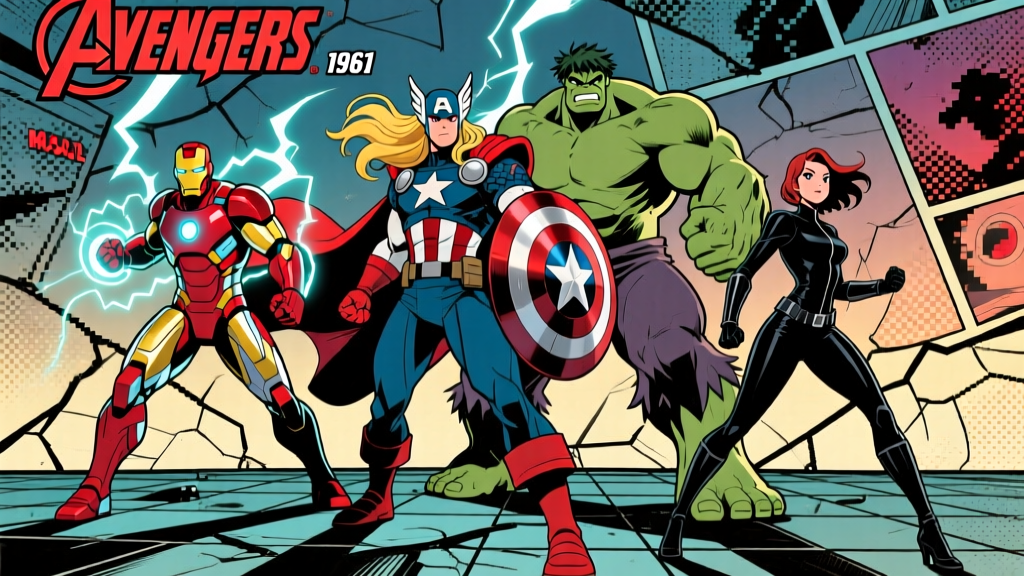
It cost twelve cents. That's what a kid walking into a newsstand in the late summer of 1963 would hand over to pick up a brand-new comic book with a bold cover: five heroes bunched together, fists raised, under the banner The Avengers. No one at that newsstand — not the kid, not the shopkeeper, not even the Marvel Bullpen itself — could have predicted that this single issue would spawn a franchise grossing over $29 billion at the global box office by 2024. Avengers #1 is not just a comic book. It is the DNA sequence from which the entire Marvel Cinematic Universe grew.
If you've been hunting for marvel digital comics avengers 1963 1 and landing on scattered forum posts, outdated links, or confusing platform menus, this guide clears the path. We'll walk through the story itself, unpack why this issue matters more than almost any other Silver Age comic, show you exactly where to read it digitally in 2026, and break down what a physical copy costs if you want the real thing in your hands.
The September 1963 Debut: What Stan Lee and Jack Kirby Actually Built
Avengers #1 shipped to newsstands with a September 1963 cover date, though in the publishing customs of the era, it likely hit racks as early as July. Written by Stan Lee and penciled by Jack Kirby — with inks by Dick Ayers — the issue arrived at a moment when Marvel was firing on every cylinder. The Fantastic Four had launched in 1961, Spider-Man in 1962, and the X-Men were debuting the very same month. Lee and Kirby were building a shared universe at a pace that DC Comics, with its more siloed editorial approach, simply could not match at the time.
The concept was deceptively simple. Instead of creating new heroes, Lee pulled existing ones into a single book. But the execution was anything but simple. The characters had clashing personalities, competing egos, and — crucially — no desire to be on a team. That friction became the engine of the series, and it traces directly back to the pages of issue #1.
"And there came a day unlike any other..." — the narration style Lee employed in Avengers #1 borrowed from epic poetry, signaling that this was not a typical superhero romp. It was a mythological event, the founding of a pantheon.
The Plot in Detail: Loki's Gambit
The story opens not with heroism but with villainy. Loki, God of Mischief and Thor's adopted brother, decides to destroy the Thunder God by manipulating another hero into fighting him. His target: the Hulk. Through an elaborate illusion, Loki engineers a scenario where the Hulk appears to sabotage a train, knowing that any distress signal aimed at Thor will draw him into battle with the green behemoth.
The plan goes sideways almost immediately. Instead of reaching only Thor, the distress call is intercepted by Ant-Man, the Wasp, and Iron Man — each independently deciding to respond. When they all converge on the scene and realize they've been played, the group tracks Loki to his hiding place. Thor confronts his brother directly, the team defeats the God of Mischief, and in the aftermath, the Wasp utters the line that launched a thousand fan clubs: she suggests they form a team, and she names it the Avengers.
The lineup in this first issue: Iron Man, Thor, the Hulk, Ant-Man (Hank Pym), and the Wasp (Janet van Dyne). Notably absent is Captain America, who wouldn't join until issue #4 — one of the most famous retcons in comic book history, where the team discovers Steve Rogers frozen in ice.
Why Avengers #1 Still Matters More Than You Think
Sixty-three years after publication, this issue remains a load-bearing pillar of the Marvel mythos. Here's why it holds up beyond mere nostalgia.
The Shared Universe Blueprint
Before Avengers #1, crossover events in American comics were rare and usually gimmicks — think of the Justice League, which DC launched in 1960 but populated largely with heroes who rarely interacted outside the team book. Lee's approach was different. The Avengers existed because of events in other comics. Thor and Loki's rivalry came straight from the pages of Journey into Mystery. The Hulk had been wandering the Marvel landscape since his own title launched (and was cancelled) in 1962. Iron Man had debuted in Tales of Suspense #39 just months earlier in March 1963.
This interconnectivity meant that reading Avengers #1 felt like watching loose threads from five separate storylines suddenly knot into something larger. It rewarded readers who followed multiple titles and created a sense that the Marvel Universe was a living, breathing place — an idea that Kevin Feige would translate directly into the MCU's phased storytelling model beginning in 2008.
Jack Kirby's Kinetic Revolution
The art in Avengers #1 deserves its own chapter in comics history. Kirby's panels crackled with energy that no other penciler could replicate. His heroes didn't stand in static poses — they lunged, twisted, and exploded across the page. The fight between Thor and the Hulk in this issue remains one of the most reprinted sequences in Marvel history, and you can see its DNA in virtually every blockbuster action set piece filmed in the last two decades. The "Kirby Krackle" — those clusters of black dots representing cosmic energy — appear throughout, adding a visual texture that digital coloring in modern reprints sometimes obscures rather than enhances.
A Template That Still Works
Look at the structure of Avengers #1 and you'll find a formula that Marvel still uses: villain engineers a crisis, heroes converge from separate storylines, initial conflict gives way to cooperation, and a team is forged in the aftermath. The 2012 Avengers film follows this beat for beat, with Loki once again serving as the catalyst. So does Avengers: Infinity War (2018) on a larger scale. The template is so durable that it has survived six decades of reboots, reimaginings, and creative team changes.
Reading Avengers #1 in Digital Comics: Platforms Compared
If you want to read the original Avengers #1 today without tracking down a physical copy, you have several legitimate options. Each has different strengths depending on whether you're a casual reader, a deep collector, or someone doing research.
Marvel Unlimited
Marvel's own subscription service is the most obvious destination. As of mid-2026, Marvel Unlimited offers Avengers #1 in its entirety as part of a catalog exceeding 30,000 issues. The subscription costs $9.99 per month or $69.99 annually (with a Mega Unlimited tier at $14.99/month that includes higher-resolution scans and offline downloads). The digital scan of Avengers #1 on Marvel Unlimited preserves the original panel layouts and lettering, and the platform offers both "full page" and "panel-by-panel" guided reading modes.
One practical note: the scan quality varies. Marvel Unlimited's archive of Silver Age comics comes from scans made at different points over the past 15 years. Avengers #1 has been rescanned at least twice, and the more recent version is noticeably cleaner — but if you're particular about color accuracy, you may want to cross-reference with a printed edition. The original four-color printing process produced hues that digital colorists sometimes "correct" in ways that alter the mood.
ComiXology (via Amazon Kindle)
After Amazon absorbed ComiXology into the Kindle ecosystem in 2022, the standalone ComiXology app was sunsetted. However, Avengers #1 remains available for individual purchase through Kindle Comics. The price typically runs between $1.99 and $3.99 for the single issue. The advantage here is ownership — you buy the file and it stays in your Kindle library permanently, accessible on any device with the Kindle app. The guided-view reading experience on Kindle is smooth, and the resolution on modern Kindle tablets renders Kirby's linework with impressive clarity.
Marvel.com and the Marvel App
Marvel also sells individual digital issues directly through its website and mobile app. The pricing mirrors Kindle's, and the reading experience is comparable, though the Marvel app has the edge of syncing your progress across Marvel Unlimited if you subscribe to both. For Avengers #1 specifically, Marvel occasionally bundles the issue into free promotional collections — it appeared in a "History of the Avengers" free bundle during the 2023 Disney+ promotion for Secret Invasion, for example.
| Platform | Cost | Reading Mode | Ownership | Offline Access |
|---|---|---|---|---|
| Marvel Unlimited | $9.99/mo or $69.99/yr | Full page + guided panel | Subscription (rental) | Yes (Mega tier only) |
| Kindle Comics (ex-ComiXology) | $1.99–$3.99 per issue | Full page + guided view | Permanent purchase | Yes |
| Marvel App (direct purchase) | $1.99–$3.99 per issue | Full page + guided panel | Permanent purchase | Yes |
| DC Universe Infinite / DC App | N/A (Marvel property) | — | — | — |
| Prices reflect standard U.S. pricing as of Q2 2026. International pricing may vary. Free promotional bundles occasionally include this issue. | ||||
Free and Archival Options
Marvel has made Avengers #1 available for free on several occasions over the years, usually timed to movie releases or anniversary celebrations. The Internet Archive also hosts a scan of the issue in its comic book collection, though the legal status of that scan is ambiguous — Marvel has never formally authorized it, but has also never issued a takedown. For academic or research purposes, university libraries with comic book archives (Ohio State's Billy Ireland Cartoon Library, for instance, houses over 450,000 original comic art pieces) may provide access to high-quality scans or physical copies.
Physical Copy Values: What Avengers #1 Is Worth in 2026
For collectors who want the real artifact — the twelve-cent issue that started it all — Avengers #1 remains one of the most actively traded Silver Age keys. Prices have shifted dramatically over the past decade, and the current market deserves careful examination.
Grade-by-Grade Price Guide
The following table reflects realized sales data from Heritage Auctions, GoCollect, and eBay completed listings as of early 2026. These are approximate ranges for the standard U.S. first printing:
| CGC Grade | Condition Label | Approximate Value Range | Market Notes |
|---|---|---|---|
| 9.4 (NM) | Near Mint | $120,000 – $175,000 | Only ~12 copies graded this high; last 9.4 sold at Heritage for $165,000 (Nov 2024) |
| 9.0 (VF/NM) | Very Fine/Near Mint | $55,000 – $80,000 | The "collector's sweet spot" — decent supply, strong demand |
| 7.0 (FN/VF) | Fine/Very Fine | $18,000 – $28,000 | Most active trading range; copies appear at auction 4–6 times per year |
| 5.0 (VG/FN) | Very Good/Fine | $6,500 – $10,000 | Readable, presentable; spine stress and minor tears expected |
| 3.0 (GD/VG) | Good/Very Good | $2,800 – $4,500 | Heavy wear but complete; popular as a "reader's copy" for serious collectors |
| 1.0 (FR/GD) | Fair/Good | $900 – $1,800 | Major defects (tape, missing pieces); still commands a premium due to the issue's status |
| Source: Heritage Auctions, GoCollect, and eBay completed listings (Q1 2026). Values reflect CGC-graded copies. Raw (ungraded) copies typically sell at 20–40% below equivalent graded prices. | |||
The jump from a 7.0 to a 9.0 isn't linear — it's exponential. That's because high-grade Silver Age keys have become a genuine alternative asset class. A CGC 9.4 Avengers #1 returned roughly 840% on investment between 2005 and 2023, outperforming the S&P 500's ~280% return over the same period (per data compiled by GoCollect's annual market report, 2024).
Key Factors That Move Prices
- White pages vs. off-white vs. cream: For a 1963 book, bright white pages are almost unheard of. Copies with CGC-certified "white pages" (OW/W) command a 30–50% premium over otherwise identical copies with cream pages.
- Restoration: Any color touch, tear seal, or page replacement drops the value by 50–70%, even if the restoration is professionally done and disclosed by CGC.
- Pedigree copies: Copies from named collections (the Edgar Church "Mile High" collection, for example) carry provenance premiums. A Mile High Avengers #1 sold for $275,000 in 2022 despite being graded only 8.0.
- MCU release timing: Every Avengers film release since 2012 has triggered a 15–25% spike in demand for Avengers #1 that lasts roughly 3–6 months post-release.
The Original Five vs. What Came Next
One of the more interesting aspects of revisiting Avengers #1 today is seeing how little the original lineup resembles what people think of as "the Avengers." No Captain America. No Black Widow. No Hawkeye. No Scarlet Witch. And the Hulk — who most audiences now associate with being a core Avenger — actually left the team at the end of issue #2. He wouldn't rejoin the roster permanently for decades.
This matters because it highlights how much the franchise's identity shifted over the years. When Joss Whedon assembled his cinematic Avengers in 2012, he took the concept of Avengers #1 — mismatched heroes forced together by a Loki scheme — but populated it with a lineup closer to the modern comics roster. The DNA was the same, even if the face had changed. That's a tribute to how strong the underlying premise was: the specific characters mattered less than the friction between them.
For readers coming from the MCU, Avengers #1 can feel both familiar and strange. The tone is more bombastic than the films. Lee's narration is omnipresent and theatrical. The characters bicker constantly and solve problems through brute force more often than strategy. But the bones of the franchise — the idea that Earth's mightiest heroes are flawed, argumentative, and ultimately bound together by shared purpose — are all present from page one.
Recommended Reading Order After Issue #1
- Avengers #2 (Nov 1963) — The team's first mission together, fighting the Space Phantom. The Hulk's departure sets up his long absence.
- Avengers #3 (Jan 1964) — Iron Man and the others face the Red Ghost; the team's dynamic solidifies.
- Avengers #4 (Mar 1964) — Captain America's return. This is the issue that retroactively defines the Avengers more than #1 does for many readers.
- Avengers #8 (Sep 1964) — Kang the Conqueror debuts, establishing the team's first truly cosmic-level threat.
Frequently Asked Questions
Is Avengers #1 available on Marvel Unlimited right now?
Yes. Avengers #1 (1963) is currently in the Marvel Unlimited catalog. You can read it via the web reader or mobile app with any active subscription. The guided-view mode works well on tablets, though the scan quality reflects the source material's age — expect slightly muted colors compared to modern reprints.
Can I buy Avengers #1 as a standalone digital issue without a subscription?
Absolutely. Both the Kindle Comics store (the successor to ComiXology) and Marvel's own digital storefront sell Avengers #1 individually, typically between $1.99 and $3.99. This is a permanent purchase — the issue stays in your digital library regardless of any subscription changes.
How much is a physical copy of Avengers #1 worth in 2026?
It depends heavily on condition. A CGC-graded copy in Fine/Very Fine (7.0) condition typically sells for $18,000 to $28,000. Near Mint (9.4) copies are extraordinarily rare and have sold for over $165,000 at Heritage Auctions. Even heavily worn copies in Fair/Good (1.0) condition fetch $900 to $1,800 due to the issue's historical significance.
Is Captain America in Avengers #1?
No. The original lineup in Avengers #1 consists of Iron Man, Thor, the Hulk, Ant-Man (Hank Pym), and the Wasp (Janet van Dyne). Captain America first appears in Avengers #4 (March 1964), where the team discovers him frozen in ice and revives him. This is one of the most famous story beats in Marvel history.
What's the difference between the original Avengers #1 and the 1990s reprint?
Marvel reprinted Avengers #1 several times, most notably as a $1.50 "Marvel Milestone" reprint in the 1990s and in various trade collections. Reprints have different cover prices, paper stock, and sometimes recolored art. For collectors, only the original September 1963 first printing with the 12-cent cover price holds significant monetary value. Digital editions, however, are based on the original and serve equally well for reading purposes.
Did the 2012 Avengers movie adapt this issue?
Not directly, but the structural parallels are unmistakable. Joss Whedon's The Avengers (2012) uses Loki as the villain who forces disparate heroes to unite — the exact plot of Avengers #1. The film swaps the original five heroes for the MCU's established lineup (Iron Man, Captain America, Thor, Hulk, Black Widow, and Hawkeye) and adds the Chitauri invasion as a large-scale climax, but the narrative skeleton is pure Lee and Kirby.
Avengers #1 endures because it solved a problem that no one in 1963 knew needed solving: how to make a shared fictional universe feel alive. The characters argue, make mistakes, and stumble into heroism rather than stride toward it. That formula worked in twelve-cent newsprint, it works on a ten-inch tablet screen, and it works on a sixty-foot IMAX display. The medium changes. The assembly doesn't.