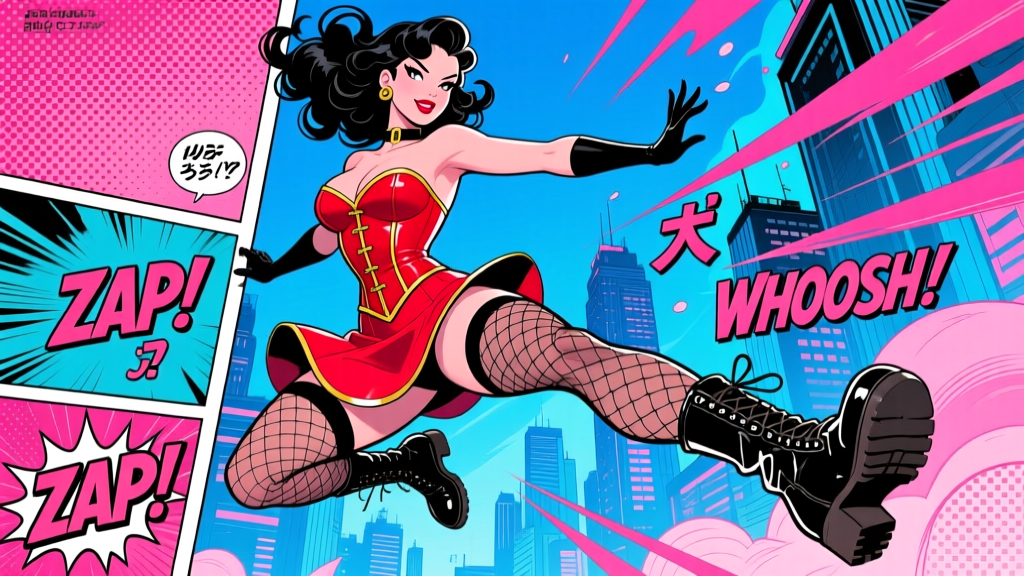
How the Nashville-born model with jet-black bangs and a cherry-red smile became one of the most illustrated real-world characters in modern comics — and why collectors are paying $400 for her first appearances.
SenpaiSite Editorial June 2026 12 min readBefore Gal Gadot wore a tiara on Themyscira, before Scarlett Johansson squeezed into a black catsuit, there was a real woman who appeared on more illustrated covers than almost any fictional character of her era. Bettie Page didn't just inspire comic book art — she became comic book art. Her image has been drawn, inked, colored, and printed by dozens of publishers across hundreds of issues spanning four decades, and the bettie page comic book phenomenon shows no signs of slowing down.
Walk into any comic shop in North America — the kind with long boxes stacked against the walls and a smell like aging newsprint and cardboard — and ask the person behind the counter about Bettie Page comics. You'll get one of two reactions. Either their eyes light up and they start pulling issues from the display wall, or they'll give you a measured nod and say, "Yeah, we move a lot of those." There's no middle ground. Bettie Page comics occupy a strange corner of the industry where pin-up nostalgia, pop art, and genre storytelling collide, and that corner has been generating solid sales since Dynamite Entertainment bet big on the license in 2017.
The story of how a 1950s pin-up model became a recurring comic book protagonist involves underground comix, licensing deals, shifting cultural attitudes toward women in illustration, and one publisher's decision to treat a real person as a genre-hopping action character. It's a stranger story than most of the scripts these comics actually contain.
♥ ♥ ♥The Pin-Up Who Walked Off the Photograph and Onto the Page
Bettie Mae Page was born April 22, 1923, in Nashville, Tennessee, one of six children in a family that moved constantly during the Depression. She graduated from Hume-Fogg High School in 1940 and earned a bachelor's degree from Peabody College (now part of Vanderbilt University) in 1944, with plans to become an actress. She moved to New York City in 1949, landing work as a secretary while pursuing stage roles — but it was her face, her figure, and those instantly recognizable bangs that paid the rent.
Between 1951 and 1957, Page appeared in roughly 30,000 photographs. She worked with Irving Klaw and his sister Paula, shooting bondage-themed images for Klaw's mail-order catalog Movie Star News. She posed for Bunny Yeager, a Miami-based photographer who produced the now-legendary jungle-themed nudes featuring Page in homemade leopard-print bikinis. And she appeared as Playboy's centerfold in January 1955, a gatefold shot taken by Hugh Hefner's staff photographer that reportedly boosted Playboy's circulation from 125,000 to over 200,000 copies in a single month.
Then she vanished. Page left modeling in 1957, found religion, and spent the next two decades as a Baptist missionary and church volunteer, largely unknown to the culture that had mythologized her image. She wouldn't resurface publicly until the early 1980s, when a rediscovery of her photographs sparked a cultural reassessment that turned her from a forgotten model into a pop art icon.
And pop art icons, in the comic book industry, eventually get drawn.
Underground Comix and the Bettie Page Rediscovery
The first comic book appearances of Bettie Page weren't licensed, authorized, or even particularly polished. In the early 1980s, as her photographs circulated through galleries and coffee-table books — a 1979 exhibition at the Gotham Book Mart in Manhattan had drawn enough attention to put her back on the cultural radar — underground and independent comic artists started incorporating her image into their work.
Eros Comix, the adult-oriented imprint of Fantagraphics Books (the Seattle-based publisher behind The Comics Journal), released some of the earliest Bettie Page-adjacent material in the late 1980s and early 1990s. These weren't narrative comics in the traditional sense. They were pin-up portfolios printed in comic book format, typically 32 pages, saddle-stitched, with print runs between 3,000 and 8,000 copies. Artists would render Page's most famous photographs in ink and watercolor, sometimes adding speech balloons and panel layouts that technically qualified them as comics but were essentially illustrated tributes.
The more interesting early work came from artists who used Page as a reference point in original stories. A few independent creators in the 1990s produced limited-run comics where a Bettie Page-like character (sometimes named differently for legal reasons) appeared in noir, horror, and crime scenarios. The reasoning was straightforward: her photographs already told stories. The bondage shoots with Klaw had narrative tension — the ropes, the props, the theatrical lighting. Yeager's jungle sessions had adventure. Page's expressions, which ranged from impish delight to wide-eyed surprise, translated naturally to sequential art.
"Bettie's face is one of those rare things in illustration — it reads equally well in a photograph, a painting, or a six-panel comic page. The bangs give you a graphic anchor. The smile gives you emotion. The eyes give you movement. You can drop her into any genre and she works."
The licensing situation was murky throughout the 1990s. Page herself, living quietly in Los Angeles, had little involvement with the comic book industry during this period. Various photographers and their estates claimed rights to her likeness. It wasn't until the early 2000s, after a series of legal settlements clarified who controlled what, that mainstream publishers could approach the Bettie Page brand without a lawyer on speed dial.
♥ ♥ ♥Dynamite Entertainment's Bettie Page Universe
Dynamite Entertainment, the Mount Laurel, New Jersey publisher founded by Nick Barrucci in 2004, had already built a reputation on two things: licensed properties and visually striking covers. Their catalog included Vampirella, Red Sonja, Flash Gordon, and Zorro — characters with strong visual identities that translated to eye-catching cover art. Bettie Page fit the template perfectly.
The first Dynamite Bettie Page series launched in November 2017, written by Trina Robbins with interior art by Emily BooBoo. The creative team made a deliberate choice: this wouldn't be a pin-up comic. It would be an action-adventure comic that happened to star a real historical figure. The plot placed Bettie in a globe-trotting espionage narrative, chasing down villains and getting into scrapes that owed more to 1950s B-movies than to glamour photography.
It sold. First-print runs for the initial five-issue arc averaged around 28,000 copies per issue according to Diamond Comic Distributors data, a strong number for a mid-tier publisher launching a new property. Variant covers — Dynamite's bread and butter — drove significant revenue, with some retailer-exclusive variants printing as few as 500 copies each.
The Series That Built the Franchise
Dynamite didn't stop at one series. Between 2017 and 2024, the publisher released at least seven distinct Bettie Page comic series or miniseries, each with a different creative team and a different genre approach. Here's how the major runs broke down:
2017 – 2018 • 5 IssuesBettie Page (Vol. 1)
The debut series. Robbins and BooBoo established the template: Bettie as a capable, quick-witted adventurer operating in a heightened version of the 1950s. The story involved Cold War intrigue, a stolen scientific formula, and a villain who felt ripped from a Republic serial. Art was clean and retro-tinged, with BooBoo's linework emphasizing period-accurate fashion and set design. Colorist Kinsun Loh used a slightly desaturated palette that evoked vintage Technicolor film stock.
2019 • 5 IssuesBettie Page: Unbound
A tonal pivot. This series leaned into horror and supernatural elements, with Bettie investigating occult phenomena in postwar America. The art shifted to a more expressionistic style — heavy shadows, distorted perspectives, and splash pages that channeled EC Comics' Tales from the Crypt. Writer Justin Grey and the art team built a story around real 1950s anxieties: McCarthyism, atomic testing, and the tension between public propriety and private desire. This series also introduced a recurring villain named The Director, a shadowy government operative who became a franchise-wide antagonist.
2019 – 2020 • 8 IssuesBettie Page vs. the World
Widely considered the strongest Dynamite Bettie Page run. The premise was audacious: Bettie teams up with historical figures — Amelia Earhart, Josephine Baker, and Hedy Lamarr among them — to stop a megalomaniac from triggering a global catastrophe. The genre-hopping structure gave each issue a distinct visual flavor: a noir-inflected New York sequence, a desert adventure set in North Africa, a spy thriller passage through Cold War Berlin. Interior artist Craig Rousseau handled the shifting tones with visible enjoyment, and the series sold well enough to justify an extended run beyond the originally planned five issues.
2021 • 5 IssuesBettie Page: Hollywood Bound
A lighter, more comedic series set in 1950s Hollywood. Bettie arrives in Los Angeles to break into the movie business and stumbles into a mystery involving a corrupt studio executive, a stolen screenplay, and a missing starlet. The art here was the most cartoonish of any Bettie Page series — exaggerated expressions, slapstick panel layouts, and a bright, saturated color palette that made every page look like a Technicolor musical frozen mid-number. Sales dipped slightly compared to earlier volumes (averaging roughly 22,000 per issue), but the series found an audience among readers who preferred character-driven comedy over action.
2022 • 5 IssuesBettie Page: Curse of the Banshee
Back to horror territory. Set in rural Ireland, this miniseries sent Bettie to investigate reports of a supernatural entity terrorizing a coastal village. The art team leaned heavily into atmosphere — fog-soaked landscapes, crumbling stone ruins, and panel compositions that used negative space to build dread. This was the most visually restrained Bettie Page comic Dynamite had published, and it polarized readers who'd come to expect camp and action. Critics were kinder: Bleeding Cool called it "the first Bettie Page comic that feels genuinely unsettling," and individual issues have since appreciated in the secondary market.
Annuals, Crossovers, and One-Shots
Beyond the main series, Dynamite released several Bettie Page specials that kept the character in rotation between volume launches. The Bettie Page Annual (2018) featured a standalone story by multiple artists, each handling a different chapter — a format that showcased how differently illustrators interpreted the same character. A crossover with Vampirella (2020) paired the two Dynamite properties in a supernatural thriller that sold approximately 35,000 copies on its debut issue, making it one of the publisher's best-selling titles that quarter.
There was also a Bettie Page / Kiss crossover (because of course there was), which placed the pin-up queen alongside the face-painted rock band in a science fiction adventure that was exactly as unhinged as it sounds. It sold well. It reads like a fever dream. It has its defenders.
"She's not a character who needs a fictional universe to be interesting. She already lived in one — the 1950s were stranger and more cinematic than anything a comic writer could invent." ♥ ♥ ♥Artists Who Drew Bettie Page: A Visual Census
One of the more fascinating aspects of the bettie page comic book catalog is watching different artists tackle the same real-world face. Bettie Page is one of the most photographed women of the 20th century, which means every artist working on a Bettie Page comic has dozens of reference images at their disposal — and every one of them makes different choices about what to keep, what to exaggerate, and what to discard.
Emily BooBoo
The artist who defined Dynamite's Bettie Page from the start. BooBoo's approach was period-faithful but not photographic: she captured the essential geometry of Page's face (the heavy bangs, the wide-set eyes, the upturned nose) without trying to replicate specific photographs. Her inking style used relatively thin, consistent line weights, which gave the character a clean, slightly idealized quality. In action sequences, BooBoo drew Bettie with a physical confidence that the real Page's photographs only hinted at — a woman who looked like she could actually throw a punch, not just pose with a prop sword.
Craig Rousseau
Rousseau's work on Bettie Page vs. the World was the most visually varied in the franchise, largely because the script demanded it. His Bettie shifted subtly from issue to issue depending on the setting: sharper angles and heavier shadows in the Berlin spy sequence, softer curves and warmer tones in the Josephine Baker chapters. Rousseau has spoken in interviews about the challenge of keeping a real person recognizable while adapting her to different visual registers. He solved it by treating Page's bangs and smile as fixed constants — everything else was flexible.
Variants and Guest Artists
Dynamite's variant cover program brought in a rotating cast of industry names to illustrate Bettie Page. J. Scott Campbell produced several variants that emphasized classic pin-up composition — full-body poses, playful expressions, minimal backgrounds. Adam Hughes contributed a cover for the 2019 Unbound series that rendered Page in his signature photorealistic style, and it became one of the highest-selling variants in the franchise's history, with raw copies trading for $80 to $150 on the secondary market within a year of release. Jae Lee's cover work pushed in the opposite direction: heavily stylized, almost abstract interpretations that reduced Page to her most graphic elements — black bangs against white skin against red lips, with backgrounds dissolving into pure ink wash.
"Drawing Bettie Page is like drawing the American flag. Everyone knows what it looks like. The trick is making your version feel like it's saying something new."♥ ♥ ♥
The Collectible Market: What Bettie Page Comics Are Actually Worth
Let's talk money. The bettie page comic book market splits neatly into two categories: modern Dynamite issues (generally affordable unless you're chasing specific variants) and pre-Dynamite independent and underground appearances (rarer, harder to find in good condition, and occasionally expensive).
For modern Dynamite comics, most standard-cover issues sit in the $4 to $8 range in Near Mint (NM 9.2–9.4) condition. That's the baseline. The variants are where prices get interesting. Retailer-exclusive covers with print runs under 1,000 copies routinely sell for $25 to $60. The Adam Hughes Unbound #1 variant has traded as high as $175 in CGC 9.8. And a complete set of the Bettie Page vs. the World series, all first printings in NM or better, will run you roughly $40 to $70 depending on which covers you're after.
Pre-Dynamite material is the deep end. The Eros Comix Bettie Page portfolios from the 1990s, particularly in high grade, have become scarce. CGC has graded fewer than 200 copies of most Eros Bettie Page titles, which means supply is thin. Copies in 9.4 or above routinely sell for $80 to $200, and a 1992 Bettie Page special in CGC 9.8 sold at Heritage Auctions for $425 in 2021.
| Issue | Publisher | Year | Standard Cover | Notable Variant | Why It Matters |
|---|---|---|---|---|---|
| Bettie Page #1 | Dynamite | 2017 | $5 – $8 | $40 – $90 (Cosplay variant) | First Dynamite series debut; strong first-print demand |
| Bettie Page: Unbound #1 | Dynamite | 2019 | $5 – $10 | $100 – $175 (Hughes variant) | Adam Hughes cover drove variant market spike |
| Bettie Page vs. the World #1 | Dynamite | 2019 | $6 – $12 | $50 – $85 (retailer exclusive) | Most acclaimed Dynamite Bettie Page run |
| Bettie Page Annual #1 | Dynamite | 2018 | $8 – $15 | $30 – $55 (sketch variant) | Multi-artist anthology; higher page count |
| Vampirella / Bettie Page #1 | Dynamite | 2020 | $6 – $10 | $45 – $80 (PhotoShop variant) | Crossover issue; ~35K first print |
| Bettie Page: Curse of the Banshee #1 | Dynamite | 2022 | $7 – $14 | $35 – $65 (horror art variant) | Lower print run; critically praised |
| Eros Bettie Page Special | Fantagraphics / Eros | 1992 | $80 – $200 | N/A (single cover) | Pre-Dynamite rarity; fewer than 200 CGC graded |
| Bettie Page Pin-Up Portfolio | Eros Comix | 1995 | $60 – $150 | N/A | Portfolio format; sought by pin-up collectors |
| Prices are estimates based on eBay sold listings, Heritage Auctions records, and GoCollect data. Actual values depend on condition, market timing, and buyer demand. | |||||
What Actually Moves Prices
Five factors drive value in Bettie Page comics, and they don't all apply equally:
- Variant scarcity. Covers with 1:10 or 1:25 retailer incentive ratios carry premiums. The lower the print run, the sharper the price.
- Guest artist pedigree. Variants by Adam Hughes, J. Scott Campbell, Jae Lee, and similar fan-favorite artists command $50+ regardless of the interior content.
- Crossover appeal. Issues that pair Bettie Page with another established character (Vampirella, Kiss) attract collectors from both fanbases simultaneously, widening the buyer pool.
- CGC grading above 9.4. As with all modern comics, the price curve steepens dramatically once a copy crosses into Gem Mint territory. A $10 raw comic becomes a $60 slabbed one overnight.
- Pre-Dynamite scarcity. Anything published before 2010 exists in relatively small numbers. Eros Comix titles from the 1990s were printed in runs of 3,000 to 8,000 copies, many of which were read, handled, and stored without protection. High-grade survivors are genuinely rare.
Where to buy? eBay remains the most active marketplace for Bettie Page comics, with roughly 150 to 250 active listings at any given time. MyComicShop.com carries a rotating stock of back issues. For high-grade and CGC-graded copies, Heritage Auctions runs comic book auctions weekly that occasionally include Bettie Page material. Local comic shops are hit or miss — the ones that stock Dynamite titles tend to carry them, but back-issue bins are unpredictable.
♥ ♥ ♥Beyond Dynamite: Other Publishers and the Wider Comic Landscape
Dynamite dominates the Bettie Page comic conversation today, but they weren't the only publisher to put her on a page. Several smaller outfits produced Bettie Page material before and alongside Dynamite's licensed run.
In 2001, a small California-based publisher called Revolutionary Comics released a two-issue biographical comic titled Bettie Page: Queen of Hearts, which attempted to tell Page's actual life story in graphic novel format. The production values were modest — standard newsprint, limited color work — and the comic drew criticism for its sensationalized treatment of Page's personal struggles. It sold approximately 12,000 copies across both issues and has since become a minor curiosity rather than a collector's prize.
International publishers also took note. In Italy, where the fumetti (comic book) tradition has always been more comfortable blending glamour illustration with sequential storytelling, at least two Bettie Page comic albums appeared in the early 2000s. These were printed in smaller quantities than American comics and are nearly impossible to find in the U.S. secondary market.
Perhaps the most unusual Bettie Page comic appearance came in 2004, when a short autobiographical story about Page's childhood in Nashville was included in an independent anthology comic. Drawn in a loose, sketchbook style, the six-page story showed Bettie as a young girl — no bangs, no pin-up poses, just a kid growing up in rural Tennessee during the Depression. It's the only known comic that depicts Bettie Page without her signature look, and copies of the anthology sell for $30 to $50 when they surface.
Bettie Page in Non-Comic Sequential Art
It's worth noting that Page's influence on sequential art extends beyond comic books proper. Her image has appeared in graphic novels (as subject matter, not as a character), zines, webcomics, and artist books. The 2005 biopic The Notorious Bettie Page, directed by Mary Harron and starring Gretchen Mol, prompted a wave of independent artists creating Bettie Page-themed zines and minicomics — small-run, self-published works that circulated through zine fairs and online communities. Most of these were produced in runs of 50 to 200 copies and are essentially uncollectible in any traditional sense, but they represent a genuine grassroots engagement with Page's image that commercial comics can't replicate.
♥ ♥ ♥Why Bettie Page Works as a Comic Character (When She Shouldn't)
On paper, Bettie Page shouldn't work as a comic book protagonist. She's not fictional, which limits what writers can do without raising ethical questions about depicting a real person (Page passed away on December 11, 2008, in Los Angeles, at age 85). She's not a superhero, which removes the genre scaffolding that supports most comic book sales. And she's primarily known as a pin-up model, which in theory makes her a visual reference rather than a narrative character.
And yet she works. Here's why:
The 1950s setting is inherently genre-rich. Cold War espionage, atomic-age science fiction, film noir, rock 'n' roll, the early civil rights movement, Hollywood's Golden Age — the decade provides more story hooks than most fictional universes. Dropping Bettie Page into any of these contexts doesn't require worldbuilding because the world already existed. A writer just needs to pick a year and a city.
Her visual identity is instantly recognizable at thumbnail size. This matters enormously for comic book covers, which are increasingly designed to catch eyes on digital storefronts and phone screens. Black bangs, red lips, wide eyes — you can read a Bettie Page cover at 100 pixels wide and know exactly what you're looking at. Few comic characters have that level of visual shorthand.
She occupies a cultural sweet spot. Bettie Page is nostalgic without being antique, sexy without being explicit (in her comic incarnations), and retro without being dated. She appeals to pin-up enthusiasts, pop art fans, comic collectors, and people who just think the 1950s looked cool. That's a broader audience than most comic book characters can claim.
Dynamite's editorial team understood all of this when they greenlit the first series, and their strategy of genre-hopping — spy thriller one year, horror the next, comedy the year after — was a smart recognition that Bettie Page the comic character is less a fixed personality and more a visual brand that can be poured into whatever narrative container a creative team chooses.
♥ ♥ ♥Common Questions About Bettie Page Comics
Are Dynamite's Bettie Page comics based on real events?
Mostly no. The Dynamite series are fictional adventure, horror, and comedy stories set in the 1950s with Bettie Page as the protagonist. The real Bettie Page was a pin-up model who worked in New York and Miami between 1951 and 1957 — she never fought supervillains or investigated the occult. The only Bettie Page comics that stick close to biography are a few early independent titles and some short stories in anthology formats.
Did Bettie Page ever approve of these comics?
Page was alive during the earliest waves of comic interest in her image, but there's no public record of her endorsing or commenting on any comic book portrayal. She was known to be ambivalent about her pin-up legacy for much of her later life, though she softened considerably in the 1990s and 2000s. The Dynamite comics are produced under license from her estate.
Which Bettie Page comic should I start with?
If you want action-adventure, start with Bettie Page Vol. 1 (2017). If you prefer horror, jump to Curse of the Banshee (2022). If you want the best-reviewed run, pick up Bettie Page vs. the World (2019–2020). For comedy, Hollywood Bound (2021) is the lightest entry. All are available as trade paperbacks from Dynamite or through digital platforms like Comixology.
How many Bettie Page comic issues exist in total?
Between Dynamite's main series, annuals, crossovers, and one-shots, plus the pre-Dynamite independent titles from Eros Comix and other small publishers, there are approximately 45 to 55 individual comic issues featuring Bettie Page as a primary character. The count varies depending on how you classify portfolio-style releases and promotional ashcans.
Are Bettie Page comics appropriate for younger readers?
Dynamite publishes most of its Bettie Page titles under a Teen+ (T+) rating, which means mild violence, suggestive themes, and occasional language. They're not explicit, but they're not aimed at children either. The Eros Comix material from the 1990s is more overtly adult-oriented and should be treated as mature content.
What's the single most valuable Bettie Page comic?
Among graded modern issues, the Adam Hughes variant cover for Bettie Page: Unbound #1 (2019) in CGC 9.8 has achieved the highest recorded sale price at approximately $175. For pre-Dynamite material, a 1992 Eros Comix Bettie Page special in CGC 9.8 sold for $425 at Heritage Auctions in 2021, making it the highest publicly recorded price for any Bettie Page comic.
♥ ♥ ♥The Bangs That Keep Coming Back
Bettie Page died in 2008, but her comic book career has only accelerated since then. Dynamite has shown no indication of retiring the character, and each new series seems to find a slightly different audience — horror readers who wouldn't normally pick up a pin-up comic, comedy fans who don't usually browse the action section, collectors who chase variant covers regardless of content.
There's a lesson in that about what makes a comic book character endure. It's not always origin stories and power sets and decades of continuity. Sometimes it's just a face — a specific arrangement of features that says something to people across generations. Bettie Page's face says: confidence, mischief, warmth, and just enough danger to keep things interesting. Those are the same things a good comic book cover says, and maybe that's why the two have fit together so naturally for so long.
The next time you're flipping through a comic shop's new arrivals wall and you see those black bangs staring back at you from a rack of spandex and capes, pick it up. Whatever genre it's wearing this month, it'll probably be entertaining. And the cover art alone will be worth the four bucks.