‘Blue Exorcist’ Manga Reading Strategy: How to Stop Feeling Like You’re Losing Time
I’ll admit it—I put the manga down for three months after Chapter 165. Not because I lost interest. Because I genuinely thought I’d misread something. Rin was in Kyoto… but also back at True Cross? Shura was alive *and* dead? The panel borders got wobblier, the screentones shifted from crisp gradients to jagged charcoal strokes, and the narration boxes switched from third-person exposition to first-person fragments—sometimes in Shiro’s voice, sometimes in Rin’s childhood memory, sometimes in no voice at all, just a single kanji bleeding across the page: 罪.
That wasn’t a mistake. That was Kazue Kato flipping the entire narrative structure like a switchblade.
The Split Isn’t a Plot Hole—It’s a Design
Vol. 17 (Ch. 141 onward) is where the timeline fractures—not with a bang, but with silence. Chapter 141 ends with Rin stepping into the Kyoto Branch gates. Chapter 142 opens on him sitting at his desk in Class 3-B, pencil hovering over a geometry test. Same week. Different psychic gravity.
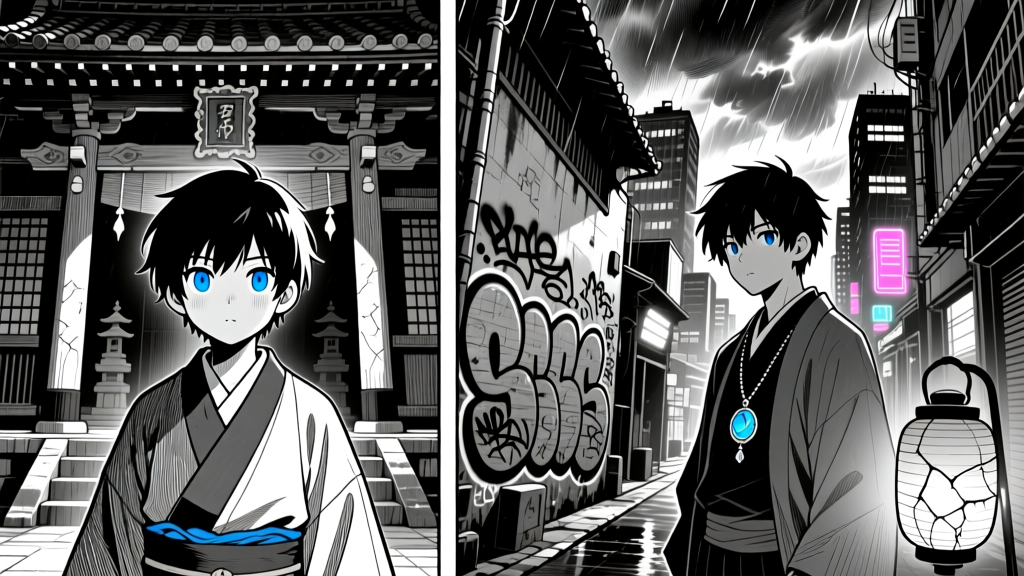
True Cross Academy (TCA) arc: Linear, grounded, almost mundane. School festivals, cram sessions, Yukio’s quiet exhaustion as he juggles classes and exorcist duties. Art stays clean, consistent—Kato’s signature precise linework, soft shadows, warm indoor lighting. Narration is external, observational. You’re watching Rin grow in real time, awkwardly, imperfectly.
Kyoto Saga (Ch. 165–192): Dream-logic pacing. Flashbacks within flashbacks. Panels bleed into each other; pages sometimes lack gutters entirely. The art gets raw—thick brushstrokes, heavy ink splatters, abrupt shifts in perspective (like Ch. 173’s two-page spread of young Rin crawling through snow while adult Rin’s hand grips a sword hilt—same frame, different decades). Narration is fractured, subjective, often internalized. You’re not watching history—you’re feeling its residue.
Kato didn’t do this to confuse readers. She did it to replicate trauma’s architecture: how memory doesn’t line up chronologically, how guilt echoes sideways, not forward.
Why “Just Read Chronologically” Fails
If you read Ch. 141 → 142 → 143… all the way to 164, then jump to 165, you miss the *resonance*. You get plot points—but not the weight.
- In TCA Ch. 142, Rin struggles to light a candle during a basic purification exercise. His flame sputters, weak. He looks down at his hands—hesitant.
- Then, Kyoto Ch. 165 hits: we see *eight-year-old Rin*, same posture, same trembling hands, trying—and failing—to light the candle at the old temple before Shiro intervenes. The exact same failure. Different context. Same shame.
- Read them back-to-back? It’s devastating. Read them weeks apart? It’s just “oh, he failed before.”
This isn’t thematic echo—it’s structural empathy. Kato forces you to hold both versions of Rin in your head at once. Not as past/present, but as coexisting emotional states.
The Interleaving Method (That Actually Works)
Here’s what I’ve used—and what fans on r/BlueExorcist and the Jump SQ forums confirmed works best:
- Start Kyoto at Ch. 165 — don’t wait. It’s the hinge.
- Read one Kyoto chapter (e.g., Ch. 165).
- Flip immediately to the corresponding TCA chapter — specifically, the one that mirrors its emotional core. Ch. 165 (Kyoto: Rin’s first memory of failing the candle ritual) → TCA Ch. 142 (Rin failing the same ritual, now as a teen).
- Then Kyoto Ch. 166 (Shiro’s journal entry about Rin’s birth) → TCA Ch. 143 (Yukio finding an old photo of baby Rin and Shiro—no dialogue, just three silent panels).
- Continue this pattern through Ch. 192. The gap narrows: by Ch. 185, Kyoto and TCA chapters land within *days* of each other in-universe.
It sounds fussy. It’s not. It takes 30 seconds to flip. And it transforms the reading experience from “keeping track” to “bearing witness.”
“Two Mirrors Reflecting the Same Sin”
Kato said it plainly in her 2023 Jump SQ interview: “The Kyoto Saga isn’t backstory. It’s the reverse side of the same coin. When Rin says ‘I am Satan’s son,’ Kyoto shows *how that label was forged*. When he says ‘I will protect my friends,’ TCA shows *how that promise is tested in daylight*. They aren’t two stories. They’re two reflections of one sin—Shiro’s, Rin’s, the Order’s—and neither reflection is whole without the other.”
That’s why the art shifts. Why the narration fractures. Why Ch. 177 (Kyoto) ends with a full-page image of Shiro’s cross cracking—then Ch. 148 (TCA) opens with Rin staring at the exact same crack in the cross pendant around his neck, lit by fluorescent classroom lights.
You’re not supposed to feel stable. You’re supposed to feel the ground tilt—just like Rin does.
So yes, grab a sticky note. Mark Ch. 165. Then go back to Ch. 142. Read them together. Let the disorientation settle. That’s not confusion—that’s the point clicking into place.