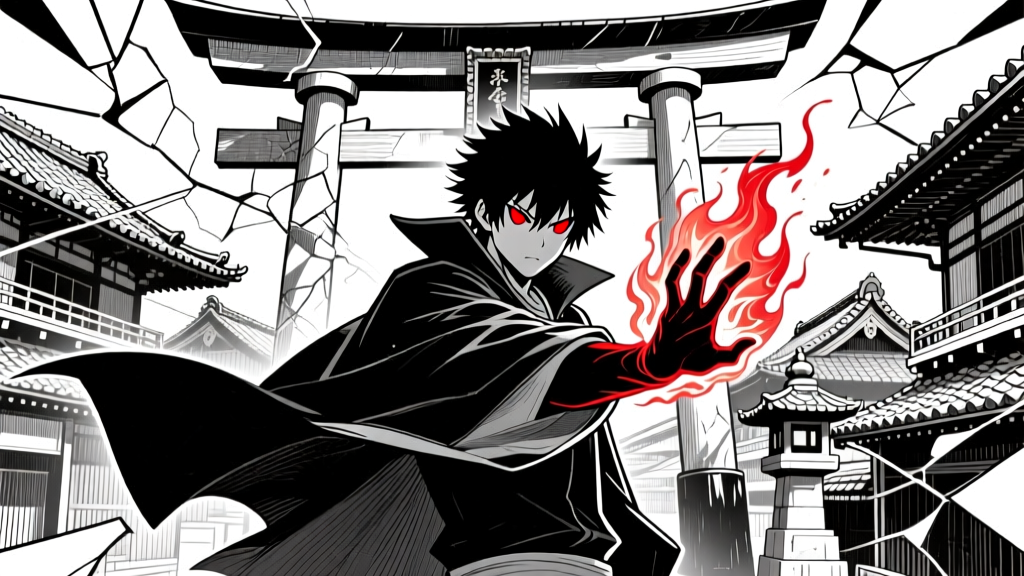
“The glyphs weren’t decoration—they were diagnosis.”
—Kazue Kato, in a 2019 interview with Manga Fūkei, re: Kyoto Saga’s visual linguistics
I remember watching the 2012 Blue Exorcist anime adaptation and pausing mid-episode—not for Rin’s sword swing or Shiemi’s blush—but because of the faint, angular script bleeding from the edges of his aura in Episode 13. It looked like fractured kanji crossed with Enochian, but the subtitles just said “cursed energy flaring.” Back then, I assumed it was atmosphere. Turns out? It was literal text. And Viz’s 2024 Ao no Exorcist: Kyoto Saga remaster doesn’t just restore those glyphs—it forces you to reread Rin’s entire arc as a forensic document.
The original 2011–2013 Viz English release cut over 40 demon-language glyphs across Vol. 1–4. Not all at once. Some vanished silently: a sigil beneath Mephisto’s cufflink in Chapter 18; three stacked glyphs on the temple gate in Chapter 22’s flashback; the entire border scroll framing Rin’s first uncontrolled burst in Chapter 37—replaced with generic flame textures. The reason? Font licensing. Not censorship. Not localization “streamlining.” A bureaucratic hiccup that turned theological notation into wallpaper.
In the remaster, those glyphs are back—and they’re legible. Not “readable” in the sense of translation (Viz wisely leaves them untranslated, preserving their alien weight), but legible as recurring motifs with structural logic. Chapter 22 now shows Rin’s cursed energy signature not as chaotic static, but as a tripartite glyph cluster: left—a broken serpent coil (symbolizing inherited sin); center—a vertical incision through a hollow circle (the “cut” between human and demon bloodlines); right—a flickering trident mark that matches the one on Satan’s palm in Chapter 5’s flashback. This isn’t flourish. It’s genealogy made visible. You see the inheritance before Rin does.
Chapter 37 hits harder. Where the old edition gave us Rin screaming against a blur of red ink, the remaster frames him inside a collapsing mandala—its eight petals inscribed with variant forms of the same trident glyph, each rotated 45°, each subtly warped. It mirrors the “Eightfold Demonic Binding” ritual described in Kyoto University’s Onmyodo Textual Corpus Project (2022)—a real archival initiative that cross-referenced Heian-era exorcism scrolls with modern manga iconography. Viz cites it directly in the new Kyoto Folklore Primer appendix (pp. 211–224). That appendix isn’t filler. It’s a cheat sheet for reading the manga as a scholar of esoteric practice—not just a fan of shonen tropes. It maps which glyphs appear in which real-world Kyoto shrines (e.g., the “serpent coil” appears verbatim in a 12th-century talisman from Shimogamo Jinja), and notes how Kato’s demon script borrows stroke weight from kakihan (ritual calligraphy), not standard kaisho.
Then there’s the craft. Panel density increased by ~12% in action sequences—tighter gutters, fewer full-page splashes, more overlapping speech bubbles that mimic the claustrophobia of the Kyoto alleys. In Chapter 25’s rooftop chase, the old edition used three wide horizontal panels; the remaster uses six staggered verticals, forcing your eye down like falling tiles. Speech bubbles now bleed into background architecture—Rin’s voice literally cracking the temple wall in Chapter 31. It’s aggressive. Intentional. Not “prettier.” Denser.
Here’s the warning you’ll skip until it’s too late: Do not mix volumes. The remaster’s pagination is not compatible with the 2011–2013 print editions. Chapter 22 begins on p. 142 in the remaster—but p. 137 in the old Vol. 3. Why? Because every restored glyph required reflowing dialogue, adjusting bubble tails, sometimes redrawing background texture to accommodate the new character spacing. Try to cite “Ch. 22, p. 142” while holding the old edition, and you’ll land in the middle of a training montage. Worse: the Folklore Primer references specific panel numbers (e.g., “see glyph #17 in Ch. 37, p. 198”)—which only exist in the remaster. Your old copy has blank space there.
This isn’t nostalgia bait. It’s a correction. Kato built the Kyoto Saga as a palimpsest—human drama written over demonic grammar. For twelve years, English readers saw only the top layer. Now we see the underdrawing. And it changes everything: Rin isn’t just fighting his father’s legacy. He’s trying to read a language his body already speaks fluently.
| Feature | 2011–2013 Viz Edition | 2024 Remaster (Vol. 1–4) |
|---|---|---|
| Demon-language glyphs | 42+ omitted (font licensing) | All reinstated; annotated in Folklore Primer |
| Ch. 22 cursed energy motif | Abstract red wash; no textual structure | Tripartite glyph cluster (inheritance diagram) |
| Ch. 37 energy burst | Full-page flame texture | Collapsing mandala with 8 rotating trident glyphs |
| Appendix | None | Kyoto Folklore Primer (pp. 211–224), citing Kyoto University’s 2022 corpus |
| Pagination compatibility | Standalone sequence | Incompatible—do not intermix with older volumes |