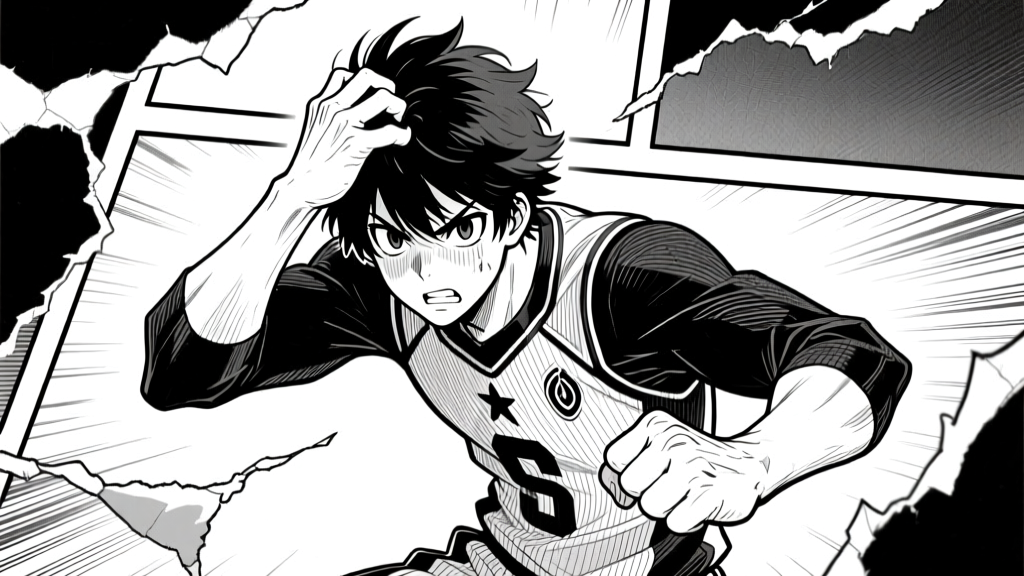
“Nagi’s breakdown wasn’t a twist. It was a sigh—long held, finally let out.”
—Muneyuki Kaneshiro, Japan Content Expo 2024
I remember watching Episode 22 of the Blue Lock anime—the one where Nagi collapses mid-game against Spain, eyes wide and unblinking, whispering “I can’t see the ball”—and feeling something off. Not disbelief, exactly. More like… dissonance. Like hearing a song with a chord missing right before the chorus. The animation was sharp. The tension crackled. But Nagi’s unraveling landed like a plot device—not a person coming undone.
Then I read Episode Nagi.
It wasn’t marketed as essential. Just a “side story,” bundled in that slim Vol. 21.5 release—shelved between the main volumes like bonus footage on a DVD. But it’s not bonus. It’s architecture. Kaneshiro didn’t just fill in gaps. He rebuilt the foundation.
Here’s what the anime cut—and why it mattered:
1. The childhood injury flashback (Ep. Nagi #2) Not a montage. Not a voiceover. A single, silent two-page spread: eight-year-old Nagi, barefoot on rain-slicked concrete, clutching his left knee. His cleat lies sideways. A soccer ball rolls away, untouched. No dialogue. Just the sound effect shiiin—the same one used when the Spain match goes quiet in Vol. 22. That injury never healed right. Not physically—his knee’s fine now—but neurologically. His visual processing began subtly fraying then, misfiring under pressure. The anime treats his vision loss as sudden, almost supernatural. Episode Nagi roots it in trauma: a body remembering danger before the mind catches up.
2. The locker room conversation with Isagi (Ep. Nagi #5) Right before the final match. Nagi isn’t brooding. He’s practicing breathing. Inhale for four. Hold for seven. Exhale for eight. Isagi notices. Nagi says, “My eyes lie to me sometimes. So I count instead.” Not bravado. Not denial. A quiet, exhausted coping mechanism. This scene lasts 97 seconds in the manga—just panels of hands gripping towel edges, blinking rhythms syncing, a half-smile that doesn’t reach his pupils. The anime cuts it entirely. Without it, Nagi’s collapse reads like failure. With it? It reads like the last possible moment he stayed upright for someone else.
3. The broken mirror motif (repeated across five panels, Ep. Nagi #1, #3, #4, #5, #6) First: Nagi sees his reflection fractured in a locker room mirror—two left eyes, one mouth, no nose. Later: a cracked phone screen showing his own face mid-pass. Then: light fracturing through a stained-glass window in the training facility chapel (yes, there’s a chapel). Then: the lens flare on a camera flash distorting his expression into shards. Finally: the actual mirror in his hotel bathroom, taped diagonally after he smashes it—not in rage, but to see himself whole again by forcing symmetry. Kaneshiro told fans at JCE 2024 this wasn’t symbolism for “identity crisis.” It was literal: “Nagi’s visual cortex was splitting perception. The mirror is how he mapped it.”
That’s why Kaneshiro called Episode Nagi “the missing third act.” The anime gives us Act I (Nagi’s genius), Act II (Nagi’s strain), then jumps straight to the aftermath—like cutting from Hamlet holding Yorick’s skull to the final body pile. Episode Nagi is the soliloquy in between. The trembling hand. The breath before the fall.
I reread Vol. 21–22 after finishing the side story—and everything changed. That moment when Nagi drops the ball in Spain? It’s not him failing. It’s him finally stopping the count. Letting go.
The manga doesn’t excuse him. It listens.
And if you’re watching the anime first—or even if you’ve already finished it—read Episode Nagi before the Neo Egoist League arc. Not as context. As correction. As compassion.