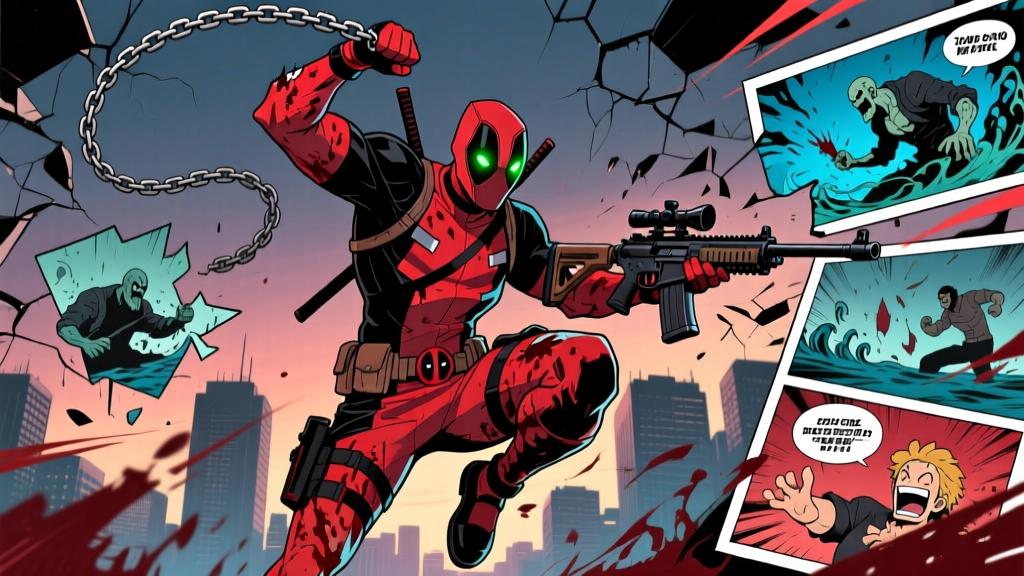
Marvel Comics | 10 Issues | November 2019 – October 2020 | Writer: Kelly Thompson | Artist: Chris Bachalo
Series Overview
In November 2019, Marvel Comics launched a new volume of Deadpool—the seventh ongoing series bearing the character’s name and the first to carry the unofficial subtitle “King Deadpool.” Written by Kelly Thompson with art by veteran penciller Chris Bachalo, the series ran for ten issues and concluded in October 2020. It marked a distinct pivot for Wade Wilson: instead of bouncing between mercenary gigs and team-ups, Deadpool found himself crowned ruler of a monster-infested island off the coast of Staten Island, tasked with governing a chaotic population of creatures that had no interest in being governed.
The premise was absurd even by Deadpool standards, but Thompson leaned into the ridiculousness while threading genuine character work through the chaos. The series tackled themes of leadership, identity, and what happens when someone fundamentally unequipped for responsibility suddenly holds absolute power over a bunch of literal monsters. It was part political satire, part creature feature, part buddy comedy with Elsa Bloodstone serving as the perpetually exasperated straight woman to Wade’s incompetence.
Spanning two collected editions—Hail to the King (issues #1–6) and Not King Deadpool (issues #7–10)—the run told a complete, self-contained story that didn’t require extensive Marvel Universe knowledge to follow. For collectors and readers looking for a tight Deadpool arc without the sprawling continuity baggage of longer runs, this ten-issue burst offered a focused entry point.
The Creative Team
Kelly Thompson — Writer
By late 2019, Kelly Thompson had established herself as one of Marvel’s most reliable voices for characters who balance humor with genuine pathos. Her work on Jessica Jones and Black Widow demonstrated a knack for sharp dialogue and grounded character work, and her Captain Marvel run proved she could handle franchise-level books. Deadpool was a natural fit: a character whose comedy only lands when the emotional stakes underneath it feel real.
Thompson’s approach to Wade Wilson avoided the trap of making him purely a joke machine. She gave him an actual arc—a man thrust into power who slowly realizes that being king means making choices that hurt people, including himself. The comedy was there (abundantly), but it served the story rather than existing as disconnected one-liners.
Chris Bachalo — Penciller
Chris Bachalo brought decades of industry experience to the book, having worked on landmark runs including Sandman, Shade the Changing Man, Generation X, and Uncanny X-Men. His style—angular, expressive, capable of both grotesque horror and subtle comedy—suited a series about an island full of monsters far better than a cleaner, more house-style approach would have.
Bachalo’s creature designs gave the island a genuine sense of menace beneath the humor. His panel layouts favored dynamic, overlapping compositions that kept action sequences legible while allowing the comedic beats to breathe. Tim Townsend handled inks, and the color work shifted between muted, grimy palettes for the island’s underbelly and bright, saturated splashes when the action demanded spectacle.
Supporting Creatives
Tim Townsend (inks), Chris Bachalo (colors on select issues), and Joe Sabino (lettering) rounded out the core team. The lettering work deserves specific mention: Deadpool’s dialogue balloons are notoriously dense, and Sabino managed the wall-of-text problem that plagues many Deadpool comics by varying balloon sizes and placement to maintain visual rhythm on crowded pages.
Prelude: Absolute Carnage vs. Deadpool
Before the main series launched, Marvel published Absolute Carnage vs. Deadpool as a three-issue tie-in to the broader Absolute Carnage crossover event (August–October 2019). Written by Frank Tieri with art by Clayton Crain, the mini-series put Deadpool in direct conflict with the symbiote threat of Carnage, who had bonded with a new host and was tearing through New York.
The mini served a practical purpose: it kept the Deadpool name visible on shelves during the gap between the end of the previous ongoing series and Thompson’s relaunch. From a story perspective, it functioned as a palate cleanser, reminding readers that Deadpool operated in the same universe as the symbiote-heavy corner of Marvel, even if the King Deadpool series would largely stay in its own lane.
Tie-in issues like these rarely break new ground, but Tieri delivered competent work, and Crain’s painted art style gave the book a distinctive visual identity that set it apart from the main series that followed. Collectors note that Absolute Carnage vs. Deadpool #1 holds modest value due to the symbiote crossover appeal and Crain’s cover art.
Storylines and Key Arcs
The King of Monsters (Issues #1–3)
Deadpool takes a mercenary contract to deal with a monster problem on a remote island near Staten Island. What starts as a simple extermination job spirals into something far more complicated when Wade discovers that the island’s monster population has established its own rough society—and that the previous “King” has just died. Through a combination of violence, dumb luck, and the monsters’ own desperate need for leadership, Deadpool ends up crowned as their new ruler.
The early issues establish the central tension: Wade wants the perks of kingship (tribute, adoration, unlimited chimichangas) without the responsibilities. The monsters, meanwhile, need protection from outside threats—including other mercenaries who see the island as a target-rich environment. Elsa Bloodstone enters the picture as a monster hunter with her own agenda, immediately clashing with Wade’s chaotic approach to governance.
Court Intrigue and Kraven’s Challenge (Issues #4–6)
Just as Deadpool begins to settle into his role, Kraven the Hunter’s forces arrive. Kraven, operating through proxies and hired guns, sees the island’s monster population as the ultimate trophy hunt. The arc shifts the series into a darker register, with Wade forced to make strategic decisions that actually affect the lives of his subjects. The X-Men make a brief appearance, complicating Wade’s already fragile authority.
Thompson uses this arc to explore what Deadpool looks like when he’s forced to be serious—not for a single dramatic moment, but sustained over multiple issues. The humor doesn’t disappear; it becomes a coping mechanism for a character who has no other way of processing the weight of decisions that might get people killed.
The Fall of the King (Issues #7–10)
The final arc brings everything crashing down. Deadpool’s kingdom begins to fracture from internal dissent and external pressure. The Venom symbiote makes an appearance in the closing issues, adding another layer of chaos. Wade’s hold on the throne weakens not because of a single catastrophic failure, but because the fundamental contradiction of his rule—a mercenary trying to be a monarch—becomes unsustainable.
The ending is deliberately messy. Wade doesn’t ride off into the sunset a changed man. He leaves the island having learned something about himself that he’d rather forget, which is about as honest a conclusion as a Deadpool story can deliver.
Key Issues Breakdown
| Issue | Cover Date | Key Events | Notable |
|---|---|---|---|
| #1 | January 2020 | Deadpool takes the island contract; first encounter with monster society | Multiple variant covers; highest-selling issue of the run |
| #2 | February 2020 | Wade is crowned King; Elsa Bloodstone arrives on the island | Elsa Bloodstone’s reintroduction |
| #3 | March 2020 | First challenges to Deadpool’s rule; monster politics deepen | Tone shifts toward political intrigue |
| #4 | April 2020 | Kraven the Hunter’s forces target the island | Major villain introduction; action-heavy |
| #5 | May 2020 | X-Men cameo; Wade’s authority questioned by allies and enemies | Cross-universe character appearances |
| #6 | June 2020 | Elsa and Wade confront their differences; Kraven battle escalates | Collected in Hail to the King TPB |
| #7 | July 2020 | Internal rebellion on the island; Wade’s leadership fractures | Final arc begins; darker tone |
| #8 | August 2020 | Venom symbiote appears; Wade faces impossible choices | Symbiote crossover elements |
| #9 | September 2020 | Full-scale battle for the island; major character confrontations | Penultimate issue; highest stakes of the run |
| #10 | October 2020 | Conclusion; Deadpool leaves the island; kingdom dissolved | Series finale; sets up later Deadpool stories |
Marvel’s Publishing Context
The 2019 Deadpool relaunch arrived during a transitional period for Marvel Comics. The company had moved away from the “Legacy Numbering” system that briefly unified issue counts across volumes, returning to volume-based numbering for most titles. Deadpool’s seventh volume reflected this approach—a fresh #1 for a new creative team, with the understanding that the character’s publishing history remained intact beneath the surface.
Marvel’s broader strategy in 2019–2020 leaned heavily on event-driven publishing. Absolute Carnage ran concurrently with the early Deadpool issues, while War of the Realms had just concluded and Empyre was building toward a 2020 launch. Deadpool existed somewhat adjacent to these events rather than embedded in them, which gave Thompson’s run a degree of creative independence that longer-running titles often lacked.
The ten-issue length was notable. Marvel’s Deadpool series had been shrinking: Daniel Way’s legendary 65-issue run (2008–2012) gave way to Gerry Duggan and Brian Posehn’s 45-issue stretch (2012–2015), which preceded shorter runs by Duggan solo, Cullen Bunn, and Skottie Young. By the time Thompson took over, the expectation was clear—Deadpool books would run for roughly ten to fifteen issues before a new creative team rebooted the title. This compressed format forced tighter storytelling, which arguably suited a character whose longer runs tended to sprawl.
The series launched in November 2019, just before the COVID-19 pandemic disrupted comic distribution in early 2020. Issues #3 and onward hit shelves during a period of significant retail disruption, which likely contributed to the series’s declining sales through its run. The direct market struggled throughout 2020, and Marvel adjusted shipping schedules accordingly, though the Deadpool title maintained a relatively consistent monthly cadence.
Collector’s Guide & Values
The Deadpool 2019 series occupies an interesting position in the collector market. It’s modern enough that high-grade copies remain accessible, but the presence of multiple variant covers on issue #1 and the involvement of Chris Bachalo (a fan-favorite artist with a dedicated following) create pockets of genuine collector interest.
Issue #1 Variants and Values
Deadpool #1 shipped with at least five variant covers, including the main cover by Chris Bachalo, variants by Ryan Stegman and Junggeun Yoon, and retailer incentive editions. In the current market:
- Main cover (Bachalo), raw/NM: $4–8
- Stegman variant, raw/NM: $8–15
- Yoon variant, raw/NM: $6–12
- CGC 9.8 (main cover): $25–45
- Retailer incentive variants (1:25+): $20–60 depending on artist and ratio
Collected Editions
| Title | Issues Collected | Format | Approx. Price |
|---|---|---|---|
| King Deadpool Vol. 1: Hail to the King | #1–6 | Trade Paperback | $12–18 (print) / $9.99 (digital) |
| King Deadpool Vol. 2: Not King Deadpool | #7–10 | Trade Paperback | $10–16 (print) / $9.99 (digital) |
| Deadpool by Kelly Thompson (Omnibus/Complete) | #1–10 | Hardcover / Omnibus | $25–40 (when available) |
Market Notes
This series is not a speculative hot property. Values are stable and modest. The primary driver of collector interest is the Chris Bachalo art connection—his covers from earlier series (Generation X, Uncanny X-Men) have appreciated over time, and some collectors pick up his modern work on the assumption that pattern will hold. The symbiote elements in issues #8–10 add minor crossover appeal for Venom collectors.
For readers rather than speculators, the trade paperbacks offer the best value. The complete run can be read in two volumes for roughly $25–30 in print, or under $20 digitally through Marvel Unlimited (available after the standard embargo period).
Legacy and Reception
The 2019 Deadpool series received generally positive reviews, with critics praising Thompson’s ability to balance the character’s trademark humor with substantive storytelling. The Bachalo-Townsend art team drew consistent acclaim for bringing visual texture that differentiated the book from Marvel’s house-style offerings.
However, the series faced headwinds in the direct market. Sales data indicated that issue #1 moved strongly (typical for a Deadpool launch), but subsequent issues saw standard attrition, dropping to roughly 30,000–35,000 copies per issue by mid-run. These numbers, while sufficient to complete the planned ten-issue arc, were noticeably lower than Deadpool’s peak sales during the early 2010s—a reflection of both the character’s diminishing novelty in the direct market and the broader contraction of non-event Marvel titles during this period.
The series’s legacy is one of a solid, if unspectacular, Deadpool run that accomplished what it set out to do. It gave Wade Wilson a contained story with a beginning, middle, and end—a rarity for a character whose publishing history is defined by perpetual relaunches and continuity tangles. Thompson went on to write other Marvel projects, while Bachalo continued his long association with the publisher.
For fans of the character who burned out on the sprawling, multi-year runs of the Way and Duggan eras, the King Deadpool arc represents a palate cleanser: a self-contained, ten-issue story that doesn’t demand homework and delivers on the promise of its ridiculous premise.
Frequently Asked Questions
How many issues are in the Deadpool 2019 series?
The series ran for ten issues, numbered #1 through #10, published from November 2019 through October 2020. The run is collected in two trade paperback volumes: Hail to the King (#1–6) and Not King Deadpool (#7–10).
Is Absolute Carnage vs. Deadpool part of the 2019 series?
Not exactly. Absolute Carnage vs. Deadpool is a separate three-issue mini-series (August–October 2019) written by Frank Tieri with art by Clayton Crain. It serves as a tie-in to the Absolute Carnage event and was published just before Thompson’s main series launched. It’s a companion piece rather than a required prequel.
Do I need to read earlier Deadpool series before starting this one?
No. Thompson’s run is largely self-contained. While there are occasional references to Deadpool’s history (particularly his relationship with the X-Men), the series establishes everything a new reader needs within the first two issues. It’s one of the better entry points for readers jumping into Deadpool comics without prior knowledge.
Which Deadpool 2019 issues are worth collecting?
Issue #1 holds the most collector interest due to its variant covers and status as the series’s first issue. The Stegman and Yoon variants carry small premiums. Beyond that, individual issues are inexpensive in both raw and graded condition. For reading purposes, the trade paperbacks offer far better value than chasing single issues.
What happened to Deadpool after this series ended?
After the ten-issue run concluded in October 2020, Marvel eventually launched a new Deadpool series in 2022, continuing the character’s cycle of periodic relaunches. The events of the King Deadpool arc are referenced in later appearances but are not critical to understanding subsequent series.
Is the Deadpool 2019 series available on Marvel Unlimited?
Yes. Following Marvel’s standard digital release schedule, the individual issues became available on Marvel Unlimited approximately three months after their print release. The trade paperbacks are also available digitally through Marvel’s digital comics platform.
SenpaiSite Manga Guides • Deadpool 2019 Series Guide • Last updated: June 2026
All character names and series titles are trademarks of Marvel Comics / The Walt Disney Company. This guide is for informational purposes only.