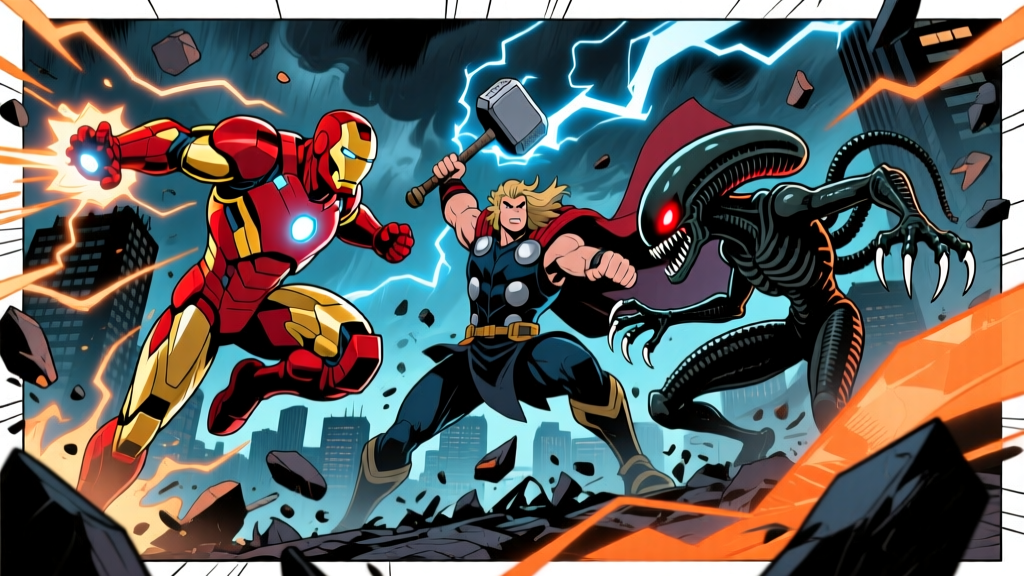
The Skrull dropped his coffee mug when the alarm hit Deck 14. Not because of the noise — he'd heard Klaxons on forty worlds — but because the face looking back at him in the polished steel bulkhead wasn't his anymore. Somewhere between the mess hall and the bridge, he'd forgotten which species he was pretending to be. That's the terror Marvel has mined for over fifty years: alien invasions in the Avengers' universe don't arrive as armadas on the horizon. They're already here, sitting in your chair, wearing your skin.
If you've landed on this page trying to figure out which comics to crack open first — or where you can actually read Avengers vs. aliens stories online without spending a second mortgage on back issues — you're in the right spot. Below is a guided tour through the essential cosmic-invasion storylines, the creative teams behind them, and practical advice on digital access in 2026.
The Kree-Skrull War: Where the Template Was Born
Roy Thomas and Neal Adams launched the Avengers into deep space with Avengers #89–97 (1971–1972), and nothing about superhero comics looked quite the same afterward. Before this arc, alien threats in the Marvel Universe were mostly one-off monsters-of-the-week. Thomas turned them into geopolitical factions with histories, grudges, and expansionist ambitions.
The plot: the Kree Empire's Supreme Intelligence has been pulling strings on Earth, using four human soldiers — later dubbed the Starforce precursors — as weapons against their ancient rivals, the Skrulls. The Avengers get dragged in when Captain Marvel's loyalties are called into question. What follows is a nine-issue space opera that introduced the concept of a cosmic chessboard where Earth sits at the intersection of two warring civilizations.
Why It Still Holds Up
Adams' art on issues #93–96 is some of the most visually ambitious work Marvel had produced up to that point. The full-page splash of the Skrull armada dwarfing the Avengers' Quinjet in deep space set a visual standard that later cosmic stories would chase for decades. And Thomas's script doesn't treat the aliens as generic invaders — the Kree are rigid militarists, the Skrulls are shapeshifting infiltrators, and neither side is exactly heroic. That moral murkiness became the DNA for every Avengers alien storyline that followed.
The arc also gave us the first real instance of an Avenger going undercover in an alien empire, a trope that Secret Invasion would weaponize thirty-six years later.
"Thomas didn't just write a space battle — he wrote a cold-war thriller with ray guns. Every subsequent Marvel cosmic event owes rent to these nine issues." — The Comics Journal, Retrospective Review #304 (2011)
Where to read it: All nine issues are on Marvel Unlimited (included with a standard subscription, currently $10.99/month or $69.99/year). Physical omnibus collectors should look for Avengers: The Kree-Skrull War TPB, ISBN 0-7851-2090-X, which has stayed in print since 2000.
Infinity Gauntlet: Thanos and the Cosmic Death Wish
Jim Starlin had been building toward Thanos since Iron Man #55 in 1973, but Infinity Gauntlet #1–6 (1991) was the payoff — a six-issue limited series where the Mad Titan collects all six Infinity Gems and snaps half the universe out of existence. Sound familiar? The MCU borrowed the skeleton of this story for Avengers: Infinity War (2018), but the comic is a stranger, more philosophical beast.
In the comics, Thanos isn't motivated by resource scarcity or Malthusian overpopulation theory. He's in love — literally, romantically in love — with Mistress Death, the cosmic entity who personifies mortality itself. She's unimpressed by his power, so he escalates. The snap isn't a strategic move. It's a courtship gesture.
The Avengers' Role
The Avengers are part of a larger coalition here — Adam Warlock assembles Earth's heroes, the Silver Surfer brings the cosmic cavalry, and even Galactus gets involved by issue #5. But the Avengers carry the emotional core: Captain America stands before a god-tier Thanos and delivers a speech about duty that still circulates on comic forums. Thor loses. Hulk gets tossed like a ragdoll. Doctor Strange, operating as Sorcerer Supreme, essentially admits he's outmatched and defers to Warlock's strategy. It's a rare story where the Avengers' greatest contribution is buying time rather than winning.
George Pérez penciled the first four issues before Ron Lim took over, and the transition is noticeable — Pérez's crowd scenes pack dozens of cosmic entities into single panels with a density that Lim's cleaner style doesn't quite match. Both approaches have their fans; Pérez's issue #4 double-page spread of the cosmic battle remains one of the most reproduced images in Marvel history.
Where to read it: Marvel Unlimited (full series). The Infinity Gauntlet trade paperback (ISBN 0-7851-0463-6) collects all six issues and has sold over 500,000 copies since its initial 1992 printing, making it one of Marvel's best-selling graphic novels. Also available for individual purchase on ComiXology (Amazon's digital comics platform) at roughly $3.99 per issue.
Secret Invasion: The Skrulls Have Been Here the Whole Time
Brian Michael Bendis and Leinil Francis Yu delivered Secret Invasion #1–8 (2008) at a moment when Marvel was still riding the post–Civil War high. The premise was simple and devastating: the Skrulls have replaced key figures across the Marvel Universe — government officials, S.H.I.E.L.D. agents, even Avengers themselves — and nobody knows who's real.
This wasn't the first Skrull infiltration story (the Kree-Skrull War planted that seed), but it was the first to make the paranoia the entire point. Every issue peeled back another layer of betrayal. Elektra was a Skrull (revealed in the lead-up series New Avengers #31–34). Then Spider-Woman. Then Hank Pym. The mid-event tie-in Secret Invasion: Who Do You Trust? one-shot spent its entire page count on characters interrogating each other in locked rooms, and it was gripping.
Reading Order Matters Here
Unlike Infinity Gauntlet, which works as a self-contained story, Secret Invasion rewards readers who tackle the build-up. Bendis seeded clues across New Avengers and Mighty Avengers for roughly eighteen months before the event launched. If you jump straight into issue #1, you'll spend the first three chapters confused about why everyone is freaking out about Spider-Woman.
Here's a lean reading path that covers the essential beats without drowning in tie-ins:
- New Avengers #31–34 (the Elektra reveal)
- Secret Invasion: Dark Reign one-shot (setup context)
- Secret Invasion #1–8 (main series)
- Secret Invasion: Dark Reign epilogue issues (if you want the aftermath)
Yu's art deserves specific mention. His Skrull reveals — the moments where a character's green-tinged true form bleeds through their human disguise — are rendered with a body-horror subtlety that most superhero comics never attempt. The sequence in issue #6 where a Skrull-copy of Captain Marvel fights the real thing is a masterclass in visual confusion that mirrors the characters' own disorientation.
Where to read it: Marvel Unlimited (main series + most tie-ins). The collected TPB Secret Invasion (ISBN 0-7851-3722-2) runs about $19.99 and includes the eight main issues. Individual digital issues are available on ComiXology. Physical single issues from 2008 have appreciated — expect to pay $8–$15 per issue on the secondary market (MyComicShop, eBay) depending on condition.
Annihilation: When the Negative Zone Came Knocking
Most Avengers fans think of Annihilation (2006) as a cosmic event that happens around the Avengers rather than to them, and that's partly fair. The core series by Keith Giffen and Dan Abnett focuses on Nova, Drax, Silver Surfer, and the cosmic side of Marvel. But the Avengers' absence is the point — Annihilus's wave of destruction from the Negative Zone is so overwhelming that even the cosmic heavyweights can barely slow it down.
The event spans four lead-in one-shots (Annihilation Prologue, plus spotlights on Silver Surfer, Nova, and Ronan), a four-issue Annihilation: Conquest mini, and the six-issue main series. If you're tracking page count, the full reading experience runs close to 480 pages — substantial but not bloated.
Why Avengers Fans Should Care
Two reasons. First, Annihilation: Conquest introduces the Phalanx and Ultron-Technarchy hybrid that sets up the Avengers: The Initiative storyline and later feeds into the War of Kings event. Second, Annihilation redefined the Nova Corps in a way that directly affects how Richard Rider interacts with Earth-based heroes for the next decade. If you've ever wondered why Nova carries the weight-of-the-universe demeanor that shows up in later Avengers crossovers, this is the origin story.
Giffen's plotting is tight — the four-issue structure of the main series (later expanded to six) moves with military precision, and Andrea DiVito's pencils give the Annihilation Wave a genuinely terrifying visual identity: billions of insectoid soldiers forming a living wall of chitin and weaponry that literally consumes star systems.
Where to read it: Marvel Unlimited has the complete event including all prologues, tie-ins, and the main series. The Annihilation Omnibus (ISBN 1-3029-0195-5, released 2018) collects everything in a 1,192-page hardcover, priced around $75–$100 at retail. It's a hefty investment but the most complete single-volume edition available.
Other Essential Avengers Alien Encounters
The four storylines above are the pillars, but Marvel's catalog of alien-invasion comics runs deep. Here are the ones worth your time if you've already cleared the main events:
| Storyline | Year | Creative Team | Alien Threat | Issues |
|---|---|---|---|---|
| Operation: Galactic Storm | 1992 | Various (crossover) | Kree-Shi'ar War spillover | 19 issues across 7 titles |
| Maximum Security | 2000 | Kurt Busiek / various | Galactic Council penal colony (Earth) | 3-issue mini + tie-ins |
| Secret Invasion tie-in: Ms. Marvel | 2008 | Brian Reed | Skrull replacement of Carol Danvers | 3 issues (#28–30) |
| War of Kings | 2009 | Abnett & Lanning | Shi'ar vs. Kree (Inhumans involved) | 6-issue main series |
| The Thanos Imperative | 2010 | Abnett & Lanning | Cancerverse invasion | 6-issue mini |
| Infinity | 2013 | Jonathan Hickman / Jim Cheung | Builders + Thanos invasion of Earth | 6-issue main series |
| Empyre | 2020 | Al Ewing & Dan Slott | Kree/Skrull Alliance + Cotati | 6-issue main series |
Empyre deserves a specific callout. Ewing and Slott managed to weave together the Kree, the Skrulls, and the plant-based Cotati into a single conflict while also resolving a decades-old subplot from Avengers #133 (1975) involving the Cotati's first appearance. That kind of long-game storytelling is what makes Marvel's cosmic universe feel lived-in, and it works as both a standalone adventure and a capstone to fifty years of alien-invasion history.
Where to Actually Read These Comics Online
Here's the practical part. As of mid-2026, there are four realistic ways to read Avengers alien-invasion comics digitally. Each has trade-offs.
Marvel Unlimited
This is the default answer for a reason. At $10.99/month (or $69.99/year), it gives you access to over 30,000 comics from Marvel's back catalog, including every storyline mentioned in this article. The catch: new issues are added three months after their physical release, so if you're trying to read something that shipped last week, you're waiting. The reading experience on tablets is solid — the guided-view panel-by-panel mode works well for cosmic splash pages — but the desktop web reader still stumbles on double-page spreads, which is frustrating for Pérez-heavy stories like Infinity Gauntlet.
Best for: Backlog readers who want maximum access without per-issue costs. If you plan to read more than 7–8 issues per month, the subscription pays for itself immediately.
ComiXology (Amazon)
Amazon's digital comics storefront lets you buy individual issues (typically $3.99–$4.99) or collected editions ($9.99–$19.99). The reading app is polished — better than Marvel Unlimited's mobile app, honestly — and purchases are permanent. The downside is cost: reading the full Secret Invasion experience (main series + key tie-ins) runs about $55–$65 in individual issues, versus the $20 TPB or the Unlimited subscription.
Best for: Readers who want to own specific storylines permanently and don't mind paying per issue.
DC Universe Infinite / ComiXology Unlimited
Wait — DC Universe Infinite won't have Marvel comics. But ComiXology Unlimited (the subscription tier, $5.99/month) includes a rotating selection of Marvel titles through Amazon's publishing partnerships. The selection is limited and changes quarterly, so you can't count on it for specific arcs. It's worth checking if any of the storylines above are currently in rotation before committing to individual purchases.
Library Lending (Libby / Hoopla)
This is the option most people overlook. If your local library participates in Hoopla or Libby (and most major library systems do), you can borrow digital graphic novels for free. The selection varies wildly by library system — some have extensive Marvel collections, others have almost nothing. But it costs you exactly nothing to check, and collected editions of Infinity Gauntlet, Secret Invasion, and Annihilation show up regularly in larger library systems. The New York Public Library's digital collection, for instance, carries at least four of the storylines listed in this article.
Best for: Budget-conscious readers who don't mind waiting for holds and working with whatever their library has licensed.
A Suggested Reading Order for the Full Experience
If you want to read these storylines as a continuous arc — watching Marvel's alien-invasion storytelling evolve from 1971 to 2020 — here's a chronological path that builds momentum:
- The Kree-Skrull War (Avengers #89–97) — the foundation
- Infinity Gauntlet (#1–6, 1991) — cosmic stakes meet personal obsession
- Operation: Galactic Storm (1992 crossover) — the Avengers as galactic peacekeepers
- Maximum Security (2000) — Earth as a prison planet
- Annihilation (2006) — the cosmic side builds its own war
- Secret Invasion (#1–8, 2008) — paranoia comes home
- Infinity (#1–6, 2013) — Hickman's grand-scale Avengers vs. the Builders
- Empyre (#1–6, 2020) — fifty years of alien politics converge
Reading these in order gives you something the individual stories can't: a panoramic view of how Marvel's alien civilizations developed as characters in their own right. The Kree went from one-dimensional invaders in the '70s to a complex, factionalized empire by Empyre. The Skrulls evolved from generic shapeshifters into a tragic species whose homeworld was destroyed, driving them to desperate measures. And the Avengers' relationship with these civilizations shifted from reactive defense to proactive diplomacy — a change that mirrors how the franchise itself grew from a superhero team book into a universe-spanning narrative.
Frequently Asked Questions
Can I read Avengers vs. aliens comics for free online?
Yes, through library lending services like Hoopla and Libby. You'll need a library card from a participating system, and the selection depends on what your library has licensed. Marvel Unlimited also offers a 7-day free trial that gives full access to their back catalog — enough to knock out a few storylines if you're strategic about it.
Do I need to read the comics to understand the MCU movies?
No. Avengers: Infinity War, Endgame, and the Secret Invasion Disney+ series all borrow concepts from these comics but tell different stories. That said, reading Infinity Gauntlet before watching Infinity War adds layers to Thanos's character that the movie simplifies, and reading Secret Invasion (2008) makes the Disney+ show's tonal choices more interesting by contrast.
Which storyline is best for someone new to Marvel cosmic comics?
Secret Invasion (2008) is the most accessible starting point. It's grounded on Earth, the stakes are personal (who's real, who's been replaced?), and Bendis writes it as a thriller rather than a space opera. You don't need deep cosmic lore to follow it — just a basic understanding of who the Avengers are.
Is Marvel Unlimited worth it just for cosmic Avengers stories?
If cosmic Avengers is your primary interest, Marvel Unlimited's back catalog covers essentially every major event and tie-in. At $10.99/month, you could read through all eight storylines listed above in about two months, cancel, and have spent roughly $22 — less than the cost of two collected editions.
Are there any Avengers vs. aliens comics from the 2020s I should watch for?
Timeless (2024) by Jed MacKay touched on future alien threats, and Avengers vol. 9 (2023–ongoing) has introduced the Ashen Combination as a new extraterrestrial antagonist. Neither has reached the narrative weight of the classics yet, but both are available on Marvel Unlimited as they release.