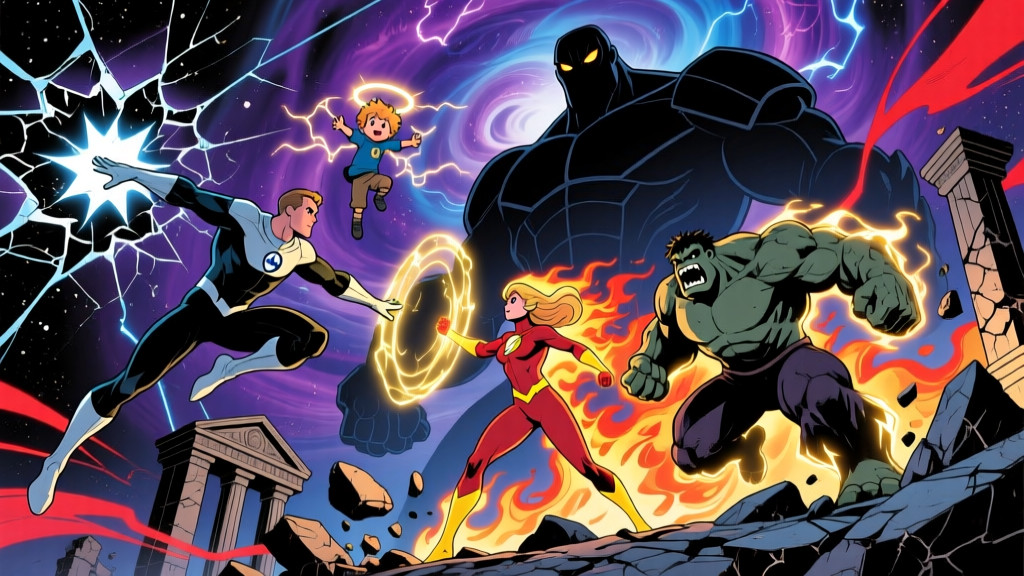
Somewhere between the Baxter Building's gleaming corridors and the violet anti-matter storms of an alternate dimension, a 25-cent comic book changed Marvel's trajectory for the next fifty-seven years. Fantastic Four Annual #6, published in November 1968, opens with a medical emergency, closes with a birth, and in between delivers a villain so terrifying that writers are still trying — and mostly failing — to top him. If you've landed here searching for marvel digital comics fantastic four annual 6, you're about to find out why this particular issue keeps showing up on shortlists of the greatest single comic books ever printed.
The Lee-Kirby run on Fantastic Four (issues #1 through #102, plus the first six Annuals) represents what most comics historians consider the most consequential creative stretch in American superhero fiction. Annual #6 sits near the tail end of that run, and it reads like a team operating at peak confidence. Stan Lee's dialogue crackles with melodramatic urgency. Jack Kirby's pencils — inked by the indispensable Joe Sinnott — depict technology, cosmic landscapes, and body horror with a density that rewards slow reading. Every panel earns its real estate.
The Crisis That Started It All: Sue Storm's Impossible Pregnancy
The story — titled "Let There Be... Life!" — begins not with a fight scene but with a diagnosis. Susan Storm Richards is pregnant, and the cosmic radiation that gave the Fantastic Four their powers is threatening to kill both her and the unborn child. Reed Richards, the man who can stretch his body into any shape and whose intellect rivals anything in the Marvel Universe, sits in his lab and confronts a problem that no equation solves cleanly.
This was a deliberate narrative choice, and a risky one for 1968. Superhero comics dealt in fistfights and doomsday machines. A pregnancy complication — one rooted in the same origin event that created the team — grounded the fantastic in something uncomfortably real. Lee and Kirby understood that the strongest Fantastic Four stories were never about saving the world in the abstract. They were about what the four members of this family would break themselves in half to do for each other.
Reed determines that anti-matter particles from the Negative Zone — an alternate dimension of anti-matter energy first explored by the team in Fantastic Four #51 (the legendary "This Man, This Monster" storyline from 1966) — can neutralize the radiation poisoning Sue's body. The catch: he needs to go get them. Personally. Into a dimension that has tried to kill him twice already.
"Reed, you can't go into the Negative Zone again! Last time, you barely made it back alive!" — Johnny Storm, Human Torch, capturing the exact moment Annual #6 shifts from domestic drama into a rescue mission with cosmic stakes.
Into the Negative Zone: Reed, Ben, and Johnny vs. the Unknown
What follows is a three-man expedition into one of Marvel's most hostile environments. Reed Richards, Ben Grimm (the Thing), and Johnny Storm (the Human Torch) don experimental Flight Harnesses — a piece of Kirby tech design that looks like a jetpack crossed with a deep-sea diving rig — and cross the dimensional barrier. Sue stays behind, bedridden and fading. The clock is not on their side.
The Negative Zone, as rendered by Kirby and Sinnott, is a masterclass in visual worldbuilding. Jagged anti-matter formations jut from impossible angles. Colors invert. Gravity behaves like a suggestion. There's a reason Kirby's Negative Zone pages from this era have been reprinted, analyzed, and imitated more than almost any other comic book environment. The man drew alien landscapes the way architects draft cathedrals — with obsessive structural logic and a sense of scale that makes the human figures inside them look impossibly small.
Ben Grimm provides the emotional texture during the journey. His dialogue — "What are ya gonna do, stretch us a path?!" — punctures the tension without undermining it. Lee wrote Ben as the team's pressure valve: when things get too heavy, he cracks a line that reminds everyone they're still a family on a road trip, even if the road runs through an anti-matter hellscape. The Thing's loyalty in this issue is quiet and total. He doesn't debate whether to go. Sue is family. You go.
The Birth of Annihilus: Marvel's Greatest Cosmic Threat Makes Its Debut
Here's where the comic earns its place in history. Deep within the Negative Zone, the team encounters a being that Kirby designed to trigger instinctive revulsion: Annihilus. Insectoid. Armored. Clad in green and purple chitin, with a face that suggests a wasp's mandibles fused with a gas mask. He moves with the jerky, predatory efficiency of something that evolved to survive in an environment where everything else died.
Annihilus is not a conqueror with a speech. He's not a tyrant with a philosophy. He's a force of extinction — a creature whose sole drive is the annihilation of all life that isn't his own. Kirby and Lee conceived him as something closer to a natural disaster than a traditional villain, and that distinction matters. You can negotiate with Doctor Doom. You can appeal to Galactus's sense of cosmic balance. Annihilus doesn't have a sense of anything except hunger and the compulsion to destroy.
The Cosmic Control Rod: A Weapon That Defines an Era
Annihilus wields the Cosmic Control Rod, a device that grants him control over matter at a subatomic level. In Annihilus's grip, the Rod can disintegrate matter, rearrange molecular structures, and project energy blasts that can stagger even the Thing. Kirby drew it as an unassuming cylinder — almost utilitarian — which made its destructive capacity all the more unsettling. The Cosmic Control Rod would go on to become one of Marvel's most sought-after MacGuffins, appearing in dozens of storylines across the next five decades and serving as the central plot device in the 2006–2007 Annihilation crossover event.
The battle sequence between the Fantastic Four and Annihilus in Annual #6 is compact but brutal. Kirby choreographs it like a bar fight in a dimension where the bar is made of anti-matter. Reed uses his elasticity to dodge energy bolts. Johnny's flames behave unpredictably in the Negative Zone's atmosphere. Ben takes hits that would level a building and keeps moving forward because that's what Ben Grimm does. The team wins — barely — by combining Reed's tactical mind with raw physical persistence. Reed secures the anti-matter particles they need, and they retreat before Annihilus can regroup.
Franklin Richards: The Child Who Would Reshape Reality
The team returns to the Baxter Building. Reed administers the anti-matter treatment. Sue survives. And in the closing pages of Annual #6, Franklin Benjamin Richards is born — a child whose mutant heritage (two parents altered by cosmic radiation at a genetic level) would make him one of the most powerful beings in the Marvel Universe.
At the time of his birth, Franklin's significance wasn't immediately obvious. He was a baby in a comic book, a plot device representing the continuation of the family. But over the next several decades, writers including John Byrne, Chris Claremont, and Mark Waid would develop Franklin into a reality-warping omega-level mutant whose powers include the ability to create pocket universes, alter timelines, and manipulate energy on a cosmic scale. In one celebrated storyline (Fantastic Four #262, 1984), a future version of Franklin — operating under the identity Psi-Lord — is shown to have the potential to surpass Galactus in raw power.
The decision to give the Fantastic Four a child in 1968 was itself groundbreaking. Superheroes didn't have babies. Marriages in comics were rare enough; parenthood was almost unheard of. Lee and Kirby committed to the idea that Reed and Sue's relationship was a real marriage with real consequences, and Franklin's birth was the payoff on that commitment. Every subsequent storyline about Franklin — his power surges, his kidnapping by Onslaught, his role in House of M and Secret Wars — traces back to the delivery room in Annual #6.
The Creative Team at Peak Form
By late 1968, the Lee-Kirby-Sinnott team had been producing Fantastic Four for over five years. Annual #6 reads like the work of creators who trust each other completely. Lee's scripting gives Kirby room to stage complex action sequences across double-page spreads without over-explaining them in captions. Sinnott's inks add weight and texture to Kirby's pencils — his heavy, sculpted line work is particularly effective on Annihilus's armor and the Negative Zone's crystalline formations.
This was also one of the last great Annuals of the Lee-Kirby partnership. Kirby would leave Marvel for DC Comics in 1970, where he created the Fourth Saga (Darkseid, the New Gods, the Forever People). The creative restlessness that drove him to leave is already visible in Annual #6: the Negative Zone sequences push further into abstract visual territory than almost anything Kirby had attempted in mainstream superhero comics up to that point. You can see the artist who would soon draw the Source Wall beginning to test the boundaries of the form.
Fantastic Four Annual #6 — Key Credits
| Role | Credit | Notable Detail |
|---|---|---|
| Writer | Stan Lee | Dialogue-heavy, emotionally grounded script |
| Penciler | Jack Kirby | Annihilus design, Negative Zone landscapes, Flight Harnesses |
| Inker | Joe Sinnott | Heavy sculptural line work; Sinnott inked 70+ Kirby FF issues |
| Editor | Stan Lee | Served as both writer and editor-in-chief at Marvel |
| Publisher | Marvel Comics | Cover price: $0.25 · On-sale: late 1968 |
| Cover Artist | Jack Kirby / Joe Sinnott | Features Annihilus front and center with the FF in combat |
Why Annual #6 Still Matters in FF History
Annual #6 sits at an intersection of several consequential threads in Fantastic Four's publication history. It's the first appearance of Annihilus, a villain who anchors Marvel's entire cosmic mythology. It's the birth of Franklin Richards, a character whose reality-altering powers make him a cornerstone of Marvel crossover events to this day. And it's one of the final high-water marks of the Lee-Kirby collaboration before Kirby's departure to DC in 1970.
The issue also introduced the Flight Harnesses — wearable devices that allow sustained travel through the Negative Zone's chaotic dimensional space. These would reappear in multiple FF storylines and became a staple of the team's equipment arsenal. More subtly, Annual #6 cemented the template for Fantastic Four stories that blend intimate family drama with cosmic-scale action. Every subsequent creative team — from John Byrne's celebrated 1980s run through Jonathan Hickman's 2009–2012 epic and Ryan North's 2022–2025 tenure — has built on that template.
The Annihilation crossover (2006–2007, written by Keith Giffen and Dan Abnett) brought Annihilus to the forefront of Marvel's cosmic narrative in a way that honored his Annual #6 origins. That event depicted Annihilus leading the Annihilation Wave — an armada that consumed entire star systems — and positioned the Cosmic Control Rod as a weapon of galaxy-ending consequence. The character's core identity as an extinction force, established in a single 1968 Annual, proved durable enough to anchor a twelve-issue crossover almost forty years later.
Reading Fantastic Four Annual #6 on Marvel Unlimited and Digital Platforms
For readers looking to experience marvel digital comics fantastic four annual 6 through legal digital channels, Marvel Unlimited remains the primary destination. The Marvel Unlimited subscription service (available at marvel.com/unlimited) includes the full Fantastic Four Annual back catalog as part of its library, which currently contains over 30,000 issues. Annual #6 is available in the standard digital comic reader format, with both full-page and panel-by-panel (Smart Panels) reading modes.
Where to Read Digitally
- Marvel Unlimited — Full issue available with monthly ($10.99/mo) or annual ($69.99/yr) subscription. Supports iOS, Android, and web browsers. Smart Panels mode is recommended for the Negative Zone double-page spreads.
- ComiXology (via Amazon Kindle) — Individual issue purchase available. ComiXology's Guided View mode handles Kirby's dense panel layouts well. Pricing fluctuates; typically $1.99–$3.99 per digital issue for back-catalog Annuals.
- Marvel.com Digital Store — Direct purchase through Marvel's own digital comics storefront. DRM-free PDF download option occasionally available through Marvel's digital promotions.
A note on reading experience: Annual #6 was published as an oversized Annual (typically 64–72 pages, compared to the standard 22-page monthly issue). The page count means the digital file is larger than usual, and some older Marvel Unlimited scans show age-related color fading on the Negative Zone sequences. If you're reading on a tablet, bump your screen brightness up — Kirby and colorist Stan Goldberg packed those anti-matter landscapes with deep purples and blacks that get lost on dimmer displays.
Reprint Collections That Include Annual #6
Several physical reprint editions collect Annual #6 for readers who prefer print or want a curated reading experience. The Fantastic Four Omnibus Vol. 3 (Marvel, 2015 reprint edition) includes Annuals #4–6 alongside the main series run, with restored colors and paper stock that does justice to the Negative Zone artwork. The Marvel Milestone Edition reprints also feature this issue, typically with bonus material including original cover art reproductions and editorial commentary on the Lee-Kirby era.
Collector Values: What Fantastic Four Annual #6 Is Worth in 2026
With first appearances of Annihilus and Franklin Richards stacked into a single issue, Fantastic Four Annual #6 has maintained strong collector demand for decades. The issue benefits from three compounding value drivers: key first appearances (dual keys, which is unusual), placement near the end of the celebrated Lee-Kirby run, and a cover by Kirby/Sinnott that features Annihilus prominently — making it instantly recognizable on a shelf or slab.
According to Heritage Auctions sales data and CGC census records, here's a breakdown of recent market values by grade:
Fantastic Four Annual #6 — Collector Value Guide (CGC Grades)
| CGC Grade | Grade Description | Approx. Market Value (2025–2026) | Availability Notes |
|---|---|---|---|
| 9.8 NM/MT | Near Mint / Mint | $12,000–$14,000 | Extremely rare; record sale $13,780 (Heritage) |
| 9.4 NM | Near Mint | $3,500–$4,500 | Scarce; record sale $4,025 |
| 9.2 NM- | Near Mint Minus | $1,800–$2,300 | Record sale $2,080 |
| 9.0 VF/NM | Very Fine / Near Mint | $800–$1,100 | Most accessible high-grade tier; ~$970 median |
| 8.0 VF | Very Fine | $450–$600 | Common collector grade; solid mid-tier investment |
| 6.0 FN | Fine | $200–$350 | Entry-level graded copy; readable with minor wear |
| Values based on Heritage Auctions, ComicBookRealm, and GoCollect sales data (2024–2026). Actual prices vary by market conditions, slab condition, and label notes. | |||
The dual first-appearance factor (Annihilus + Franklin Richards) gives Annual #6 a floor that most Silver/Bronze Age Annuals lack. Even mid-grade copies (CGC 4.0–6.0) hold meaningful value because collectors who can't afford a 9.0 still want the key appearances in their collection. If you're buying raw (ungraded), expect to pay roughly 40–60% less than equivalent CGC-graded prices, but factor in grading costs ($65–$150 per submission through CGC's standard tier) before deciding whether grading is worth the investment.
Five Moments That Make This Issue Unmissable
- Reed's quiet desperation in the lab. The opening sequence where Reed calculates the odds of Sue's survival is drawn by Kirby with unusual restraint — close-ups on Reed's face, hunched over equipment, the weight of a genius who knows that being smart isn't always enough.
- First sight of Annihilus. Kirby's full-page splash reveal of the insectoid tyrant is one of the most effective villain introductions in comic history. The panel doesn't explain him. It just shows him, and you understand immediately that this is something different.
- Ben Grimm refusing to stay behind. When Reed suggests the mission might be too dangerous, Ben's response is essentially: "She's my family too." No speech. No grandstanding. Just loyalty stated as fact.
- The Cosmic Control Rod in action. Annihilus's first use of the Rod — disintegrating Negative Zone matter to demonstrate its power — is rendered by Kirby with a crackling energy effect that became the visual template for cosmic weapons in Marvel for decades.
- Franklin's birth. The final pages, with Reed holding his son for the first time while Sue recovers, close the story with the emotional directness that made the Lee-Kirby Fantastic Four feel like a family you could come home to. It's earned sentiment, not manufactured sentiment.
Frequently Asked Questions
Is Fantastic Four Annual #6 available on Marvel Unlimited?
Yes. Marvel Unlimited subscribers can read the full issue digitally, including Smart Panels mode for guided reading. The subscription costs $10.99 per month or $69.99 per year and includes access to over 30,000 comics in the Marvel back catalog.
What makes Fantastic Four Annual #6 so valuable to collectors?
Three factors drive the value: the first appearance of Annihilus (one of Marvel's premier cosmic villains), the first appearance of Franklin Richards (an omega-level mutant central to multiple crossover events), and the issue's placement near the end of the landmark Stan Lee/Jack Kirby run. High-grade copies (CGC 9.0+) have appreciated steadily, with a 9.8 selling for $13,780 at Heritage Auctions.
Who created Annihilus?
Annihilus was co-created by writer Stan Lee and artist Jack Kirby, debuting in Fantastic Four Annual #6 (November 1968). Kirby designed the character's distinctive insectoid appearance, while Lee provided the character's core motivation as an extinction-level threat driven by an instinctive need to destroy all non-Negative-Zone life.
How many pages is Fantastic Four Annual #6?
The issue runs approximately 64 pages (including covers, letters page, and editorial content), which is standard for Marvel Annuals of the Silver Age era. The main story, "Let There Be... Life!", occupies the majority of the page count.
Does Franklin Richards appear in the 2025 Fantastic Four film?
Franklin Richards is featured in Marvel Studios' The Fantastic Four: First Steps (2025), confirming the character's ongoing relevance across media. His comic book origin in Annual #6 remains the definitive version of his birth and the foundation for every subsequent storyline involving the character.
What other issues should I read alongside Annual #6?
For the full Negative Zone trilogy context, read Fantastic Four #51 ("This Man, This Monster," 1966) and Fantastic Four Annual #6 as a pair — they bookend Reed Richards' relationship with the Negative Zone during the Lee-Kirby era. For Annihilus's modern evolution, the Annihilation crossover (2006–2007) is essential reading and directly builds on the character's Annual #6 debut.
SenpaiSite · Manga Guides · Fantastic Four Annual #6 · Updated June 2026
Collector values reflect publicly available auction data and should not be treated as financial advice. Always verify current market prices before purchasing.