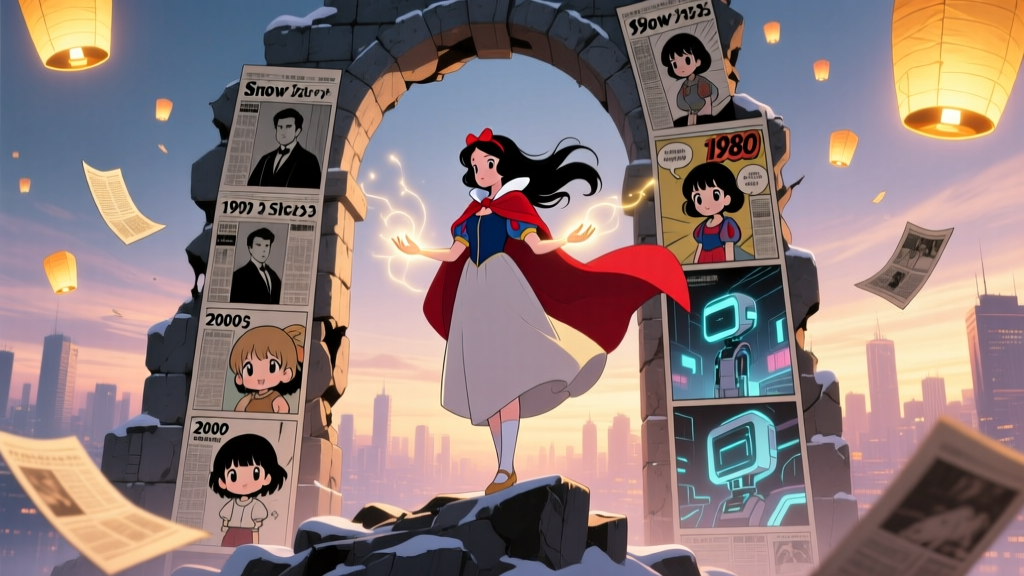
On a cold Sunday in December 1937, newspaper readers flipping through their funny pages found something unusual. Where the Silly Symphony strip typically offered loose gag-a-day vignettes tied to Disney's animated shorts, this week's installment opened with a full narrative — a young woman with skin "white as snow" fleeing through a dark forest while a huntsman lowered his knife. Merrill De Maris wrote the script. Hank Porter drew the panels. Neither of them knew they were launching the first snow white comic adaptation in history, predating the film's wide theatrical release by weeks.
That strip ran through May 1938, clocking in at roughly 20 Sundays. It was faithful to the film frame-by-frame in places, and wildly divergent in others — Porter gave the dwarfs broader, more caricatured faces than the animation department had finalized, and several gags were improvised directly on the drawing board. Collectors today consider original tearsheets from this run among the most difficult Disney comic ephemera to locate. Fewer than a dozen complete sets are believed to exist in private hands.
What followed that initial strip was a comic book presence spanning nearly nine decades, stretching across multiple publishers, artistic generations, and radical reinterpretations. Snow White never headlined a single flagship title the way Batman or Spider-Man did. Instead, she drifted through anthology series, tie-in specials, film re-adaptations, and unexpected guest roles — a pattern that makes her comic history both fascinating and maddeningly hard to catalog.
The Dell Years and Four Color Gold
Western Publishing, operating through its Dell Comics partnership, began printing Disney comic books in 1940 with the launch of Walt Disney's Comics and Stories. That title quickly became one of the best-selling comic books in the world — by 1953, it was moving over three million copies per issue, a figure that dwarfs virtually every modern comic book on the market.
Snow White appeared in WDCS sporadically during the 1940s, usually in backup stories or seasonal specials. The Seven Dwarfs, frankly, got more panel time. They were easier to draw in quick gag formats, and kids loved them. But the princess herself received marquee treatment in Dell's Four Color series — the tryout anthology that tested characters for potential solo titles.
The Four Color Issues That Matter
Three Four Color issues form the backbone of any serious Snow White comic collection:
- Four Color #227 (1949) — "Walt Disney's Seven Dwarfs": Despite the title centering the dwarfs, Snow White appears throughout. The art here reflects the late-1940s Disney house style — clean linework, bright four-color process printing, and panel layouts that feel like storyboards adapted from the film's key sequences. A CGC 6.0 copy sold at Heritage Auctions in 2021 for roughly $180.
- Four Color #382 (March 1952) — "Snow White and the Seven Dwarfs": The definitive Golden Age Snow White comic. This issue re-adapted the film with more confident art and tighter scripting than the 1937 strip. It remains the single most sought-after Snow White comic book issue. A CGC 8.0 copy commands $400 or more at auction; a 9.0 or above can exceed $800 if the pages are white.
- Four Color #600 (1954) — assorted Disney stories: Snow White appears in a supporting role. Less valuable as a standalone collectible, but notable for featuring art that deviated from the film's visual template — the dwarfs are drawn stockier and rounder, and the forest scenes use heavier shadows than typical Disney comics of the era.
"The Four Color Snow White issues are where you see Disney's comic art department finding its voice. The 1937 strip was basically tracing the film. By 1952, the artists were interpreting it — adding their own compositions, their own pacing." — Dr. Ana María Sánchez, Ink and Enchantment: Disney Comics in American Print Culture (University Press of Mississippi, 2019)
Beyond the Four Color reprints, Dell also published original Snow White stories in seasonal giveaways and promotional comics. A 1949 Christmas giveaway titled Walt Disney's Christmas Parade featured a Snow White segment drawn in a simplified style meant for younger readers. These promotional pieces — often distributed through department stores and banks — survive in surprisingly low numbers given their original print runs were in the hundreds of thousands.
Gold Key and the Long Middle Period
In 1962, Western Publishing severed its relationship with Dell and began distributing comics under the Gold Key imprint. The transition barely registered for readers — the same writers, artists, and editors continued producing the same titles, just with a new logo on the cover.
Gold Key's Walt Disney's Comics and Stories continued as the flagship title, and Snow White appeared in it periodically through the 1960s and 1970s. But the editorial focus had shifted hard toward Donald Duck, Uncle Scrooge, and the adventure-oriented stories coming out of Carl Barks's and later Don Rosa's orbit. Snow White was, in practical terms, a secondary character in Disney's own comic lineup.
The Whitman Era and the Slow Fade
When Gold Key transitioned to the Whitman Comics imprint in the late 1970s — selling comics in bagged three-packs to toy stores and department stores rather than through newsstands — Snow White appearances became even rarer. The Whitman variant covers from this period are a curio for specialists: same interior content, different cover configurations, often with subtle color shifts that only hardcore Disney comic collectors notice.
A notable exception came in 1982, when Disney released a special Snow White and the Seven Dwarfs comic to tie into the film's theatrical re-release that year. Printed in a slightly larger format than standard Gold Key output, it mixed reprinted panels from the 1952 adaptation with new framing pages. It sold well at the time, but few copies survived in high grade — most ended up creased and dog-eared in children's bedrooms.
By the mid-1980s, with Gladstone Publishing picking up the Disney comics license and focusing heavily on the Duck universe, Snow White had essentially vanished from American comic book pages. She existed in reprints, in foreign editions (European publishers like Egmont in Scandinavia and Mondadori in Italy produced their own Snow White stories with distinct art styles), and in the memories of older readers who remembered finding her in the funny pages as children.
Disney Adventures and the Magazine Interlude
In fall 1990, the Walt Disney Company launched Disney Adventures, a monthly magazine aimed at children aged 6 to 14. It ran until November 2007 — 17 years and over 200 issues — and it mixed celebrity interviews, game reviews, puzzles, and original comic strips into a format that felt more like Nintendo Power than a traditional comic book.
Snow White showed up in Disney Adventures intermittently. She appeared in full-page illustrations tied to seasonal features, in brief comic strips that ran alongside the magazine's Darkwing Duck and Gargoyles serials, and in promotional tie-ins for home video re-releases. A November 1997 issue featured her prominently on the cover alongside Will Smith, who was promoting Men in Black — a surreal juxtaposition that captures the magazine's pop-culture-blender approach.
The comics in Disney Adventures were generally lighter and more humor-driven than the Dell/Gold Key material. Snow White was typically portrayed as the straight-laced foil to the dwarfs' antics — less fairy tale heroine, more exasperated babysitter. It wasn't high art, but it kept her visible to a generation of readers who might otherwise have known her only from a VHS tape and a theme park meet-and-greet.
The magazine's cancellation in 2007 coincided with Disney's broader shift toward digital content and away from print. For several years afterward, Snow White's comic book presence existed almost entirely in reprints and foreign-market publications.
The Dark Mirror: Fables Reimagines the Princess
Everything changed in July 2002, when DC Comics' Vertigo imprint published Fables #1. Written by Bill Willingham with art by Lan Medina, the series proposed a deceptively simple question: what if fairy tale characters were real, and they'd been exiled from their homelands by a mysterious enemy called the Adversary, forced to live in secret in modern-day New York City?
Snow White was not a supporting character in Fables. She was one of the two leads, alongside private detective Bigby Wolf (the Big Bad Wolf, reformed and walking upright in a trench coat). In Willingham's version, Snow White served as the deputy mayor's secretary — and, in practice, the person who actually ran Fabletown. She was sharp-tongued, administratively ruthless, and recently separated from Prince Charming, who had cheated on her with her sister Rose Red.
Why Fables' Snow White Hit Different
Willingham's Snow White retained the core traits that made the character recognizable — fairness, integrity, a certain moral clarity — but he recontextualized them in a gritty urban fantasy setting. Her "fairest of them all" status became a political liability: other Fables resented her authority, questioned whether her beauty gave her unfair advantages, and plotted against her. The Magic Mirror, now a sentient surveillance system installed in the Fabletown business office, served as both ally and potential threat.
Key Fables Snow White Story Arcs:
- Legends in Exile (issues #1–5): Introduction, murder mystery plot
- A Wolf in the Fold (issues #12–13): Snow White and Bigby's relationship deepens
- March of the Wooden Soldiers (issues #19–27): Snow White's leadership tested during an invasion
- Sons of Empire (issues #36–41): Confrontation with the Adversary
- Snow White (Volume 18, collected 2013): A full story arc centered on her origins
The series ran for 150 issues, concluding in July 2015. It won 14 Eisner Awards over its run, and the Snow White character became arguably the most recognizable element of the franchise — more so than Bigby, which is saying something given that the wolf detective was the nominal lead. A video game adaptation, The Wolf Among Us (Telltale Games, 2013), brought the Fables version of Snow White to an audience that had never touched a Vertigo comic.
"Willingham didn't deconstruct Snow White. He reconstructed her. He took the same traits — kindness, stubbornness, moral backbone — and asked what those traits would actually look like in a 45-year-old woman running a refugee community in Manhattan. The answer was more interesting than the original." — Gabe Bullock, Vertigo's Revolution: Mature Fairy Tales in Mainstream Comics (Sequart Organization, 2017)
It is worth noting that Fables is not a Disney property. Willingham drew from the original Brothers Grimm tales and other public-domain sources, not from Disney's animated adaptations. This legal distinction allowed him to portray Snow White in ways that Disney would never sanction — swearing, drinking, navigating a divorce, giving birth. The character's visual design in Fables (by artists including Mark Buckingham, Steve Leialoha, and Russ Braun) owed more to classic illustration than to the 1937 film, but the cultural association was unavoidable.
Ever After High and the Next Generation
In 2013, Mattel launched Ever After High, a companion franchise to its blockbuster Monster High line. Where Monster High centered on the teenage daughters of Dracula, Frankenstein's monster, and other horror icons, Ever After High placed fairy tale royalty in a boarding school setting. The core dramatic conflict: students must choose whether to follow their parents' "destinies" or forge their own paths.
Snow White's daughter, Apple White, was positioned as one of the two leads (alongside Raven Queen, daughter of the Evil Queen). Apple embraced her destiny — she wanted the poisoned apple, the glass coffin, the prince, the whole package. Raven wanted to be anything except a villain. This tension drove the franchise's narrative across webisodes, novels, and a series of comics published through DC's Johnny DC imprint.
The Comics Angle
The Ever After High comics ran as backup features in various DC all-ages titles and as standalone mini-comics packaged with dolls. They were short — typically 4 to 8 pages — and aimed squarely at the franchise's target demographic of girls aged 7 to 12. The art was clean, modern, and heavily influenced by the character designs of the doll line: big eyes, fashion-forward outfits, and color palettes that skewed toward pastels and jewel tones.
These comics didn't carry the narrative weight of Fables or even the adventure-driven plotting of the Gold Key era. But they did something important: they kept the Snow White mythos alive in print for a new generation. Apple White was, in every meaningful sense, Snow White by proxy — the same core character traits, updated for a media landscape that expected its princesses to have goals beyond waiting for a prince.
The franchise wound down around 2018, but its comic tie-ins remain in print through collected editions and continue to attract readers through digital platforms. A niche but enthusiastic fan community still creates and shares Ever After High fan comics online.
Collector Market: What the Snow White Comic Is Actually Worth
The collector market for Snow White comics is smaller and more specialized than the market for superhero first appearances, but it has held steady for decades. Disney Golden Age comics, broadly speaking, attract a dedicated buyer pool that includes animation historians, nostalgia collectors, and Disneyana enthusiasts — a demographic that overlaps heavily with the classic animation art market.
CGC (Certified Guaranty Company) grading has brought more transparency to pricing in recent years. Before third-party grading became standard in the early 2000s, a Four Color #382 in "pretty nice" condition might sell for $50 or $200 depending on the seller's confidence and the buyer's knowledge. Now, with a numerical grade locked in, prices track more predictably.
| Issue | Publisher / Year | CGC 4.0 (VG) | CGC 7.0 (FN/VF) | CGC 9.0 (NM-) | Notes |
|---|---|---|---|---|---|
| Four Color #227 | Dell, 1949 | $45–$65 | $120–$180 | $350–$500 | Seven Dwarfs title; Snow White featured |
| Four Color #382 | Dell, 1952 | $75–$110 | $250–$400 | $800–$1,200 | Most sought-after Snow White issue |
| Snow White #1 (reprint) | Gold Key, 1963 | $12–$20 | $40–$65 | $120–$175 | Reprinted from Four Color #382 |
| WDCS #309 | Gold Key, 1966 | $8–$15 | $25–$45 | $80–$130 | Snow White backup story |
| Snow White '82 Special | Whitman, 1982 | $5–$10 | $15–$25 | $40–$65 | Theatrical re-release tie-in |
| Fables #1 | Vertigo/DC, 2002 | $8–$12 | $25–$40 | $75–$120 | First appearance, Fables Snow White |
A few patterns emerge from this data. First, the Golden Age Dell issues carry the bulk of the value, which is typical for any comic character — scarcity and age drive price. Four Color #382 in CGC 9.0+ with white pages is a genuine rarity; fewer than five copies have been certified at that grade as of early 2026.
Second, Gold Key and Whitman issues remain remarkably affordable. A complete run of every Snow White appearance from the Gold Key era (roughly 15–20 issues across various titles) can be assembled in mid-grade condition for under $400. That is a fraction of what a single mid-grade Amazing Fantasy #15 costs, and it speaks to the lower profile that Disney comics occupy in the broader collector market.
Third, the Fables issues are appreciating, but slowly. First printings of Fables #1 in CGC 9.8 have sold for $150–$200 in recent auctions, driven by readers who love the series rather than speculators chasing a hot property. It is a healthy collector dynamic — demand based on genuine affection rather than hype.
European Editions: The Undervalued Frontier
One area where collectors can find genuine bargains is in European Snow White comics. Italian publisher Mondadori produced Biancaneve stories in the 1950s and 1960s with art that was often more painterly and atmospheric than the American versions. Danish and Norwegian Egmont editions from the same period featured unique cover paintings not used in the US market. Mexican "Blanca Nieves" comics from Editorial Novaro are among the rarest, with surviving copies commanding $100–$300 in any condition due to the tiny number of known examples.
These international editions remain under-collected by American buyers, partly due to the language barrier and partly because most price guides focus on US-published issues. For a collector who wants something distinctive and historically rich without spending four figures, a 1950s Italian Biancaneve comic is hard to beat.
Snow White in the Current Comics Landscape
As of 2026, Snow White's presence in new comic material is spread across several channels. Disney's current comics licensee, IDW Publishing (under its Disney Comics imprint), occasionally features Snow White in anthology issues, though she rarely headlines. The character appears in manga-style adaptations published in Japan, where the Disney Manga line has been expanding aggressively since 2020.
Independent publishers and webcomic creators have also taken advantage of the Brothers Grimm source material being in the public domain. The result is a steady trickle of Snow White reinterpretations in indie comics — horror versions, cyberpunk versions, feminist retellings, and mash-ups that combine the Snow White story with other fairy tale cycles. None of these have achieved the cultural footprint of Fables, but collectively they demonstrate how durable the character's core mythology remains.
The webcomic space deserves particular attention. Platforms like Webtoon and Tapas host dozens of active Snow White reinterpretations, many of them serialized in the manga-influenced vertical-scroll format. Titles range from straightforward fairy tale retellings to Isekai-style stories where modern characters are transported into the Snow White narrative. These digital comics reach audiences that traditional print distribution simply cannot touch, and several have attracted readerships in the hundreds of thousands.
Questions Collectors and Fans Actually Ask
What was the very first Snow White comic ever published?
The earliest Snow White comic was the Silly Symphony Sunday newspaper strip adaptation written by Merrill De Maris and drawn by Hank Porter, which began in December 1937 — just before the film's general release. It ran through May 1938 as part of the Silly Symphony series distributed by King Features Syndicate. The first Snow White comic book appearance came later, in Dell's Four Color series in the 1940s.
How many Snow White comic issues exist in total?
If you count every title, anthology appearance, promotional comic, and international edition, the number exceeds 200 individual issues featuring Snow White in a significant role. In terms of US-published comic books where Snow White plays a primary role — solo titles, dedicated adaptations, and major story arcs — the count is closer to 40–50. The Fables series alone accounts for 150 issues in which she appears, though not always as the lead.
Is the Fables version of Snow White connected to Disney?
No. Fables is a creator-owned series published through DC Comics' Vertigo imprint. Bill Willingham based his characters on the original Brothers Grimm fairy tales and other public-domain sources, not on Disney's animated adaptations. The visual design of Fables' Snow White deliberately avoids resembling the 1937 Disney version. This is a legally important distinction — Disney aggressively protects its character designs, and Willingham's Snow White looks notably different as a result.
What Ever After High comics feature Snow White or Apple White?
Apple White (Snow White's daughter in the Ever After High franchise) appears in comics published through DC's Johnny DC imprint as backup features, in standalone mini-comics bundled with dolls, and in digital-first content. Snow White herself appears in the franchise as an adult character — Apple's mother and a faculty-adjacent figure at the school. The original Snow White does not headline her own Ever After High comic, but she is referenced and depicted in flashbacks and supporting scenes throughout the franchise's tie-in materials.
Are Snow White comics a worthwhile investment?
For pure financial returns, Snow White comics are a moderate, long-game investment rather than a speculative windfall. Golden Age Dell issues like Four Color #382 have appreciated steadily, with CGC 8.0+ copies roughly doubling in value over the past 15 years. But the market is thin — fewer active buyers than superhero comics, and selling can require patience. The real value is in owning a piece of animation and comics history. If you love Disney, fairy tales, and the craft of mid-century comic art, these books offer something that no amount of CGC slab grading can quantify.
Where can I read Snow White comics digitally?
Disney's back-catalog comics are available in varying degrees through the Disney+ platform (which occasionally features comic-format content), through IDW's digital storefronts, and via the ComiXology/Amazon Kindle ecosystem. Fables is available digitally through DC Comics' website and app. Ever After High comics are harder to find in legitimate digital form — your best bet is collected editions through Amazon or secondhand book platforms. For the original 1937 newspaper strips, the Silly Symphonies: The Complete Disney Daily Comic Strips volumes published by IDW/Library of American Comics are the most accessible reprint option.
One Mirror, Many Reflections
Snow White's comic book journey doesn't have a clean narrative arc. There was no single defining run the way Frank Miller defined Batman or Chris Claremont defined the X-Men. Instead, her comic history reads like a mosaic — dozens of artists, writers, and editors each contributing a single tile, none of them quite aware of the full picture they were building together.
Hank Porter's ink-stained newspaper panels from 1937 sit in the same lineage as Bill Willingham's sharp-edged political operator from 2002. The Dell artists who painted Snow White in cheerful primary colors in 1952 share a creative DNA with the Italian illustrators who rendered her in soft watercolors for Mondadori a decade later. The Ever After High artists who gave Apple White her manga-influenced eyes in 2013 are working within a tradition that stretches back to those first Sunday funnies, even if they have never seen them.
That is the strange gift of a public-domain character filtered through corporate adaptation: every version is simultaneously the same and completely different. The princess in the glass coffin, the administrator in Fabletown, the mother watching her daughter navigate a fairy tale high school — they are all Snow White, and none of them are definitive. For a collector, that multiplicity is the entire appeal. There is always another version waiting in a long box at a convention table, priced at two dollars and change, drawn by someone you have never heard of, telling a story you did not expect.
Maybe that is the realest thing about Snow White in comics: she was never really about the mirror. She was about the person who kept showing up, decade after decade, in panels that smelled like cheap newsprint and four-color ink, waiting for someone to turn the page.