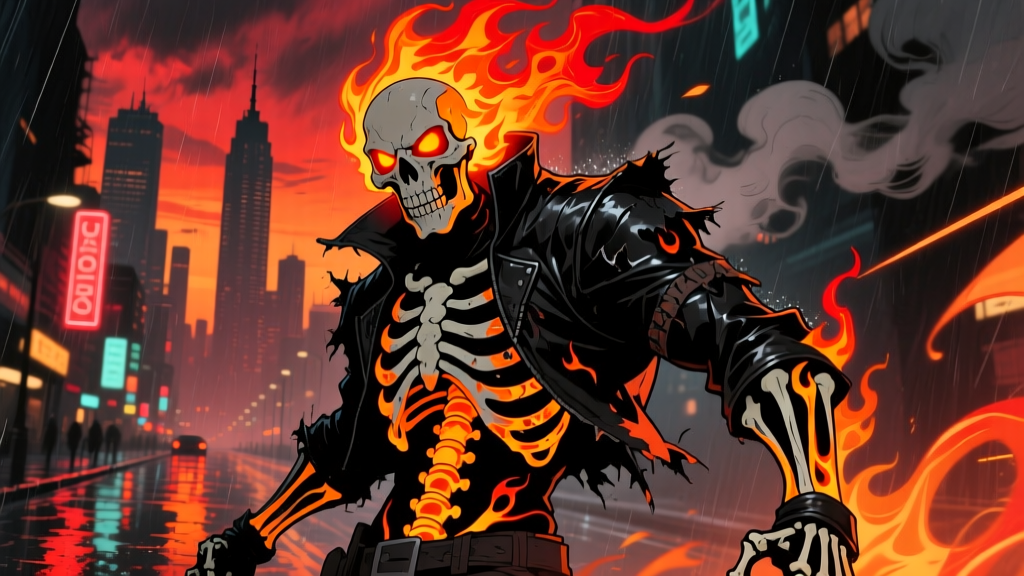
Picture this: Johnny Blaze, the original Ghost Rider, chained to something ancient and unspeakable while a voice he recognizes — his dead friend's sister — whispers that vengeance was never enough. That image alone should tell you everything about where Spirits of Violence takes Marvel's most punishing corner of the supernatural universe. This is not a superhero team-up where everyone shakes hands and poses for a cover. This is a five-issue descent into hellfire, grief, and the question of what happens when the dead refuse to stay buried.
Released between October 2025 and February 2026, Spirits of Violence is the direct follow-up to Spirits of Vengeance (2024–2025), and together they form what Marvel has branded the Violent Era of Ghost Rider comics. Writer Sabir Pirzada, who cut his teeth on the Cult of Carnage: Misery arc before taking over the Ghost Rider mythos, returns with a story that pulls every living (and formerly dead) host of the Spirit of Vengeance into a single conflict. Artist Paul Davidson handles interior pencils for the entire run, with Kendrick Lim on main covers and an all-star variant roster including Peach Momoko, E.M. Gist, Simone Bianchi, and Sandoval.
The premise hits hard and escalates fast: a new entity calling itself the Spirit of Violence has awakened, and it wants every Ghost Rider — past, present, and future — wiped from existence. Not defeated. Not imprisoned. Erased. And the thing wearing that title? Barbara Ketch, Danny Ketch's sister, who was murdered decades ago in the crossfire of supernatural warfare and has clawed her way back from whatever passes for the afterlife in Marvel's underworld.
The Road to Violence: What Spirits of Vengeance Set Up
You cannot walk into Spirits of Violence cold without feeling lost. The five-issue Spirits of Vengeance (2024–2025), drawn by Sean Damien Hill and Chris Campana, functioned as a slow-burn prologue. Pirzada used that series to re-establish the Ghost Rider mythology after years of scattered appearances across other Marvel titles. The core conceit: a reawakened enemy from the earliest days of the Spirit of Vengeance has begun hunting every host it can find, and the Riders must figure out who — or what — is pulling the strings before they are picked off one by one.
By Spirits of Vengeance #5, the identity of the puppet master remained hidden, but the damage was done: alliances between Blaze, Ketch, and Reyes had fractured, Kushala was fighting her own war in the Spirit Realm, and Hellverine was doing what Hellverine does — causing problems on purpose. Then came the sixth issue's revelation that changed the board entirely. Barbara Ketch — Danny's younger sister, killed in what readers long believed was a mob hit connected to his original transformation into Ghost Rider — was the Spirit of Violence. She had been waiting. She had been planning. And she was furious.
"The thing about vengeance is that it only satisfies the one who demands it. Violence? Violence satisfies everyone. That's what makes her more dangerous than anything we've fought." — Johnny Blaze, Spirits of Violence #1
That setup gives Spirits of Violence its narrative engine. This is not some random cosmic threat descending from the sky. This is personal. Barbara Ketch knows every Ghost Rider intimately — she grew up with Danny, she watched Johnny's career from the sidelines, and she has strong opinions about who deserves to carry a flaming skull and who does not.
The Full Rider Roster: Who Shows Up and Why It Matters
One of the things Spirits of Violence gets right is the sheer number of Ghost Rider variants it manages to juggle without turning the book into a roll call. Let's break down who is in play across the five-issue run:
| Character | Role | First Appears | Key Detail |
|---|---|---|---|
| Johnny Blaze | Original Ghost Rider | Marvel Spotlight #5 (1972) | Central protagonist; tortured throughout the arc |
| Danny Ketch | Second Ghost Rider | Ghost Rider Vol. 3 #1 (1990) | Barbara's brother; personal stakes drive his arc |
| Robbie Reyes | Third Ghost Rider | All-New Ghost Rider #1 (2014) | Muscle car variant; youngest of the main trio |
| Kushala | Spirit Rider | Strange Academy (2020) | Apache heritage; first female Ghost Rider host |
| Fantasma | Spirit of Vengeance host | Ghost Rider: Kushala (2022) | Spirit Realm connection; spectral abilities |
| Hellverine | Bagra-ghul host | Ghost Rider/Wolverine (2022) | Demon-flesh weapon hybrid; chaos agent |
| Barbara Ketch | Spirit of Violence | Spirits of Vengeance #6 (2025) | Danny's murdered sister returned as the antagonist |
Having six different Riders in active play means the story operates on multiple fronts simultaneously. Johnny Blaze carries the emotional weight of the series — he is the one who gets broken down, physically and psychologically, as the Spirit of Violence targets the people closest to each host. Danny Ketch is wrestling with the fact that his dead sister is now the thing trying to kill them all. Robbie Reyes brings a younger, more reckless energy that clashes with Blaze's world-weariness. Kushala and Fantasma handle the mystical side of the conflict, operating in the Spirit Realm where the rules of engagement look nothing like a street fight in Manhattan.
And Hellverine? Hellverine is the wildcard. The baghra-ghul demon fused to a host body makes him simultaneously the most dangerous person in any room and the least likely to follow a plan. Pirzada uses him as a narrative disruptor — when a scene needs to go sideways fast, Hellverine is the match that lights the gasoline.
Barbara Ketch as the Spirit of Violence: Why the Villain Works
The best antagonists in superhero comics are the ones who force the hero to confront something about themselves. Barbara Ketch does exactly that, but she does it to every Ghost Rider at once, which is a trick very few villains have managed.
Barbara was murdered as a child — killed in the crossfire of supernatural violence that Danny, as Ghost Rider, was powerless to prevent. That guilt has haunted Danny Ketch's character since the 1990s. Bringing her back as the Spirit of Violence means Danny faces the one person whose death he carries everywhere, and she is angry. Not at him specifically, but at the entire system of cosmic justice that allowed her to die and then handed her brother a flaming motorcycle as compensation.
Her argument, stripped down, is simple: the Spirits of Vengeance are reactive. They punish after the fact. They avenge. But vengeance does not bring anyone back. Vengeance does not heal. Vengeance is, in Barbara's view, a coward's substitute for actual justice. The Spirit of Violence proposes something more direct — eliminate the source of suffering before it causes harm. The problem, of course, is that "the source" keeps expanding. First it is the people who killed her. Then it is the people who enabled them. Then it is the systems that produced them. There is no bottom to that logic, and the series knows it.
What makes Barbara compelling as a villain is that she is not wrong about the Ghost Riders' limitations. Every host in this series has failed someone. Johnny Blaze could not save his brother. Danny Ketch could not save his sister. Robbie Reyes lost his uncle. Kushala watched her community suffer. They are all people defined by what they could not prevent, and the Spirit of Vengeance bonded to them as a coping mechanism dressed up as cosmic duty. Barbara just says the quiet part loud.
Issue-by-Issue Breakdown: Five Steps Into the Furnace
Issue #1 — October 1, 2025
The opener establishes the threat immediately. A new cadre of villains emerges, targeting Ghost Riders across multiple locations simultaneously. Johnny Blaze is the first to encounter them, and the issue wastes no time demonstrating that these are not standard Marvel henchmen — they move with purpose and hit with conviction. The issue ends on a gut-punch reveal that reframes the entire Spirits of Vengeance run. Critic reception was strong: an average score of 8.2 out of 10 on Comic Book RoundUp, with Nerd Init awarding it 9.0 and calling it "a must-read for fans," while AIPT rated it 7.5, describing it as "a strong, atmospheric opener." User scores told a different story at 5.6, signaling the usual divide between professional reviewers and the fanbase.
Issue #2 — November 5, 2025
The Spirit of Violence reveals its scope. This is not a single-target assassination — it is a campaign. The entity begins targeting people connected to the Ghost Riders: family, friends, anyone whose proximity to a host makes them vulnerable. Danny Ketch learns the full extent of what Barbara has become, and the issue forces him into a choice no sibling should face. The Riders begin coordinating, though "coordinating" is generous when Hellverine is involved.
Issue #3 — December 2025
Johnny Blaze, Danny Ketch, and their allies go on the offensive after learning the Spirit of Violence's origin. This is the issue where the team dynamic solidifies and where Pirzada's dialogue does its heaviest lifting. User ratings on Comic Book RoundUp settled at 7.0, reflecting a series that had found its rhythm even as some readers grew frustrated with the pacing. The "no playing it safe" promise from the solicitation text pays off here with a confrontation that leaves at least one major character severely compromised.
Issue #4 — January 2026
The penultimate chapter tightens the noose. With the Spirit of Violence closing in on its endgame, the Ghost Riders split into teams for a multi-front assault. This is the issue where Davidson's action sequences hit their stride — large-scale supernatural combat rendered in heavy shadow and hellfire orange. The stakes escalate from personal survival to something closer to existential: if Barbara Ketch succeeds in her plan, the Spirit of Vengeance itself could be permanently altered or destroyed.
Issue #5 — February 11, 2026
The finale. Johnny Blaze has been, in the solicitation's words, "tested and tortured" to his limit, and the question of whether he survives the encounter is the issue's central tension. Without spoiling the ending, the resolution addresses Barbara's grief directly rather than resorting to a bigger-punch-wins solution. It is the kind of conclusion that divides readers — some find it earned, others find it too neat for a story this messy. But it closes the Violent Era arc with a definitive statement on what the Ghost Rider mythos actually means.
The Art: Hellfire, Shadow, and the Davidson Debate
Paul Davidson's interior art on Spirits of Violence is the most debated element of the series, and that debate is worth examining honestly. Davidson leans into the horror register hard — heavy inks, deep blacks, and a willingness to let panels go dark in ways that make you squint at the page. For atmospheric supernatural storytelling, this approach has clear strengths. The hellfire sequences, where the Ghost Riders transform or unleash their powers, crackle with an almost sickly orange against pitch-black backgrounds. The Spirit of Violence herself is rendered in cold whites and bruised purples, giving her a visual identity distinct from the warm-toned Riders.
Where the art draws criticism is in visual storytelling clarity. Several readers on the Ghost Rider subreddit flagged panel-to-panel transitions that felt abrupt, with action beats that did not always communicate spatial relationships clearly. One widely upvoted comment described Davidson as "not a good artist" whose "storytelling" faltered in complex action sequences. That assessment is harsh, and it does not account for the colorist's contribution to the book's mood, but the criticism about clarity has merit in specific issues — particularly #3, where a multi-character fight scene loses track of at least two combatants for several pages.
The variant covers, meanwhile, are uniformly excellent. Peach Momoko's variant for #1 reimagines the Ghost Riders in her signature anime-influenced watercolor style, while E.M. Gist's covers lean into gritty, photorealistic horror. Simone Bianchi's contributions add a painterly elegance that contrasts with the brutality inside the book. For collectors, the variant covers alone justify picking up individual issues over the digital editions.
Reception: Critics Liked It, Fans Argued About It
The reception split on Spirits of Violence mirrors a pattern common in modern Marvel supernatural titles. Professional critics gave the opening issue warm reviews — the 8.2 critic average on Comic Book RoundUp reflects genuine enthusiasm for Pirzada's script and the ambition of pulling six Riders into one narrative. AIPT's 7.5 review acknowledged pacing issues but praised the atmospheric tone and the willingness to make Barbara Ketch a sympathetic antagonist. Nerd Init's 9.0 was the highest score, calling the book essential for anyone invested in Marvel's horror corner.
Reader reception told a different story. The 5.6 user score on the same platform reflects genuine frustration from a segment of the fanbase. The complaints cluster around three points: the art's inconsistency in action sequences, the pacing of the middle issues, and — this one stung — the treatment of female characters. At least one significant female character meets an end that multiple readers described as "fridging," a term for the comic book practice of killing or harming women to motivate male protagonists. That criticism has dogged the Ghost Rider line for years, and Spirits of Violence does not fully escape it, even as it gives Barbara Ketch the most substantial character arc in the entire series.
Despite the mixed fan reception, the series sold well enough to complete its full five-issue run and the trade paperback collection is slated for release later in 2026. Marvel has not announced a direct sequel, but the Violent Era branding suggests the publisher intends to continue building on this foundation.
Where to Read Spirits of Violence
If you want to get caught up with the series, here are your options as of early 2026:
- Local Comic Shops — Single issues (#1–5) are available through direct market retailers. Back issues may require some hunting, particularly #1 with the Momoko variant.
- Marvel Unlimited — Marvel's digital subscription service ($10.99/month or $69.99/year as of 2026) typically adds issues approximately three months after print release. Issues #1 and #2 should be available by early 2026.
- ComiXology / Amazon Kindle — Individual digital issues are available for purchase at $3.99–$4.99 per issue through Amazon's digital comics storefront.
- Marvel.com Digital — Direct digital purchases from Marvel's own store, usually matching ComiXology pricing.
- Trade Paperback — A collected edition is expected in mid-to-late 2026, likely priced around $17.99. This will include all five issues plus bonus material.
For the full experience, you will also want to read Spirits of Vengeance (2024–2025) first. That series is already available in trade paperback and on Marvel Unlimited. Skipping it means walking into Spirits of Violence without understanding why Barbara Ketch's return matters or why the Riders' relationships are already strained before the first page.
Spirits of Vengeance vs. Spirits of Violence: What Changed Between the Two Series
Since these two series form a continuous narrative, it is worth understanding the handoff between them:
| Detail | Spirits of Vengeance (2024–2025) | Spirits of Violence (2025–2026) |
|---|---|---|
| Issues | 5 issues | 5 issues |
| Writer | Sabir Pirzada | Sabir Pirzada |
| Artist(s) | Sean Damien Hill, Chris Campana | Paul Davidson |
| Editor | C.B. Cebulski | C.B. Cebulski |
| Focus | Mystery / setup; Riders re-unite | Full-scale war; Barbara Ketch confrontation |
| Tone | Slow-burn supernatural thriller | Horror-action; emotional gut punches |
| Critic Avg. (#1) | ~7.8 | 8.2 (Comic Book RoundUp) |
| Key Villain Reveal | Barbara Ketch identity (issue #6) | Spirit of Violence endgame |
The shift in tone between the two series is deliberate. Spirits of Vengeance played the long game — establishing stakes, reintroducing characters, and building dread. Spirits of Violence cashes in all that dread at once. If Vengeance was the slow tightening of a noose, Violence is the drop.
Themes That Run Deeper Than the Hellfire
Beneath the supernatural action, Spirits of Violence is circling a handful of ideas that give it more weight than the average Marvel tie-in.
Grief as fuel. Every character in this series is motivated by loss. Johnny Blaze lost his family. Danny Ketch lost his sister. Barbara Ketch lost her life. The question the series poses is not whether grief can be overcome, but whether the systems built around grief — in this case, the literal Spirits of Vengeance — help or just perpetuate the cycle. The Ghost Riders are, essentially, grief weaponized. Barbara Ketch is what happens when the weaponized grief decides it has had enough.
Vengeance vs. prevention. This is the philosophical core. The Ghost Riders punish evil after it happens. Barbara wants to eliminate evil before it occurs. Both positions have obvious problems, and Pirzada does not pretend otherwise. The series lets both sides argue their case and then shows the consequences of each.
Family as weakness and strength. The Spirit of Violence specifically targets the Riders' loved ones because that is where they are most vulnerable. But family is also the thing that keeps them fighting. Danny does not stop trying to reach Barbara because she is his sister. Johnny does not stop because he remembers what it felt like to lose everyone. The series treats family not as a simple motivator but as an open wound that never fully closes.
Frequently Asked Questions
Do I need to read Spirits of Vengeance before Spirits of Violence?
Yes. Spirits of Violence picks up directly from the events of Spirits of Vengeance, and the emotional impact of Barbara Ketch's return depends entirely on understanding who she is and why her death mattered. The Spirits of Vengeance trade paperback collects all five issues and is available on Marvel Unlimited.
How many Ghost Riders appear in Spirits of Violence?
Six characters carrying some form of the Spirit of Vengeance or a related demonic bond appear: Johnny Blaze, Danny Ketch, Robbie Reyes, Kushala, Fantasma, and Hellverine. Barbara Ketch serves as the antagonist Spirit of Violence.
Is Spirits of Violence considered canon?
Yes. The series is part of Marvel's main continuity (Earth-616) and follows established Ghost Rider canon. Events in this series affect the broader Marvel Universe and will be referenced in future Ghost Rider stories.
Who is Barbara Ketch and why is she the villain?
Barbara Ketch is Danny Ketch's younger sister, murdered during the events that originally transformed Danny into Ghost Rider in 1990. In Spirits of Vengeance #6, she is revealed to have returned from death as the Spirit of Violence — a darker counterpart to the Spirit of Vengeance that channels raw destructive force rather than punitive justice. Her motivation is the belief that vengeance is insufficient and that only preemptive violence can prevent suffering.
Will there be a Spirits of Violence Volume 2?
As of early 2026, Marvel has not announced a direct sequel. The "Violent Era" branding suggests the publisher intends to continue the Ghost Rider line in some form, but no specific title or creative team has been confirmed. The trade paperback collection, expected mid-to-late 2026, may include announcements about what comes next.
What makes this series different from other Ghost Rider comics?
Most Ghost Rider stories focus on a single host — usually Johnny Blaze or Danny Ketch — dealing with a personal supernatural threat. Spirits of Violence is one of the few arcs that unites every living Ghost Rider variant against a single antagonist, and it is the first to position a member of the Ketch family as the villain. The scope and the personal stakes set it apart from standard Ghost Rider fare.
Is the art worth the price of admission?
That depends on what you value. If atmosphere and mood are your priorities, Davidson's heavy-shadow approach delivers a genuinely unsettling reading experience. If clean, precise action choreography matters more to you, be prepared for some frustration in the middle issues. The variant covers by Peach Momoko, E.M. Gist, and Simone Bianchi are worth seeking out regardless of your opinion on the interior art.